


More news on this day
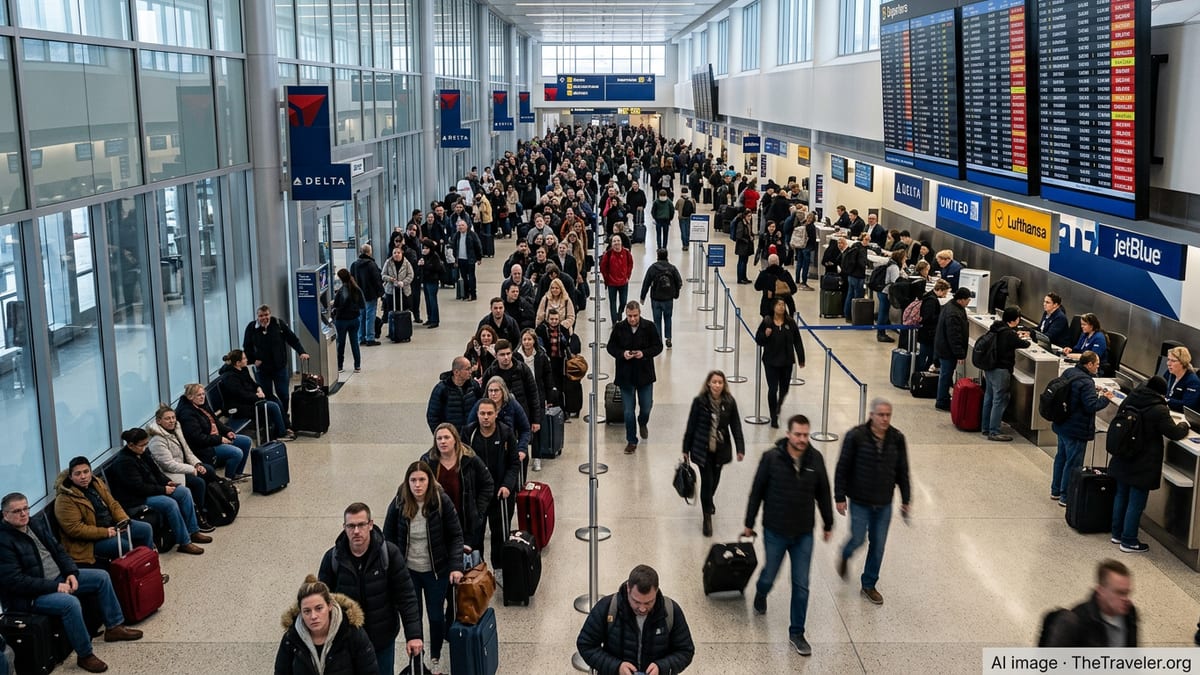
U.S. air travel faced another rough day Monday as widespread disruptions pushed at least 1,358 flights into delayed status and 85 flights into cancellations, with the most severe impacts concentrated in the Northeast where a communications failure and subsequent air-traffic flow restrictions slowed operations at multiple major airports.
Get the latest news straight to your inbox!
What triggered the latest wave of delays and cancellations
Published coverage and publicly available air-traffic summaries point to a technical breakdown tied to the Federal Aviation Administration’s regional air traffic control infrastructure serving the New York City area. The disruption affected traffic into and out of key airports including John F. Kennedy International (JFK), LaGuardia (LGA), Newark Liberty (EWR), Philadelphia International (PHL), and surrounding airspace, with knock-on effects felt well beyond the region as aircraft and crews were displaced.
Reports indicate a primary communications circuit failed at an FAA facility in the Philadelphia region, and an attempted switchover to a backup line ran into trouble after a fiber-optic line had been cut. The result was a period of halted or heavily constrained arrivals and departures at New York-area airports, followed by a slow restart that still left schedules unstable for much of the day.
Even after flights began resuming, delay totals continued to build, a common pattern when busy hubs are paused for multiple hours. A morning stoppage can cascade into late-afternoon and evening because aircraft rotations get out of sequence, crews may “time out” under duty limits, and gates remain occupied by late arrivals.
Where disruptions hit hardest and why the Northeast is so vulnerable
Publicly available FAA system summaries showed ground delay programs and other traffic-management initiatives Monday affecting several of the nation’s most capacity-constrained airports, including New York-area hubs and Boston. These programs typically meter arriving flights to match what the airport can safely handle when equipment issues, weather, or volume reduces capacity.
In Boston, published local coverage described hundreds of disrupted flights at Logan International Airport as ripple effects from New York-area ground stops spread across the region. Separately, FAA flow-control postings also reflected additional weather-related constraints in Boston later in the day, illustrating how overlapping problems can compound disruption: a technical issue creates congestion, and then weather squeezes the schedule even further.
The Northeast is particularly sensitive to operational shocks because major airports are geographically close, airspace is complex, and flights are tightly banked to feed connections. When New York City-area traffic slows, it frequently affects New England, the Mid-Atlantic, and connections from the Midwest and South that route through those hubs.
What travelers should do right now if their flight is affected
For travelers flying Monday night or early Tuesday, the most practical step is to check status directly with the airline before leaving for the airport, since delays can move quickly as ground programs are updated and aircraft reposition. Travelers with connections through the New York City area and Boston may also want to watch inbound aircraft routing because a flight can appear on time until the inbound plane is delayed elsewhere.
When a flight is canceled, rebooking options can shrink fast during network disruptions, especially on routes with limited daily frequency. Travelers who have flexibility may find earlier relief by searching for alternate routings through less-congested hubs, even if it adds a stop, because seats on nonstop options from constrained airports can disappear first.
Many major airlines commonly issue travel waivers during significant disruptions, which can allow changes without a change fee or fare difference within a defined window. Terms differ by carrier, so travelers should read the waiver details in their reservation tools and keep screenshots of notices that show the waiver’s date range and eligible airports in case the policy changes while they’re rebooking.
Passenger rights: refunds, rebooking, and what “significant change” can mean
U.S. Department of Transportation guidance makes clear that passengers are generally entitled to a refund when a flight is canceled and they choose not to travel, even if the ticket is nonrefundable. Refund eligibility can also apply when a flight is significantly changed and the traveler declines the alternative, though definitions of “significant” can vary by circumstance and may involve substantial schedule shifts.
During irregular operations, airlines may offer multiple options: rebooking on the next available flight, rerouting through a partner, or providing a refund if the trip is no longer viable. Travelers who accept rebooking should still review whether the new itinerary matches their needs, especially when a missed connection could turn into an overnight delay at a hub with limited hotel availability.
When the root cause is outside an airline’s control, such as air-traffic equipment issues or severe weather, policies around meals, hotels, and ground transportation can be more limited than for airline-controlled causes like crew or maintenance. Because the classification can be complex in multi-factor events, travelers often get the clearest, most current options by checking the airline’s app for automated rebooking choices and available confirmations.
What to watch next as operations normalize
Airline schedules often take a full day or more to stabilize after a major hub interruption, particularly when the disruption coincides with heavy demand periods. Monday’s outages and ground programs arrived during a high-visibility week for New York City due to the United Nations General Assembly, adding to the complexity of managing airspace and airport throughput.
Travelers should expect continuing “aftershocks” into Tuesday in the form of late inbound aircraft, last-minute gate changes, and occasional aircraft swaps. Those flying in the corridor between Washington, D.C., Philadelphia, New York City, and Boston may see the most volatility because short-haul schedules rely on frequent turns and are more exposed to airspace constraints.
For those still planning trips this week, the best indicator of improving conditions is not a single on-time departure but a sustained reduction in ground delay programs and major airport arrival queues. Monitoring airport-specific advisories and airline notifications, rather than national headlines alone, can provide the most actionable picture for a given itinerary.