


The long awaited TGV M has finally entered commercial service on SNCF’s flagship Paris–Marseille high speed corridor, but only on a limited number of TGV INOUI departures. For 2027 travelers, that means you now need to distinguish between conventional TGV sets and the new fifth generation train if you want to experience the latest interior design, improved energy performance and updated passenger amenities. This guide uses the latest official announcements and booking data to explain exactly what is running, how to book it, and whether it is worth paying extra to secure a seat on the TGV M.
Get the latest updates straight to your inbox!
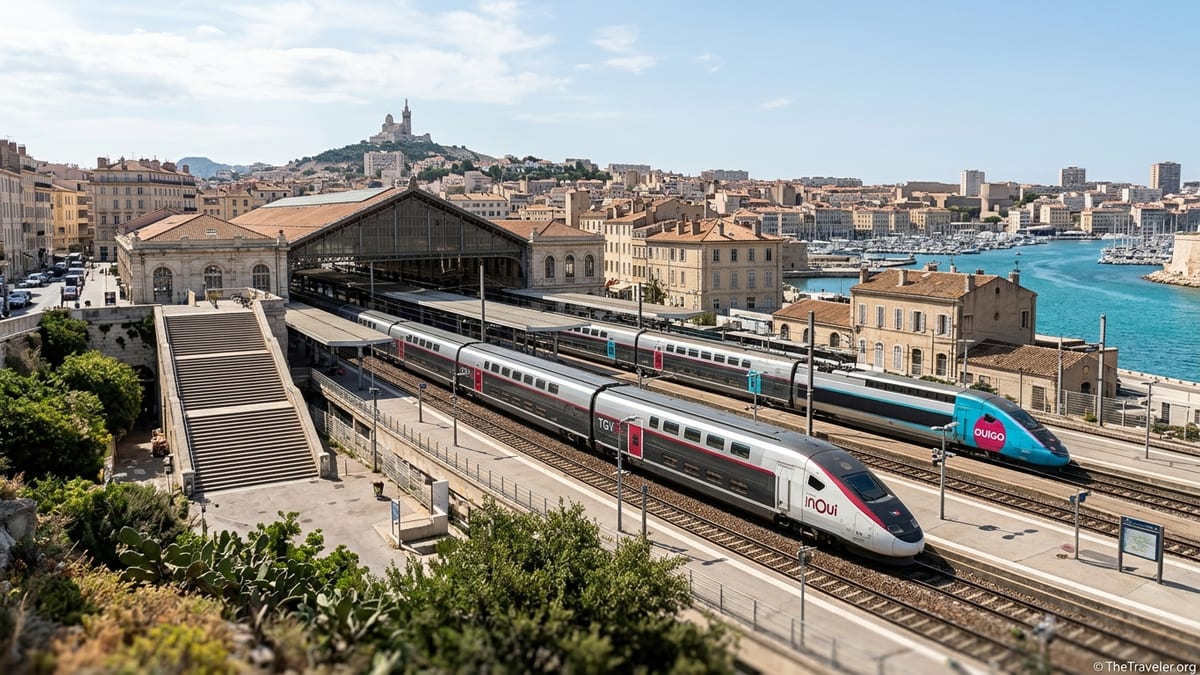
Launch status in late 2026 and what it means for 2027 trips
The commercial story of TGV M has been unusually stop start. SNCF first trailed the new train for the Paris 2024 Olympic Games, then moved the target to 2025, and later communicated a fall 2026 launch window. Industry presentations and internal union documents through 2025 and early 2026 consistently pointed to the Paris–Lyon–Marseille axis as the first corridor to see the new fleet, but without fixed public dates. Throughout summer 2026, rail enthusiasts and staff reports described frequent non commercial test runs between Paris Gare de Lyon and Marseille Saint Charles, confirming that sets were present on the line but still not carrying fare paying passengers.
In September 2026 SNCF and Alstom jointly acknowledged another delay and restated fall 2026 for entry into service. The technical milestone arrived when the European Union Agency for Railways granted the TGV M its authorization to be placed on the French market in late May 2026, after which SNCF began a phase of so called pre commercial running with empty or invitation only trains on the PLM (Paris–Lyon–Marseille) corridor. Only after these runs did SNCF and Alstom confirm the firm commercial start date.
On 6 November 2026 Alstom announced that the new generation TGV, known in France as TGV M, had entered commercial service, operated by SNCF under the TGV INOUI brand. The first paying passenger working was a Paris–Marseille TGV INOUI service with a scheduled late morning departure from Paris Gare de Lyon. French news outlets the same day reported this inaugural run and stated that the train would operate in regular service on the Paris–Marseille link from the following Monday, integrating into the normal timetable rather than as a one off special.
For 2027, this means that TGV M sets are in regular commercial use on the Paris–Marseille axis but only as part of a gradual fleet introduction. SNCF’s own long term information still frames TGV M as a progressive roll out on the south east high speed lines, and there is no indication that all Paris–Marseille TGV INOUI services will be converted in a single step. When you book in 2027 you should expect a mix of classic TGV INOUI rolling stock and a growing number of TGV M diagrams, particularly on high demand daytime trains where SNCF wants to showcase the new product.
Which 2027 Paris–Marseille trains are TGV M and how to verify yours
Because SNCF has not publicly published a permanent list of diagrammed TGV M services for the whole 2027 timetable, the most reliable way to identify these trains is through the official booking tools. On SNCF Connect and other authorized distributors, Paris–Marseille high speed services show the brand (TGV INOUI or OUIGO) plus technical details when you expand “more information” for a specific train. For departures where the new equipment is firmly allocated, this area indicates train type TGV M or a description such as new generation TGV INOUI, sometimes accompanied by an indicative seat map that matches the new nine car double deck configuration.
As of late 2026 booking tests, several weekday daytime TGV INOUI services between Paris Gare de Lyon and Marseille Saint Charles display journey times around 3 hours 15 to 3 hours 20 minutes with limited intermediate stops, usually at Lyon Part Dieu, Avignon TGV and Aix en Provence TGV. Typical early morning and evening trains continue to be diagrammed with classic TGV sets even on similar timings, underlining that the fleet mix will remain heterogeneous into 2027. When you search for a March or April 2027 trip from “Paris (toutes gares)” to “Marseille St Charles” and open details for mid morning departures, you are most likely to see TGV M allocations first, though these can change for operational reasons.
It is important not to assume that any specific train number is always TGV M. Early reports on the inaugural train identified it as a TGV INOUI numbered in the 35xxx series, but allocations can vary day to day. SNCF may also rotate TGV M sets onto other south bound destinations such as Nice during busy periods. The practical traveler approach in 2027 is to check rolling stock information at booking, take a screenshot of the train type for your records, and double check within 24 hours of departure in the SNCF app, which often updates equipment if there has been a planned substitution.
If SNCF substitutes a classic TGV INOUI set for a planned TGV M on your booked departure, your ticket remains valid and your seat reservation is maintained as far as possible, but you may find yourself in a different car number or seat orientation. SNCF generally treats such changes as equipment substitutions rather than cancellations, so standard refund rules apply rather than automatic compensation. If you paid a visibly higher fare specifically to ride at a popular time that was marketed as TGV M and are downgraded in comfort, current practice is to contact customer service after travel with proof of the original train type display; outcomes vary and there is no published guarantee of a partial refund solely for equipment changes.
Stations, timetables and real world journey times
On this corridor the TGV M operates the same high speed route as existing TGV INOUI services. In Paris all TGV M departures use Paris Gare de Lyon, Hall 1 or 2, on the mainline platforms accessed from the large concourse. In Marseille the terminus is Marseille Saint Charles, the historic station located on a hill above the city center. The high speed portion uses the LGV Sud Est and LGV Méditerranée, connecting through Lyon Part Dieu and down towards Avignon and Aix.
Recent timetable data for weekday Paris–Marseille trains show representative departure times around 07:00, 09:56, early afternoon slots and a late afternoon or early evening departure in each direction. The new TGV M services in late 2026 have been highlighted around the mid morning Paris departure and a corresponding late morning or early afternoon Marseille departure northbound, though this pattern may be expanded across the 2027 timetable. Point to point journey times on the fastest trains are still a little over 3 hours, with commonly advertised timings such as 3 hours 15 minutes or 3 hours 20 minutes including stops at Lyon Part Dieu, Avignon TGV and Aix en Provence TGV.
Access to Paris Gare de Lyon from central Paris remains straightforward. From the Right Bank many travelers use metro line 1 to Gare de Lyon or line 14 from hubs such as Châtelet and Saint Lazare, allowing a door to concourse time of around 20 minutes from the Louvre area and 30 minutes from Montmartre with a single metro change. From the Left Bank, the RER A and D link through Châtelet and other central nodes. In Marseille, Saint Charles is about a 15 minute walk down steep steps or via a ramp into the Vieux Port area, or 5 minutes by metro line 1 or 2 to Vieux Port or Castellane, making true center to center time much shorter than airport based journeys.
For a realistic 2027 door to door calculation, a traveler staying near Paris Opéra, taking metro line 14 to Gare de Lyon and allowing a 30 minute station buffer before a 09:56 TGV M departure, will leave the hotel at around 09:00. On arrival in Marseille around 13:15, a 10 minute walk or short metro ride brings you to hotels at Vieux Port by 13:45. This yields a total travel time of around 4 hours 45 minutes from central Paris hotel to central Marseille hotel, with most of the time spent comfortably seated on the high speed train.
Inside the TGV M: layout, comfort and accessibility
TGV M is a double deck, articulated train like previous TGV generations but with a reworked nine car configuration and modular interior. Official information from SNCF and Alstom describes a capacity increase of up to around one fifth compared with current TGV duplex sets, achieved by optimizing interior space, adding one extra car and redesigning vestibules. The inner layout uses wide entrance areas with vertical luggage racks and clearer circulation routes, a design that some early riders have noted reduces bottlenecks at doors, though it also concentrates large suitcases away from the seating bays.
Both first and second class benefit from updated seating. Publicly released images from Alstom and French media show fixed shell style seats with refined headrests, armrests with integrated power sockets and larger tablet style tables in many places. Power outlets are advertised at every seat, typically in the form of a combination of standard European sockets and USB or USB C ports depending on class. Onboard Wi Fi is provided as on existing TGV INOUI sets, with SNCF indicating that network equipment has been modernized to improve stability and throughput; however, performance depends heavily on the mobile coverage along the line so travelers should still download work files or entertainment in advance.
Catering on TGV M remains aligned with the TGV INOUI bar buffet model. The café car serves hot and cold drinks, simple meals, snacks and a mixture of branded and SNCF own label products. Internal documents about catering refits on TGV M indicate a reworked buffet area designed for quicker service and additional self service options, such as fridges where passengers can pick up drinks and cold items directly, but the product range is broadly comparable to existing INOUI services. Reservations do not include complimentary meals in either class; everything is purchased on board or brought with you.
Accessibility has been a key selling point of the TGV M design. Official descriptions highlight accessible toilets designed from the outset for wheelchair users, dedicated wheelchair spaces with companion seating and improved boarding arrangements at specific doors. Because the train still uses the existing platform heights and high floor cars, wheelchair users continue to require mobile ramps or assistance at many stations, but the goal has been to reduce the internal obstacles once on board. SNCF station assistance for TGV services still works through the Accès Plus service that must be booked in advance; the difference on TGV M is mainly the presence of clearly marked spaces and more generous maneuvering room between doors and accessible seats.
Comparing TGV M with classic TGV INOUI, OUIGO and flights
In 2027, the Paris–Marseille high speed offer broadly consists of three products: TGV M operating under the TGV INOUI brand, classic duplex and single deck TGV sets also under TGV INOUI, and low cost OUIGO high speed services that use separate branding and usually depart from the same Gare de Lyon complex but are marketed very differently. In terms of speed, all use the same high speed lines and share similar end to end timings on equivalent stopping patterns. The real differences are in interior comfort, included services and fare structure.
TGV M distinguishes itself with the newest interior, reworked lighting and modernized luggage and circulation areas. Classic TGV INOUI trains have also been refurbished in recent years, so the gap is not as extreme as between an aging regional train and a brand new flagship, but early riders report a noticeably fresher atmosphere on TGV M, particularly in first class. Both TGV M and classic INOUI include power outlets, Wi Fi and access to the bar buffet. OUIGO, by contrast, is stripped back: limited or paid options for luggage, more basic seating, and fewer flexibility options, though journey times can be similar.
On price, SNCF uses yield management across all brands. Look at bookings three months ahead for a midweek Paris–Marseille trip and you often see OUIGO fares in the region of several tens of euros for a basic seat, classic TGV INOUI from perhaps a few tens of euros higher for second class non flexible fares, and first class INOUI sometimes double the OUIGO level for the same day. There is no separate public fare table that charges a supplement solely for TGV M equipment, but in practice TGV M tends to be allocated to peak and high profile departures which carry higher base fares. For example, a mid morning TGV INOUI departure that booking tools label with TGV M equipment might show standard advance second class fares in the high tens of euros, while an early morning classic INOUI departure the same day could be priced lower if demand is weaker.
Compared with flights between Paris and Marseille, the train retains its door to door advantage. Flights typically take around 1 hour 25 minutes in the air, but you must add at least 45 to 60 minutes for airport access from central Paris to Orly or Charles de Gaulle, 60 to 90 minutes for check in and security, and at least 30 minutes from Marseille Provence Airport into the city center by shuttle bus or train. In many realistic scenarios the door to door time is at least 4 hours, similar to the TGV M example, but with more time spent in security queues and less predictable disruptions. When you account for airport transfers and ancillary costs, a competitive advance purchase TGV fare can be cheaper or similar to an economy light air fare, especially once hold luggage or seat selection fees are added on flights.
Classes, fares, baggage and seat selection on TGV M
Class structure on TGV M mirrors existing TGV INOUI. First class offers a quieter ambiance, more legroom and a denser concentration of solo seats, particularly on the upper deck. Publicly released seat maps and early booking interfaces suggest that first class on TGV M continues the 1+2 seating layout across the car width, with solo seats on one side of the aisle and paired seats on the other. Second class uses a 2+2 layout. Both decks are available in most cars, though certain cars are dedicated to specific functions such as the bar or accessible spaces.
SNCF supports paid seat selection on most TGV INOUI fares, including TGV M. When choosing a seat you can generally specify upper or lower deck, direction of travel, solo or duo seating in first class, and sometimes quiet or family zones where designated. For 2027, seat maps that clearly show the distinctive TGV M car layout are gradually being integrated into SNCF Connect and partner sites. Because the precise numbering and location of features such as power sockets and luggage racks can vary by car, travelers who need specific arrangements, like proximity to accessible toilets or space for a musical instrument, should consult the seat map presented at booking rather than rely on diagrams found in news articles or rail forums.
Fare families on TGV M remain the familiar INOUI structure: non flexible advance fares, semi flexible options and fully flexible business oriented fares. The most restrictive tickets can be changed before departure for a fee plus any fare difference and are non refundable; mid range fares allow more generous change terms and partial refunds; fully flexible fares typically allow free changes and full refunds before departure and sometimes partial refunds afterward. The presence of TGV M equipment does not alter these rules, so your choice should be driven by how fixed your plans are rather than by the rolling stock.
For baggage, TGV M follows the general TGV INOUI rules that do not impose strict weight limits but require luggage to be labeled and stowed safely in racks, overhead shelves or under seats. There is no check in baggage process comparable to airlines. TGV M’s redesigned vestibules include more vertical luggage racks near doors, reflecting demand for large suitcase storage. Oversized items such as skis, surfboards or musical instruments are still subject to SNCF’s general conditions of carriage; in practice staff usually accept them if they fit into the train without blocking corridors or doors, but travelers should avoid very large non standard items on busy peak departures.
Accessibility, families and special items
Wheelchair users on Paris–Marseille TGV M services continue to book through SNCF’s Accès Plus service, which coordinates assistance at both departure and arrival stations. The new train provides dedicated wheelchair spaces with nearby companion seating and improved internal circulation, which early reports suggest makes it easier to reach accessible toilets and the bar area. Boarding still generally relies on portable ramps positioned by staff, since platform heights and basic infrastructure are unchanged. At both Paris Gare de Lyon and Marseille Saint Charles, accessibility staff are based near the main concourses; travelers are advised to arrive at least 30 minutes before departure to allow time for coordination and boarding, particularly on the first generation of TGV M sets where staff routines are still bedding in.
For families, TGV M’s double deck design can be both an advantage and a consideration. Upper deck seating offers better views for children and can feel brighter, while lower deck seats closer to entrances may be easier for strollers and bags. SNCF often designates family friendly areas or at least indicates carriages that are most convenient for families in its booking tools, and the TGV M seat map highlights bays of four seats around a table that work well for parents traveling with two children. As on classic INOUI services, baby changing facilities are located in selected toilets, typically on the lower deck.
Travelers with bicycles must pay close attention to the specific rules on their chosen train. SNCF policy distinguishes between folded bikes that can be treated as luggage and standard bikes that require a reservation in designated spaces. On Paris–Marseille TGV INOUI services, a limited number of spaces for non folded bicycles are available on certain trains for a small supplement. Early technical documents and press images for TGV M indicate that bike spaces are integrated into at least some cars, but not every TGV M working on the corridor is guaranteed to accept full size bicycles. When booking a Paris–Marseille trip that includes a bike, always use the specific bicycle option in the booking form; this will filter to departures that officially carry bikes, regardless of whether they are TGV M or classic sets.
Oversized luggage such as sports equipment or musical instruments should be discussed with SNCF in advance if dimensions are extreme. While the more open vestibules and additional racks on TGV M make it easier to place large suitcases or ski bags vertically, items longer than about 1.2 to 1.3 meters can still be awkward in corridors and staircases, particularly on busy trains. For very large items or groups with large gear loads, it may be more comfortable to target less busy departure times or to split equipment between several travelers to avoid overloading a single rack area.
Sample 2027 itinerary from central Paris to central Marseille
Consider a traveler staying near Paris Opéra in early spring 2027 who wants to experience TGV M on a daytime run to Marseille. Checking SNCF Connect two to three months in advance, they search for “Paris (toutes gares)” to “Marseille St Charles” on a midweek date and filter to TGV INOUI. Among the results, a 09:56 departure from Paris Gare de Lyon labeled with TGV M equipment appears with a journey time around 3 hours 19 minutes, stopping at Lyon Part Dieu, Avignon TGV and Aix en Provence TGV. Second class non flexible fares may be in the range of several tens of euros, with semi flexible and first class options higher.
On travel day they leave the hotel at 09:00, take metro line 7 to Pyramides then line 14 to Gare de Lyon, arriving at the station around 09:25. After a short walk through the concourse and checking the departure boards for the assigned platform, they board the TGV M shortly after platform opening, usually around 20 minutes before departure. They have chosen an upper deck seat in second class near a luggage rack to keep an eye on a medium suitcase and enjoy views over the Rhône valley and Provence.
The train departs at 09:56 and runs non stop to Lyon Part Dieu in about 2 hours, then continues to Avignon TGV and Aix en Provence TGV before arriving at Marseille Saint Charles shortly after 13:10. During the journey they use the onboard Wi Fi to work briefly, plug in a laptop at the shared power outlet, and visit the bar car once for coffee and a sandwich at prices broadly comparable to Paris café takeout. Arrival at Marseille Saint Charles is on time, and by 13:30 they are either walking down the monumental steps into the city or taking metro line 1 two stops to Vieux Port for hotel check in.
For the return leg a few days later, they choose a late afternoon classic TGV INOUI service rather than TGV M, partly for price and partly to fit a later departure from Marseille. This underlines a practical reality of 2027: while the new train is an attractive experience, it is often better to prioritize departure time and fare conditions, viewing TGV M as a bonus when it aligns with your schedule rather than as an absolute requirement.
Should you pay extra for TGV M and how to book wisely
By 2027, TGV M will be an established though still growing part of the Paris–Marseille timetable. The comfort improvements, cleaner design and perceived modernity make it especially appealing for first time visitors and rail enthusiasts. However, SNCF’s pricing is driven more by demand and time of day than by equipment. That means you will rarely see a published surcharge simply for TGV M, but you might find that the departures most likely to be TGV M also happen to be the busiest and therefore the most expensive.
For most travelers, the best strategy is to set a target price band and time window, then look within that frame for departures where the booking interface clearly identifies TGV M. If you find a TGV M option within a few euros of an equivalent classic INOUI train at a similar time, it makes sense to choose the new train. If the only TGV M departures are significantly more expensive or at inconvenient hours, the marginal benefit may not justify the cost, especially in second class where refurbished classic TGVs already offer acceptable comfort.
Because equipment substitutions remain possible in 2027 as the fleet is still bedding in, you should avoid paying a substantial premium solely for the promise of TGV M. Treat any extra spend as paying for a better timed or more flexible ticket first, and an enhanced probability of new rolling stock second. Keep screenshots of the train type at booking if riding TGV M is particularly important to you, but manage expectations that operations on the day can still lead to classic trains appearing on your service.
Overall, the Paris–Marseille high speed corridor was already one of Europe’s most competitive rail markets, with frequent departures, modern classic TGV INOUI sets, low cost OUIGO and dense flight competition. The arrival of TGV M refines rather than revolutionizes the experience: it improves comfort, energy efficiency and accessibility while keeping the fundamental advantages of high speed rail. For 2027 travelers, the practical advice is simple: use official booking tools to verify train type, value flexibility and timing at least as highly as equipment, and enjoy the new train as a welcome upgrade when it fits naturally into your plans.
Quick comparison and key FAQs for 2027
Compared side by side, a 2027 Paris–Marseille trip on TGV M in second class typically offers around 3 hours 15 minutes of high speed travel with a standard advance fare in the mid range of SNCF’s pricing spectrum, power and Wi Fi included, station to station convenience and minimal access times. A similar journey on a classic TGV INOUI offers almost the same timing and price with slightly older but still comfortable interiors. OUIGO undercuts both on price at the cost of stricter luggage rules and flexibility. A flight may equal or slightly beat the fastest train on pure in vehicle time but usually loses in door to door convenience and often costs more once airport transfers and extras are counted.
Common questions for 2027 include launch status, exact trains, seat comfort, prices and refunds. On launch, the latest official statements and news confirm that TGV M is fully in commercial service on Paris–Marseille as of November 2026, with more sets added progressively. On exact trains, only the booking interfaces and near term operational notices can reliably indicate which departures are TGV M at any given date; there is no static published list for the year. Regarding comfort, TGV M generally scores higher for lighting, noise levels and luggage space but remains evolution rather than total reinvention.
On prices and refunds, TGV M follows standard TGV INOUI fare structures: look for advance purchase to secure lower fares, choose fare families according to your flexibility needs, and expect standard change and refund conditions regardless of train type. If a TGV M diagram is replaced with a classic train, you travel under the same ticket and seat reservation, and any post trip complaint will be assessed under SNCF’s usual service quality rules rather than a guaranteed refund policy linked to rolling stock.
For travelers wondering whether to pay more specifically to ride TGV M, the balanced 2027 answer is that the new train is worth a modest premium or a small schedule compromise if you value design and comfort, but not a major price jump or a significantly less convenient timetable. The underlying strengths of the Paris–Marseille rail link remain its frequency, reliability and city center access; TGV M enhances that package and provides a glimpse of the next generation of European high speed travel, but does not make older TGVs obsolete overnight.