


More news on this day
U.S. air travel stumbled into the June peak season under heavy strain, as tracking platforms logged 3,895 delayed flights and 91 cancellations in early June 2026, battering schedules at major hubs from Chicago and New York to San Diego and rippling across airline networks nationwide.
Get the latest news straight to your inbox!
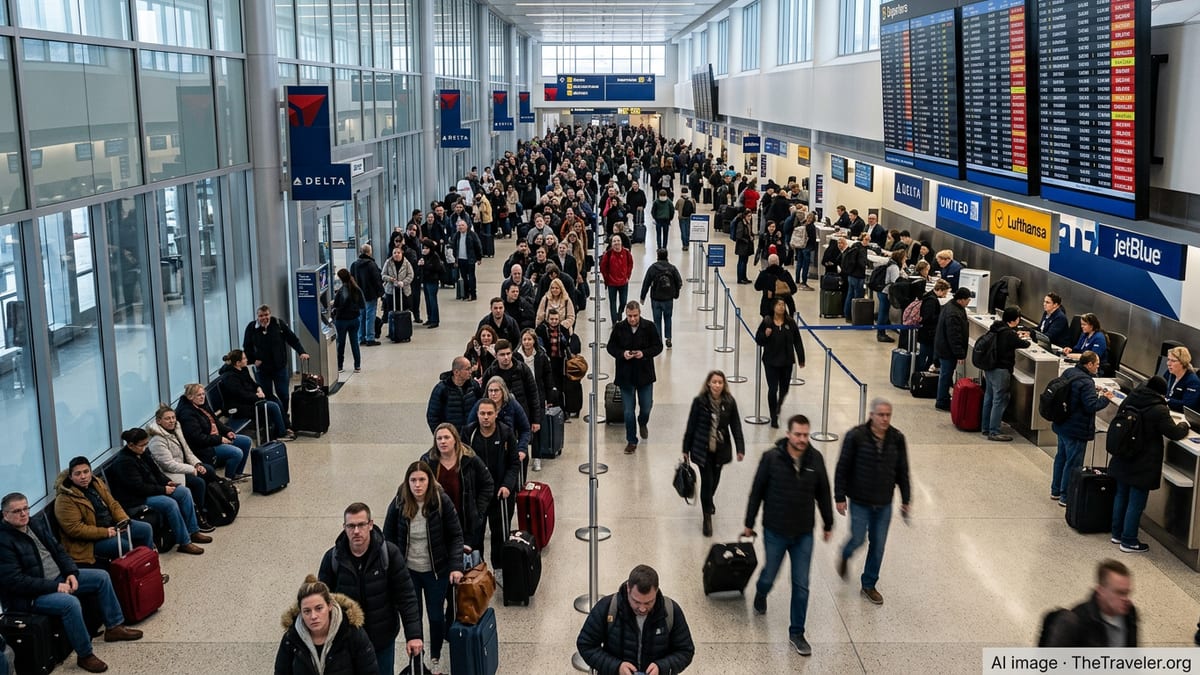
Crunch Hits at the Start of Summer Travel
Publicly available flight monitoring data for the first stretch of June 2026 shows a mounting disruption across U.S. carriers, with nearly 3,900 flights arriving late and just over 90 scrubbed entirely. While the majority of affected services eventually departed, the scale and timing of delays created crowded terminals, missed connections and extended duty days for flight crews at the very moment demand is climbing toward its seasonal peak.
The imbalance between delays and outright cancellations mirrors broader patterns seen in recent travel seasons, where airlines and airports attempt to preserve schedules by pushing departures deeper into the day rather than removing flights upfront. That strategy can keep nominal capacity in place but often results in rolling knock-on effects, particularly at complex hubs. Passenger accounts circulating on social platforms this month describe long sequences of 30-minute rolling delays that ultimately culminated in overnight cancellations.
Industry performance data published by the U.S. Department of Transportation highlights how even in typical months only a small fraction of flights are formally cancelled, while a larger share arrive late because of air carrier issues, late inbound aircraft and constraints in the national aviation system. The June pattern of thousands of delays compared with dozens of cancellations appears to fit that historic profile, though compressed into a few intensive days of disruption.
Chicago, New York and San Diego Under Pressure
Chicago, New York and San Diego emerged as focal points for the latest wave of irregular operations. These three metro areas sit at the center of dense, highly interconnected route networks, amplifying the effects of any breakdown in scheduling. Monitoring reports and schedule data indicate that services between Chicago and coastal gateways such as New York and San Diego experienced a particularly high incidence of delayed departures and arrivals in early June.
Chicago O’Hare, already one of the busiest and most delay-prone hubs in the United States, is highly sensitive to weather and airspace constraints that can quickly back up arrivals and departures. When inbound aircraft are held or rerouted, the result is a cascading series of late turns for narrowbody fleets that feed regional routes across the Midwest and beyond. Travelers connecting through O’Hare over the past week have reported abrupt cancellations labeled as weather-related even before they reached the airport, underscoring how conservative decisions in the face of storms can wipe entire rotations from the schedule.
In the New York region, the tight clustering of major airports and heavily trafficked airspace compounds the problem. LaGuardia, JFK and Newark handle intensive schedules where even minor ground delay programs can slow operations for hours. Data compiled by online flight trackers shows that East Coast weather and congestion regularly translate into long ground holds, with downstream consequences for transcontinental flights and evening departures that depend on aircraft and crews arriving from earlier legs.
San Diego has faced its own constraints as a single-runway airport handling a growing volume of domestic and long-haul services. National Airspace System status reports in recent days have flagged ground delay measures affecting departures, limiting the rate at which flights can leave and creating backlogs on peak afternoons and evenings. These restrictions, combined with tight turn times, increase the likelihood that late arrivals from other hubs will miss their departure slots, slipping further into the night or, in some cases, being canceled outright.
How Delays Cascade Across Airline Networks
The pattern of 3,895 delays against 91 cancellations reflects the interconnected nature of airline scheduling. Each aircraft typically flies multiple legs per day, so one late departure from a constrained airport can ripple through subsequent sectors. Carriers can attempt to make up time in the air or on the ground, but when crews approach the maximum hours permitted under federal duty rules, airlines must choose between delaying flights further while replacements are found or canceling services entirely.
Operational data and historical analyses from Transportation Department reports show that late arriving aircraft and carrier-specific issues, such as maintenance and crew availability, are among the leading causes of delays. When these factors coincide with broader system limitations like air traffic control initiatives or thunderstorms near major hubs, the risk of large-scale knock-on disruptions increases sharply. In early June, those dynamics appear to have played out across multiple days as storms and congestion washed through central and eastern U.S. airspace.
Because Chicago and New York function as key transfer points, disruptions there also affect travelers in smaller markets whose only access to the national network may be via one or two daily feeder flights. If a regional jet into a hub is delayed or cancelled, passengers may lose same-day connectivity altogether, driving up missed-trip statistics even when the overall cancellation rate remains relatively low. San Diego’s role as a gateway for West Coast and transcontinental routes means similar vulnerabilities for leisure and business travelers starting or ending their journeys there.
What Travelers Are Experiencing on the Ground
Accounts shared through travel forums and social media during the first week of June describe a familiar pattern for passengers caught up in the latest disruption. Many report arriving at airports to find flights already marked significantly delayed on departure boards, with subsequent notifications extending those waits in incremental steps. Others describe last-minute diversions or mid-journey rebookings as airlines attempt to reposition aircraft and keep at least part of their schedules moving.
Some travelers connecting through Chicago relay stories of flights cancelled for weather while skies appeared clear at the terminal, a reminder that conditions along the broader route and in surrounding airspace can trigger preventive action long before local weather visibly deteriorates. Elsewhere, passengers routed between New York and coastal destinations such as San Diego have reported crews timing out after hours of accumulated delay, forcing airlines to cancel final legs despite aircraft being physically present at the gate.
The net effect is a travel environment in which the majority of flights still operate, but reliability on any given day feels fragile. Packed gate areas, long waits for customer service and uncertainty around baggage handling compound frustration, especially for travelers without flexible itineraries. For those with urgent commitments, even a single protracted delay can be as disruptive as a cancellation when missed connections or overnight stays are involved.
Outlook for the Remainder of June
As the peak summer period continues, operational data and past seasonal trends suggest that the pressures seen in early June are unlikely to be an isolated episode. Airlines have restored much of their pre-pandemic capacity, but many continue to operate with tight staffing buffers and limited spare aircraft, leaving little room to absorb weather or air traffic control shocks without visible impacts on passengers.
Regulatory filings and federal proposals related to congestion management highlight ongoing efforts to refine ground delay programs and operating limits at major hubs. Measures aimed at smoothing peaks and better aligning scheduled capacity with realistic runway throughput may eventually ease some of the worst bottlenecks at airports like Chicago O’Hare and New York’s trio of major fields. In the near term, however, travelers are likely to continue feeling the squeeze when storms or system outages coincide with already dense schedules.
For now, the tally of 3,895 delays and 91 cancellations in early June serves as an early warning for the rest of the summer travel season. With Chicago, New York and San Diego already showing signs of strain, the resilience of airline operations across the United States will depend on how effectively carriers, airports and the broader air traffic system can manage the next rounds of severe weather and surging demand.