


I expected my walk through Florence’s Boboli Gardens to be beautiful but crowded, a box to tick after the Uffizi and Ponte Vecchio. Instead, it became the most peaceful few hours of my trip, a slow wandering through Renaissance terraces, shaded alleys, and hidden viewpoints where the city slipped into the distance and the sounds softened to wind in cypress branches and gravel underfoot.
Get the latest updates straight to your inbox!
Arriving Above the City: First Impressions at Pitti Palace
I entered Boboli Gardens from the courtyard behind Palazzo Pitti, the vast former Medici residence that anchors the south bank of the Arno. The contrast with the streets outside was immediate. After the bottleneck at the palace ticket line and the busy Piazza de’ Pitti, the stone colonnades opened onto a broad gravel space that felt oddly quiet for a site this famous.
Today, you can buy a dedicated Boboli Gardens ticket or a combined ticket with Pitti Palace, which makes sense if you plan to see the Palatine Gallery or the royal apartments. As of mid 2026, walk-up garden tickets are roughly in the low teens in euros, while the combined pass costs noticeably more but covers both palace and gardens for the day. Buying online in advance can help you skip the longer queues, especially in spring and early autumn when tour groups arrive steadily from late morning onward.
Despite its reputation as Florence’s grand formal garden, the first feeling inside Boboli is surprisingly relaxed. Families sit on the low stone steps of the courtyard, adjusting strollers and sharing snacks. A pair of art students lean against the balustrade with sketchbooks open, studying the huge stone wall that rises in tiers ahead. Nothing about the scene suggests manicured perfection. Instead it feels lived-in, like a monumental backyard slowly waking up for the day.
Climbing to the Amphitheater: Where the Garden Opens Up
The first real climb begins as you follow the central axis up from the palace courtyard to the amphitheater, the heart of the garden’s formal design. Here, the space opens into a wide, oval basin ringed with stone steps and lined with statues. It is easy to imagine the Medici court assembled here in the sixteenth century, watching performances staged against the backdrop of the palace façade.
In practice, the amphitheater is one of the few parts of Boboli that can feel bustling. On my visit, a couple posed for engagement photos near the central obelisk, and a school group clustered around their guide on the upper step. Yet even here, there was a sense of order that kept the noise from becoming overwhelming. Because the space is so large, you can drift to the side, stand by one of the weathered marble figures, and let your eyes follow the axis up to the high hedge that marks the next level of the garden.
The climb from the courtyard to the amphitheater is just a few minutes, but the gravel slope can be slippery in sandals, and Florence’s summer sun arrives early. This is where visiting times matter. In June, July, and August, the Boboli Gardens typically open around 8:15 in the morning and remain open until early evening, with last entry an hour before closing. In the cooler months, closing times shift earlier, sometimes as early as late afternoon. Arriving in the first two hours of the day or during the late golden hour not only softens the light for photos but also reduces the crowds on this exposed, central climb.
Finding Shade in the Cypress Avenues and Side Paths
From the amphitheater, most visitors continue straight up toward the Fountain of Neptune, but turning away from the central axis is where the gardens start to feel personal. I followed a side path into a long, shaded avenue lined with cypress and stone benches. The air cooled noticeably under the trees, and the murmur of voices from the amphitheater faded to a background hum.
Boboli is known as an open-air museum, with statues and fountains punctuating nearly every turn. Yet many of its most peaceful corners are not attached to headline monuments. One of my favorite stretches was a simple gravel path running parallel to the main climb, bordered by clipped hedges and terracotta pots. A local woman walked slowly ahead of me, hands behind her back, while a gardener knelt in the dust, trimming a low hedge by hand. This was not the Florence of rushed itineraries or timed museum entries but something closer to the city’s everyday rhythm.
If you need a genuine break, these side alleys are ideal. Benches appear regularly, especially near major junctions, and you can sit with a paperback or simply watch the play of light and shadow as clouds drift over the city. Official maps, printed and digital, highlight major features like the Pegasus fountain, the Kaffeehaus pavilion, and the Porcelain Museum, but they do not always capture the slower pleasures of simply wandering from one shaded corner to the next.
Unexpected Calm at the Fountain of Neptune and Higher Terraces
Eventually, I rejoined the main axis and climbed to the Fountain of Neptune, a broad basin set on a terrace with sweeping views back toward Palazzo Pitti. The statue of Neptune, trident raised, is typical of the garden’s proud, somewhat theatrical Renaissance symbolism. Yet what struck me most was not the drama of the sculpture but the way the terrace seemed to hold a pocket of quiet, even as tour groups passed through.
From this level, the geometry of Boboli becomes more apparent. Straight paths radiate from the fountain, leading either deeper uphill or off toward side gardens and viewpoints. It would be easy to treat this terrace as a brief photostop and move on, but staying a few minutes changes the mood. On my visit, a group that had hurried up for quick pictures left as quickly as they arrived, leaving only a few scattered visitors leaning on the stone balustrade. The sound of the city drifted faintly on the wind: a church bell, a snatch of motorcycle engine, the echo of someone calling across a courtyard below.
Above the Fountain of Neptune, the slopes continue to rise toward some of Boboli’s most panoramic viewpoints. The climb can feel steep in the midday heat, so I stopped midway at a small terrace where a pair of older Florentines were quietly chatting in Italian, their conversation punctuated by comfortable silences. We shared the space without acknowledgment, simply three strangers enjoying the same patch of stone and sky. In that moment, the grand narrative of Medici prestige dropped away, replaced by something simpler and more immediate.
Views Over Florence and the Tuscan Hills
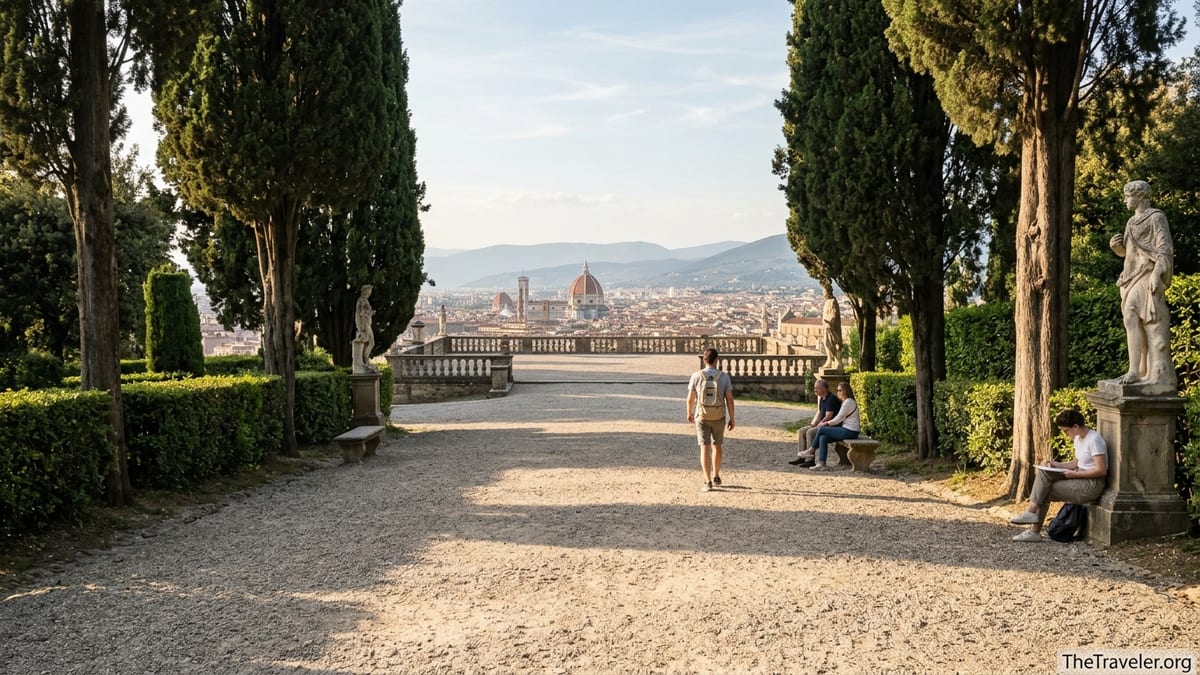
One of Boboli’s great strengths is the way its design alternates enclosed spaces with long, open vistas. After the shaded avenues and sculpted terraces, stepping out onto one of the high viewpoints feels like opening a window. From several points along the upper paths, Florence spreads out in layers of terracotta roofs, church domes, and distant hills, with the Duomo’s dome rising unmistakably above it all.
A particularly memorable view came just beyond a hedge-lined curve, where a low stone wall framed the city like a painting. To the right, the tower of Palazzo Vecchio cut a sharp vertical line into the sky. To the left, the Arno shimmered faintly between rooftops. Beyond it all, the hills of Fiesole and Settignano rolled away in softened blues and greens. A couple nearby shared a quiet picnic, their backs against the wall, plastic cups of supermarket wine in hand. It was a reminder that you do not need a rooftop bar or pricey terrace to enjoy one of Florence’s finest panoramas.
These views also help you orient yourself within the city. Looking down, you can trace your morning route from the Oltrarno streets around Santo Spirito up to the palace gates. On my walk, spotting the narrow grid of Via Romana below and the distant outline of Piazzale Michelangelo gave me a clearer sense of Florence’s scale. It is smaller than you think, and standing in Boboli, you feel how closely the urban core presses against the beginning of the Tuscan countryside.
Quiet Corners: Grottos, Lawns, and Subtle Details
Boboli’s famous Buontalenti Grotto, near the entrance by Palazzo Pitti, deserves a look, even when partially closed or roped off for preservation. Its dripping stalactite-like surfaces and sculpted figures feel theatrical, almost surreal, a deliberate attempt by the Medici to impress and astonish visitors. Yet the real calm of Boboli lies in the less photographed details that surround such showpieces.
Farther from the main routes, I found small lawns where only a handful of people had spread out on the grass, despite clear signs in some sections asking visitors not to step on certain restored areas. These more relaxed patches felt like the garden breathing. A student lay on her back with headphones in, sketchbook open on her chest. Nearby, a couple of friends passed a paperback back and forth, trying to puzzle out a page of Italian poetry. No one seemed in a hurry to move on to the next sight.
The garden’s statues, many of them weathered and softened by centuries of exposure, add to this sense of time unfolding slowly. A stone nymph leaning over a basin, its water barely rippling. A Roman copy of a Greek torso whose missing limbs invite the imagination to complete them. Name plaques are present but unobtrusive, and you can choose to study them or simply acknowledge the figures as part of the garden’s quiet company.
Practical Ways to Make Your Visit More Peaceful
The tranquility I found in Boboli was not only a matter of luck. A few practical choices made a significant difference. Arriving early in the day helped avoid both the heat and the peak crowds. When the gates open around 8:15, you may share the first hour mostly with solo travelers, a few local joggers, and photographers chasing soft morning light, particularly in high season from late spring to early autumn.
Ticket strategy also plays a role. Purchasing a timed entry online in advance, whether through the official channels or reputable resellers, can reduce time standing in the exposed courtyard of Palazzo Pitti. If your budget allows, a combined ticket that includes the gardens and Pitti Palace gives you flexibility. You can wander Boboli in the morning, retreat indoors to the Palatine Gallery during the midday heat, then return to the garden as shadows lengthen. Prices for these combined options are higher than garden-only tickets, but they may compare favorably to booking separate tours.
Inside the gardens, simple habits make the space feel calmer. Turning left or right at main intersections instead of always following the central axis immediately takes you to quieter paths. Carrying a refillable water bottle is wise, as fountains suitable for drinking are limited and cafes near the palace can be relatively expensive for a quick drink. Restrooms are concentrated near key areas like the Amphitheater and certain museum buildings, so it helps to note their locations on the official map when you enter.
The Takeaway
By the time I descended back toward Palazzo Pitti, dust on my shoes and the sun sinking lower over the hills, my expectations of Boboli had shifted completely. I arrived picturing a formal showpiece, a place to admire quickly before rushing on to the next museum. I left feeling as if I had borrowed a few quiet hours from another, slower version of Florence, one in which the Medici terraces and cypress avenues belong as much to local dog walkers and art students as to tour groups.
If you give the garden enough time, Boboli rewards you not only with grand architecture and historic fountains but also with moments of true stillness. A deserted bench in a shaded alley. A brief, wordless exchange with a gardener. A hazy view of the Duomo from a high stone wall. In a city defined by masterpieces and must-see lists, those small, unhurried moments might become the memories that stay with you longest.
FAQ
Q1. How much time should I plan for a visit to the Boboli Gardens?
Most visitors are satisfied with 2 to 3 hours, but if you enjoy slow wandering, sketching, or photography, you can easily spend half a day exploring.
Q2. What are the typical opening hours for Boboli Gardens?
The gardens usually open around 8:15 in the morning, with closing times varying by season from late afternoon in winter to early evening in summer. Last entry is typically one hour before closing.
Q3. Do I need to buy tickets in advance?
Advance purchase is not strictly required, but buying tickets online can reduce waiting times and is helpful in busy periods such as spring weekends, public holidays, and peak summer dates.
Q4. Are the Boboli Gardens suitable for visitors with limited mobility?
Some sections feature steep slopes, gravel paths, and steps, which can be challenging. However, there are gentler routes and terraces where those with limited mobility can still enjoy views and key features.
Q5. Can I bring food and have a picnic inside the gardens?
Small snacks and simple picnics on designated lawns are generally tolerated, provided you respect signs, avoid restricted areas, and carry out all your rubbish to help preserve the site.
Q6. Is there shade in the Boboli Gardens during hot months?
Yes, many paths run under cypress and oak trees, and several sections offer deep shade. Planning your route through these avenues can make midday visits more comfortable.
Q7. Are there restrooms and places to buy water inside the gardens?
Restrooms are available near major areas such as close to the Amphitheater and certain museum buildings. Water and drinks can be purchased near the palace, but bringing a refillable bottle is advisable.
Q8. Can I visit the Boboli Gardens without seeing Pitti Palace?
Yes, you can buy a garden-only ticket. However, many travelers choose a combined ticket with Pitti Palace to experience both the interiors and the outdoor landscape on the same day.
Q9. When is the quietest time to visit for a peaceful experience?
Early morning on weekdays is typically the calmest, especially outside peak holiday periods. Late afternoon in shoulder seasons can also be pleasantly uncrowded.
Q10. Are guided tours worth it, or can I explore on my own?
Guided tours provide historical context and help you find key features efficiently, but the gardens are easy to navigate independently, and wandering alone often enhances the sense of peace.