


Set behind the hulking facade of Palazzo Pitti, Florence’s Boboli Gardens rarely get the same headlines as the gardens of Versailles or the tulip fields of Keukenhof. Yet for many travelers, a few unhurried hours wandering Boboli’s cypress alleys, grottoes, and sculpture-lined terraces leave a deeper impression than more famous European gardens. This is not just a pleasant park or a flower spectacle. Boboli is the open-air stage on which the Medici family projected power, experimented with landscape design, and blurred the line between museum and nature. That combination is exactly what makes it different from almost any other garden in Europe.
Get the latest updates straight to your inbox!
A Prototype of the European Formal Garden, Not a Copy
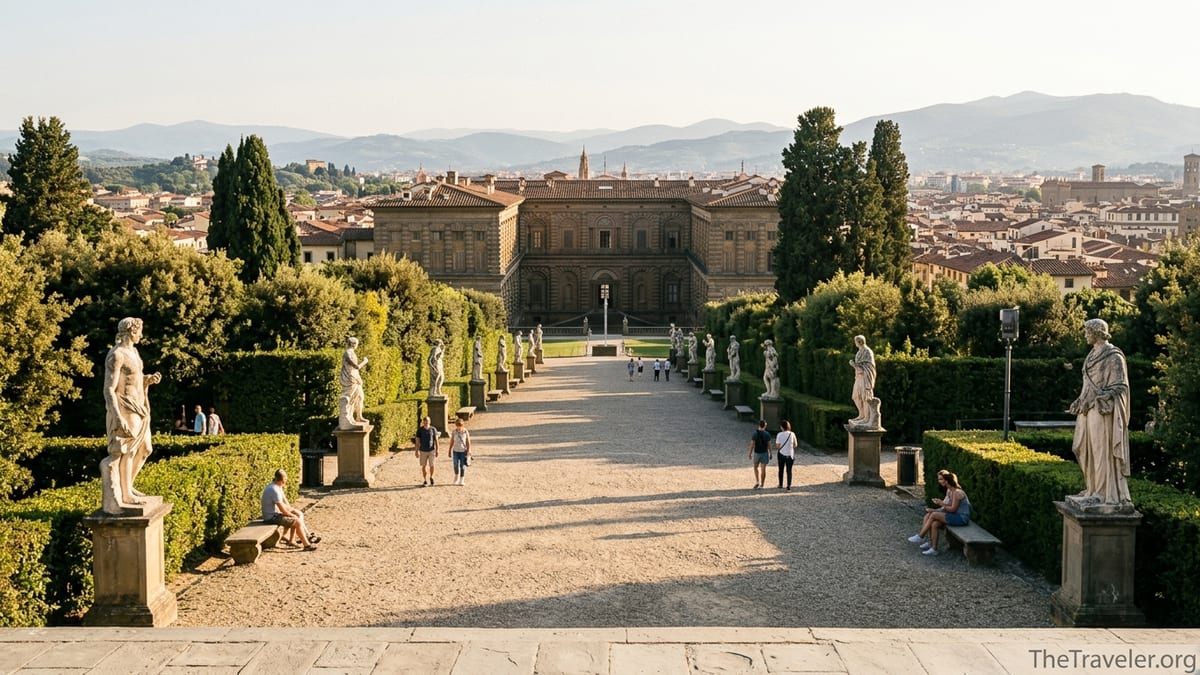
Most travelers know the grand French gardens at Versailles or the Jardin des Tuileries in Paris as the archetype of formal European landscaping, with long axial views, geometric parterres, and reflecting pools. What is easy to overlook is that Boboli predates many of these and directly influenced them. Laid out from the mid 16th century behind the Medici’s Palazzo Pitti, Boboli helped define the Italian garden style that later inspired designers like André Le Nôtre at the French court. When you stand on the main amphitheater slope and look back toward the palace, you are seeing an early template that would echo across Europe, not a later reinterpretation.
Unlike younger showpiece gardens that were planned as finished works, Boboli evolved over centuries. Successive architects and gardeners reworked the terrain, added water features, and cut new vistas from the 1500s through the 1800s. You can feel this layered history as you move from the rigid geometry of the amphitheater to winding, shaded paths near the Kaffeehaus pavilion. This gradual growth contrasts with the more unified, single-period look you find at sites like Keukenhof in the Netherlands, which was established as a spring flower park in the 20th century and is replanted yearly to achieve a specific seasonal effect. Boboli, by comparison, is a living record of changing tastes in garden design.
For travelers, this means the garden never feels like a static, preserved diorama. Instead, it reads almost like a city, with older “neighborhoods” and later additions coexisting. You might walk from a strictly axial cypress avenue into a more romantic 19th century lawn backed by oak trees in a matter of minutes. That mix, rooted in centuries of experimentation rather than a single master plan, gives Boboli an unpredictability missing from more uniform European gardens.
A Garden Built to Project Medici Power
While every royal garden in Europe carries political meaning, Boboli is unusually explicit in how it stages power. The garden sits directly behind Palazzo Pitti, which served as the main residence of the Medici grand dukes and is now part of Florence’s UNESCO-listed historic center. As you climb the central axis from the palace up toward the Knight’s Garden and the terrace aligned to Fort Belvedere, the perspective is carefully designed to pull your eye up and out over the city and surrounding Tuscan hills. The Medici built this hillside stage not only for private enjoyment but as a statement: their family literally looked down over Florence and its territory.
Other famous gardens, like the vast park at Versailles, were also instruments of propaganda. The difference is scale and atmosphere. At Versailles, the size and symmetry can feel almost overwhelming. Boboli, though large, is compact enough that a reasonably fit traveler can walk its main routes in two to three hours, with frequent places to sit in the shade. The power message is still there in the axial views, fountains, and statuary, but it is delivered in a more intimate register. You sense the Medici as shrewd urban rulers, not just distant monarchs detached in a countryside palace.
Modern visitors still encounter subtle reminders that Boboli is treated as a cultural monument rather than a simple park. There are specific rules of conduct, including restrictions on picnicking on the grass in central areas and guidelines that treat the grounds as an open-air museum. Just entering through the palace side, with its ticket checks and security, sets a formal tone that feels closer to visiting a major museum than strolling into a neighborhood garden. That atmosphere is part of what sets Boboli apart from places like London’s Hyde Park or Berlin’s Tiergarten, which function primarily as public urban green spaces rather than royal stage sets preserved for their historic fabric.
An Open-Air Sculpture Gallery Across Centuries
One of Boboli’s most distinctive traits is the density and range of sculpture woven into the landscape. Many European gardens feature statues and fountains, but Boboli’s collection reads like an outdoor annex of Florence’s museums. As you move along the main alleys, you pass classical Roman pieces, Renaissance works, Baroque figures, and even some more recent additions. The result is a chronological walk through European art history, set among hedges and lawns instead of gallery walls.
Near the amphitheater, travelers encounter stone niches filled with ancient-style figures and decorative vases. Further into the garden, the Neptune Fountain, with the sea god holding his trident, commands a basin at the top of a hill, its surface often ruffled by wind and reflecting the surrounding greenery. On another axis, the Fountain of the Ocean anchors an island in the Isolotto basin. Here, mythological figures cluster around the central Ocean statue, encircled by carefully manicured plantings. These works were never mere decoration; to Medici-era guests, they signaled knowledge of the classical world, artistic patronage, and control of water and nature.
Compared with other gardens famous for their art, such as the sculpture-dotted grounds of Vienna’s Schönbrunn Palace, Boboli feels less choreographed and more exploratory. You might round a bend and suddenly come upon a weathered Roman sarcophagus or a whimsical modern piece placed along a secondary route. The statues often show signs of age, with lichen on stone surfaces and softened details, which adds to the authenticity of the setting. For visitors who have just exited the Uffizi Gallery, walking through Boboli can feel like watching the paintings come alive in three dimensions under open sky.
Practical details reinforce this museum-like side of Boboli. Tickets for the garden are typically sold in combination with Palazzo Pitti and, in some cases, as part of a multi-day pass that includes access to the Uffizi. While prices shift over time, travelers often pay an amount roughly similar to a mid-range museum ticket in Florence, reflecting the garden’s role as part of the city’s core cultural circuit rather than a free public park. This pricing structure is notably different from gardens such as the Tuileries in Paris, which you can enter freely and where the art is a bonus, not the main focus.
Dramatic Topography and Tuscan Vistas
Unlike many famous European gardens laid out on relatively flat terrain, Boboli clings to the back of a hill. The gradient shapes everything about the experience, from the feel underfoot to the unfolding views. Travelers quickly notice the climbing involved: stairs, gravel slopes, and gently rising avenues require more exertion than a stroll through, say, the level lawns of Kensington Gardens. Sturdy shoes are advisable, especially if you plan to explore beyond the central axis.
The reward for the effort comes at the upper terraces. Near the Knight’s Garden and the Kaffeehaus pavilion, you gain sweeping outlooks over Florence’s sea of terracotta roofs, with the Duomo’s dome and the tower of Palazzo Vecchio cutting into the skyline. On clear days, the surrounding Tuscan countryside forms a hazy, rolling backdrop. This relationship between enclosed green space and open-city panorama is rare among Europe’s marquee gardens. Versailles, for instance, offers long views across its grand canal and forested avenues, but you are always within a royal domain, not looking directly down into the capital.
Boboli’s slopes also create micro-environments: sunny, exposed lawns alternate with cool, shaded side paths sunk slightly below grade. Travelers who visit in mid-summer often seek out these lower routes to escape the heat, while spring visitors are more likely to linger on benches near the upper viewpoints. The hillside location means weather can change the character of a visit. After rain, paths can feel slick and scents from damp boxwood and cypress become prominent. In late afternoon light, the stone statues cast long shadows down the slopes, emphasizing the contours of the land more dramatically than in the flat formal gardens found elsewhere.
For photographers, the topography offers opportunities that go beyond straightforward flower or fountain shots. A common experience is to frame a statue in the foreground, a row of cypresses mid-distance, and the Florence skyline behind, compressing layers of art, garden, and city into a single image. This combination of garden interior and urban panorama is one of the details that many visitors recall long after the visit, and it is a view that is hard to replicate at sites like Keukenhof, whose surroundings are more agricultural than urban.
Grottoes, Waterworks, and Theatrical Surprises
Boboli is famous among garden historians for its theatrical features, particularly the grottoes that blend sculpture, painting, and water. The most celebrated is the Buontalenti Grotto near the entrance from Palazzo Pitti. From the outside, its rough stone and sculpted figures hint at an artificial cave. Inside, travelers find walls covered in elaborate stucco reliefs, once enhanced by water effects and lighting that would have astonished 16th century guests. Portions of the decoration include copies of works by Michelangelo and imaginative figures that seem to emerge from the rock, underscoring the Medici taste for spectacle.
These grottoes are not common in most modern park landscapes and set Boboli apart from many other well-known gardens. For example, Keukenhof’s appeal lies largely in its beds of tulips and spring flowers arranged around gently curving paths and ponds, with only limited sculptural or architectural theatrics. Similarly, while Versailles has dramatic fountains timed to music on certain days, its grotto-like features are relatively restrained compared with the immersive artificial cave effects at Boboli.
Elsewhere in the garden, water continues the theme of surprise. Travelers walking along the main axes suddenly come upon basins with central sculptures, narrow channels, or staircases where water once cascaded during special events. Even when some features are partially dormant or undergoing maintenance, the remains hint at a time when the garden was an active stage for courtly entertainments, complete with controlled jets, mists, and hidden fountains. Modern visitors may see only fragments of this hydraulic theater, but these remnants still give Boboli a more experimental, almost playful character than many strictly formal European gardens.
The sense of discovery extends to smaller structures scattered across the grounds. The Kaffeehaus, with its light green exterior, and the small lemon houses used for wintering citrus pots reveal another side of Medici life: a passion for exotic plants, coffee, and seasonal display. Coming across these buildings after a stretch of trees and gravel walks reinforces the feeling that the garden was designed as a series of scenes to be revealed one after another, much like a theatrical production.
Less About Flowers, More About Structure and Atmosphere
Travelers who come to Boboli expecting the kind of intense flower displays found at Keukenhof or ornamental rose gardens in England are often surprised by how restrained the planting schemes are. Boboli’s emphasis lies in its architecture of hedges, lawns, trees, and statuary, rather than in layered borders bursting with seasonal color. The main decorative plantings often consist of clipped boxwood outlines, terracotta pots of citrus, and stretches of grass that frame sculptures and fountains.
This does not mean the garden lacks botanical interest, but the focus is on evergreen structure and shade rather than short-lived floral spectacle. Cypress alleys provide vertical lines, while laurel and boxwood give depth to the parterres. In some areas, particularly near the amphitheater and the Knight’s Garden, travelers may spot seasonal flowers, but they are typically accents rather than the star of the show. The effect is one of calm and continuity, suitable for year-round visits. Where a garden like Keukenhof is at its best during a narrow spring window, Boboli offers its core experience in late winter, high summer, and autumn alike, with changes more in light and foliage tone than in dramatic blossom cycles.
For many visitors, this structural approach encourages slower, more contemplative exploration. Instead of rushing from one floral highlight to the next, you might spend time sitting on a stone bench, watching shadows move across a statue or observing how a long alley frames the palace facade in the distance. Travelers coming from highly curated flower parks sometimes find Boboli’s lawns a bit worn or its hedges slightly irregular. Others feel that this lived-in quality makes it easier to imagine the centuries of use the garden has seen. In practice, it means that Boboli feels like a historic environment you pass through, not a floral exhibition assembled for a single photo season.
Comparisons with other European city gardens underline this distinction. The Tuileries in Paris, for instance, often features modern art installations and carefully replanted beds that shift with fashion and civic programming. Boboli’s programming is more subtle. Occasional contemporary artworks appear, and horticultural maintenance continues, but the core layout and plant palette change slowly. Visitors looking for vivid seasonal beds might add a stop at the nearby Bardini Garden, which often features more concentrated flower displays, and then return to Boboli for its grand structural design and atmosphere.
Visitor Experience: Practical Differences on the Ground
From a traveler’s perspective, what sets Boboli apart from other gardens is as much about logistics and atmosphere as history. Entry is controlled through ticketed gates, commonly via Palazzo Pitti, and opening hours vary seasonally, with morning openings typically around 8:15 a.m. and closing times shifting from late afternoon in winter to early evening in summer. Last admission is usually about an hour before closing, which is important to remember if you are fitting the garden into a busy Florence itinerary. This structured schedule contrasts with many European urban gardens that remain open into the evening and have multiple ungated access points.
Ticket prices change periodically, but travelers can expect to spend roughly what they might pay for admission to a single major Florence museum, with occasional seasonal adjustments and options for combined tickets. There are sometimes multi-day passes that bundle Boboli with the Uffizi and Palazzo Pitti, which can make sense if you plan several cultural visits in a short stay. These combined passes are different in character from, say, day tickets to Keukenhof, which focus on access to flower displays and do not usually bundle major museums.
On the ground, Boboli’s terrain and restrictions shape how you move. Paths are predominantly gravel and stone, and the slopes can be challenging for travelers with mobility issues. There are some more accessible routes, but the nature of the hillside layout means certain viewpoints and corners remain demanding. Facilities like restrooms and small refreshment points exist but are sparser than in heavily commercial gardens or theme-park style attractions. As a result, many visitors plan their visit around a late morning entry, a slow climb to the upper terraces, and a return to the city center for lunch, rather than expecting extensive on-site dining.
Atmospherically, Boboli can feel remarkably quiet compared with headline attractions like the Uffizi or Florence’s cathedral dome climb, especially if you arrive at opening or in the shoulder seasons. Even on busier days, the size of the garden allows crowds to spread out. It is relatively easy to step off a main route onto a side alley and find yourself almost alone, hearing only birds and distant city noise. This sense of seclusion is harder to achieve in more compact, centrally traversed gardens such as the Tuileries, which double as major pedestrian thoroughfares. For travelers craving a break from crowded Renaissance interiors, Boboli delivers a different, more spacious expression of the same cultural story.
The Takeaway
Standing in the shade of a cypress alley, with a weathered statue at your side and Florence’s rooftops glowing in the distance, it becomes clear why Boboli is not just another beautiful European garden. It is a prototype of formal landscape design, a political stage for the Medici, and an open-air sculpture museum all woven into a steep Tuscan hillside. Where other gardens specialize in floral displays, leisurely urban promenades, or royal grandstanding, Boboli combines all these elements in a way that feels uniquely Florentine.
For travelers choosing between Europe’s great gardens, Boboli offers something more introspective than Keukenhof’s explosions of color or Versailles’s engineered symmetry. It invites you to walk slowly, notice how art and nature interact, and imagine the courtly spectacles that once unfolded along its axes and in its grottoes. Practical details such as ticketed entry, combined museum passes, and steep paths might require a bit more planning, but they also help preserve the garden as a coherent historic site rather than a casual shortcut across town.
If your time in Florence is limited, it can be tempting to prioritize only the big-name indoor museums. Yet those who set aside a morning or afternoon for Boboli often describe it as the moment when the city’s art and history finally “breathe.” The garden’s unique blend of landscape, sculpture, and city views makes it different not just from other gardens, but from almost any cultural experience in Europe.
FAQ
Q1. How long should I plan to spend in the Boboli Gardens?
Most travelers find that two to three hours is enough to walk the main routes, pause at key viewpoints, and visit a few quieter corners, though garden enthusiasts may easily spend half a day.
Q2. Are the Boboli Gardens very different from the gardens at Versailles?
Yes. While both are formal historic gardens, Boboli is more compact, steeper, and more focused on sculpture and grottoes, with direct views over Florence, whereas Versailles emphasizes immense flat axes and grand water parades.
Q3. Is Boboli a good choice if I mainly want to see flowers?
Boboli has some seasonal plantings and citrus displays, but it is not a flower garden on the scale of Keukenhof. Its appeal lies in landscape architecture, statues, fountains, and views rather than large, colorful flower beds.
Q4. Do I need to buy tickets to Boboli Gardens in advance?
Booking ahead is increasingly recommended in busy months, especially if you want combined tickets with the Uffizi or Palazzo Pitti, as popular dates can sell out, but same-day tickets are often still available outside peak periods.
Q5. Are the Boboli Gardens suitable for visitors with limited mobility?
The hillside layout means many paths are steep or uneven, which can be challenging. There are some gentler routes, but travelers with mobility issues should expect limited access to certain viewpoints and bring any necessary aids.
Q6. Can I picnic inside the Boboli Gardens?
Rules treat Boboli as an open-air museum, so picnicking on central lawns is restricted. Small snacks on benches are usually tolerated, but large picnics are better planned in other Florence parks with more relaxed regulations.
Q7. What is the best time of day to visit Boboli Gardens?
Early morning generally offers cooler temperatures, softer light for photos, and fewer crowds. Late afternoon can also be beautiful, with warm light on the city, though you must watch closing times.
Q8. Are the Boboli Gardens open year-round?
Yes, the gardens are open in all seasons, with shorter hours in winter and longer hours in summer. Core features like statues, vistas, and grottoes can be enjoyed at any time of year.
Q9. How do Boboli Gardens compare with Florence’s Bardini Garden?
Bardini is smaller, quieter, and often has more concentrated flower displays and a famous wisteria pergola, while Boboli is larger, grander, and richer in historic architecture and sculpture.
Q10. Can I visit Boboli Gardens without seeing the museums inside Palazzo Pitti?
Yes. Tickets are typically sold in different combinations, and you can choose an option that grants access to the gardens alone if you prefer to focus on the outdoor experience.