


Behind the sober stone facade of Florence’s Pitti Palace, the Boboli Gardens unfold in a sequence of terraces, fountains, groves and vistas that feel like a living stage set for Renaissance power. More than a pleasant green escape from the city’s packed streets, Boboli is one of Europe’s great historic garden experiences, a place where art, politics, and landscape design still shape how visitors move, look and linger today.
Get the latest updates straight to your inbox!
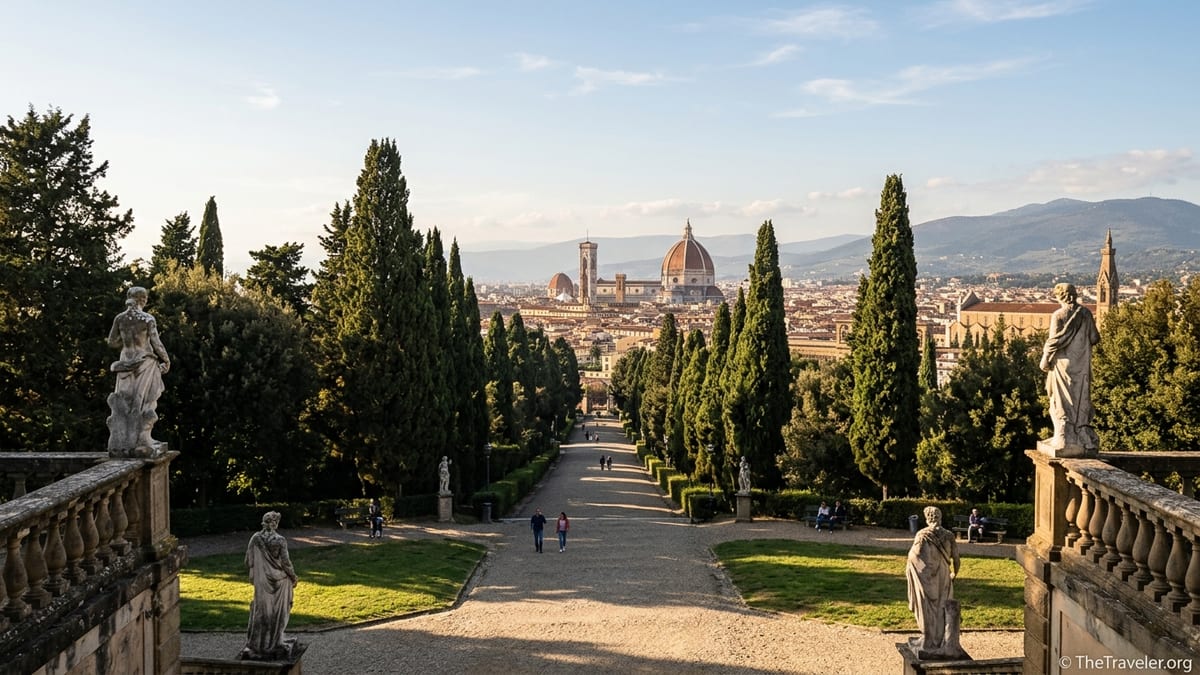
A Royal Stage Set Above Florence
Boboli Gardens began in the mid 1500s as the private backyard of the Medici grand dukes, laid out behind their newly acquired Pitti Palace on the southern bank of the Arno. Rising up the hillside in broad terraces, the design broke from the enclosed, inward looking medieval garden. Instead, its long axial views and open slopes were meant to project Medici prestige outward over Florence and the countryside beyond, an effect that visitors still feel as they climb away from the palace courtyard toward the hilltop avenues.
Today, that sense of theatricality greets you almost as soon as you step through the palace. The stone amphitheater carved into the former quarry behind Pitti forms a grand outdoor room, ringed by statues and crowned by an Egyptian obelisk and Roman granite basin that were moved here from the Villa Medici in Rome in the 18th century. Standing on the central axis, with the palace at your back and the terraces rising above, you can imagine court festivals, allegorical performances and fireworks staged here for visiting dignitaries.
The layout that took shape under architects like Niccolò Tribolo and Bartolomeo Ammannati would become a template for formal gardens across Europe. When travelers later admired the grand perspectives of Versailles or Vienna’s Schönbrunn, they were seeing ideas first tested on this Tuscan hillside. Walking Boboli in the 21st century is not just a stroll through pretty lawns; it is a chance to move through the prototype of the European princely garden.
For modern visitors, the royal stage set feeling is intensified by the way the garden frames Florence itself. From many points along the main axis you catch glimpses of the Duomo’s dome, Giotto’s bell tower and the line of the city walls. On a clear late afternoon, with soft light catching terracotta rooftops beyond the cypress silhouettes, it feels less like a museum and more like a carefully composed painting in which you have been placed.
An Open-Air Museum of Sculpture and Fountains
Boboli is often described as an open air museum, and that is not an exaggeration. Scattered along the avenues and tucked into groves are hundreds of sculptures ranging from ancient Roman fragments to 16th and 17th century allegorical figures, along with a few modern works. Many travelers will recognize the atmosphere from the first time they round a bend and come face to face with a weathered marble god or a mossy fountain in what seemed like a simple stand of trees.
Near the amphitheater, the Neptune Fountain, with its trident wielding figure atop a rocky basin, anchors the upper terrace. Locals sometimes call it the "Fountain of the Fork" for the statue’s silhouette. On hot summer days, visitors rest on the low stone wall surrounding the basin, watching reflections ripple across the water before continuing up toward the cypress alleys. A few minutes away, the Fountain of the Ocean, by Giambologna and his workshop, gathers personifications of the world’s rivers around a muscular sea god, a reminder of how the Medici used mythological imagery to position themselves as rulers of a global trading power.
Perhaps the most surprising corner of the garden is the Grotta Grande, or Buontalenti Grotto, near the entrance closest to the Pitti courtyard. Designed in the late 16th century by Bernardo Buontalenti, its interior blends dripping rock forms, painted stucco, and once even live water effects to create a fantasy of nature tamed and staged. Today, visitors step into its cool, dim chambers from the bright Tuscan sun and find themselves in a space decorated with Michelangelo copies, stalactite like decorations and frescoes that blur the boundary between garden and cave.
The sculpture is not confined to grand showpieces. As you wander secondary paths, small statues of putti, shepherds and seasonal figures appear beside benches and at intersections of the gravel alleys. Many of these works have been moved indoors for conservation and replaced with copies, but the overall effect of walking through a curated landscape remains. Unlike a typical city park, every turn in Boboli was composed with a combination of planting, architecture and art objects, and that deliberate design is still legible in the visitor experience.
Design That Defined the Italian Garden Tradition
Boboli is one of the earliest and most influential examples of the formal Italian garden. Hallmarks of this style are visible at every step: a strong central axis leading up the slope, carefully clipped hedges defining outdoor rooms, geometrically shaped boschi (wooded groves) cut through with straight alleys, and views that unfold in planned sequences rather than all at once. For travelers familiar with informal English style parks, the rigor of Boboli’s geometry can feel striking, yet it is softened by Mediterranean planting and the patina of age.
The long Viottolone, a grand double row of cypresses leading toward the Isolotto basin, is one of the clearest expressions of this style. Walking here, you move along a straight line that seems to pull you forward, while side paths tempt you into denser woodland. At the far end, the axis resolves in a circular island pool adorned with statues and framed by laurel hedges. In practice, many visitors stop halfway along the avenue to sit on a bench under the cypress shade and watch joggers, sketching art students and families with strollers pass by.
Another key element is the interplay between formal terraces and wilder slopes. Above the main amphitheater, grass ramps that once hosted temporary theaters now serve as informal seating, where students lie with paperbacks and picnicers share bread and pecorino bought from nearby Santo Spirito markets. From there, well defined staircases lead to more intimate sections like the Kaffeehaus, an 18th century pavilion with a pale green dome that looks out over olive groves and suburban Florence.
Because the garden has evolved over centuries, visitors see layers of design history in a single afternoon. Early Medici elements sit alongside later interventions by the Lorraine and Savoy dynasties, who opened parts of the garden to the public and added features like the formal flowerbeds near the Palazzo’s rear façade. To understand why Boboli is considered a model, you only need to compare this complexity to smaller Tuscan villas nearby: where a private villa might offer a single terrace and a parterre, Boboli strings together multiple garden types into a single, coherent experience.
Views, Vistas and Everyday Life Above the City
One of Boboli’s great pleasures is how it reconnects you with Florence after the crush of the historic center. From terraces near the Knight’s Garden and the adjacent Palazzina del Cavaliere, the city unfurls in almost every direction. You see Brunelleschi’s dome rising above the dense core, the green hills of Fiesole in the distance, and the ribbon of the Arno glittering when the light hits at the right angle. Many travelers who spend their mornings in indoor museums deliberately plan an afternoon in Boboli to reset and reorient themselves to the city’s geography.
These viewpoints are not purely scenic. Historically, they were part of how the ruling families surveilled and symbolically dominated their territory. Today, that political layer feels distant, yet the sense of overview is powerful. On clear winter days, when the air is crisp and the cypresses stand out in dark relief, photographers line up tripods on the upper terraces to capture Florence without needing to climb the crowded Duomo or the Piazzale Michelangelo steps.
The garden also functions as a piece of everyday Florentine life in ways that surprise many visitors. University students from the nearby Oltrarno neighborhoods come to read on the lawns above the amphitheater. Parents push strollers along the flatter paths nearest the Pitti entrance before naptime. In the late afternoon, elderly couples take measured walks along the gravel alleys, stopping at familiar benches. A traveler who visits on a weekday outside of peak summer is likely to share the space with as many locals as tourists, particularly in the less visited corners toward Porta Romana.
Seasonality transforms the experience. In spring, the formal beds near the palace burst with tulips and irises, and the wisteria covered pergolas drip with lavender blooms. In high summer, the lawns may yellow slightly under the Tuscan sun, but the dense groves offer welcome shade, and a bottle of water from a nearby bar on Piazza Pitti becomes essential. Autumn brings softer light and turning leaves on the deciduous trees that punctuate the evergreens, while winter strips the canopy back to reveal the strong geometry of avenues and terraces.
Practicalities: Tickets, Timing and How to Experience the Garden
Boboli Gardens share an administration and ticketing system with the Uffizi Gallery and Pitti Palace. As of mid 2026, a standard adult ticket for the gardens alone typically costs around 10 euro at the desk, with slightly higher prices for advance or peak period options, and reduced rates for EU visitors aged 18 to 25. Combined tickets that include the Uffizi, Pitti Palace and Boboli are widely used by travelers who plan to visit all three sites over several days, and can offer better value than buying separate admissions.
Opening hours usually run from 8:15 in the morning, with closing times shifting seasonally. In the long days of late spring and summer, last entry can be in the early evening, while in winter months closing comes earlier. Because last admission is typically about an hour before closing, and sections can close temporarily after storms for safety checks, it is wise to check the latest schedule on the Uffizi Galleries’ official information channels right before your visit and allow extra time if the weather has been windy or wet.
Most visitors enter through Pitti Palace on Piazza Pitti, which is the most straightforward access point if you are coming from the Ponte Vecchio or central Florence. There are additional entrances at Porta Romana and Annalena on Via Romana, which can be convenient if you are staying in the Oltrarno or arriving from other neighborhoods. A practical itinerary for many travelers is to tour selected Pitti Palace galleries in the morning, have a light lunch at a café in Santo Spirito or on Via della Sprone, and then enter Boboli early in the afternoon with enough time to explore before sunset.
Inside the garden, there are long slopes and gravel paths, so good walking shoes are important. Elevation changes can be significant if you intend to climb from the palace up to the high terraces and down again toward the Isolotto. Drinking fountains and restrooms are available but not on every corner, so it helps to note their locations near the main entrances and by landmarks like the Amphitheater and the Porcelain Museum. Travelers with mobility concerns may prefer to focus on the lower terraces and amphitheater area, where paths are wider and gradients gentler.
Beyond the Lawns: Museums, Pavilions and Neighboring Gardens
What makes Boboli particularly rich as a historic experience is how it connects with smaller museums and architectural gems within and just beyond its fences. Near the summit of the hill, the Porcelain Museum occupies a pavilion known as the Palazzina del Cavaliere, overlooking formal rose beds and countryside views. While the porcelain collection itself appeals especially to decorative arts enthusiasts, even casual visitors appreciate the quiet atmosphere, far removed from the crowded streets below.
On another side of the garden, the 18th century Kaffeehaus pavilion introduces a Central European note into the Italian setting, a reminder of the Habsburg Lorraine rulers who followed the Medici. Its light green dome and loggia, perched above terraced slopes, serve as one of the garden’s most picturesque resting spots. Pausing here with a takeaway espresso from a bar near Piazza Pitti, visitors watch swifts loop over the rooftops as the late afternoon sun picks out the city’s church facades.
Boboli also connects, both visually and in ticketing terms, with the nearby Bardini Garden, a smaller hillside garden a short walk away toward the Arno. Many combined tickets historically have included both gardens, and when that option is available it allows travelers to contrast Boboli’s grand axial design with Bardini’s narrower terraces, orchard like spaces and famous wisteria tunnel. Spending a day moving between the two offers a compact lesson in how different aristocratic families interpreted the Florentine hillside.
For travelers interested in fashion and domestic history, the Museum of Fashion and Costume, housed in the Palazzina della Meridiana on the garden side of Pitti Palace, adds yet another layer. Accessed via the palace but set against the green backdrop of Boboli, its rotating exhibitions of garments, textiles and court dress underline how the same rulers who commissioned these gardens also shaped European tastes in clothing and ceremony.
The Takeaway
Boboli Gardens is more than a pleasant patch of green behind a famous palace. It is one of the rare places where a traveler can walk through the physical language of Renaissance and Baroque power, read in avenues, fountains and sightlines rather than in texts. From the quarry turned amphitheater and the allegorical fountains to the long cypress alleys and distant skyline views, the garden offers a complete, layered historic landscape that still functions as part of everyday Florence.
For visitors willing to give it time, Boboli can easily absorb half a day or more. Arriving with comfortable shoes, a basic grasp of its Medici origins, and a rough plan that balances main axes with quieter side paths will help the garden reveal itself. Whether you linger in the Buontalenti Grotto’s cool shadow, sit on the amphitheater steps imagining court spectacles, or watch the late light slide across the city from the upper terraces, Boboli makes history feel tangible and lived in.
That combination of design innovation, artistic richness, lived daily use and ever changing light is what sets Boboli apart from many other historic parks in Italy. It is not simply a place to tick off between the Uffizi and the Duomo, but a destination in its own right. For many travelers, a memory of Florence is not complete without at least one unhurried afternoon spent wandering its slopes.
FAQ
Q1. How much time should I plan for visiting Boboli Gardens?
Most visitors are satisfied with 2 to 3 hours, but if you want to explore upper terraces, the Isolotto area and smaller pavilions at a relaxed pace, plan for half a day.
Q2. What is the best time of day to visit Boboli Gardens?
Early morning offers cooler temperatures and fewer crowds, while late afternoon provides the most atmospheric light and the best views over Florence’s skyline.
Q3. Are Boboli Gardens suitable for visitors with limited mobility?
The garden is built on a hillside with many slopes and gravel paths. The lower terraces near Pitti Palace are more accessible, but reaching upper viewpoints can be challenging.
Q4. Can I buy tickets to Boboli Gardens on the day of my visit?
Same day tickets are often available at the Pitti Palace ticket office, but during spring and early summer weekends and holidays, advance purchase is advisable to avoid sold out time slots.
Q5. Is it worth buying a combined ticket with Pitti Palace or the Uffizi?
If you plan to visit at least two of the three sites within a few days, a combined ticket is usually cost effective and more convenient than separate admissions.
Q6. Are there places to eat inside Boboli Gardens?
There are limited refreshment options within the garden itself, so many visitors eat in nearby cafés on Piazza Pitti or in Santo Spirito and then use the gardens mainly for walking and relaxing.
Q7. Can I picnic on the lawns in Boboli Gardens?
Small, discreet picnics are generally tolerated on certain grassy areas, but large spreads, glass bottles and playing ball games are discouraged to protect the historic landscape.
Q8. What should I wear for a visit to Boboli Gardens?
Comfortable walking shoes are essential due to gravel paths and slopes, and in warmer months a hat, sunscreen and a refillable water bottle make the experience more pleasant.
Q9. Are guided tours necessary to appreciate Boboli Gardens?
Guided tours offer useful historical context, but independent visitors can still enjoy the main highlights by following garden maps and reading basic information panels near key monuments.
Q10. Can I visit Boboli Gardens in bad weather?
The garden remains open in light rain, though paths can be slippery, but sections may close temporarily during or after storms if there is a risk from wind or falling branches.