


Ask a few recent visitors whether Boboli Gardens is worth visiting on a Florence trip and you will hear wildly different answers. Some rave about the sweeping city views, quiet corners and Medici history. Others complain about patchy maintenance, steep hills and a lack of flowers. The truth sits somewhere in between, and whether Boboli deserves a spot in your limited Florence time depends a lot on when you go, what you enjoy and how you pace your days. This guide breaks down the real experience in 2026 so you can decide with clear expectations.
Get the latest updates straight to your inbox!
What Boboli Gardens Really Is (And Is Not)
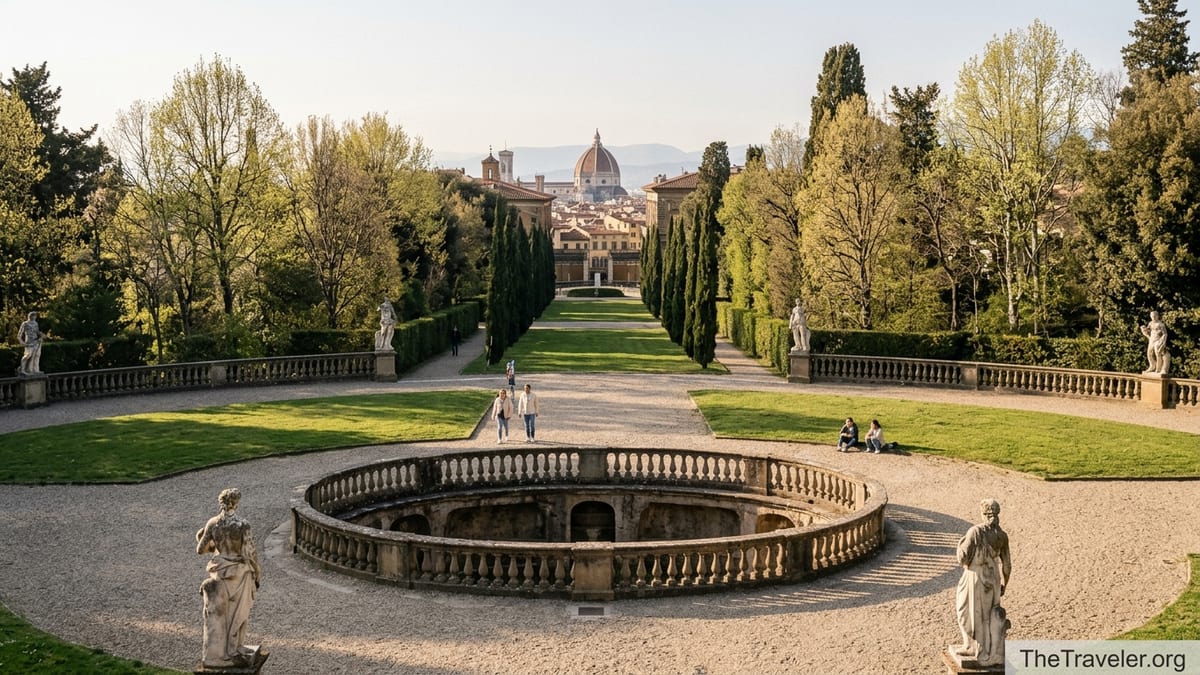
Boboli Gardens is not a small, manicured flower garden you stroll through in 20 minutes. It is a vast historic park behind the Pitti Palace, laid out in the 16th century for the Medici family as a statement of power and taste. Visitors today walk through a hillside landscape of gravel avenues, cypress-lined paths, terraces, statues, fountains and grottoes that became a model for formal Italian gardens across Europe. Expect long perspectives, stone sculptures and clipped hedges more than colorful flower beds.
On the ground this means the experience feels closer to exploring a historic estate park than visiting a compact botanical garden. You might walk 2 to 3 miles if you loop around the main axis, climb to the higher viewpoints and detour to features like the Kaffeehaus pavilion or the Neptune Fountain. The scale surprises many first-time visitors who only glimpsed the greenery from the Ponte Vecchio or the Pitti Palace courtyard.
The gardens are also very much a product of their time and climate. Large open lawns can look brown in the height of a hot Tuscan summer. Many shrubs and hedges are evergreen rather than flowering. Seasonal beds around the amphitheater or near the porcelain museum change with the year, but if you are imagining tulip fields or constant rose displays, you may be disappointed. Understanding that Boboli is fundamentally a historic landscape and outdoor sculpture park is key to judging whether it suits your interests.
There is minimal interpretive signage inside, so unless you join a guided tour or do a bit of research before you go, you may not fully appreciate what you are seeing. For some travelers that is part of the charm: you simply wander, find a shady bench, and enjoy the views of Florence and the Tuscan hills. For others, especially those craving context and storytelling, combining Boboli with a visit inside Pitti Palace works better.
Tickets, Costs and Practical Logistics in 2026
As of mid 2026, a standard adult ticket for Boboli Gardens alone typically costs just over 10 euros when purchased through official channels, with small seasonal variations between low and high season. Combined tickets that include Pitti Palace and Boboli Gardens are around 22 euros for adults, and there is also a five day pass that bundles Uffizi Gallery, Pitti Palace and Boboli Gardens for a higher price tier. Families and students from the European Union often benefit from reduced or free entry, particularly for visitors under 18 or in specific age brackets, so it is worth checking current concessions when you book.
One financially useful detail is that a Boboli ticket issued by the official Italian museum system usually gives you free entry to nearby Bardini Garden within its validity period. Bardini is smaller, quieter, and famous for spring wisteria and a postcard-perfect terrace view back over Florence. In practice, many travelers plan a late morning in Pitti and Boboli, then walk ten minutes downhill to Bardini in the afternoon for coffee and a less crowded panorama.
Boboli Gardens keep broadly daylight-centered hours. In winter they tend to open around 8.30 in the morning and close mid to late afternoon as light fades. In late spring and summer, closing times shift later into the early evening, which is ideal if you want golden hour views. Exact hours can change for special events or maintenance, so it is safest to confirm the schedule the week you travel. On national holidays such as early January Epiphany, the Italian culture ministry has announced ordinary opening hours for Boboli, which means you can still enter when some other sites are closed.
For 2026, advance booking for Boboli is recommended but not always critical on quieter weekdays outside peak season. However, if you are visiting during busy spring weekends, around late April public holidays, or during June weekends, ticket allotments for popular days can sell out ahead of time. Travelers sharing their recent experience reported certain April and early May dates fully booked on the official system, while midweek dates remained flexible. Buying ahead becomes more important if you are using a combined pass that locks in an Uffizi entry time and then gives you flexibility over the following days for Pitti and Boboli.
What the Experience Feels Like: Terrain, Crowds and Comfort
Imagining the physical feel of Boboli helps decide if it suits you. The gardens climb a hillside behind Pitti Palace, so even the main paths involve moderate inclines. Surfaces are mostly gravel or compacted earth rather than pavement. In dry weather they are manageable in regular sneakers, but the loose surface can be tiring if you have mobility issues, are pushing a stroller, or are used to flat city walking. Several recent visitors have mentioned uneven paths and occasional potholes along the wide cypress avenue, so those with ankle or balance concerns should be cautious.
Facilities exist but are not spaced as closely as in an urban park. You can expect a couple of restrooms, some drinking fountains and a café kiosk or small refreshment point near the main central areas, but not at every corner. Shade varies: some routes are tree lined and cool, while the large amphitheater lawn and upper terraces can be exposed to strong sun. In July or August, temperatures on those slopes quickly feel intense, which is why many summer visitors recommend coming in the early morning or late afternoon instead of midday.
Crowding patterns differ from Florence’s museums. The Uffizi and Accademia regularly feel shoulder to shoulder in high season. Boboli, while popular and often granted Travelers’ Choice style awards on review platforms, tends to disperse people across its large footprint. On a typical spring Saturday you may queue briefly at the Pitti ticket office but then find plenty of space once inside. Local feedback suggests that the first broad lawn and amphitheater get the highest concentration of people taking photos, while higher up near the Kaffeehaus and porcelain museum it becomes quieter.
If you are sensitive to construction or maintenance, set your expectations. Parts of the garden may be under restoration at any given time, particularly sculptures, balustrades and sections of the famous Buontalenti Grotto. Seasonal watering restrictions can also affect how lush lawns look at the end of a dry summer. Some travelers come away calling the gardens magical, especially in April and May when greenery is fresh. Others, visiting in late August heat when grass has browned, describe them as dusty and underwhelming. The divergence often traces back to timing and weather more than to the site itself.
Best Seasons and Times of Day to Visit
In terms of both aesthetics and comfort, the sweet spot for Boboli Gardens is typically spring and early summer, roughly April through mid June. During these months the lawns are greener, seasonal plantings stand out more clearly, and temperatures on the hillside are pleasant for walking. Flowers are never the primary draw, but citrus trees, roses in certain corners and potted plants arranged around key staircases create more color than in winter.
Autumn, especially from late September into October, can also be very appealing. The garden contains a good number of deciduous trees that pick up warm tones, and the lower sun angle makes afternoon views of Florence particularly atmospheric. The air is usually cooler and the city slightly less crowded than in peak summer, which turns Boboli into a calm buffer after mornings in busy museums.
Summer visits in July and August can still be enjoyable if you adjust the timing. Aim for shortly after opening or a couple of hours before closing when light is softer and temperatures are lower. Midday visits mean strong sun on exposed slopes, which can feel punishing for families with young children or anyone not used to southern heat. In these months a hat, sunscreen and refillable water bottle are almost essential, and you will likely gravitate toward shaded avenues rather than open lawns.
Winter is when expectations matter most. From December through February, the garden can look stark, with bare branches and more obvious signs of ongoing work. On the other hand, there are far fewer visitors, soft winter light over Florence, and ticket prices or combined passes that feel reasonable if you are mainly after long walks and city views. If your idea of a garden visit requires abundant blooms, winter Boboli will probably feel underwhelming. If you like moody landscapes and quiet, it can be a rewarding time.
Who Will Love Boboli Gardens (And Who Might Skip It)
Boboli Gardens is most rewarding for travelers who genuinely enjoy landscape, history and views as much as paintings and churches. If you are the kind of person who lingers in parks at home, seeks out historic estates, or loves combining city breaks with green space, Boboli can easily become a highlight. Many visitors describe their favorite Florence day as a morning at the Uffizi, lunch in the Oltrarno district around Piazza Santo Spirito or Via Romana, then a lingering afternoon wandering Boboli’s terraces and sitting with a book on the grass.
The gardens also work well for families who need unstructured space after guiding children through quiet galleries. Kids can roam more freely here, fascinate themselves with fountains and statues, and burn energy on the slopes. Just be prepared for the practicalities: stroller wheels handle the gravel, but pushing uphill gets tiring, and you will want snacks and sun protection. Teenagers interested in photography often appreciate the skyline views, especially from higher terraces looking across the Duomo and Palazzo Vecchio.
Travelers focused mainly on ticking off major art highlights in limited time might consider Boboli optional. If you only have one full day in Florence, most first time visitors prioritize the Duomo complex, Uffizi and Accademia, and perhaps a sunset walk to Piazzale Michelangelo. In such a compressed schedule, adding a two to three hour garden visit can feel rushed. Likewise, if mobility challenges, heat sensitivity or very short attention spans for gardens are part of your reality, you might get better value from indoor sites or smaller, flatter green spaces like the Rose Garden near Piazzale Michelangelo.
Budget travelers weighing costs carefully should look at how Boboli fits with broader ticket choices. If you plan to visit Pitti Palace anyway, the incremental cost of adding the gardens through a combined ticket is modest, and being able to step into green space right after exploring Medici apartments can feel like excellent value. If you are not interested in Pitti and must pay solely for the garden, you may ask if that same amount might be better spent on a guided city walk, a day trip train ticket to Lucca, or another experience. The answer depends on how much you personally value open air time.
How Boboli Fits into a Florence Itinerary
One of the most efficient ways to experience Boboli is to anchor it around a visit to Pitti Palace. A common plan is to reserve a late morning entry for Pitti, spend 90 minutes to two hours exploring the Palatine Gallery and royal apartments, then exit directly into the gardens through the rear doors. You can then grab a light lunch at a nearby café on Via Romana or Via dei Serragli, and return to wander the main axes of Boboli in the early afternoon, finishing with a walk over to Bardini Garden for its terrace views.
Another popular combination links Boboli with the Uffizi via the five day pass. For example, on day one you might tour the Uffizi in the morning then walk over Ponte Vecchio to scout the Pitti exterior and Oltrarno streets, saving the palace interior and Boboli Gardens for a quieter second or third day. That separation keeps museum fatigue at bay and turns Boboli into a slower, more contemplative counterbalance to the intense art immersion of the Uffizi.
If your time in Florence is extremely short, you can still sample Boboli without committing to the entire garden. Enter from the Pitti courtyard, explore the lower amphitheater and the primary central axis up to the Isa fountain viewpoint, then loop back down. This abbreviated circuit can take as little as 60 to 90 minutes while still offering a taste of the grand Medici layout and a solid city panorama. In that scenario Boboli becomes more of a scenic backdrop to your stroll through the Oltrarno rather than a half day destination.
Travelers who like to break up city time with countryside may also consider pairing Boboli with a separate day trip into the Tuscan hills, such as Chianti villages or Pratolino Park. In that broader context, Boboli reads as Florence’s own historic hillside, offering views back over the terracotta roofs rather than out to vineyards. Seeing both gives you a sense of how the Medici balanced urban power with country estates.
Alternatives and Complements: When Bardini or Other Gardens Might Be Better
Boboli is not the only green space option in Florence, and comparing it to alternatives helps clarify its appeal. Bardini Garden, often accessed free with a Boboli ticket, is smaller and more intimate, with winding paths, orchard-like sections and a famous wisteria covered pergola that erupts in purple in April. Its main terrace has one of the classic postcard views of Florence’s skyline, and because it is less well known than Boboli, it tends to feel calmer, especially in the late afternoon.
For travelers primarily seeking a quiet viewpoint rather than a full historic park, Bardini alone can be a satisfying choice. On a short trip you could skip Boboli, pay directly for Bardini, and still enjoy a garden setting with city views and seasonal flowers. Similarly, the Rose Garden below Piazzale Michelangelo offers free access, sculptures scattered among roses, and sweeping vistas without any ticket at all, which suits budget focused visitors or those wanting a spontaneous sunset stop.
On the other hand, Boboli offers something the alternatives do not: a sense of scale and the feeling of walking through a grand ducal backyard that once shaped garden design across Europe. Features like the amphitheater, Neptune Fountain, and elaborate Buontalenti Grotto do not have equivalents in smaller gardens. If you enjoy comparing how power and aesthetics show up in architecture and landscape, Boboli gives you a three dimensional lesson that complements what you see inside Medici palaces.
A practical way to decide is to look at your day as a whole. If you already plan to cross the river to visit artisan workshops on Via Maggio, eat around Piazza Santo Spirito and tour Pitti Palace, then Boboli blends naturally into your route and offers good value on a combined ticket. If your time south of the river is limited to an evening stroll for gelato and a view from Piazzale Michelangelo, then Bardini or the Rose Garden might give you more payoff for less time and money.
The Takeaway
So is Boboli Gardens worth visiting during a Florence trip. For many travelers the answer is yes, provided you arrive with the right expectations. It is a sprawling historic landscape and outdoor sculpture park more than a flower filled botanical garden. Its strengths lie in long Medici perspectives, quiet corners, city and hillside views, and the chance to step into a green space that once served as the stage set for court life rather than in spectacular seasonal blooms.
Boboli makes the most sense if you value time outdoors as much as museum visits, are already planning to explore Pitti Palace, or want a slower half day in the Oltrarno to balance out the intensity of Florence’s historic center. It is less essential if your schedule only allows for the big three art stops, if mobility or heat are major concerns, or if you prefer intimate gardens with dense flowers over grand but sometimes austere formal layouts.
With a realistic sense of terrain, seasonal appearance and cost, you can decide whether to weave Boboli into your itinerary or to focus instead on smaller gardens and panoramic viewpoints. Either way, planning some time on a hillside looking back at Florence’s domes and towers, whether from Boboli, Bardini or the Rose Garden, will deepen your sense of how the city sits within its Tuscan landscape.
FAQ
Q1: How much time should I plan for Boboli Gardens?
Most visitors are comfortable with 2 to 3 hours inside the gardens, which allows you to walk the main avenues, climb to at least one upper terrace for views and linger at a few fountains or shaded benches. If you only want a quick taste, you can see the lower amphitheater area and one viewpoint in about 60 to 90 minutes.
Q2: Is Boboli Gardens suitable for people with limited mobility?
The gardens are built on a hillside with several long, sometimes steep gravel paths and uneven sections, which can be challenging for visitors with limited mobility or balance issues. There are some flatter areas near the entrance and amphitheater, but exploring higher terraces usually involves moderate uphill walking, so those with significant mobility concerns may prefer smaller, flatter gardens or viewpoints.
Q3: Are the gardens worth visiting in winter?
In winter Boboli can feel stark, with bare trees, fewer flowers and more visible maintenance work, but there are also far fewer crowds and a quiet, atmospheric quality. If you enjoy long walks, muted landscapes and soft winter light over the city, it can still be rewarding, but travelers seeking lush greenery and blooms might be better off focusing on indoor attractions during the coldest months.
Q4: Should I buy tickets for Boboli Gardens in advance?
Buying tickets in advance is helpful, particularly in spring and early summer when visitor numbers spike and some dates sell out on the official system. On off peak weekdays you can often buy tickets on the day without trouble, but advance booking is advisable if you are coordinating with timed entries for the Uffizi or Pitti Palace, or if your schedule in Florence is tight.
Q5: Is it better to visit Boboli Gardens or Bardini Garden?
Boboli offers scale, grand Medici perspectives and a larger variety of historic features, while Bardini is smaller, quieter and more focused on views and seasonal flowers, especially in spring. If you already have a Boboli ticket that grants free Bardini entry, visiting both makes sense, but if you must choose only one and prefer intimacy and a single iconic viewpoint, Bardini may feel more satisfying on a short trip.
Q6: Can I picnic inside Boboli Gardens?
Rules on picnicking can vary and are enforced to protect the historic landscape, but in general you are expected to avoid full blanket style picnics on the main lawns and to keep food consumption discreet. Many visitors bring a simple snack or sandwich and eat it quietly on a bench or in a less formal corner, then save larger picnics for public parks or the free Rose Garden on the Oltrarno hillside.
Q7: What should I wear and bring for a visit?
Comfortable walking shoes with decent grip are important, as most paths are gravel or compacted earth and can be uneven in places. In warmer months bring a hat, sunscreen and a refillable water bottle, since shade and fountains are not available everywhere, and in cooler seasons a light layer helps when wind picks up on the exposed terraces.
Q8: Are there good photo spots inside Boboli Gardens?
Yes, several terraces offer excellent photo opportunities, particularly those looking back over the Pitti Palace roofline toward Florence’s cathedral dome and Palazzo Vecchio tower. The amphitheater, the Neptune Fountain and views near the higher hilltop pavilions are especially popular, and combining Boboli shots with photos from the Bardini terrace can give you a varied set of perspectives on the city.
Q9: Is Boboli Gardens child friendly?
Boboli can be very enjoyable for children who like open space, hills and exploring, but parents should be aware of the lack of playground equipment, the presence of steep slopes and water features, and the effort of pushing strollers on gravel. Many families plan a flexible visit, letting kids set the pace and taking frequent shade and snack breaks rather than trying to cover the entire garden systematically.
Q10: How does Boboli compare to other European palace gardens?
Compared with places like Versailles or Schönbrunn, Boboli feels more intimate in overall size but similarly formal in layout, with axial avenues, sculptural groups and water features. Its hillside setting and direct relationship with Florence’s skyline give it a distinctive character, and instead of vast flat parterres you get layered terraces and views across tiled roofs and Tuscan hills, which many visitors find uniquely atmospheric.