


When you are investing five or even six figures in a dream vacation, the planning question quickly becomes strategic: do you hand everything to a luxury specialist like Abercrombie & Kent, or do you piece together a high-end itinerary yourself using online tools, local experts and your own research time? The right answer is rarely one-size-fits-all. It comes down to what you value most: time, control, insider access, budget efficiency or a mix of all four.
Get the latest updates straight to your inbox!
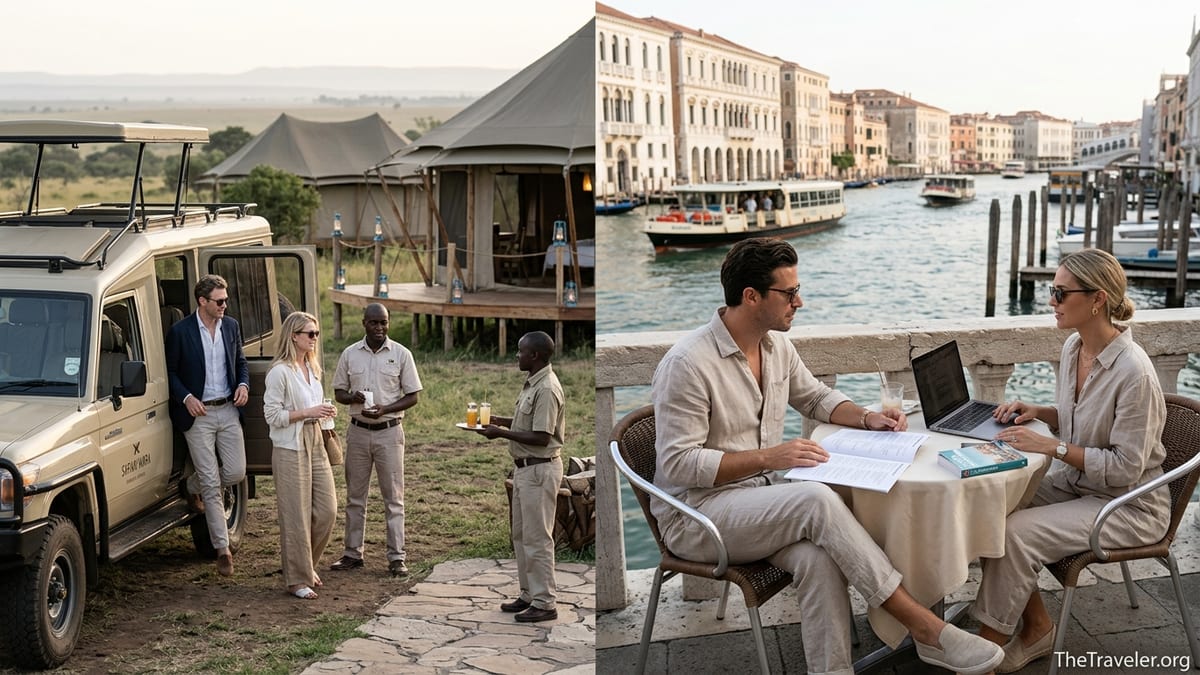
What Abercrombie & Kent Actually Offers
Abercrombie & Kent, often abbreviated as A&K, has been operating since the early 1960s and built its reputation on high-touch, logistics-heavy trips, especially safaris and complex itineraries. Today the company sells luxury small group journeys, tailor‑made private trips, expedition cruises and private jet itineraries across all seven continents. Their promise is largely about ease and access: carefully curated hotels, English‑speaking guides who live in‑country, and a support team that manages transfers, meals, sightseeing and problem‑solving behind the scenes.
To understand the scale, look at some of A&K’s current small group journeys. An 11‑day “Northern Italy: Cinque Terre, Lake Como and Venice” itinerary limited to about 18 guests starts from roughly 14,800 dollars per person before international flights. A nine‑day “Classic Japan” trip runs from around 16,200 dollars per person, while a 14‑day “Ultimate Great Migration Safari” in East Africa can start near 24,700 dollars per person. These prices typically include premium hotels or camps, most on‑trip transport, many meals, guided touring and special experiences.
A&K also sells more rarefied products. An 11‑day “Italy by Private Jet” journey, capped at just 13 guests, starts around 47,500 dollars per person. That reflects chartered jet segments between cities, top‑tier hotels and heavily choreographed experiences that would be difficult to stitch together independently. For travelers for whom convenience and exclusivity matter more than price, this style of trip is the core of A&K’s appeal.
Another key selling point is group size and guiding style. A&K keeps most group departures at roughly 14 to 18 guests, led by a Resident Tour Director who has spent years in the destination. That is a very different experience from a 40‑person coach tour run on a tight budget. The value you are paying for is not just the room or the vehicle, but the handholding and the ability to show up in, say, rural Botswana or inland Japan knowing someone else has checked the flight timings, the road conditions and the restaurant reservations.
What a Comparable DIY Luxury Trip Really Costs
It is easy to assume that planning a trip yourself will always be cheaper, but in luxury travel the comparison is more nuanced. Take that notional 10‑day Italy itinerary with Rome, Florence and Venice, staying in five‑star hotels and moving by high‑speed rail. If you book business‑class flights from New York to Rome in high season, you might pay anywhere from 3,500 to 6,000 dollars per person depending on dates and sales. Five‑star hotels in central Rome, Florence and Venice commonly run 700 to 1,200 dollars per night for a double room in peak months.
If you choose properties like a five‑star palazzo on the Grand Canal in Venice, a design‑forward luxury hotel near the Duomo in Florence and a classic luxury address near Piazza di Spagna in Rome, you could easily average 900 dollars per night. Over nine nights that is about 8,100 dollars per room, or just over 4,000 dollars per person if you are two people sharing. Add high‑speed train tickets in business class (perhaps 250 to 350 dollars total per person for Rome–Florence–Venice segments), private airport and station transfers, museum skip‑the‑line tickets, a couple of full‑day private guides and wine or food tours, and it is realistic for the land portion to reach 6,000 to 8,000 dollars per person without particularly extravagant choices.
In destinations with lower price points, a DIY luxury stay can be much more affordable. In Southeast Asia, for example, a genuine five‑star hotel in Bangkok, Hanoi or Siem Reap might cost 150 to 300 dollars per night, and high‑end private tours and transfers are priced accordingly. Thoughtful travelers often design trips there with a total daily spend of around 300 to 500 dollars per person including accommodation, local transport, meals and one premium experience per day, especially if they are willing to fly economy or premium economy on long‑haul flights and splurge on luxury once in‑country.
However, when you try to mimic an A&K small‑group safari or remote expedition on your own, the DIY discount can shrink. High‑quality safari lodges in Kenya or Botswana, for instance, often bundle game drives, meals and drinks. A classic tented camp in the Masai Mara or a lodge in the Okavango Delta might charge 1,200 to over 2,000 dollars per person per night in high season. Once you add small‑plane flights between camps, park fees and transfers, a 10‑day independent safari staying at equivalent properties can quickly approach the same five‑figure totals you see on A&K brochures, even before you factor in your own planning hours.
Where Abercrombie & Kent Has a Clear Edge
Abercrombie & Kent makes the most sense in destinations where reliable logistics and insider access are hard to achieve as an outsider. East African safaris are a textbook example. On a 10‑day group journey in Kenya and Tanzania, A&K coordinates light aircraft flights between game reserves, pairs you with experienced driver‑guides, secures rooms at sought‑after luxury camps and includes extras like sundowner cocktails in the bush or private visits to conservation projects. For many travelers, simply not worrying about whether a transfer will show up at a gravel airstrip at dusk is worth a serious premium.
The company is also strong in culturally complex or infrastructure‑light destinations such as Egypt, certain parts of India, remote areas of South America, Antarctica and the Arctic. For example, an A&K Egypt and Nile itinerary will typically include a curated sequence of Cairo, Luxor, Aswan and a Nile cruise on a high‑end vessel, with Egyptologist guides, private security arrangements where appropriate and tightly timed visits to popular sites like the Pyramids of Giza or the Valley of the Kings. Trying to replicate that on your own requires vetting boats, guides and drivers, often through scattered online reviews of varying quality.
Another area where A&K can deliver real value is special events or seasonal phenomena. A Great Migration safari timed to river crossings in the Serengeti, or a Japan trip aligned with cherry blossom, demands more than just picking dates. A&K uses decades of on‑the‑ground knowledge to choose camps and vantage points, add contingency plans if wildlife moves unexpectedly and work around crowds at popular viewpoints. A traveler booking piecemeal might rely heavily on luck or generic timing advice, while a large tour operator can adjust faster based on local reports.
Finally, some travelers are simply not interested in project‑managing their own vacations. For high‑earning professionals, parents juggling careers and children, or older travelers less comfortable navigating foreign booking platforms, the value equation often favors A&K. You pay more, but you outsource the mental load. When a flight is delayed or a border rule changes, you can text or call a support team instead of refreshing airline apps and negotiating with hotel front desks in a second language.
Where a DIY Luxury Trip Often Wins
For destinations with strong tourism infrastructure and clear English‑language information, planning your own luxury trip is usually the better value. Western Europe, much of North America, Australia and New Zealand fit this category. In Italy or France, for example, you can access the same historic palace hotels, boutique properties and Michelin‑listed restaurants that tour operators book, as long as you plan early for popular months. Online tools make it relatively straightforward to book high‑speed train tickets, private drivers, local guides and timed museum entries yourself.
A concrete illustration: imagine a couple planning 12 days in Japan with Tokyo, Kyoto and a few nights in a hot‑spring town. A&K’s curated “Classic Japan” journey, at around 16,000 dollars per person plus flights, includes upscale hotels, internal transport, guiding and some meals. A self‑planned trip using five‑star hotels such as a well‑known skyscraper hotel in Shinjuku or a luxury ryokan in Hakone might cost 600 to 1,200 dollars per night for accommodation, plus maybe 500 to 800 dollars per person for a Japan Rail Pass and individual limited express trains, and daily spending on meals and private tours. With careful choices, it is realistic to design an itinerary that feels equally indulgent for 8,000 to 10,000 dollars per person including flights, particularly if you split private guiding with another couple or mix in a few self‑guided days.
DIY also shines when you have very specific tastes that do not fit a pre‑designed tour. Perhaps you want a week in the Dolomites focused entirely on hiking and small design hotels, or a Caribbean trip that avoids large resorts in favor of eco‑luxury lodges and chartered day sails, or a food‑centric journey through Mexico that prioritizes street food and local markets over formal tasting menus. Large operators understandably design for broad appeal. When you plan yourself, you can select a tiny eight‑room inn on an Italian hillside instead of the international five‑star brand favored by many groups, or book a niche tequila distillery visit that never appears on mainstream itineraries.
Finally, travelers who enjoy research often find that designing their own itinerary is part of the pleasure. Reading about regional trains in Italy or ryokan etiquette in Japan, comparing small safari camps in South Africa, or learning how to navigate a city’s restaurant scene becomes a hobby in itself. For this type of traveler, the extra dollars saved over a packaged tour are a bonus. The real payoff is the sense of authorship and flexibility inherent in a self‑built journey.
The Middle Path: Using a Luxury Travel Advisor
There is a third option between A&K and pure DIY: partnering with an independent luxury travel advisor. Many high‑end advisors can access similar inventory to A&K, including boutique lodges, top hotels and vetted ground operators, without being tied to a single brand’s group departures. In practical terms, you explain your preferences and budget, and the advisor builds a fully bespoke trip using local partners. They can often secure perks like room upgrades, complimentary breakfast or resort credits at luxury hotels that are not available when booking directly online.
For example, instead of booking a published A&K safari, a travel advisor might work directly with a collection of camps in Kenya and Tanzania, designing a 12‑night route that balances two or three ecosystems, schedules internal flights sensibly and matches property style to your personality. Because there is one less corporate layer between you and the ground operators, pricing can sometimes come in under the per‑day cost of an A&K group journey, even after the advisor’s commission is factored in. Similar logic applies to European rail itineraries, yacht charters in Greece or Croatia, or complex island‑hopping in French Polynesia.
This middle path is also useful if you like some control but do not want to handle every detail. You might ask an advisor to sort flights, hotels and a rough structure for your two‑week trip to Spain and Portugal, but leave several days unprogrammed for spontaneous exploring. Or you may request that they book restaurant reservations for the first few nights in each city and leave the rest open. A good advisor will dial the level of structure up or down according to your comfort level, something a fixed group tour cannot easily do.
The trade‑off is that you still need to invest some time in selecting the right advisor and communicating your expectations clearly. Not all advisors specialize in every region, and not everyone has experience at the ultra‑luxury level. When it works, though, this model can deliver the customization of DIY with much of the ease and safety net of a company like Abercrombie & Kent.
Cost, Transparency and the “Middleman” Question
One of the most debated aspects of Abercrombie & Kent is pricing transparency. Because they package hotels, transport, guiding and experiences into one per‑person cost, it can be difficult to see exactly where your money goes. Some travelers who have reverse‑engineered their itineraries report that mid‑range hotels were packaged at what felt like luxury nightly rates, with significant markups on flights or transfers. Others are satisfied with the value once they factor in on‑trip support, group size and built‑in contingencies.
The reality is that companies like A&K are, by design, intermediaries between you and the local providers. They negotiate wholesale rates but add margins to cover marketing, staffing, head office overheads and profit. In return you get a single phone number, cohesive branding and the reassurance of a large, long‑established firm. A smaller local operator, or a trip you piece together yourself, will often come in cheaper simply because fewer entities are taking a cut.
When you plan independently, you see each line item clearly: 850 dollars per night for a canal‑view room at a historic hotel in Venice, 280 dollars for a private walking tour with a local guide, 120 dollars for a high‑speed train ticket in first class. That transparency can make the cost feel more rational and gives you control to downgrade or upgrade individual pieces. You might happily pay for a particularly atmospheric riad in Marrakech but opt for economy flights and allocate savings to a hot‑air balloon ride, choices that are harder to make on a fixed tour.
On the other hand, there is a risk in chasing the lowest possible version of a high‑end itinerary. In destinations like safari regions, the Arctic or parts of South America, quality and safety vary widely. The temptation to save a few hundred dollars a night by choosing a less reputable lodge or a bargain local operator can backfire if vehicles are poorly maintained, guides are under‑trained or contingency planning is thin. This is where the better large operators and experienced advisors provide real, if less visible, value: they have already screened out plenty of weak links.
How to Decide What Works for You
Choosing between Abercrombie & Kent and planning your own luxury trip starts with a clear audit of your priorities. First, consider your time and appetite for research. If you work long hours and the idea of comparing ten different safari lodges or reading through dozens of hotel reviews feels like another job, then A&K or a similar operator may simply be the smartest use of your resources, even if you know you could build something cheaper.
Second, think about your risk tolerance. Are you comfortable handling flight disruptions, rail strikes or last‑minute museum closures on your own, perhaps in a language you do not speak? Travelers who grew up booking their own trips, or who enjoy improvising, may find that DIY plus a few prebooked anchors suits them perfectly. Others would prefer to call a dedicated trip manager and let them reshuffle logistics. The more remote or logistically complex the destination, the more this question matters.
Third, be honest about what “luxury” means for you. For some travelers, it is the guarantee of a globally recognized five‑star brand, with plush bedding, multiple restaurants and a spa. Many A&K itineraries lean this way. For others, luxury is privacy, character and a sense of place: a stone farmhouse with only six suites on a Tuscan hill, or a simple but beautifully located ecolodge on a remote island. These are often easier to secure on a bespoke or DIY trip than via a big‑brand operator with global contracts.
Finally, look at your budget and trip frequency. If travel is your primary indulgence and you only take one big international trip every few years, paying a premium for seamlessness and support on a marquee experience like Antarctica or the Galapagos can make sense. If you travel abroad two or three times a year, the cumulative markups of packaged luxury tours may crowd out other experiences you could have afforded by mixing high and low on self‑planned itineraries.
The Takeaway
Abercrombie & Kent excels when you want a polished, largely worry‑free experience in destinations where logistics and quality control are hard to manage on your own. Safaris, polar expeditions and culturally dense itineraries in places like Egypt or India are strong candidates for a company with established local networks, full‑time destination experts and 24/7 support. The trade‑off is cost and a degree of rigidity: you pay a premium and work within the structure of their itineraries, even when they are branded as custom.
Planning a luxury trip yourself, possibly with the help of a skilled independent advisor, gives you more transparency, control and often better value, especially in destinations with robust tourism infrastructure. You can direct your budget to what you personally care about, whether that is a particular hotel, restaurant scene, scenic train or private guide, and accept a little more uncertainty and effort in return. Neither approach is inherently superior; each suits different types of travelers and different phases of life.
For many people, the smartest strategy is selective: use Abercrombie & Kent or a similar operator for the few trips where you truly want turnkey support and complex logistics handled by experts, then embrace DIY or advisor‑assisted planning for easier regions like Western Europe, Japan or coastal North America. In other words, reserve the fully packaged, high‑touch model for trips where it clearly adds value, and take the reins yourself when the incremental cost no longer matches the benefits.
FAQ
Q1. Is Abercrombie & Kent worth the premium price compared with planning my own trip?
It can be worth it in destinations where logistics are complex, such as safaris, polar regions or parts of the Middle East and South Asia, especially if you value having a single point of contact and 24/7 support. In easier destinations with strong public transport and plenty of English‑language resources, planning yourself or using an independent advisor often gives you similar or better experiences at a lower overall cost.
Q2. How much more does an Abercrombie & Kent trip usually cost than DIY?
The difference varies widely, but for itineraries in popular destinations like Italy or Japan, travelers often find that a self‑planned five‑star trip comes in at perhaps half to two‑thirds of the per‑person price of a comparable A&K small group journey. For remote or highly specialized trips, the gap narrows because local costs are high regardless of who books them.
Q3. Do Abercrombie & Kent trips include international flights?
Most published prices from companies like A&K include land arrangements only, meaning hotels, internal transport, guiding and many meals, but not your long‑haul flights from home. Your travel advisor or A&K consultant can help you book flights as an add‑on, but it is important to check what is and is not included before comparing costs.
Q4. Can I customize an Abercrombie & Kent itinerary?
Yes. In addition to set small group departures, A&K offers tailor‑made private journeys that can be heavily customized, from hotel choices to daily activities and pacing. However, customization within their ecosystem may still be constrained by preferred partners, contract rates and operational realities, so it is not as open‑ended as building a trip entirely from scratch.
Q5. Are there alternatives to Abercrombie & Kent for luxury travel?
There are many alternatives, including other global luxury tour operators, region‑specific safari specialists, expedition cruise lines and independent high‑end travel advisors who design bespoke itineraries using local partners. The best choice depends on your destination and whether you prefer a branded group tour, a private trip with one company or a mix of handpicked services.
Q6. How do I know if I should hire a luxury travel advisor instead of using A&K?
Consider a luxury travel advisor if you want a highly customized trip, prefer boutique properties that may not appear on big‑brand itineraries, or are trying to optimize value without sacrificing comfort. An advisor can also be helpful if you enjoy some involvement in planning but want professional guidance on routing, seasonality and property selection.
Q7. Is planning a luxury trip myself realistic if I have never done it before?
It is realistic for many destinations, especially if you are comfortable using online booking platforms and reading reviews critically. Starting with a relatively simple country such as Italy, France, Japan or New Zealand, and focusing on one or two regions instead of trying to see everything, makes the process manageable. For very remote or multifaceted trips, first‑timers may prefer at least partial professional help.
Q8. What are the biggest risks of a DIY luxury itinerary?
The main risks are misjudging distances and travel times, overpacking the schedule, booking inconsistent quality in hotels or guides, and having no backup when disruptions occur. These risks can be mitigated by building in buffer days, checking multiple sources when choosing suppliers, and purchasing strong travel insurance that includes support services, but they are still greater than when a reputable operator is orchestrating the trip.
Q9. Can a DIY trip ever feel as “luxurious” as an Abercrombie & Kent tour?
Yes. Many independently planned trips use the same caliber of hotels, private guides and experiences that appear on branded itineraries. In some cases, DIY can feel more luxurious because it is more personalized: you stay longer in places you love, avoid group schedules and focus spending on what matters most to you instead of paying for inclusions you may not value.
Q10. How should I decide which trips to book with Abercrombie & Kent and which to plan myself?
A practical rule of thumb is to reserve A&K for trips that are remote, logistically complex or once‑in‑a‑lifetime for you, such as a major safari, a polar expedition or a deep cultural journey in a region you find intimidating to navigate alone. Plan easier, infrastructure‑rich destinations yourself or with a flexible advisor. This way you match the planning model to the specific demands and stakes of each journey.