


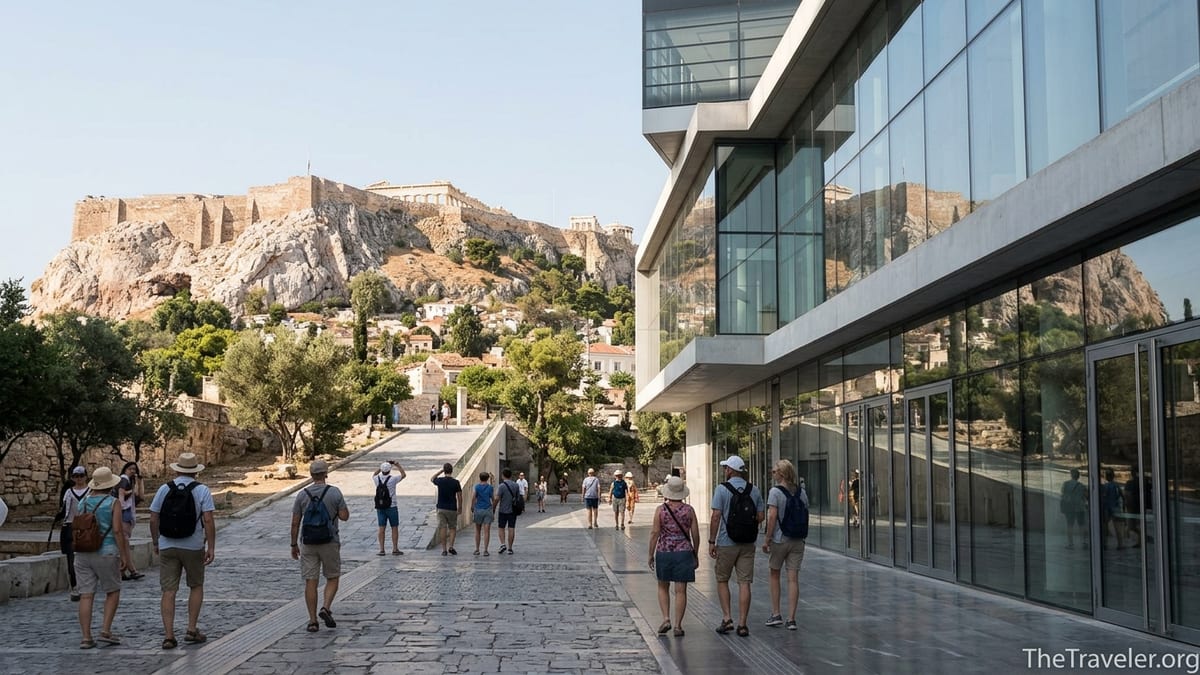
Standing in front of the Acropolis Metro station, you can see both Athens icons at once: the glass-and-steel Acropolis Museum at your feet and the limestone rock of the Acropolis rising above it. Most visitors do both on the same day. The real question is in which order. The right choice can mean cooler temperatures, fewer crowds, better photos, and a smoother day, especially if you are timing tickets, planning lunch, or meeting friends in Plaka.
Get the latest updates straight to your inbox!
Key Facts: Opening Hours, Heat and Ticket Basics
On a typical summer day between April and October, the Acropolis archaeological site opens at 8:00 in the morning and closes around sunset, with last entry 30 to 60 minutes earlier depending on the month. In July and August, midday temperatures on the rock often climb above 35 degrees Celsius, and there is little shade once you are up among the temples. Morning and late afternoon are therefore the most comfortable times for walking the slopes and standing on the exposed plateau.
The Acropolis Museum is just a few minutes’ walk downhill on Dionysiou Areopagitou Street. It usually opens a bit later in the morning than the hill, and in high season it stays open into the evening on several days, with extended hours on Fridays and sometimes weekends. Crucially, almost all of your time in the museum is spent indoors with strong air conditioning, making it an ideal refuge during the hottest hours of the day or if there are temporary heat-related closures at the Acropolis.
Tickets for the Acropolis archaeological site now use timed entry slots for crowd management in high season. You choose a one-hour window, such as 8:00–9:00 or 17:00–18:00, and you are expected to arrive during that period. The combined ticket that includes several ancient sites still requires you to pick a time for the Acropolis itself. In contrast, the Acropolis Museum ticket is usually valid for a flexible entry during the day of your choice, and many visitors simply buy it on the day at the museum ticket desk or as part of a combo tour.
Taken together, these details suggest a basic rule of thumb: whenever the sun is strong, you want your exposed Acropolis slot at the coolest end of the day, and you can fit the shaded, climate-controlled museum wherever the heat or your schedule naturally creates a gap.
Option 1: Acropolis First, Then the Museum
The classic pattern, especially in summer, is to visit the Acropolis as early as possible and move into the museum late morning. For example, a couple visiting in July might book an 8:00–9:00 entry slot for the Acropolis, be at the main entrance near the ticket office by 7:45, and walk up to the Propylaea while it is still relatively cool. Even with photo stops at the Parthenon, Erechtheion and viewpoints over the Theater of Dionysus, most people complete the main circuit in about 1.5 to 2 hours.
By around 10:15, that couple can begin to descend via the south slope, exit near the Theater of Dionysus, and follow Dionysiou Areopagitou Street directly to the museum entrance. After a short security check, they can be inside the air-conditioned building while the sun becomes harsher outside. Many visitors comfortably spend another two hours moving through the glass-floored ground level, the Archaic gallery, and finally the top-floor Parthenon Gallery, where the sculptures line up in the same orientation as they once did on the temple.
This order works particularly well for photographers and those who care about views. On a clear morning, the sunlight hits the western side of the Parthenon, and the city below is free from the heat haze that can build later in the day. Cruise groups and large tours tend to build up from mid-morning onwards, so arriving close to opening time often means a quieter experience, shorter security lines and fewer crowds filling your shots. Afterward, you can linger in the museum, have a coffee on the terrace with its direct view of the Acropolis, and decide on lunch without rushing.
Acropolis first is also a strong option in the shoulder months of March, April, October and November, when heat is less intense but early morning still offers a calmer atmosphere. If you have a short stay in Athens or you are catching an afternoon ferry or flight, getting the hill done first thing reduces the risk that a delayed arrival or temporary closure might force you to skip the main site altogether.
Option 2: Museum First, Then the Acropolis
For many travelers, especially in the height of summer, starting with the Acropolis Museum can be equally appealing. Imagine a family arriving in Athens on a hot August day who slept badly after a late flight. Instead of trying to be at the Acropolis gate at 8:00, they might book a 17:00–18:00 slot for the archaeological site and plan to enter the museum around 10:00. They can sleep in, have a leisurely breakfast in Koukaki or around Makrigianni, and then walk the short distance to the museum while the sun is still manageable.
Inside, the museum tells the story of the Acropolis in a chronological and thematic way, from the finds on the slopes to the early temples, the Persian destruction, and the classical rebuilding that produced the Parthenon and its siblings. By the time you stand in front of the Parthenon marbles on the top floor, you have a good sense of what you are going to see later up on the rock. Many visitors report that after seeing the original Caryatids, the sculpted metopes and frieze blocks, they appreciate the weathered remains on the site far more and can mentally “reconstruct” missing pieces when walking around the Parthenon.
After two to three hours in the museum, that same family could have lunch either in the museum’s restaurant, which offers panoramic views of the hill, or in a nearby taverna in the pedestrian streets between Makrigianni and Plaka. They then have time to retreat to their hotel for a rest or stroll slowly through Plaka’s alleys as the day cools off, before walking up to the Acropolis entrance in time for their late afternoon slot. Reaching the top closer to golden hour, they enjoy softer light on the marble, cooler temperatures and a slightly thinner crowd than at midday, all with the benefit of the context they gained earlier.
Museum first is especially attractive on very hot days when authorities may temporarily close the Acropolis during peak heat hours, often around midday or early afternoon. If you already have a later entry slot, you are less likely to be affected, and you can calmly explore the museum earlier in the day while monitoring any announcements about closures or re-openings.
How Season and Time of Day Change the Best Order
In mid-summer, roughly from late June through August, the weather is the single biggest factor. The sun can feel intense even at 9:30, and by midday the gleaming stone and reflective surfaces around the Parthenon make the plateau feel even hotter. During this period, two patterns work well in practice: Acropolis at opening time followed by the museum late morning, or museum late morning followed by Acropolis after 17:00 when the site begins to cool and the light softens.
In shoulder seasons like April, May, September and early October, the decision becomes more flexible. In these months, you can often be comfortable on the hill by 9:00 or 10:00, and evening visits may not feel as necessary for heat avoidance, especially on breezy days. Here, your broader itinerary matters more. If you are planning a late dinner in Plaka or Monastiraki, an afternoon museum visit that leads into an early-evening Acropolis slot can bridge the day nicely, leaving you already close to your restaurant afterward.
Winter visits, from November through March, change the calculation again. With cooler temperatures and shorter days, heat is no longer a concern, but limited daylight is. The Acropolis closes earlier in winter, often around 17:00, and mornings can feel crisp but bright. In this season, most travelers find it easiest to visit the Acropolis first when the light is best, perhaps with a 9:00 or 10:00 start, then retreat into the museum for the afternoon as temperatures drop and the city gets windier. Museum hours in winter can be slightly shorter too, so checking closing times before committing to a late entry helps avoid feeling rushed.
Rain is another occasional factor, particularly in late autumn and winter. The Acropolis can be slippery in wet weather, and access may be restricted in extreme conditions. When rain is forecast later in the day, prioritizing the hill first and leaving the flexible museum ticket for the afternoon is usually the safer choice. Conversely, if a summer heatwave is predicted with potential midday closures on the rock, starting with the museum and scheduling the Acropolis either as early or as late as possible is the more resilient plan.
Walking Route, Plaka Plans and Lunch Options
Geographically, the Acropolis and Acropolis Museum are separated by only a few hundred meters, and most visitors move between them along Dionysiou Areopagitou Street, the wide pedestrian avenue that wraps around the southern side of the hill. From the main Acropolis entrance by the large ticket office, the museum is about a 10-minute downhill walk at a relaxed pace. From the south slope exit near the Theater of Dionysus, the walk is even shorter, just a few minutes.
If your goal is to combine the sites with lunch in Plaka, both orders can work, but the flow feels slightly different. Consider an early-morning Acropolis visit followed by a downhill stroll through the Anafiotika quarter and deeper into Plaka’s streets, where you could stop for lunch around 12:00 at a taverna on Adrianou Street or a quieter side lane. From there, a relaxed walk back along the pedestrian streets brings you to the museum in mid-afternoon. In this pattern, Plaka sits between the hill and the museum.
Alternatively, you might start with the museum at 10:00, break for lunch on its terrace with a direct line of sight to the Parthenon, and then use the pedestrian street to ascend gently toward the Acropolis entrance for a late-afternoon slot. After exiting, you can peel off into Plaka from the main gate and wander downhill, perhaps stopping for a drink on a rooftop with Acropolis views before dinner. Here, Plaka becomes the natural evening continuation of your Acropolis visit.
For travelers staying in nearby neighborhoods like Koukaki or Makrigianni, the museum is practically on your doorstep and may feel like the easiest starting point, especially if you wake up late. Visitors based closer to Syntagma Square or Monastiraki often find it equally straightforward to approach the Acropolis first from the north side, then descend toward the museum and Plaka. Whatever you choose, comfortable shoes are essential, as the marble and stone pathways on the hill can be uneven and slippery, particularly on the way down.
Guided Tours, Skip-the-Line Tickets and Real Examples
Guided tours can strongly influence the best order for your day. Many popular group tours, especially those marketed as half-day city highlights, begin with a guided walk up to the Acropolis and then include a shorter guided section inside the museum. In such cases, the structure is essentially fixed: Acropolis first, museum second. If you choose one of these tours, you might still return independently to the museum later in the week, using the knowledge gained from the guide to explore specific galleries in more depth.
Other operators offer the reverse order, starting in the museum in late morning to provide historical context in front of key sculptures and models before moving up to the Acropolis in the late afternoon. One common pattern used by private guides for summer guests is a 10:00–12:00 museum visit followed by a break and a 17:00 or 18:00 escorted visit to the hill. This fits well with the heat patterns in July and August and allows for a long lunch or siesta in between.
Skip-the-line tickets are mainly about avoiding the ticket desk queues rather than bypassing security or controlling crowds on the plateau, but they significantly simplify timing. For example, a traveler might pre-book a timed Acropolis ticket for 8:00 along with a separate museum ticket valid all day. On the day, they can walk straight past the sales line at the Acropolis, pass through security and head up the hill within minutes. Afterward, they can enter the museum through the dedicated pre-booked ticket scanners just inside the entrance, again skipping the purchase line.
Real visitor stories reflect how these choices play out. Some travelers who did the Acropolis in the early afternoon heat later said they wished they had reversed the order, doing the museum midday and the hill in the evening. Others who visited the museum first reported that the detailed models and explanations made the broken columns and fragmentary carvings on the hill far more meaningful. A frequent pattern in practical trip reports is to pair an 8:00 or 9:00 Acropolis slot with an 11:00 or flexible museum entry and to pair a late-afternoon Acropolis slot with a mid-morning or lunchtime museum visit.
How to Decide: A Simple Framework by Traveler Type
The best order also depends on your travel style and constraints. If you are an early riser who enjoys being out at first light, Acropolis first is almost always more satisfying. You will have cooler air for the climb, gentler light for photography, and a sense of calm before day-trippers and cruise excursions swell the crowds. In this case, treat the museum as your reward: an air-conditioned, unhurried space where you can go deeper into the stories you have just glimpsed on the hill.
Night owls, families with young children and anyone recovering from jet lag may find it unrealistic to commit to an 8:00 entrance. For these travelers, museum first usually works better. Because the museum is more forgiving in terms of entry time and environment, you can adjust your morning on the fly, then aim for a late-afternoon Acropolis visit when your energy and the temperature both improve. This pattern has the added benefit of letting the children or less enthusiastic history fans engage through the museum’s visible-restoration displays, models and short films before tackling the physical climb up the slopes.
If your schedule in Athens is compressed, for example if you are visiting on a cruise stop with only one full day, prioritize whichever element would be hardest to replicate elsewhere. You can see collections of ancient Greek art in many major world museums, but you cannot stand on another hill with this exact ensemble of monuments and this view over Athens. In that situation, orient your day around the Acropolis first while leaving flexible time for the museum. Conversely, if you know you are sensitive to heat, have mobility concerns or are traveling in a heatwave, it is entirely reasonable to treat the museum as the anchor and choose an Acropolis slot that minimizes your exposure, even if that means sacrificing some quiet morning atmosphere.
Couples or friends who plan to spend the evening in Plaka or on a rooftop bar may want to time the Acropolis to overlap with golden hour and use the museum as a mid-morning or early-afternoon activity. Solo travelers who like to move quickly and absorb a lot in one day often choose to start very early at the Acropolis, reach the museum by late morning, and still have the afternoon free for another site such as the Ancient Agora or the National Archaeological Museum.
The Takeaway
There is no single correct order for visiting the Acropolis and the Acropolis Museum, but there are clear patterns that tend to work best in specific circumstances. In summer, pairing an early-morning or late-afternoon Acropolis slot with a mid-morning or midday museum visit usually delivers the best balance of comfort and depth. In shoulder seasons, you can choose more freely based on your plans in Plaka, your preferred meal times and whether you value context before or reflection after.
As you finalize your itinerary, look first at your travel dates, the daily high temperatures and the available timed slots for the Acropolis. Decide when you want to be on the rock itself, then drop the museum into the coolest, most flexible part of the rest of the day. If you are unsure, a highly reliable choice for most travelers is Acropolis at opening time followed by a late-morning or early-afternoon museum visit and a leisurely meal in the surrounding streets. With that structure, you will have seen Athens’s most famous hill from both outside and within, in comfort and with a clear sense of the stories behind the stones.
FAQ
Q1. Is it better to visit the Acropolis Museum before or after the Acropolis?
There is no universal best choice. In peak summer heat, many travelers prefer the museum late morning and the Acropolis in the early evening, while early risers often visit the Acropolis first at opening time and move into the museum as the day warms up.
Q2. How long do I need for the Acropolis and the museum together?
Most visitors spend about 1.5 to 2 hours on the Acropolis and another 2 to 3 hours in the museum. Allow at least half a day in total, and a full day if you want a relaxed lunch in Plaka between or after the two visits.
Q3. What is the best time of day to visit the Acropolis in summer?
The most comfortable times in summer are usually right after opening in the early morning and the last couple of hours before closing in the early evening, when temperatures are lower and the light is softer.
Q4. Can I easily walk between the Acropolis and the Acropolis Museum?
Yes. The museum sits just below the south side of the Acropolis. It is about a 10-minute downhill walk from the main entrance on the plateau and only a few minutes from the south slope exit near the Theater of Dionysus, mostly along a wide pedestrian street.
Q5. Should I book timed tickets for both the Acropolis and the museum?
The Acropolis uses timed entry slots in high season, so booking in advance is strongly recommended. The museum is more flexible and often does not require a specific entry time, but pre-booking can still reduce waiting at the ticket desk, especially on busy mornings and Friday evenings.
Q6. Does visiting the museum first really make the Acropolis more meaningful?
Many visitors find that seeing the sculptures, models and explanations in the museum first helps them understand what they are looking at on the hill. After viewing the Caryatids and the Parthenon frieze indoors, the remains on the Acropolis plateau tend to feel more vivid and complete.
Q7. What if my Acropolis slot is in the hottest part of the day?
If your slot falls around midday in summer, plan to spend as little time as possible in unshaded areas during the peak heat. Consider doing the museum either before or after as your cool refuge, carry water, wear a hat and take your time on the climb, using any available shade on the slopes.
Q8. How should I plan lunch when visiting both sites?
For an early-morning Acropolis visit, a popular pattern is a late breakfast before you start, a light snack or coffee at the museum café, and a fuller lunch in Plaka afterward. If you do the museum first, lunch on the museum terrace or in the nearby pedestrian streets works well before an evening Acropolis slot.
Q9. Is one day enough to see both the Acropolis and the museum properly?
Yes, one day is enough for most travelers, provided you allow at least half a day and pace yourself sensibly. If you are especially interested in ancient art and archaeology, you might split them over two days to avoid museum fatigue and combine each with other nearby sites.
Q10. What should I wear and bring if I am doing both on the same day?
Wear comfortable walking shoes with good grip, lightweight clothing, a hat and sunscreen. Bring a refillable water bottle and, in warmer months, consider sunglasses and a small handheld fan. Inside the museum, temperatures are cool, so having a light layer you can put on if needed can be useful.