


Few museums in the world are as purpose built as the Acropolis Museum in Athens. Every glass panel, concrete column and open space exists to frame one story: the life of the Acropolis and, especially, the Parthenon above it. For first time visitors, the sheer amount of sculpture, friezes and artifacts can feel overwhelming. This guide walks you floor by floor through the essential highlights, from the ruins beneath your feet to the Parthenon Gallery that crowns the building, so you can make the most of a visit that many travelers call the single best museum experience in Greece.
Get the latest updates straight to your inbox!
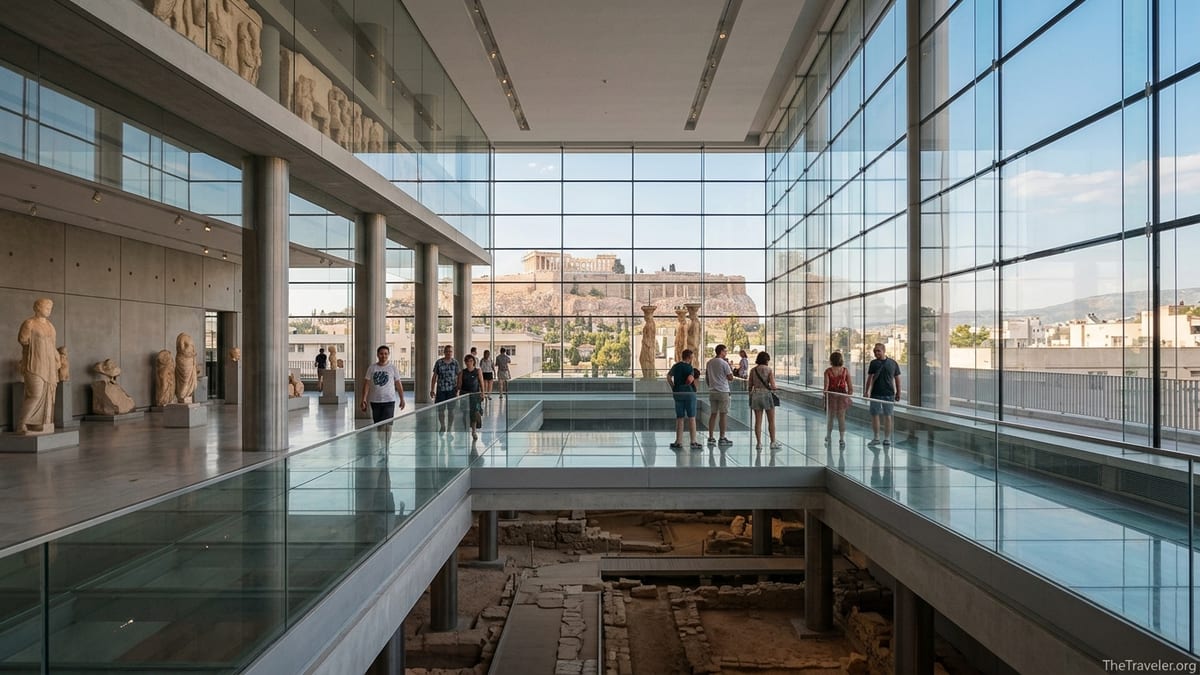
How the Acropolis Museum Is Laid Out
The Acropolis Museum is a compact, modern building on the southeastern slope of the Acropolis, about a five minute walk from the Acropolis metro station. It is organized thematically and chronologically around a single archaeological site: the Acropolis and its surrounding slopes. Instead of trying to cover all of Greek history, it focuses intensely on what was found on and around this one rocky hill.
For a first visit, it helps to understand the basic vertical layout before you arrive. Beneath the museum on level minus one lies a large archaeological excavation of an ancient Athenian neighborhood, visible through glass walkways. The ground floor holds the Gallery of the Slopes of the Acropolis, with finds from houses, streets and shrines that once clung to the hill. The first floor is home to the Archaic Gallery and key sculptures from temples such as the Erechtheion and the Temple of Athena Nike, including the famous Caryatids. The top third floor is dedicated almost entirely to the Parthenon Gallery, where the marbles are displayed in the same orientation as on the temple itself.
Most visitors enter at ground level, walk along the glass floors above the ruins, then gradually work their way up toward the Parthenon Gallery. If you are short on time, you can go directly by escalator to the third floor and then backtrack down, but first time visitors usually get more out of the museum by following the intended chronological flow from the earliest material to the height of classical Athens.
Allow at least two hours if you want to see the main highlights without rushing, and three to four hours if you plan to read labels, watch the short films, and take a break at the café or restaurant. In summer, many visitors choose to climb the Acropolis early in the morning, have lunch nearby, and then escape the afternoon heat inside the air conditioned museum between roughly 2 and 5 pm.
Walking Across History: Glass Floors and the Acropolis Slopes
One of the first striking features you will notice as you approach the Acropolis Museum is that the building seems to float on concrete piers above an exposed archaeological site. Glass panels in the plaza outside and in parts of the lobby allow you to peer down into streets, courtyards and drainage channels of an ancient Athenian neighborhood. These remains date from the 4th millennium BC through the Byzantine era and give an immediate sense that the Acropolis was not just a sacred rock but also part of a living city.
On the ground floor, the Gallery of the Acropolis Slopes continues this theme. The gallery is laid out along an inclined ramp that gently rises as if you were walking up the hill itself. In display cases you will see everyday objects from the houses and small sanctuaries that once lined the paths: terracotta household pots, children’s toys, little clay figurines offered to local deities, and painted drinking cups carried to festivals. Visitors with kids often pause at the case of miniature furniture and animal figurines, which bring home that real families once lived and played directly under the shadow of the Parthenon.
The glass floors here can be both thrilling and a little disorienting. You look down and see stone walls and mosaic fragments only a few meters below your feet. In practical terms, it is wise to wear shoes with good grip and to avoid very long skirts or loose dresses if you are concerned about reflections. Travelers who have been through airport style glass floors often comment that the sensation here is more intense because the excavations are continuous and clearly visible on a large scale, not just in a small window.
In this part of the museum, do not rush. Find a quiet corner by the glass and watch for a moment as other visitors cross the transparent sections above the ruins. This simple act of seeing contemporary life layered over ancient streets captures what the Acropolis Museum does best: connecting the daily routines of Athenians across 2,500 years.
The Archaic Gallery: Faces Before the Parthenon
From the ground floor ramp you ascend to the first floor Archaic Gallery, a large, bright hall filled with freestanding sculptures from the 7th to early 5th centuries BC. These works predate the Parthenon and many were buried on the Acropolis after the Persian sack of Athens in 480 BC. Because they were entombed rather than left exposed to weather, their surfaces are remarkably well preserved and in some cases still carry faint traces of original paint.
The standout pieces here are the kore and kouros statues: standing figures of young women and men that once lined sanctuaries and pathways. One famous example is the smiling Kore with the elaborate braid and patterned dress, whose almond shaped eyes and carefully carved jewelry show the shift from rigid early forms to more naturalistic representation. Another is the so called Kritios Boy, an early classical statue of a youth whose weight shifts subtly to one leg. Many art historians see this as one of the first truly lifelike figures in Western sculpture.
The layout of the Archaic Gallery allows you to walk around most pieces in the round, which is a rare privilege compared to older museums where statues are often set against walls. Take advantage of this to look for carved details on the backs of garments and hairstyles. A useful tip is to step back several meters and look at each statue from different angles; changes in the shoulders and hips often reveal how sculptors were beginning to experiment with movement and balance in stone.
Among the smaller works, do not miss the votive reliefs and architectural fragments from early temples on the Acropolis. Many visitors are surprised at how colorful Greek religious spaces once were. On some fragments you may glimpse reconstructed colors on the label illustrations, which contrast starkly with the white marble we usually imagine. The museum periodically highlights these traces of pigment in temporary displays or family programs, so if you are visiting during school holidays, check the information desk for any special color themed activities in this gallery.
Meeting the Caryatids: Maidens Who Hold Up a Temple
On the same museum level as the Archaic Gallery you enter a high ceilinged space dedicated to sculptures from the Erechtheion, a complex temple on the north side of the Acropolis plateau. The stars here are the five original Caryatids from the Porch of the Maidens, carved around 421 to 406 BC. These larger than life marble women once served as architectural supports in place of columns. In the museum they stand in a semicircle, raised on a platform, allowing you to get far closer to them than is possible with the weathered replicas on the Acropolis itself.
Each Caryatid is subtly different, from the fall of her peplos garment to the arrangement of her thick braids. One leans slightly forward as if stepping, another’s hip twists just enough to suggest movement. Stand between them and you will notice how the sculptors balanced elegance and structural duty; their heads and hair were engineered to bear the weight of the porch roof. Today, the museum continues delicate conservation work on their surfaces to remove centuries of pollution, and lighting is kept carefully calibrated, so expect a soft, even glow rather than harsh spotlights.
There is an unavoidable absence here: the sixth original Caryatid remains in London, part of the marbles removed in the early 19th century. The museum leaves a deliberate gap in the line where she should stand, which many visitors find quietly powerful. First time visitors often pause to take in this empty space, which speaks to the ongoing international debate about returning Acropolis sculptures to Athens. Docent led talks sometimes address this directly, so if you time your visit to coincide with one of the short “gallery talks” advertised on the museum’s daily program boards, you may hear the story from an archaeologist’s perspective.
After spending time with the Caryatids, look around at the surrounding walls, which display other sculptures from the Erechtheion and the Temple of Athena Nike, including sections of a parapet with winged figures adjusting their sandals. These details help you visualize how varied and richly decorated the Acropolis once was, beyond the single silhouette of the Parthenon that dominates modern photographs.
The Parthenon Gallery: Crown Jewel of the Museum
The highlight for most visitors is the third floor Parthenon Gallery, a glass walled rectangular hall that mirrors the footprint and orientation of the Parthenon itself. As you step off the escalator, you are greeted by floodlit marble metopes and a long frieze that wraps around the interior walls, while, outside the glass, the real Parthenon rises on the hill almost eye to eye with you. It is one of the few museum spaces in the world where the original monument and its sculptural decoration can be viewed in such direct dialogue.
The sculptural program of the Parthenon is displayed here in three main zones. At either short end of the gallery you will find fragments and reconstructions of the pediments, the triangular gables that once held scenes of Athena’s birth and her contest with Poseidon. Along the outer ring of columns are the metopes, high relief panels showing mythological battles, from Lapiths and centaurs to Greeks and Amazons. Inside, at comfortable eye level, runs the continuous frieze depicting a grand processional scene usually interpreted as the Panathenaic festival. Where original blocks are missing or housed elsewhere, the museum uses lighter colored casts to indicate gaps, creating a continuous narrative that also makes the losses and dispersals obvious.
First time visitors should allow at least 45 minutes in this single gallery. A useful approach is to start at the north side, where you can look out toward the modern city, then move slowly around the outside of the hall to study the metopes, and finally step into the inner ring to follow the progress of the frieze. Look for small details that bring the festival to life: a dog trotting alongside a youth, a girl adjusting her cloak, horsemen trying to control restless mounts. You will also see where modern restorers have carefully joined broken pieces and where entirely missing heads or limbs have been left blank rather than guessed at.
Audio guides and some organized tours pause in the Parthenon Gallery to explain how the display here differs from that in other museums. The sculptures are oriented outward, as they would have been on the temple, and natural daylight plays across their surfaces through the floor to ceiling glazing. This creates subtle shifts in shadow over the course of the day, much as sunlight once moved across them outdoors. If your schedule allows, visiting in the late afternoon can be particularly atmospheric, with warmer light hitting the marbles and the Acropolis hill glowing beyond the glass.
Reading Statues and Friezes: How to Look, Not Just See
With so much sculpture inside the Acropolis Museum, it can be tempting to rush from one famous piece to the next. First time visitors get more from the experience by learning a few simple ways to “read” statues and friezes rather than just glance at them. Fortunately, you do not need any art history background to try this.
Start by looking for narrative clues. In the Parthenon frieze, for example, notice how the types of figures change as you move around the room, shifting from riders and chariots to elders, women and finally deities. This progression likely reflects different groups in the Panathenaic procession. In the metopes, pairs of figures locked in combat represent moral and political themes that mattered to Athenians, such as the victory of order over chaos. Even without reading every label, you can often infer who is winning and losing from the pose of the bodies.
Next, pay attention to craftsmanship. When you stand near the Kritios Boy or the Caryatids, look closely at how muscles are indicated under the skin, how fabric clings and folds, how hair is carved. Compare earlier, more rigid figures in the Archaic Gallery to later, more fluid ones near the Parthenon display. You will begin to see how Greek sculptors pushed marble toward ever greater realism and complexity over time. This method of comparison works especially well if you are visiting with others; choose one statue each and point out details the other person might have missed.
Finally, consider vantage point. Many works in the museum were originally installed high on temple walls, seen from below, or glimpsed in the flicker of torchlight rather than evenly lit galleries. Try crouching a little or moving back several meters to approximate how a figure would have appeared on a pediment or metope. Some visitors find it helpful to step to the window in the Parthenon Gallery, look at the actual temple, then turn back to the sculptures with that scale and distance fresh in mind. This simple habit can transform the experience from looking at isolated museum pieces to imagining them active on an architectural stage.
Practical Tips for First Time Visitors
Beyond the artworks themselves, a few practical details can make your first visit to the Acropolis Museum smoother. The museum typically opens in the morning and stays open into the evening, with extended hours on certain days in high season. Schedules and ticket prices change occasionally, but as of mid 2026 adult admission is usually in the low to mid teens in euros, with reduced rates for students and seniors and free entry on selected national holidays. It is worth checking current hours and any free entry days before you plan the rest of your Athens itinerary.
Security is similar to that at major museums elsewhere in Europe. You will pass through a bag check at the entrance, and large backpacks may need to be stored in the cloakroom. Photography is generally allowed in many areas without flash, but some sculptures, particularly in conservation, may be signed as no photography zones. Staff are usually friendly but firm about these rules, so keep an eye on posted signs and ask an attendant if you are unsure.
For food and breaks, the museum café and the restaurant on the upper levels are popular even with locals. Prices are a little higher than in nearby street side tavernas, but still reasonable by Western European standards for the location and view. Expect to pay a few euros for a coffee and around ten to fifteen euros for a light main dish or salad. Many travelers like to time a coffee break on the terrace with a direct view of the Acropolis, especially in the early evening when the rock begins to light up. If you are visiting in peak summer, this can also be a much needed cool pause between galleries.
If you are combining the museum with a visit to the Acropolis itself, consider the order carefully. Doing the hill first in the cool of the morning and the museum in the afternoon is common and makes physical sense. However, some visitors with a deep interest in art and architecture prefer to see the museum first, so that when they climb the Acropolis they can recognize specific features like the Caryatid porch, metopes and frieze locations with fresh eyes. Either order works, but the key is to allow enough time; trying to fit the Acropolis, the museum and several other major sites into a single short day often leaves people exhausted and unable to appreciate the details that make this museum so exceptional.
The Takeaway
For a first time visitor, the Acropolis Museum is far more than an add on to the famous hilltop ruins. It is the place where scattered fragments of temples, statues and everyday objects are brought together into a coherent story of how Athenians lived with their gods and monuments. From the glass floors revealing ancient streets to the serene faces of the Caryatids and the unfolding narrative of the Parthenon Gallery, the building is designed to draw you gradually into that story.
By understanding the layout in advance, focusing on a few key works in each gallery, and giving yourself time to linger in the spaces that resonate most, you can turn what might have been a quick checklist stop into one of the most memorable museum visits of your travels. Whether you come to admire the artistry of the friezes, to stand almost level with the Parthenon while inside a glass walled hall, or simply to shelter from the Athenian sun while walking across 2,500 years of history, the Acropolis Museum rewards attention and curiosity at every turn.
FAQ
Q1. How long should I plan for a first visit to the Acropolis Museum?
Most first time visitors are comfortable with about two to three hours inside the museum. If you want to watch films, read many of the labels and take a break at the café or restaurant, allow closer to three to four hours.
Q2. Is it better to visit the Acropolis Museum before or after the Acropolis itself?
Both orders work, but many travelers choose to climb the Acropolis early in the morning to avoid heat and crowds, then visit the museum in the afternoon. Visitors who are especially interested in art sometimes prefer the opposite order so they can recognize sculptures and architectural details on the hill after studying them in the museum.
Q3. Are the Caryatids in the museum the originals?
Five of the original Caryatids from the Erechtheion porch are housed in the Acropolis Museum, where they are carefully conserved and displayed. The sixth original remains in London, and a deliberate gap is left in the line of figures in the museum to mark her absence.
Q4. Can I walk on the glass floors without special footwear?
Yes, you can walk on the glass floors in normal shoes, but it is sensible to wear comfortable footwear with good grip since some people find walking on glass visually unsettling. High heels and very smooth soles are not ideal, and long skirts can create awkward reflections.
Q5. Is photography allowed inside the Acropolis Museum?
Photography without flash is allowed in most parts of the museum, including the Parthenon Gallery. However, some sections, especially where conservation work is ongoing, may restrict photos. Always look for posted signs and follow staff instructions.
Q6. Do I need to book tickets to the Acropolis Museum in advance?
Outside of the busiest summer months, many visitors buy tickets on the day without difficulty. During peak season, weekends or holidays, advance booking can save time in line and help you plan around a specific entry time if crowds are heavy.
Q7. Is the Acropolis Museum suitable for children?
The museum is generally child friendly, with wide open spaces, elevators and plenty of visual interest such as models, glass floors and large statues. Some families find that visits of around 90 minutes to two hours work best for younger children, perhaps combined with a stop at the café and some time in the nearby pedestrian streets.
Q8. Are there guided tours or audio guides available?
The museum often offers short gallery talks by archaeologists in Greek and English on specific days, and many independent tour companies run guided visits that include the museum. Audio guides or app based tours are also available through various providers, which can be a good choice if you prefer to explore at your own pace.
Q9. Is the Acropolis Museum accessible for visitors with limited mobility?
Yes, the building is designed with accessibility in mind. Elevators connect all public floors, ramps are available in key areas, and glass floors typically have alternative solid floor routes alongside them. Visitors with mobility needs can also request assistance from staff at the entrance.
Q10. What is the dress code inside the museum?
There is no formal dress code, but comfortable, modest clothing is recommended. Because of the glass floors and reflective surfaces, some visitors prefer to avoid very short skirts. Light layers and good walking shoes are ideal, especially if you are combining the museum with outdoor sites the same day.