


On the top floor of the Acropolis Museum, a glass-walled gallery turns one of the world’s most contested monuments into something you can finally read and understand. Here, in the Parthenon Gallery, Athens has rebuilt its most famous temple in marble fragments, casts, light and reflections, with the living Parthenon itself staring back through the windows. This guide walks you through that space step by step, explains how to read the sculptures and frieze, and gives the context you need for the missing marbles that still sit in London.
Get the latest updates straight to your inbox!
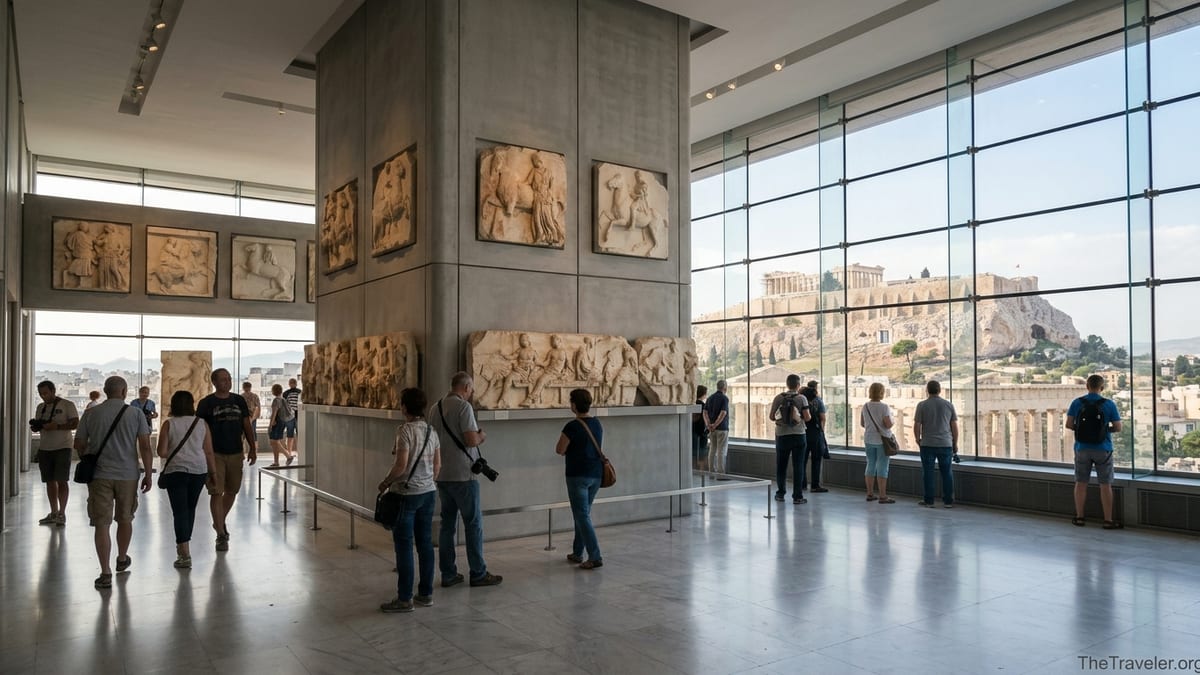
How the Parthenon Gallery Is Laid Out
The Parthenon Gallery crowns the Acropolis Museum in a large rectangular glass hall whose dimensions and orientation mirror the Parthenon itself. In practical terms, that means when you step out of the escalator on the third floor, you are instantly inside a full-scale outline of the temple. The central core represents the cella, while the perimeter of the gallery follows the footprint of the colonnade. The museum has used that footprint to rehang the surviving sculptures exactly where they originally belonged, only at eye level so visitors can read them without a crane.
Walk to the outer ring and you will see the metopes, the high-relief panels that originally stood above the outer colonnade, mounted on steel uprights. Behind them, just slightly lower, runs the continuous band of the Ionic frieze that once wrapped the top of the inner cella walls. Above the short ends of the core, the sculpted pediment figures are reconstructed, with originals, casts and neutral-toned fillers standing in for missing parts. It is a three-dimensional diagram that preserves the original sequence of the sculpture while creating a clear walking circuit for visitors.
The gallery’s glass walls are not just architectural flair. They bring in the same Attic light that still washes over the ruins on the Acropolis hill. On a clear morning, the sculptures are modeled by raking sunlight, while in the late afternoon they catch a warmer tone that gives the marbles a honeyed glow. For travelers used to dim European sculpture halls, the sensation of seeing these works in bright natural light, with the actual temple framed beyond, is one of the museum’s defining experiences.
In busy months like June and September, the Parthenon Gallery can feel crowded during the middle of the day. If you want the clearest sense of the layout, aim for the first hour after opening, when school groups have not yet arrived and you can walk the perimeter slowly. Many independent guides schedule their private tours so they reach this floor as soon as the museum opens for precisely that reason.
Reading the Sculptures: Metopes, Frieze and Pediments
The Parthenon’s sculptural program can be overwhelming at first glance, but the gallery is designed to help you decode it logically. Start with the metopes on the south and north sides, where violent mythological battles are carved in high relief. On the south side, for instance, you will notice muscular Lapith warriors wrestling with wild, rearing centaurs. One panel shows a centaur rearing back with a cloak swirling behind, while the human figure collapses beneath, a composition many visitors recognize from textbooks the moment they see it in person.
Move on to the west end and you find scenes of Greeks arming for battle, shields and helmets rendered with crisp detail. On the east, the metopes show the Olympian gods fighting giants. Although time and later damage have broken faces and limbs, the flowing drapery and deep undercutting retain a striking sense of energy. The museum labels below each metope give short, clear explanations in Greek and English, which makes it easy for travelers without an art history background to follow the narrative.
Behind the metopes runs the more subtle but equally important frieze. Unlike the mythic violence of the metopes, the frieze shows a civic procession, often interpreted as the Panathenaic festival in honor of Athena. Look closely and you will see horsemen adjusting their cloaks, chariots rolling forward, elders walking in deliberately calm steps, musicians carrying flutes and lyres, and young girls with folded cloth. At the east side, just above what would have been the entrance to the cella, a quiet central scene appears to show a sacred garment being presented, a moment some scholars read as the ritual heart of the festival.
The pediments, re-created at the short ends of the hall, fill in the grand stories that framed the temple. One end depicts the birth of Athena from the head of Zeus; the other shows her contest with Poseidon for the patronage of Attica. In the Acropolis Museum you mostly see fragments of these once-crowded compositions: a reclining river god with rippling torso, draped figures leaning in animated conversation, and a few powerful horses’ heads pulling a chariot into view. Replicas, tinted slightly different from the originals, complete the missing silhouettes to help you imagine the overall scenes.
Understanding the Frieze Layout in the Gallery
One of the Parthenon Gallery’s quiet achievements is that it restores the frieze to a readable sequence. In many older publications the blocks are shown as isolated plates, which makes it hard to grasp the movement of the procession. Here, the curators have followed the original order of the blocks as far as surviving evidence allows, mounting them on the inner core so that, as you walk around, you follow the ancient Athenians on their ceremonial route.
Begin on the northwest corner of the core, where riders are just mounting their horses. Turn south and you move along lines of cavalry gaining pace, horses tossing their heads and hooves overlapping in a tightly packed rhythm. By the time you reach the middle of the south side, the procession has expanded to include chariots and sacrifice scenes. The museum’s descriptive panels point out details that are easy to miss, like a groom calming an anxious horse by gripping its bridle or a youth trying to steady a skittish animal at the last moment.
Continue around the east side and the composition calms. Here, the figures are mostly standing, forming small groups in low relief. If you stand back a few meters and let your eye run along the band, the effect is like a continuous film strip of ancient Athenians waiting for the climactic ritual. This is also where you will notice breaks in the original marble. Where blocks are missing, the museum uses plaster casts from pieces in London, Paris and other collections, and leaves blank panels where neither originals nor casts exist. For many visitors this is the first visceral realization that the Parthenon is a puzzle of scattered fragments rather than a single intact masterpiece.
Audio guides and some third-party tour apps sold in Athens, usually priced around 5 to 10 euros, now include specific commentary keyed to the layout of the frieze in this gallery. They often suggest stopping at particular blocks, such as a panel showing a youth trying to control a restless horse or another where a small dog trots beneath the procession, details that might otherwise slip by you in the dense visual narrative.
The Views: Seeing the Parthenon While Standing Inside It
What distinguishes the Acropolis Museum’s Parthenon Gallery from almost any other sculpture hall is the direct visual relationship with the monument itself. From the north side windows, the Parthenon rises above you on the Acropolis hill at roughly the same axis as the reconstructed temple footprint under your feet. On a clear day, you can stand beside a metope that once crowned the north façade and look straight out to the ruined colonnade where it originally stood, just a few hundred meters away.
This sightline is not accidental. The architects oriented the gallery so its long axis runs parallel to the Parthenon’s, with floor-to-ceiling glass on all four sides to keep the ruins constantly in view. Travelers often describe a strong sense of connection when they realize that a frieze block in front of them, now at eye level, used to be more than ten meters above ground, exposed to wind and weather. Seeing the worn edges and bullet scars in bright daylight, while the current Parthenon looms beyond, drives home how much history these stones have absorbed.
For photographers, the best vantage points tend to be along the north and east sides in the late afternoon, when the sun sits behind the museum and illuminates the Acropolis hill without harsh glare on the glass. Many visitors instinctively walk up close to the windows, but if you step back toward the inner core you can frame both the sculptures and the hilltop temple in a single wide shot. Museum staff generally allow discreet photography without flash in this gallery, though tripods are not permitted, so a fast lens and steady hand help in lower light.
Weather changes the mood. On hazy summer days, the hill and museum blend into a pale band of stone and sky. In winter, after rain has cleared the air, every column drum and scaffolding pipe on the Acropolis stands out sharply, rendering the contrast between ruin and reconstruction even more dramatic. If you are visiting Athens for several days, consider coming to the museum once during the bright midday heat and again on a quieter morning or evening to experience how the relationship between gallery and Parthenon shifts with the light.
The Missing Marbles: Where They Are and Why It Matters
No visit to the Parthenon Gallery is complete without confronting the empty spaces. Roughly half of the surviving Parthenon sculptures are in the Acropolis Museum, while many of the others, removed in the early nineteenth century by agents of Lord Elgin under Ottoman rule, are now in the British Museum in London. Smaller fragments are scattered across Europe, including pieces in the Louvre and Vatican Museums. In the Acropolis Museum, casts from these collections are used where possible, their slightly different surface tone and texture making it clear which elements are original and which are reproductions.
The absence becomes especially visible on the west and north sides of the frieze, where small white plaster sections alternate with weathered Pentelic marble. Visitors often notice labels noting that the originals of particular blocks are “in London” or “in Paris.” For many, this is the moment when the long-running debate over the so-called Elgin or Parthenon Marbles shifts from an abstract news story to a tangible experience. You can look out at the Parthenon, glance back at a gap in the sequence, and understand that part of the story is physically missing from Athens.
The controversy turns on questions of legality, ethics and conservation. Supporters of return argue that the marbles were taken under dubious permissions from an occupying power and that the purpose-built Acropolis Museum now offers ideal conditions for their care. Advocates for keeping them in London emphasize the British Museum’s role as a world collection, where the sculptures sit in conversation with artifacts from Egypt and the Near East. The Acropolis Museum does not attempt to settle the argument in didactic panels, but by presenting the surviving works in their original sequence, with visible absences, it invites visitors to draw their own conclusions.
In recent years, informal discussions between Greek officials and representatives of the British Museum have periodically made headlines, often raising visitor expectations that a compromise may emerge, such as a long-term loan or rotating displays. When you stand in the Parthenon Gallery and see how seamlessly the missing pieces would slot back into this glass-walled space with the ancient temple in view, it becomes clear why the gallery has become a symbolic stage for the broader debate over restitution.
Planning Your Visit: Tickets, Timing and Practical Tips
The Acropolis Museum operates on a timed ticket system during peak months, and visiting both the hilltop Acropolis and the museum on the same day is a common choice for travelers. Many people start early at the Parthenon itself, then walk down the gentle slope along Dionysiou Areopagitou Street to reach the museum, arriving by late morning. Standard museum admission is typically in the low teens in euros for adults, with reduced prices for EU students and seniors, and slightly lower off-season rates. Combination tickets covering both the archaeological site and museum are sometimes available through tour operators, though you should check current details at the time of booking.
Inside the museum, give yourself at least 60 to 90 minutes for the Parthenon Gallery alone if you are interested in understanding the narrative in depth. Travelers on tight schedules often try to see the entire museum in an hour; in practice that usually means a quick pass through the ground-floor finds and Archaic sculptures, followed by a focused visit to the Parthenon floor. If you are visiting with children, some families find it helpful to pick specific “missions” such as spotting all the horses on the frieze or finding a particular centaur, which keeps younger visitors engaged in what can feel like a dense series of reliefs.
Facilities are modern and traveler friendly. There is a café-restaurant on an upper level with a generous terrace that also frames the Acropolis, making it a pleasant spot for a coffee or light lunch before or after you explore the Parthenon Gallery. The museum shop just off the exit offers detailed guidebooks devoted specifically to the Parthenon sculptures, along with pocket-sized foldout diagrams of the frieze layout that many visitors find useful to reference while walking the gallery. Audio guides, when available, can be rented in the lobby for a modest fee and typically include a dedicated Parthenon section.
To avoid crowds, consider visiting on a weekday late afternoon outside the core summer holidays, when many organized tour groups have already departed. Security checks at the entrance are similar to those at other major European museums, and liquids above a small volume are usually not allowed, so plan to finish large water bottles before reaching the scanners. Photography rules can change, but at the time of writing personal photography without flash is generally tolerated on the Parthenon floor; always check the posted signage or ask a guard if in doubt.
Why This Gallery Matters for Understanding the Parthenon
Standing on the Acropolis plateau, the Parthenon is a powerful but distant object. You see rows of columns and fragments of sculpture high overhead, yet the building remains largely abstract, wrapped in scaffolding and protected zones. The Parthenon Gallery bridges that distance by letting you walk around the temple at ground level, eye to eye with the carvings. It turns an iconic ruin into a legible story about Athenian identity, religious practice and artistic ambition in the fifth century BCE.
For travelers, this matters because it reshapes the entire experience of visiting the Acropolis. Many visitors who see the temple first and the museum later report that they understood the monument only in hindsight. Those who reverse the order, starting with the gallery and then climbing to the hill, often find themselves mentally reassembling the building as they walk around it, imagining where each metope and frieze block once belonged. In that sense, the Parthenon Gallery functions as a kind of user manual for the ancient site, one that enriches every later photograph and memory.
The gallery also sits at the intersection of several contemporary conversations: about cultural heritage, the ethics of collecting, and the role of national museums in a globalized world. By presenting original sculptures, casts and absences side by side, the Acropolis Museum quietly emphasizes continuity between past and present. It reminds visitors that monuments are not static relics but contested, lived-in symbols whose meanings continue to evolve. Whether or not you have strong opinions about restitution before you visit, you are likely to leave with a more nuanced sense of what is at stake.
Ultimately, the power of the Parthenon Gallery lies in its combination of precision and emotion. Everything about the space, from the measured alignment of the walls to the wash of natural light, is designed to echo the original building without pretending to rebuild it. The result is a room where you can feel both the loss and survival of the Parthenon at the same time, surrounded by Athenians carved in stone, with the living city stretching out below.
The Takeaway
The Acropolis Museum’s Parthenon Gallery is more than just the final stop on a museum circuit. It is the place where Athens presents its argument about what the Parthenon was, what it became and what it still means today. By aligning the gallery to the temple, carefully rehanging the sculptures in their original positions and leaving visible gaps where pieces are missing, the museum offers visitors a clear, thoughtful way to engage with a monument that has shaped Western ideas of beauty and democracy for centuries.
For travelers planning a trip to Athens, setting aside unhurried time in this gallery is one of the most rewarding cultural investments you can make. Whether you arrive after a sunbaked morning on the Acropolis or slip in during a hot afternoon to cool off in the air-conditioned light, the experience of walking the glass hall, following the frieze procession and looking out at the ruined temple will likely stay with you long after your ticket has been recycled. The Parthenon itself may be a fragmentary survivor, but in this room, its story is told with clarity, care and a view toward the future.
FAQ
Q1. Where is the Parthenon Gallery located inside the Acropolis Museum?
The Parthenon Gallery occupies the entire third floor of the Acropolis Museum, in a large glass hall aligned with the Parthenon on the Acropolis hill.
Q2. How much time should I allow to visit the Parthenon Gallery?
Most visitors find that 60 to 90 minutes is enough to walk the perimeter, read key labels and spend time with the most important metopes and frieze blocks.
Q3. Can I see the actual Parthenon from inside the gallery?
Yes. From the north side windows you have a direct view of the Parthenon on the Acropolis, visible across a short distance at roughly the same axis as the gallery.
Q4. Are all of the original Parthenon sculptures in the Acropolis Museum?
No. About half of the surviving sculptures are in Athens, while many others are in the British Museum in London and a few fragments are in other European collections.
Q5. How can I tell which pieces in the gallery are originals and which are casts?
Originals are carved in warm-toned Pentelic marble, while casts are slightly different in color and texture. Museum labels also note when a piece is a copy of a work held elsewhere.
Q6. Is photography allowed in the Parthenon Gallery?
Personal photography without flash is generally permitted, but rules can change. Always check the posted signs or ask a museum attendant before taking pictures.
Q7. Should I visit the Acropolis or the museum first?
Both orders work, but many travelers prefer to see the museum first so they can understand the sculptures and layout, then visit the Parthenon with that context in mind.
Q8. Do I need a guided tour to appreciate the Parthenon Gallery?
A guide is helpful but not essential. The gallery’s labels are clear, and inexpensive audio or app-based guides can provide additional context at your own pace.
Q9. Why are some parts of the frieze missing or replaced by blank panels?
Some sections were destroyed over time, while others are in museums elsewhere. The Acropolis Museum leaves gaps or uses casts to show how the original sequence once ran continuously.
Q10. Is the Parthenon Gallery suitable for children and non-specialists?
Yes. The clear layout, natural light and vivid scenes of horses, battles and processions make the gallery engaging even for visitors with no background in ancient art.