


More news on this day
Hundreds of passengers transiting the United Arab Emirates have faced renewed disruption after Air Arabia cancelled a cluster of key flights at Sharjah International Airport, affecting links to Moscow, Cairo, Alexandria, Kuwait City, and Bahrain and leaving many travelers stranded or scrambling for alternative routes.
Get the latest news straight to your inbox!
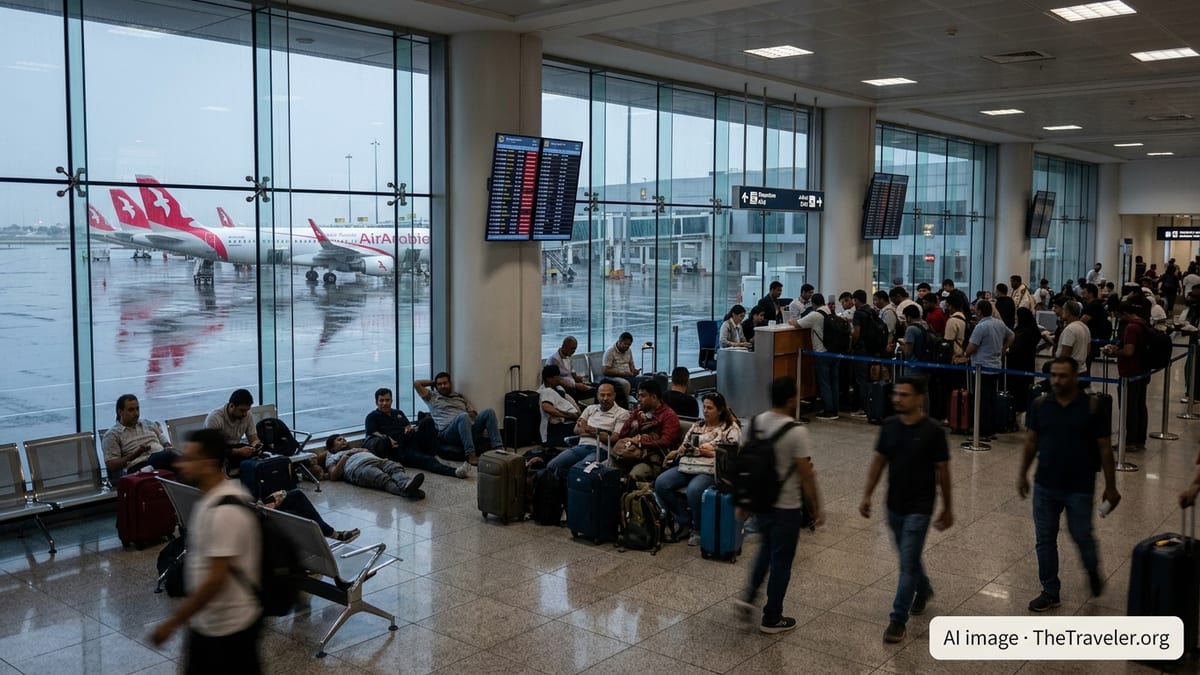
What Happened At Sharjah Airport
Operational data and flight-tracking platforms show that Air Arabia has recently withdrawn or scrubbed several departures and arrivals touching Sharjah, including services on routes connecting to Moscow, Cairo, Alexandria, Kuwait City, and Bahrain. These cuts come on top of a wider pattern of irregular operations in the Gulf, where a mix of airspace restrictions, staffing constraints, and ground-handling bottlenecks has periodically disrupted traffic at regional hubs.
Reports indicate that at least five Air Arabia flights linked to Sharjah and these cities were cancelled within a short time frame, compounding earlier waves of disruption that had already tested the airline’s network resilience. Passengers arriving to connect onward, as well as those originating in the UAE, have described long waits in terminal areas and uncertainty over when replacement services would become available.
Publicly available information from route-monitoring services and passenger accounts suggests that the cancellations did not follow a single clear pattern such as bad weather or a single airport closure. Instead, they appear to be part of an ongoing series of tactical schedule changes affecting parts of Air Arabia’s Gulf and Middle East network as carriers continue to navigate a volatile operating environment.
The resulting disruption at Sharjah, one of Air Arabia’s main bases, has had a disproportionate impact on travelers relying on the carrier’s extensive point to point network to reach Russia, Egypt, and neighboring Gulf states.
Routes Hit: Moscow, Cairo, Alexandria, Kuwait City, Bahrain
The latest cancellations have centered on routes that are particularly important for migrant workers, family visitors, and price sensitive leisure travelers. Services between Sharjah and Moscow have been a key link for Russian travelers heading to the UAE and beyond, and tracking platforms in recent days have registered multiple adjustments and at least one outright cancellation on this sector.
Cairo and Alexandria are among Air Arabia’s busiest regional destinations, serving a large Egyptian expatriate community working in the Gulf. According to published coverage of recent disruptions, these Egyptian routes have already experienced rotations being retimed or dropped on short notice during earlier airspace-related turbulence, and the latest cancellations have further unsettled travel plans for those who rely on overnight or early morning departures to make tight connections.
Links to Kuwait City and Bahrain, meanwhile, are critical short-haul hops within the Gulf, used heavily for weekend trips, business shuttles, and onward long-haul connections operated by other carriers. Travel industry reports note that Bahrain and Kuwait have repeatedly appeared in recent cancellation and delay tallies across several airlines, and the removal of yet more Sharjah based services has added to the sense of fragility around these corridors.
While the number of flights involved in this latest cluster is modest compared with the airline’s overall schedule, the concentration on high-demand routes means the practical impact for affected passengers has been significant, especially where same day alternatives were limited or already full.
Knock On Effects For Passengers And The Region
The cancellations at Sharjah have created a cascade of problems for travelers, particularly those on multi leg itineraries or using separate tickets. When an initial segment into Sharjah is delayed or cancelled, onward flights to destinations such as Moscow or Alexandria may be missed entirely, with passengers forced to purchase last minute alternatives or wait for the next available departure.
Recent analytical coverage of operations at Dubai and Sharjah highlighted that even a small number of cancellations can trigger extensive secondary disruption, as aircraft and crew rosters are repositioned and later rotations depart behind schedule. When combined with airspace restrictions affecting some regional routes, these knock-on effects can stretch over several days, meaning that travelers booked well after the original incident may still encounter delays or rebookings.
Stranded passengers have also faced challenges securing accommodation, meals, and clear information. Consumer forums and social media posts describe confusion at boarding gates and check-in counters when flights were first marked as delayed and then later removed from departure boards. In some cases, travelers report receiving email or app notifications only shortly before scheduled departure, leaving little time to adjust ground transport or visa arrangements.
For the wider region, disruptions on these Sharjah based routes further complicate already strained travel flows. Previous episodes of cancellations across Gulf hubs have shown that when one low cost carrier reduces capacity, demand often spills over onto neighboring airports and rival airlines, pushing up fares and limiting availability for days or weeks.
How Air Arabia Handles Cancellations
According to information published on Air Arabia’s own channels, the airline typically aims to notify passengers of delays and cancellations using email and SMS when contact details are available and time permits. Travelers are advised to monitor the carrier’s flight status tools and mobile app, which display live departure and arrival information and highlight flights that have been cancelled or significantly retimed.
The airline’s published conditions of carriage outline options that may be offered when a flight is cancelled, including rebooking on the next available service, credit vouchers, or refunds in certain cases. However, passenger advocacy organizations and recent case studies have pointed out that the practical experience can vary, particularly during large scale disruptions when call centers and airport desks are under heavy pressure.
Reports shared on consumer platforms over recent months suggest that some Air Arabia customers affected by cancellations have experienced delays in obtaining refunds or have been encouraged to accept travel credits instead of cash. Others describe difficulties securing written confirmation of cancellations needed to pursue compensation under local or international passenger rights rules when applicable.
It is important to note that the exact remedies available to a given traveler depend on the origin and destination of the flight, the jurisdiction whose passenger protection rules apply, and whether the disruption is deemed within the airline’s control. In the case of services touching Sharjah and nearby Gulf points, national regulations and the airline’s own policies generally frame what support is provided.
What Travelers Can Do Now
For passengers booked on upcoming Air Arabia services to or from Moscow, Cairo, Alexandria, Kuwait City, or Bahrain, travel industry guidance suggests adopting a proactive approach. Checking flight status repeatedly in the 24 hours before departure using official channels can provide early warning of schedule changes, and signing up for SMS or app alerts can help ensure that notifications arrive as soon as they are issued.
Experts in passenger rights recommend that travelers keep all documentation related to their trip, including booking confirmations, boarding passes for completed segments, and any written notices of cancellations or delays. These records can be important when requesting refunds, seeking rebooking on alternative dates, or pursuing compensation where frameworks such as European or UK passenger regulations may be relevant because of the itinerary’s endpoints.
Passengers already stranded in Sharjah or at outstations are generally advised by consumer groups to contact the airline through multiple channels, such as airport service desks, official call centers, and digital chat tools, while also monitoring departure boards for ad hoc recovery flights. In cases where overnight stays become necessary, receipts for hotels, meals, and ground transport should be retained in case reimbursement is later offered.
Given the ongoing volatility in the region’s airspace and the possibility of further last minute adjustments, travelers planning connections through Sharjah may also wish to build in longer layovers, avoid separate tickets where possible, and consider fully flexible or refundable fares on at least one leg of the journey. While such measures cannot eliminate the risk of disruption, they can provide more options if another wave of cancellations affects these key routes again.