


More news on this day
Travelers in northern Quebec’s Nunavik region faced hours of uncertainty after reports indicated that four Air Inuit flights serving Kangirsuk Airport were grounded, disrupting connections to Quaqtaq, Kuujjuaq and other remote communities that rely heavily on the carrier’s limited schedule.
Get the latest news straight to your inbox!
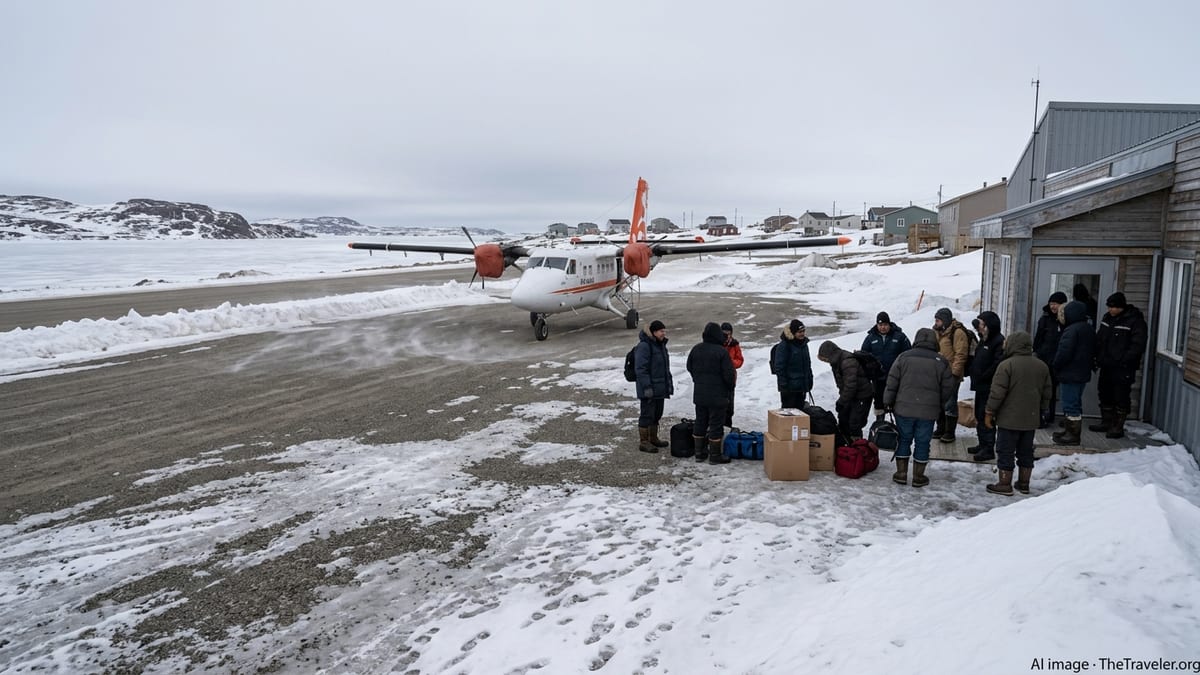
Grounded Flights Spark Anxiety at Small Arctic Airport
The disruption at Kangirsuk Airport occurred along one of Air Inuit’s key regional corridors, where a small number of daily flights typically connect the community with Kuujjuaq, Quaqtaq and other Nunavik villages. Publicly available timetables show that these routes are often operated by De Havilland turboprops with short turnaround times, leaving little margin when irregular operations occur.
With four services reportedly grounded in quick succession, passengers at Kangirsuk described a scene of growing frustration as departure boards remained static and aircraft did not appear on the gravel runway. Travel forums and schedule trackers indicated that flights linking Kangirsuk with Kuujjuaq and Aupaluk were among those affected, compounding delays for travelers with onward medical, educational and work commitments in larger hubs.
Unlike major southern airports that can absorb disruptions by rerouting travelers, Kangirsuk’s role as a small community aerodrome means that even a handful of cancellations can leave passengers with no immediate alternatives. The airport primarily serves as a lifeline for residents of Nunavik, and irregular operations can rapidly translate into missed connections in Kuujjuaq and limited access to essential services farther south.
As the grounded flights extended through the day, travelers faced uncertainty over when they would be able to leave or arrive, with some turning to online tools to monitor changing schedules and search for available seats on later departures.
Key Regional Links to Quaqtaq and Kuujjuaq Disrupted
Air Inuit’s network positions Kangirsuk as an important node in eastern Nunavik, with published route maps highlighting regular links to Quaqtaq and Kuujjuaq. These airports form part of a chain of remote communities across northern Quebec, where most travel between villages and to southern Canada depends on a small number of regional flights.
Timetable data from multiple aviation platforms shows that flights between Kangirsuk and Kuujjuaq often operate several times a week, with additional services connecting Kangirsuk and Quaqtaq. When four flights on this circuit are grounded, the ripple effect can extend beyond the immediate departures, tightening capacity on subsequent days and forcing rebooked passengers to compete for scarce seats.
According to publicly accessible schedule aggregators, travelers use Kuujjuaq as a major connecting point for onward services to Quebec City and Montreal. Any interruption in feeder traffic from Kangirsuk and Quaqtaq can therefore affect not only local residents but also visitors, contractors and government staff moving between Nunavik and the south.
Observers note that in regions where road connections between communities do not exist, regional carriers effectively function as both an airline and a critical element of public infrastructure. The grounding of several flights in a single day at a hub like Kangirsuk underscores how sensitive the system is to even short-lived operational issues.
Passengers Report Long waits, Limited Options and Rising Costs
Posts on travel discussion boards and social platforms described passengers in Kangirsuk and connecting airports waiting for updates while monitoring online flight trackers that showed repeated schedule changes. Some reported concerns about running out of necessary medications, missing specialist medical appointments, or incurring unexpected accommodation and meal costs while stranded.
The situation highlighted the financial strain that irregular operations can impose on travelers in remote regions. While major carriers serving large hubs may offer more flexibility, options in Nunavik are comparatively limited. Weather-related delays, crew availability and aircraft positioning can all affect a small fleet, and once several flights are grounded, rebooking may not be possible on the same day.
Travelers also face challenges in adjusting ground arrangements at their final destination. Missed connections in Kuujjuaq or Quebec City can lead to cascading expenses for hotels, ground transport and reissued tickets on other airlines. In some cases, passengers relying on fixed-income support or employer-funded travel budgets have little room to absorb such unexpected costs.
Advocacy groups and local commentators have periodically called attention to the vulnerability of air-dependent communities to sudden schedule disruptions, emphasizing the need for clearer communication, contingency planning and support mechanisms when multiple flights are grounded at once.
Weather, Operational Constraints and Arctic Infrastructure Pressures
While the precise triggers for the grounded Air Inuit flights at Kangirsuk were not immediately evident from public data, aviation observers routinely point to a combination of factors that frequently affect northern operations. These can include fast-changing Arctic weather, limited daylight during parts of the year, maintenance requirements on small fleets and staffing constraints in specialized roles.
Environment and climate records for Arctic and sub-Arctic airports show that strong winds, turbulence, blowing snow and poor visibility are recurring challenges. Such conditions can force airlines to cancel or consolidate flights, particularly at smaller gravel-strip airports where landing and takeoff margins are narrower than at major paved runways in the south.
In addition to weather, infrastructure and regulatory constraints play a role. Many Nunavik airports have modest terminal facilities and limited refueling or de-icing capacity, which can slow down recovery efforts after disruptions. Regional reports on northern transportation also describe ongoing coordination between local authorities, federal agencies and carriers on issues such as fuel management, safety procedures and seasonal infrastructure upgrades.
Air Inuit’s public information emphasizes its long-standing role in serving Nunavik communities with specialized equipment and expertise. However, the recent grounding episode at Kangirsuk illustrates how even experienced northern operators can face cascading operational challenges when conditions converge against a tight schedule.
Calls for More Resilient and Passenger-Focused Northern Air Service
The events at Kangirsuk Airport have reignited discussion about how to strengthen the resilience of air service across Nunavik. Commentators following northern transportation issues suggest a range of possible measures, from increased backup capacity during peak travel periods to improved passenger communication tools that provide real-time updates in multiple languages.
Some observers argue that better coordination between airlines, regional governments and community organizations could help mitigate the impact of sudden groundings. Proposals include pre-arranged emergency accommodation options, streamlined rebooking protocols and clearer information for passengers about their rights and available support when flights are canceled or significantly delayed.
The experience has also underscored the importance of digital connectivity for travelers in remote regions. Passengers at Kangirsuk and other small airports often depend on mobile devices to access flight-status pages, airline apps and third-party trackers when terminal announcements are limited. Ensuring reliable connectivity at these facilities is increasingly seen as part of basic travel infrastructure.
As Air Inuit and regional stakeholders assess the latest disruptions, many residents and travelers are watching closely to see what adjustments might be made ahead of future peak travel periods. For communities that rely almost entirely on air links for medical care, education, food supplies and family visits, the stability of airline operations remains a central concern and a defining factor in the overall travel experience across Nunavik.