


More news on this day
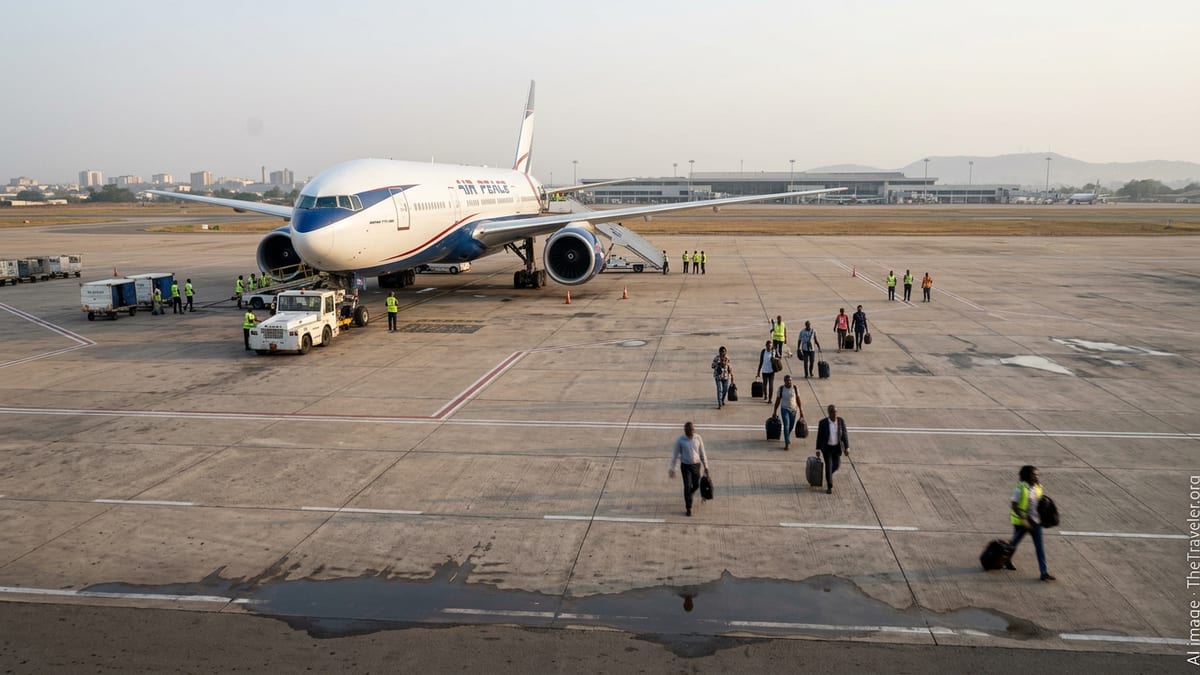
Nigeria’s largest domestic carrier, Air Peace, is disputing a widely circulated August 2026 flight disruption scorecard attributed to the Nigeria Civil Aviation Authority (NCAA), arguing that the regulator’s dataset undercounted its operated flights and overstated its delay profile because of data and methodology gaps.
Get the latest news straight to your inbox!
What the NCAA’s August scorecard reported
Published coverage indicates the NCAA released a “Summary of Domestic Airline Flight Disruption Operations” for August 2026, tallying 7,961 domestic flights across 15 carriers. Of those, 4,765 flights were recorded as delayed and 36 as cancelled, implying that a large share of domestic operations did not run on schedule during the month.
Within the carrier-by-carrier figures reported by multiple Nigerian outlets, Air Peace was listed with 1,864 flights for August, alongside 1,330 delays and seven cancellations. Separate reporting also included a delay-duration breakdown for the airline’s entries in the NCAA table, with the largest share in the 16 minutes to one hour range, followed by one to two hours, two to three hours, and three hours or more.
The same scorecard put United Nigeria Airlines among the highest-disruption operators by delay counts, with other carriers such as Enugu Air and ValueJet also featuring prominently. For travelers, the overall picture suggested a month of network-wide operational strain rather than isolated issues affecting only one airline.
Air Peace’s rebuttal centers on flight-count discrepancies
In a statement reported on September 17, 2026, Air Peace said it operated 2,564 flights in August, compared with the 1,864 flights reflected for the airline in the NCAA’s published table. The carrier said the gap of more than 700 flights is material because it can change the denominator used to interpret performance, including the implied delay rate when readers convert raw delay counts into percentages.
Air Peace also argued that the regulator’s summary did not separate airline-attributable delays from disruptions driven by external constraints, a distinction the airline says is essential for passengers trying to understand why schedules slip in Nigeria’s domestic market.
The airline’s response also pointed to timing and completeness. Coverage of the statement indicates Air Peace questioned why a monthly table surfaced quickly for August but was not paired with comparable public reporting for July, and why major operational events that shaped August flying were not clearly reflected in the way the data was presented to the public.
External disruptions cited: congestion, weather, industrial action, and bird strikes
Air Peace’s statement, as described in published reporting, attributed much of August’s disruption profile to factors outside the airline’s direct control. These included airport congestion and traffic management constraints, adverse weather, and airport infrastructure limitations that can cascade through flight rotations even when an initial delay begins elsewhere in the system.
Industrial action was highlighted as a key shock. Air Peace said an aviation-union disruption that began on August 11 affected its operations for more than 14 days, creating rescheduling and knock-on delays that did not stay confined to the specific days of the action. That kind of operational whiplash can be especially severe for high-frequency domestic networks where aircraft are scheduled for multiple short sectors daily.
The airline also cited a bird strike incident involving an aircraft identified in coverage as 5N-BYG in Abuja. Air Peace said the strike damaged a key component beyond acceptable limits and required repairs costing about $1.8 million, leading to the aircraft being removed from service for more than a week. According to the airline, the aircraft typically operated at least eight sectors per day and carried roughly 1,000 passengers daily, meaning its absence would have amplified schedule stress across multiple routes.
What this dispute means for passengers and the wider market
For travelers, the immediate takeaway is that published delay scorecards can be interpreted in more than one way. A table that reports delays and cancellations offers a snapshot of reliability, but it may not fully explain causation, such as whether delays were driven by airline processes, airport constraints, or network disruptions that spill over from earlier events.
At the same time, the NCAA’s summary provides a rare system-wide view of how widespread disruptions were across Nigeria’s domestic market in August. Even if individual airlines dispute the precision of the figures, the aggregate totals reported by multiple outlets still point to persistent timetable pressure, with thousands of delayed departures affecting passenger connections, ground transport plans, and business schedules.
The dispute also underscores a recurring consumer problem: passengers tend to experience delays as a single outcome, regardless of cause. Air Peace’s call for clearer categorization of delay drivers raises the prospect that future monthly reporting could evolve toward more granular definitions, potentially differentiating delays attributable to an airline’s operations from those linked to airfield congestion, weather, infrastructure, or labor disruptions.
As of the latest published coverage, the NCAA had not publicly addressed Air Peace’s specific discrepancy claims about flight totals. In the meantime, the airline says it remains focused on reducing delays within its control, while arguing that broader improvements require coordinated action across airports, air traffic management, and sector infrastructure.