


More news on this day
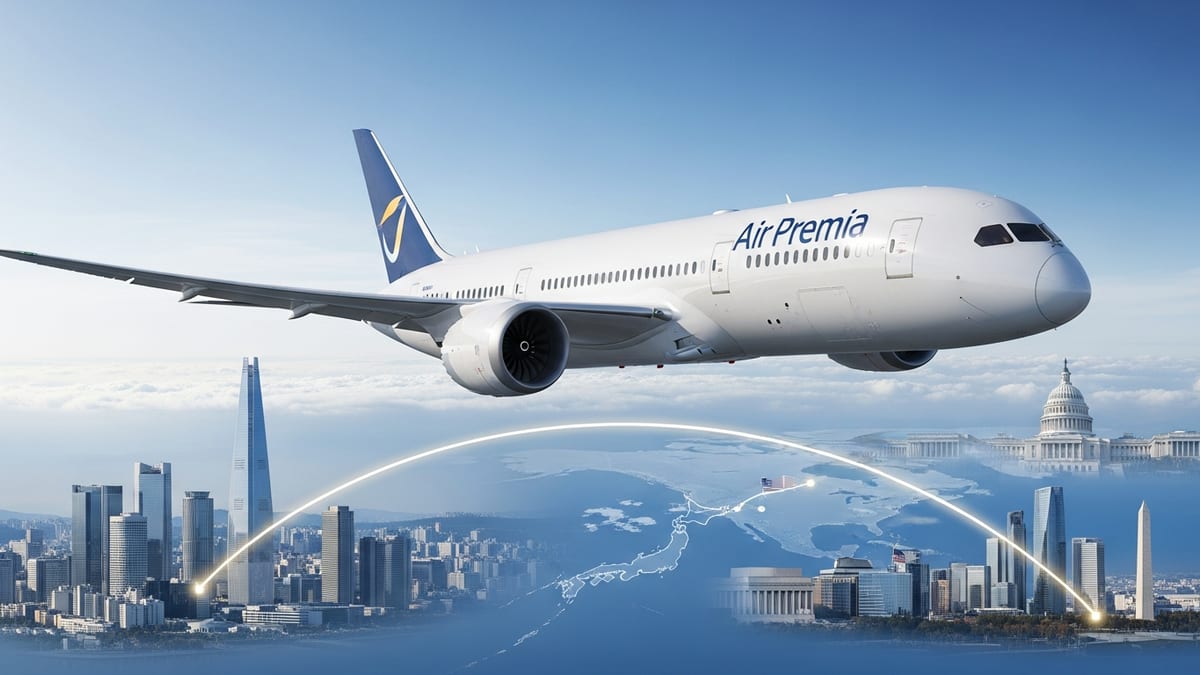
South Korean hybrid carrier Air Premia and low-cost giant Jeju Air are deepening their interline partnership, creating more seamless one-ticket connections between the United States and a wider web of Asian destinations at a moment of rapid change in transpacific travel.
Get the latest news straight to your inbox!
A New Layer of Connectivity Between U.S. Gateways and Asia
According to Air Premia’s latest announcement, the expanded interline agreement allows passengers flying the carrier’s long-haul routes from major U.S. cities to connect onto Jeju Air-operated services across South Korea and wider Asia on a single itinerary. Publicly available information shows that Air Premia currently links Seoul Incheon with U.S. gateways including Los Angeles, San Francisco, Honolulu, Newark and the Washington, D.C. area, positioning the airline as a growing player in the Korea–U.S. market.
Jeju Air, widely described in industry materials as South Korea’s largest low-cost carrier, brings a dense short- and medium-haul network into the partnership. Its schedule includes key domestic routes such as Seoul–Jeju and regional services across Northeast and Southeast Asia. By combining Air Premia’s long-haul reach with Jeju Air’s regional footprint, the interline deal effectively knits together secondary and leisure destinations with major U.S. hubs via a single connection at Incheon.
Reports indicate that travelers will be able to check in once, through-check baggage and receive boarding passes for both carriers when booked on an interline itinerary. While detailed pricing and fare structures are not disclosed, the model is designed to undercut traditional full-service fares on many city pairs while avoiding the inconvenience of separate tickets, re-checking bags or re-clearing immigration during transit.
The timing is notable as consolidation among larger legacy airlines reshapes capacity on some transpacific routes. Industry analysis suggests that mid-sized and low-cost operators are seeking to capture demand on city pairs that no longer support nonstop service, using interline and virtual network strategies to fill gaps left by mergers and fleet restructuring.
How the Interline Partnership Works in Practice
In practical terms, the expanded partnership means that a passenger flying from a U.S. city such as Los Angeles or Newark on Air Premia can connect in Seoul to Jeju Air flights bound for domestic destinations like Busan or Jeju, or to regional cities in Japan, China and Southeast Asia, all under a single reservation. The itinerary can be ticketed by either carrier or through travel agencies connected to global distribution systems that list the interline agreement.
Interline cooperation typically covers coordinated baggage handling, minimum connection times and the ability to rebook passengers during irregular operations. While the Air Premia–Jeju Air arrangement stops short of full codesharing or alliance membership, it provides many of the customer-facing benefits that leisure and small-business travelers value, including simplified disruption handling when connections are missed or delayed.
From an operational perspective, Seoul Incheon Airport serves as the primary transfer point. Air Premia’s long-haul flights use widebody aircraft suited for transpacific sectors, while Jeju Air’s narrowbody fleet operates high-frequency regional and domestic services. Industry observers note that the combined schedules can create multiple daily connection opportunities on heavily traveled flows such as U.S.–Seoul–Okinawa or U.S.–Seoul–Danang, alongside niche city pairs that have never supported nonstop flights.
The carriers are also expected to leverage shared digital tools over time, such as aligned online check-in for interline itineraries and clearer display of through-fare options in booking engines. For now, published information emphasizes the core travel benefits of single-ticket journeys, rather than deeper integration such as shared loyalty programs.
Part of a Wider Interline Strategy for Air Premia
The Jeju Air partnership is the latest in a series of interline deals Air Premia has pursued to expand its virtual network on both sides of the Pacific. Recent announcements describe similar arrangements with Southwest Airlines in the United States, allowing passengers arriving on Air Premia’s transpacific flights to connect to more than one hundred domestic and near-international destinations under a single booking.
Earlier steps in this strategy included interline agreements with Korean Air for onward connections from Incheon to cities across Asia, as well as cooperation with Alaska Airlines for additional U.S. domestic reach. Publicly available corporate materials frame these deals as a way to combine Air Premia’s long-haul strength with partners’ short- and medium-haul networks, building a web of connectivity without the complexity of joining a global alliance.
Analysts point out that this approach is particularly suited to a hybrid carrier model. Air Premia positions itself between traditional low-cost and full-service airlines, offering relatively spacious seating and inclusive services at price points that can undercut legacy competitors on many routes. Interline partnerships then extend the carrier’s appeal by making it easier for travelers to reach secondary cities without sacrificing price or comfort.
For Jeju Air, the deal with Air Premia complements its own evolving partnerships. The low-cost airline has developed interline and codeshare relationships with a number of global carriers and has been active in regional alliances that connect budget airlines across Asia. The Air Premia tie-up represents a way to tap long-haul demand to and from North America without acquiring widebody aircraft.
Implications for U.S. Travelers and Competitive Dynamics
For travelers in the United States, the expanded interline partnership opens new one-stop options to reach secondary destinations in Korea and Asia via Seoul. Instead of flying nonstop solely to major hubs and then purchasing a separate low-cost ticket onward, passengers can now buy a single itinerary that covers both the transpacific leg and the regional sector, with baggage and connection protections built in.
This could be particularly attractive for price-sensitive leisure travelers heading to resort destinations such as Jeju Island, or to emerging beach and cultural destinations in Southeast Asia that are heavily served by Jeju Air. Small and medium-sized businesses with ties to manufacturing hubs in countries like Vietnam or the Philippines may also see value in new one-stop combinations that were previously costly or complex to book.
The move adds further competition to a transpacific marketplace already being reshaped by new entrants and shifting capacity. As major network carriers adjust their schedules following mergers and regulatory remedies, smaller airlines are stepping in to claim traffic on routes and via hubs that may have been underserved. The Air Premia–Jeju Air partnership strengthens Seoul’s role as a connecting hub between North America and Asia at a time when travelers are increasingly willing to mix and match carriers.
Industry commentary suggests that the success of this model will hinge on execution: maintaining reliable on-time performance, ensuring smooth baggage transfers and making interline fares easy to find across online travel agencies and corporate booking tools. If those elements align, the partnership could help normalize the idea that U.S.–Asia journeys need not rely exclusively on the largest legacy airlines or alliance-based itineraries.
A Test Case for Hybrid and Low-Cost Cooperation
Observers are watching the Air Premia–Jeju Air collaboration as a test case for how hybrid and low-cost airlines can cooperate across long-haul and regional networks. Unlike traditional alliance structures, which are often centered on full-service flag carriers, this model relies on leaner cost bases and unbundled or semi-bundled service offerings to generate competitive fares.
If the partnership gains traction, it may encourage similar link-ups between long-haul operators and low-cost carriers elsewhere in Asia and beyond. Markets such as Europe–Southeast Asia and North America–South Pacific could see more hybrid network solutions that leverage interline technology rather than full mergers or alliance membership to achieve scale.
For now, the expanded agreement between Air Premia and Jeju Air signals that the next stage of U.S.–Asia connectivity is likely to be defined as much by agile mid-sized airlines as by the largest global groups. As travelers adapt to a more fragmented but flexible market, seamless interline connections may become an increasingly important factor in choosing how to cross the Pacific.