


When a long-awaited trip gets derailed by a delayed or cancelled flight, the last thing most travelers want is a legal battle with an airline. That is where flight compensation companies like AirAdvisor and AirHelp step in, offering to handle EU261 and similar claims in exchange for a share of your payout. Both promise “no win, no fee” help, but they differ in price, scope, and how they handle your case. For travelers deciding whether to use one of these services at all, and if so, which one, understanding these differences can easily mean hundreds of euros saved.
Get the latest updates straight to your inbox!
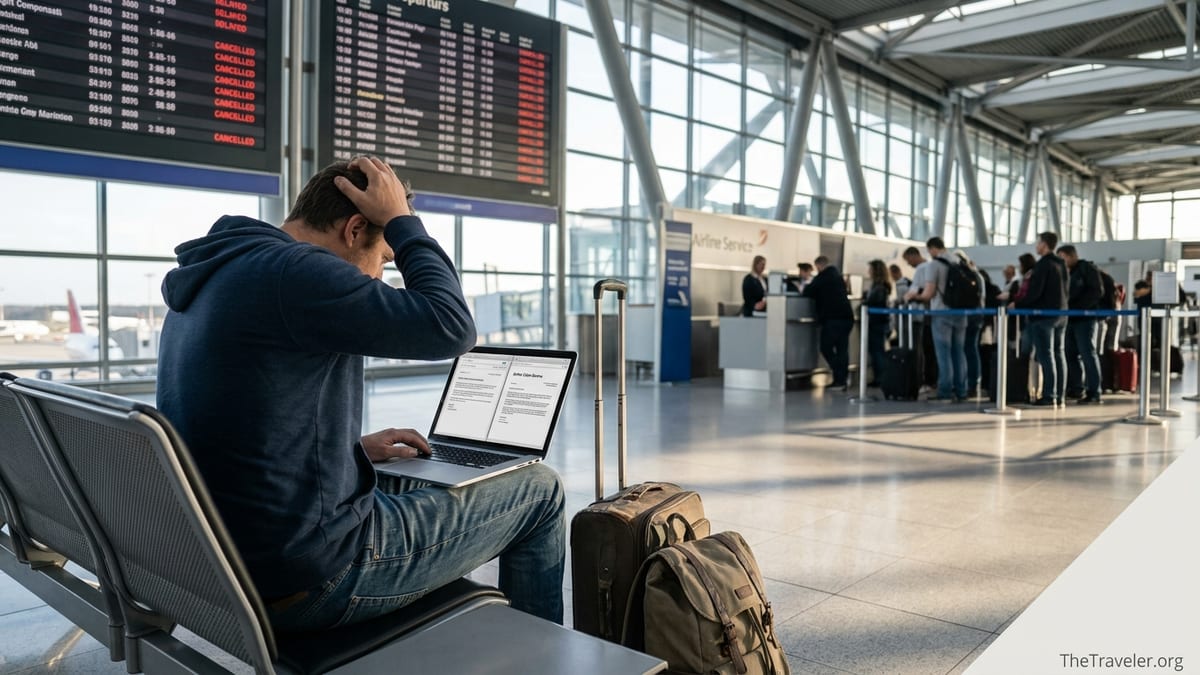
What AirAdvisor and AirHelp Actually Do
AirAdvisor and AirHelp are specialist claim companies that pursue compensation from airlines when flights are delayed, cancelled, overbooked, or when baggage is mishandled under passenger rights laws such as EU261/2004, UK261 and the Montreal Convention. Instead of you arguing directly with the airline, you authorize them to act on your behalf. They prepare the claim, correspond with the airline, and in some cases escalate to legal action if the airline refuses to pay.
In practice, that might look like a traveler from New York to Paris whose flight arrives more than four hours late due to a technical issue. Under EU261, that passenger may be entitled to up to 600 euros in compensation on top of a refund or rebooking. With AirHelp, the traveler completes a short online form, uploads the boarding pass, and signs a digital authorization; the company then contacts the airline, disputes any rejection, and transfers the money minus its fee once the case is paid out.
AirAdvisor offers a similar process. A couple flying from London to Rome whose flight is cancelled the night before departure can enter their flight details on AirAdvisor’s website, which automatically checks eligibility based on route, delay length, and cause. If the claim qualifies, AirAdvisor contacts the airline and, if necessary, relies on partner law firms in Europe to push stubborn airlines to pay. In both cases, the companies make money only when the passenger receives compensation.
Both brands stress simplicity: no legal knowledge required, no upfront costs, and no need for you to decipher whether a “technical issue” counts as extraordinary circumstances. For many occasional travelers, that convenience is the main reason they look at these services in the first place.
Fees and How Much You Actually Keep
Where AirAdvisor and AirHelp diverge most clearly is pricing. As of mid 2026, AirAdvisor charges a 30 percent success fee on standard claims, with VAT included and no separate court fee. AirHelp’s standard fee is higher: 35 percent of the compensation amount, also including VAT, and an additional 15 percent legal action fee if the case must go to court. That means a worst-case cut of up to 50 percent on a litigated claim.
To see how this plays out in real life, imagine you are owed 600 euros for a long-haul delay under EU261. If AirHelp wins this on a straightforward basis, its standard 35 percent fee leaves you with 390 euros and the company keeps 210 euros. If the case requires legal action and the extra 15 percent is charged, you would receive about 300 euros while AirHelp keeps roughly 300 euros. A number of travelers posting online describe this outcome in cases where airlines initially refused to pay and AirHelp went to court on their behalf.
By comparison, AirAdvisor’s fee structure is simpler. On the same 600 euro payout, AirAdvisor’s 30 percent fee would leave you with 420 euros while the company retains 180 euros. AirAdvisor publishes illustrative tables with real numbers: for example, on a 500 euro compensation payment, its fee is 150 euros and you receive 350 euros; on 300 euros, the fee is 90 euros and you keep 210 euros. The company emphasizes that VAT is already included and that it covers all standard legal work within that percentage.
For families, the difference can quickly add up. Take a family of four each entitled to 600 euros after a cancelled transatlantic flight that departed from the European Union. The total compensation is 2,400 euros. With AirAdvisor at 30 percent, the family would take home 1,680 euros. With AirHelp at 35 percent for a straightforward case, they would receive 1,560 euros. If legal action were required and the full 50 percent applied, the net amount would fall to 1,200 euros. It is not unusual for travelers to accept these numbers when they feel they had no realistic way to sue the airline themselves, but from a purely financial standpoint AirAdvisor is typically cheaper.
Coverage: Where Each Service Works Best
Both companies focus strongly on EU261 and UK261 claims, which cover flights departing from the European Union and United Kingdom, as well as flights arriving there on EU or UK carriers. AirHelp markets itself heavily to international travelers, especially from the United States, highlighting that it can handle complex itineraries that start or end outside Europe when at least one leg is covered by EU261 or UK261. For example, a New York to Lisbon ticket on a European airline or a Miami to Madrid connection that misconnects in Europe can fall squarely within its core business.
AirAdvisor also handles EU261 and UK261 but makes more visible reference to the Montreal Convention and baggage-related issues. In practical terms, that means if your checked suitcase goes missing on a flight from Toronto to Warsaw, or arrives several days late on a Doha to Berlin route, AirAdvisor may pursue compensation under international baggage rules in addition to or instead of EU261. The company advertises potential claims of up to roughly 1,600 pounds or 1,920 euros for mishandled baggage on eligible routes, though the actual amount depends on documented losses.
Where you live can influence which service feels more natural. AirHelp has built a very global profile, with marketing in multiple languages and particular visibility in North America and Western Europe. It also sells an annual membership called AirHelp+, which can be purchased by frequent travelers in the United States, Canada and many European countries. AirAdvisor, while available to travelers worldwide, positions itself strongly in the European market and in jurisdictions closely tied to EU law.
Coverage is not just about geography; it is also about airline behavior. Some regional carriers are notorious for ignoring or delaying direct claims but respond more quickly when a specialist firm with a legal team gets involved. Travelers have reported, for instance, that small low-cost airlines or non-EU carriers sometimes pay out only after months of pressure. Both AirHelp and AirAdvisor deal regularly with these airlines, but AirHelp’s larger scale and long track record may matter for borderline cases where airlines test the limits of EU261.
Speed, Transparency and Real-World Experiences
Timelines are one of the most common complaints in flight compensation. Travelers using either service often report waiting months for a result, especially when a national enforcement body or court becomes involved. That reflects the reality of dealing with airlines and regulators rather than the companies alone, but the way each firm communicates along the way can make the process feel more or less frustrating.
Positive experiences with AirHelp often describe a simple sign-up process, a clear dashboard showing case status, and an eventual payout that was substantially more than the original ticket price. For example, one traveler who had a cancelled flight within Europe reported that AirHelp secured compensation more than four times the cost of their ticket; even after paying the fee, they came out far ahead and felt the service was worth it. Others note that AirHelp’s scale and legal expertise helped in cases where airlines repeatedly denied valid claims or invoked “extraordinary circumstances” that were later rejected.
On the other side, negative reviews of AirHelp frequently mention long periods with little communication, difficulty getting precise updates, and shock at the final fee when legal action was needed. A few travelers describe situations where airlines claimed they had already transferred the money to AirHelp while the customer still had not been paid. Complaints also surface about cases being dropped when the jurisdiction proved complicated or less favorable, leaving the traveler back at square one after months of waiting.
AirAdvisor’s public feedback is generally positive on review platforms, often citing responsive customer service and clear explanations of next steps. Travelers praise its straightforward fee display and the sense that someone is actively pushing their case forward. That said, any company dealing with slow-moving airlines will attract frustration. Some AirAdvisor users mention waiting close to a year for a decision in complex cases, particularly when an airline’s refusal had to be challenged through a national authority, underlining that even the best claim service cannot fully control external timelines.
Memberships, Extras and When DIY Might Be Better
One major difference between the two services is AirHelp’s AirHelp+ membership. For a relatively low annual fee, this subscription promises that members do not pay the usual success or legal action fees on covered claims. Instead, they pay only the membership cost and receive the full compensation amount if the case is successful. AirHelp+ also advertises extras such as airport lounge access in certain disruption scenarios and help with tracking flights for eligibility.
This model can be attractive for frequent flyers. Consider a business traveler from Chicago who flies to Europe six times a year. If a single delay results in a 600 euro EU261 payout and they have an active AirHelp+ membership, they could potentially receive the full 600 euros. For someone expecting multiple EU261-eligible flights over twelve months, the economics may favor the membership fee instead of paying 35 to 50 percent of each payout.
AirAdvisor does not offer a comparable annual subscription at the time of writing and instead focuses on a pure “no win, no fee” approach. That can be simpler for occasional leisure travelers who only expect to need help once every few years. You do not pay anything unless compensation is secured, and there is no separate decision about whether a membership will pay for itself.
However, both companies are potentially unnecessary for straightforward claims, especially for travelers comfortable with paperwork. Under EU261 and UK261, you can write directly to the airline, using online claim forms many carriers now provide. A traveler flying from Berlin to Barcelona who arrives four hours late due to a technical problem could, in many cases, simply submit a short claim citing EU261, attach the boarding pass, and receive the full 250 or 400 euros after some weeks or months. Several frequent travelers report having successfully claimed this way multiple times, keeping 100 percent of their compensation without paying third-party fees.
Which Travelers Are Better Suited to AirAdvisor or AirHelp?
For travelers who value keeping as much of their compensation as possible and whose case seems relatively clear under EU261 or UK261, AirAdvisor’s lower, single-tier 30 percent fee will often be more attractive. A family that rarely travels long-haul and just wants help with one complicated cancellation is likely to be cost sensitive. In their situation, choosing AirAdvisor could mean an extra 100 to 200 euros in their pocket compared with a higher-fee alternative.
AirHelp, by contrast, may be a better fit for those who want a very established global brand or who are interested in the AirHelp+ membership model. A digital nomad or consultant who shuttles regularly between New York, London, and European hubs might find value in paying an annual fee up front and then keeping full payouts on any eligible disruptions. The company’s scale, extensive language support, and long list of handled airlines are also draws for travelers who hop between regions frequently.
Risk tolerance plays a role too. Some travelers are comfortable trying to claim on their own first, then turning to a company only if the airline refuses to pay. In that case, either AirHelp or AirAdvisor can function as a “plan B” when a direct claim stalls. Others prefer to outsource from the start, especially when the trip was stressful and they do not want to deal with more email exchanges or regulatory jargon. For them, the question is less about whether to use a claim service at all and more about which one feels more transparent and responsive.
It is also worth considering the specific type of problem. If your main issue is lost or seriously delayed baggage on an international itinerary, AirAdvisor’s emphasis on the Montreal Convention and baggage-related claims might be appealing. If you are based in the United States and regularly book transatlantic tickets with multiple legs and codeshares, AirHelp’s broader marketing and experience with complex itineraries could tip the balance.
The Takeaway
When flights go wrong, both AirAdvisor and AirHelp can turn a frustrating travel day into a meaningful payout. They exist because many airlines still delay, deny, or complicate valid compensation claims, and because most travelers have neither the time nor the appetite to fight a cross-border legal battle over a few hundred euros.
If you decide to use a claim service, the main financial difference is fairly simple. AirAdvisor typically takes 30 percent of your compensation, covering standard legal work, while AirHelp’s standard cut is 35 percent, rising to as much as 50 percent when court action is required. Over one or two claims this may not seem huge, but on a family trip or repeated disruptions the gap can be hundreds of euros.
For confident travelers with straightforward EU261 or UK261 cases, the most economical option is still to claim directly from the airline and keep 100 percent of the money. Many successful claims start with a short online form and end, weeks or months later, with a full payout. For everyone else, the choice between AirAdvisor and AirHelp comes down to priorities: lower fees and a straightforward structure versus a larger global brand with a membership model that can benefit frequent flyers.
Before you hand over your boarding pass and your claim, take ten minutes to check recent reviews, confirm current fee percentages, and think about how much time you are willing to invest yourself. The right choice will depend less on the company’s marketing and more on your personal travel patterns, budget, and tolerance for paperwork.
FAQ
Q1. Is it better to claim EU261 compensation myself or use AirAdvisor or AirHelp?
For simple cases, claiming directly with the airline is usually best because you keep 100 percent of the money. If the airline ignores you, repeatedly denies a seemingly clear case, or you do not want to deal with the process, using a company like AirAdvisor or AirHelp can be worth the fee.
Q2. Which is cheaper: AirAdvisor or AirHelp?
As of mid 2026, AirAdvisor is typically cheaper. It charges about 30 percent of the compensation, while AirHelp charges around 35 percent as a standard fee and can add another 15 percent if legal action is needed.
Q3. How long do AirAdvisor and AirHelp claims usually take?
Timelines vary widely. Straightforward cases can sometimes be resolved in a few weeks, but it is common for claims to take several months, especially when airlines resist or national authorities become involved. Neither company can guarantee a specific timeframe.
Q4. Can US-based travelers use AirAdvisor and AirHelp?
Yes. Both companies accept clients who live in the United States as long as the underlying flight is covered by EU261, UK261, or applicable international rules. AirHelp markets particularly strongly to US travelers and offers its AirHelp+ membership in many states.
Q5. Do these services cover missed connections and multi-leg itineraries?
Often, yes. If your overall arrival at the final destination is delayed enough and at least one segment falls under EU261 or UK261, both AirAdvisor and AirHelp may pursue a claim. Eligibility depends on where your trip started, where it ended, and which airlines operated the flights.
Q6. What happens if my claim is unsuccessful?
With both AirAdvisor and AirHelp, the “no win, no fee” policy means you do not pay if they do not secure compensation. You will not receive money for the disruption, but you will not owe them a service fee or legal costs either.
Q7. Are AirAdvisor and AirHelp legitimate companies?
Both are established businesses that have handled large numbers of EU261 and similar claims over several years. They have many positive reviews but also some negative ones, particularly about communication and waiting times, so it is wise to read recent feedback before signing up.
Q8. Does using a claim company reduce my chances of getting paid?
In general, no. Airlines are familiar with both brands and may actually take formal claims from such companies more seriously, especially if legal proceedings are a real possibility. However, using a company is not required to win; many travelers succeed on their own.
Q9. Can I switch from one company to the other or go back to handling the claim myself?
Once you sign a mandate or power of attorney, that company is usually authorized to handle the claim until it is resolved or you formally revoke the authorization. Switching later can be complicated, so choose carefully at the start and avoid submitting the same case to multiple firms.
Q10. When would AirHelp+ membership make more sense than paying per claim?
AirHelp+ can make sense for frequent travelers who expect at least one significant EU261-eligible disruption per year. If a single delay leads to a 400 or 600 euro payout and you pay no success fee as a member, the membership cost may be lower than what a standard percentage fee would have been.