


More news on this day
A powerful summer storm sweeping across the U.S. Northeast grounded at least 726 flights today and triggered cascading delays, while widespread glitches and slowdowns in airline mobile apps left many travelers struggling to rebook or even confirm whether their flights were still operating.
Get the latest news straight to your inbox!
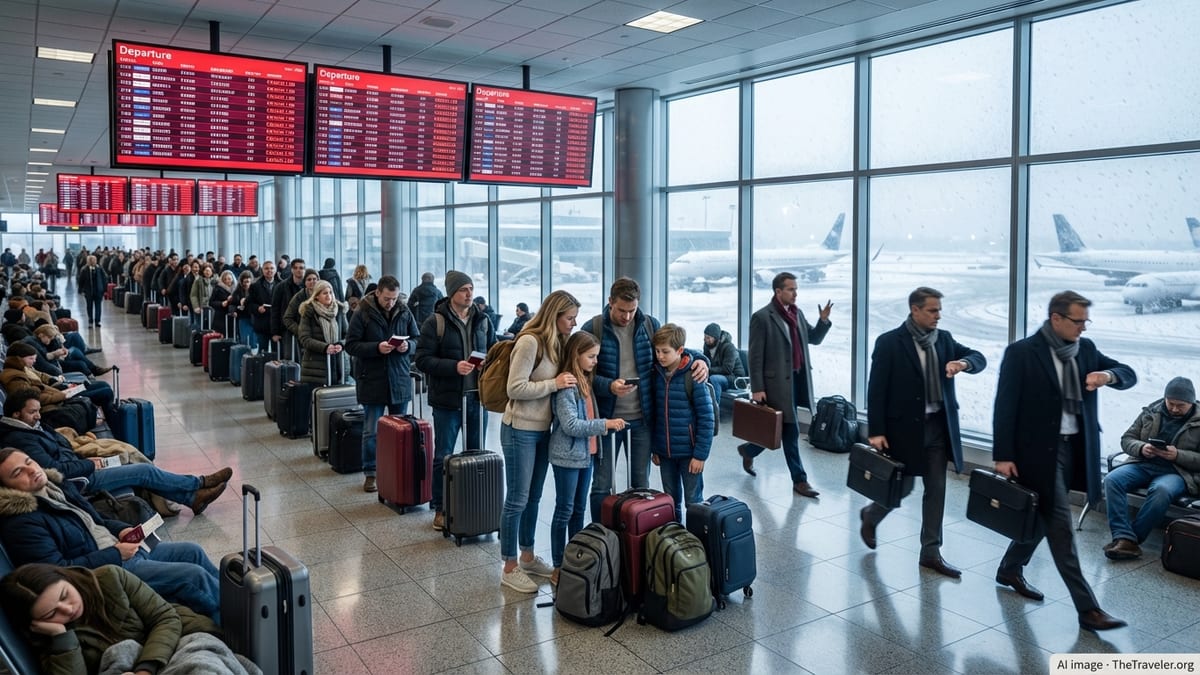
Storm Slams Major Northeast Hubs
Publicly available flight-tracking data shows that thunderstorms and severe weather across the Northeast forced hundreds of cancellations and delays at key hubs including New York’s JFK and LaGuardia, Newark Liberty, Boston Logan and Philadelphia. Ground stop programs and extended spacing between arrivals and departures sharply reduced capacity, leaving aircraft and crews out of position throughout the day.
Operational reports indicate that the bulk of the 726 grounded flights involved short-haul and regional services, which airlines often cut first when weather reduces available runway slots. Travelers bound for secondary cities around the region, as well as those connecting through New York and Boston to the Midwest and West Coast, faced some of the longest disruptions.
The storm added strain during an already busy summer travel stretch, when schedules are tightly packed and spare aircraft are limited. Weather-related flight reductions can ripple outward for days, particularly when storms repeatedly form over the same congested airspace, as forecasters reported today.
Airports issued general advisories urging passengers to check flight status before leaving home, but many travelers reported they were already at the gate when cancellations were announced, compounding crowding at customer-service desks and adding pressure on digital tools that are supposed to help manage rebooking.
Mobile Apps Lag Just When Travelers Needed Them Most
As the storm intensified, many passengers turned to airline mobile apps expecting automatic rebooking options and real-time updates. Social media posts and user reports, however, described frozen boarding passes, missing reservations and error messages when attempting to search alternate flights. In some cases, itineraries temporarily disappeared before reappearing hours later, creating confusion over whether tickets were still valid.
Travelers described apps that showed flights as “on time” long after airport departure boards listed them as heavily delayed or canceled. Others reported that push notifications announcing a disruption arrived well after they had already learned of the change from gate screens or crew announcements on board.
Several major carriers promote their apps as the fastest way to self-service rebooking during irregular operations. Today’s storm highlighted a recurring gap between that marketing and passengers’ real-world experiences, especially when thousands of people attempt to access the same systems at once. According to published coverage of previous disruption events, even modest slowdowns in core reservation and check-in systems can cascade into widespread front-end glitches for mobile users.
In practical terms, the limitations left many people in the same long lines they had hoped to avoid, competing for a shrinking pool of open seats on later flights as the storm disrupted evening operations.
Why Airline Technology Struggles in Severe Weather
Industry analyses of past disruption events show that major storms expose weaknesses not only in airport infrastructure but also in airline IT architectures. Complex legacy reservation platforms sit behind glossy consumer apps, and when schedules change rapidly, those older systems can choke on waves of rebookings, cancellations and seat-map updates.
During today’s Northeast storm, that structural challenge appeared again: travelers reported app timeouts when trying to confirm same-day changes, alongside lagging updates to gate numbers and departure times. While individual carriers did not immediately provide technical breakdowns, analysts frequently point to the difficulty of scaling decades-old core systems to handle sudden spikes in demand.
Weather-driven disruptions are especially punishing because they simultaneously reduce physical capacity in the sky and on the ground while driving up digital demand. As more passengers expect to solve problems from their phones instead of at a counter, any slowdown or mismatch in data between back-end systems, websites and apps becomes highly visible.
Technology specialists note that airlines have invested heavily in digital check-in, mobile boarding passes and biometrics, but resilience under stress conditions has lagged. Events like today’s storm are prompting fresh scrutiny of how prepared carriers are for peak-load scenarios that blend extreme weather with intense summer travel volumes.
Airports, Airlines and Travelers Improvise Workarounds
With official channels overloaded, travelers reported turning to a mix of strategies to navigate the disruption. Many used third-party flight-tracking tools to verify whether aircraft operating their routes had actually departed from prior cities, viewing that as a more reliable indicator than fluctuating departure times in airline apps.
Others sought help through call centers and airport kiosks, though hold times and queues were lengthy across the region. Some passengers described greater success when contacting airlines through direct messaging on social platforms, where agents were sometimes able to process rebookings even as apps continued to show limited options.
Airport operations teams, according to local media coverage and public statements, attempted to ease bottlenecks by adding staff in check-in halls and deploying additional wayfinding personnel. Still, congestion around security checkpoints, concessions and restrooms grew as more travelers remained in terminals for hours past their scheduled departure times.
Hotels near major Northeast airports also saw rising demand as evening cancellations mounted. Travel forums carried accounts of last-minute room shortages at properties close to the terminals, pushing some passengers to search farther from the airport or spend the night in gate areas while waiting for morning flights.
Calls Grow for More Reliable Digital Tools
The extensive disruptions from today’s storm added to a broader debate over the reliability of airline technology during crises. Consumer advocates argue that mobile apps and websites are now as critical as airport power or runway de-icing equipment, and that carriers should be held to clearer performance standards when digital tools fail large numbers of customers at once.
Analysts point out that extreme-weather events in the Northeast and nationwide are expected to become more frequent and volatile, increasing the likelihood of large-scale operational disruptions. Without more robust and transparent digital infrastructure, they warn, travelers will continue to shoulder much of the uncertainty and stress that come with sudden mass cancellations.
Some industry observers have urged carriers to publish clearer guidance on when apps may be unreliable, along with backup procedures for passengers who cannot access boarding passes or rebooking options on their phones. Others suggest regulatory bodies could push for standardized metrics on outage reporting and customer-impact thresholds.
For the thousands affected by today’s 726 grounded flights, the debate is immediate rather than abstract. As storms, crowded skies and aging technology converge, the experience of trying to navigate a disrupted travel day increasingly hinges not only on the weather outside but also on whether the app in hand can keep up.