


More news on this day
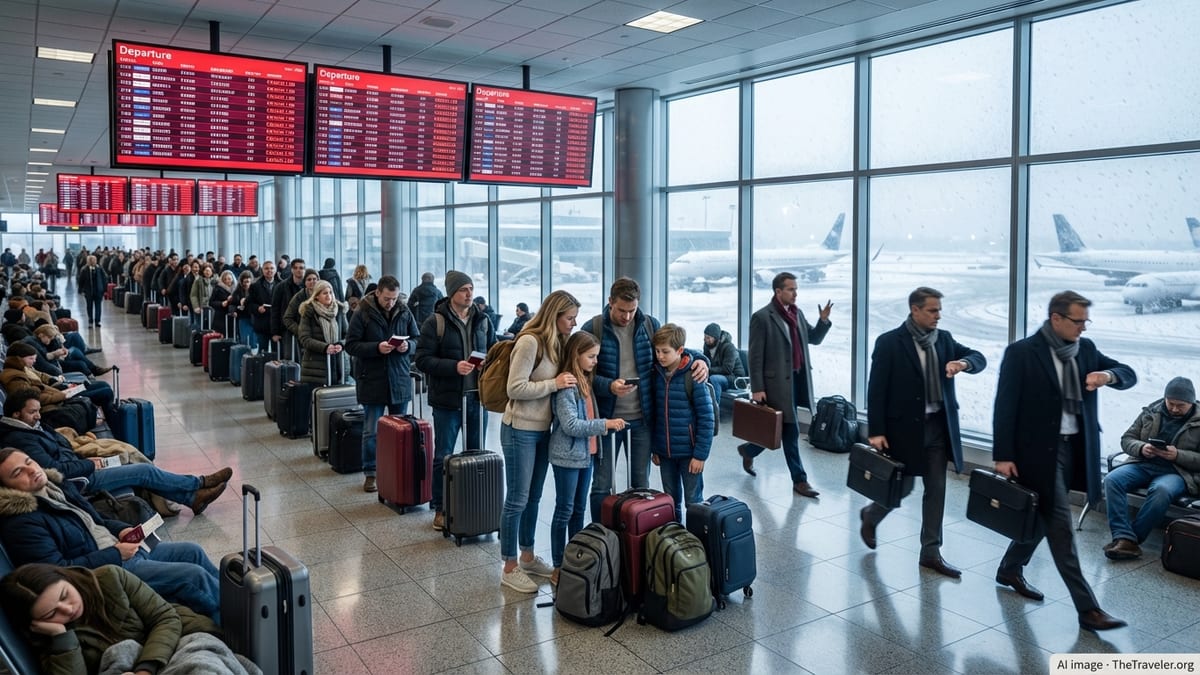
Airlines are increasingly pointing to two culprits behind stubborn flight delays: crowded airports that struggle to absorb peak-day schedules and weather that squeezes already-tight runway and airspace capacity.
Get the latest news straight to your inbox!
Congestion pressures build as schedules outpace capacity
Published coverage and federal filings show the U.S. air travel system continues to operate with little slack at major hubs, leaving airlines vulnerable to delay cascades when an airport or airspace region hits a bottleneck. When the schedule gets ahead of what gates, taxiways, runways, and air traffic management can handle, even small disruptions can turn into long lines of aircraft waiting to depart or arrive.
A recent example came at Chicago O’Hare International Airport, where the Federal Aviation Administration imposed temporary scheduling limits for the 2026 summer season after determining that planned operations would exceed airport capacity given current conditions, including construction and competitive scheduling dynamics. The FAA said more than 3,080 flights had been planned on peak days for summer 2026, and its action limited daily operations to 2,708 from May 17 through October 24, 2026.
Separately, Newark Liberty International Airport has remained a congestion flashpoint tied to airspace and operational constraints. A Department of Transportation summary of an amended FAA order shows Newark’s operating limits were extended through October 24, 2026, with an hourly cap increased from 68 to 72 operations.
Weather is still the biggest systemwide delay trigger, according to FAA data
Airlines often place weather at the center of their public explanations during disruption-heavy travel periods, and FAA material supports the claim that weather is a dominant driver of system-impacting delays. The FAA’s weather-delay guidance describes weather as the largest cause of air traffic delay in the National Airspace System, citing multi-year OPSNET reporting that shows weather driving a substantial share of significant system delays.
The agency also emphasizes that weather rarely acts alone. When airports run near capacity for much of the day, even brief thunderstorms, low ceilings, or winter conditions can force traffic management initiatives that reduce arrival and departure rates. Those capacity reductions can quickly create queues, ground stops, and airborne holding patterns, with knock-on effects reaching cities far from the original storm.
Government delay-cause reporting further shows how weather is embedded inside broader “system” categories. Bureau of Transportation Statistics guidance notes that a full picture of weather-related delays requires combining multiple reporting buckets, because weather can appear as extreme weather, as a component within National Aviation System delays, and indirectly through late-arriving aircraft once earlier flights are disrupted.
Delay data shows “late-arriving aircraft” can dominate airline performance
When passengers think “weather delay,” they typically picture the local forecast at their departure airport. In airline operations, however, delays frequently start earlier in the day and then spread as aircraft and crews fall behind schedule. That dynamic is visible in the Department of Transportation’s Air Travel Consumer Report, which breaks delays into broad categories including air carrier, extreme weather, national aviation system, security, and late-arriving aircraft.
In the July 2026 Air Travel Consumer Report covering May 2026 data, the overall totals show late-arriving aircraft as a major contributor, accounting for 7.98% of reported operations, compared with 6.68% attributed to National Aviation System delays and 0.28% to extreme weather. Air carrier delays were 5.76% in the same table.
Those category boundaries help explain why airlines often cite both weather and congestion at the same time. A storm can reduce capacity in one region, congestion can magnify the impact at busy hubs, and the resulting late arrivals can dominate the next wave of departures even after conditions improve. Travelers may experience that as repeated delays on a clear day, without realizing the disruption started earlier elsewhere.
Policy responses focus on smoothing demand and boosting air traffic staffing
Recent federal actions indicate a two-track approach: cap or smooth schedules where demand exceeds capacity, while investing in air traffic hiring and modernization. Alongside the O’Hare limits and extended Newark constraints, the FAA has also highlighted workforce planning as a key lever to reduce congestion-related disruption over the longer term.
In May 2026, the FAA released an air traffic controller hiring plan and said it had identified a full staffing target of 12,563 Certified Professional Controllers based on forecast demand, with approximately 11,000 certified controllers deployed as of April 2026 and thousands more in the training pipeline. The agency said it aims to meet hiring targets of 2,200, 2,300, and 2,400 new controllers in fiscal years 2026, 2027, and 2028.
For travelers, the immediate impact of these initiatives is uneven and airport-specific. Scheduling reductions at heavily constrained hubs can improve predictability but may also mean fewer peak-time options. Meanwhile, staffing and modernization efforts can take years to translate into consistent day-to-day gains, particularly because controller training and certification can extend well beyond a single season.
What travelers can realistically expect during peak disruption periods
The latest data and policy moves point to a practical takeaway: delays are rarely attributable to a single cause, and airlines’ explanations often reflect the reality that weather and congestion interact. A thunderstorm forecast can trigger proactive traffic management, while a packed schedule can remove the flexibility needed to recover quickly.
Travelers trying to interpret airline notifications may also benefit from understanding the reporting categories used in federal data. “National Aviation System” delays can include heavy traffic volume, airport operations, and air traffic control constraints, while weather can be recorded in more than one bucket. Even when the weather is no longer severe at a given airport, the late-arriving aircraft category can keep disruptions rolling as aircraft and crews work to reset.