


Walking the Dubrovnik city walls is the single most iconic thing to do in Croatia’s most famous coastal town. It is also one of the most expensive activities in Dubrovnik and can be brutally hot and crowded if you time it wrong. This guide walks you step by step through tickets, entrances, walking direction, heat, photo spots, and honest advice on whether the walls are worth it for you.
Get the latest updates straight to your inbox!
What Exactly Are the Dubrovnik City Walls?
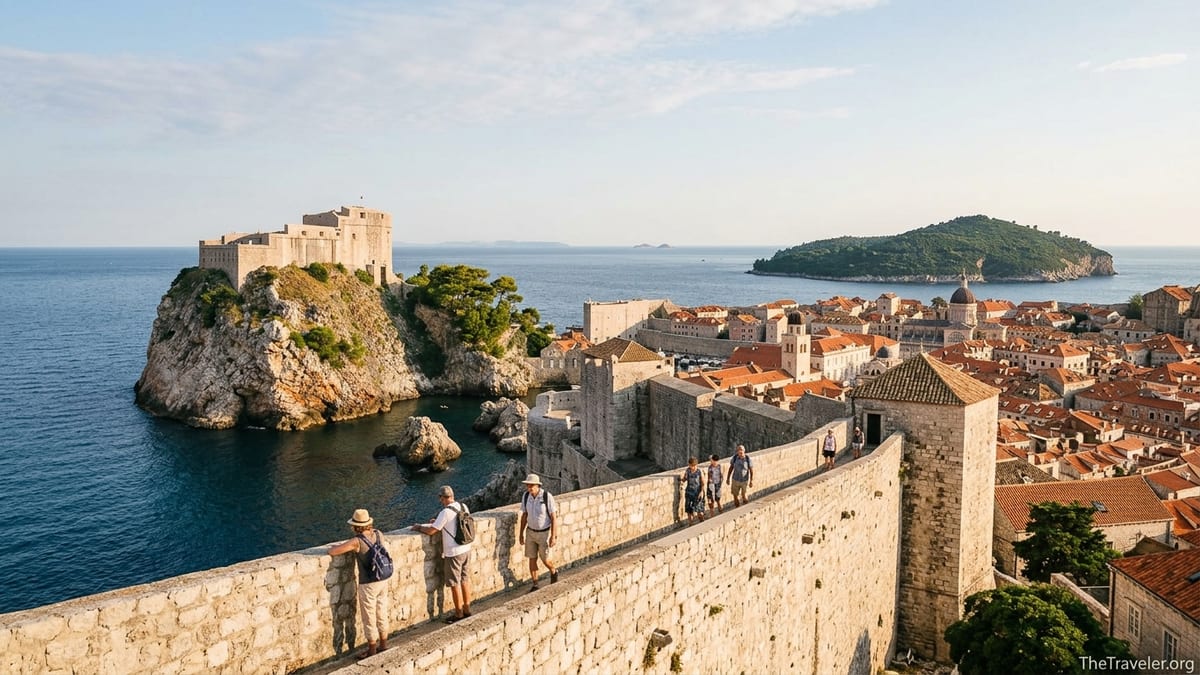
The stone ring that wraps around Dubrovnik’s Old Town is just under 2 kilometres long and up to 25 meters high in places. Built and reinforced from the 13th to the 16th century, the ramparts include towers like Minčeta, sea-facing forts like Bokar, and views across to the separate fortress of Lovrijenac on its rocky headland. From the top, you see terracotta roofs, church domes, the Adriatic Sea and the green mass of Lokrum island offshore.
For visitors, “doing the walls” means climbing a steep staircase from street level up to the ramparts and then walking an anti clockwise one way loop around the town. There are railings along exposed sections, but the path is often narrow, with steps up and down and little shade. Allow 1.5 to 2 hours at an unhurried pace with photo and drink stops. Very fast walkers can rush it in about an hour, while photographers and families can easily spend up to three hours.
The walls walk is not a casual promenade like a city park. You are out in full sun most of the time, especially on the sea side between Fort Bokar and the old harbour, and there are many steps. Think of it as a short but intense hike in a historic setting. With the right expectations and timing, though, it can genuinely be the highlight of a trip to Dubrovnik.
Tickets, Prices and the Dubrovnik Pass
A standard adult ticket for the Dubrovnik city walls is around 40 euros in high season. The price has climbed steadily over the years and surprises many visitors, especially couples and families who are suddenly looking at 80 to 120 euros for a single activity. On the positive side, that ticket also includes entry to Fort Lovrijenac, the freestanding fortress across the bay, usually valid for the same or following day.
You can buy tickets at any of the three wall entrances, where there are staffed booths, or you can purchase in advance through official local providers or as part of the Dubrovnik Pass. The Dubrovnik Pass, particularly the one day version which typically costs roughly the same as a walls ticket alone, includes the walls plus several museums and public bus transport for 24 hours. For example, a traveller planning to visit the city walls, Fort Lovrijenac, the Rector’s Palace and use buses to get from Lapad to the Old Town will almost certainly get better value from the pass than buying everything separately.
If you are visiting only the walls and Lovrijenac and you are walking everywhere, a simple walls ticket is usually enough. Queues at the ticket booths can form in mid morning and early evening, but they move reasonably quickly. Card payments are widely accepted, and student discounts require a physical student card such as ISIC or a recognised Croatian or European youth card. Always check the latest price and inclusions shortly before you travel, as these have changed several times in recent years.
Entrances and the Best Direction to Walk
There are three official entrances to the Dubrovnik city walls: Pile Gate, Ploče Gate and the entrance near St John’s Fortress by the old harbour. All three sell tickets, all three lead to the same one way circuit, and you cannot walk in the opposite direction. Staff at checkpoints will turn you back if you try to go the wrong way, so follow the flow of the crowd.
The main and most popular entrance is at Pile Gate, just outside the western gate where most people enter the Old Town. Here you climb a steep staircase directly from street level up to the ramparts. Starting at Pile gives you the classic route: first along the sea side past Fort Bokar with superb views across Pile Bay to Fort Lovrijenac, then around to the southern cliffs and eventually to the highest point at Minčeta Tower.
The Ploče entrance is on the eastern side of the Old Town, near the Revelin Fortress and the bridge used by taxis and transfer vans. This entrance is useful if you are staying on the Ploče side in hotels like the Excelsior or Hilton Imperial, or if you are arriving on foot from the Banje Beach area. It can be a bit quieter than Pile first thing in the morning. The third entrance by St John’s Fortress near the old harbour is handy if you are coming straight off a Lokrum ferry or a kayak tour and want to continue directly onto the walls.
The standard walking direction is anti clockwise from each entrance, and that works best for most visitors. Starting at Pile and heading anti clockwise means you reach Minčeta, the highest lookout over the rooftops, while your legs are still fresh. It also lines you up for increasingly dramatic sea views as you round the southern side and look back towards Lokrum and out along the coast.
Opening Hours, Timing and Beating the Heat
Opening hours vary by season, but the walls typically open around 8 am and close around sunset, with last ticket entry roughly one hour before closing. In summer, that might mean entry until early evening, while in winter the day is shorter and the final entry can be mid afternoon. Always confirm the exact hours for your travel dates once you arrive in Dubrovnik, either at the tourist office or the ticket booths.
Heat is the biggest practical issue on the walls. In July and August, midday temperatures often sit around 30 degrees Celsius or higher, and there is almost no shade on the ramparts. The stone underfoot reflects heat, and the path can feel like a narrow oven during the middle of the day. Cruise ship groups and large tours tend to hit the walls from about 9 or 10 am onward, which quickly fills the narrow sections.
For a comfortable experience, aim to start as close to opening time as possible or in the last two hours before closing. For example, in peak summer many travellers aim to be at the Pile Gate entrance a few minutes before 8 am. The first half hour can feel almost peaceful, with soft morning light, locals on their way to work below, and almost no queues at the viewpoints. Similarly, a 5.30 or 6 pm start in high season can give you lower sun, cooler air and warm golden light on the roofs as you circle back to your starting point.
Try to avoid starting between 11 am and 3 pm in July and August unless you are very heat tolerant. If you have to go at that time, bring at least one litre of water per person, wear a wide brimmed hat and sunglasses, and schedule breaks at the small cafés along the route. Families with young kids may want to plan the walls early in the day and then escape to Lokrum island or one of the shaded Lapad beaches during the hottest hours.
Route Highlights, Photo Spots and Best Views
The sea facing stretch between Fort Bokar and the southern cliffs is one of the best sections for photos. From the western corner near Bokar you can frame Fort Lovrijenac rising across the turquoise Pile Bay, with kayakers paddling below the cliffs. This is a classic Dubrovnik postcard angle and a favourite shot for travellers who want the walled city plus the fortress in a single frame.
Continuing around the southern side, the walls run along the cliff edge high above the open Adriatic. Here you get wide sea horizons and views towards Lokrum island, which appears almost forested from above. Early morning and late afternoon work well for this section, as the harsh midday sun can flatten the colours. Look for vantage points near the little lookout terraces that sit just above the cliffside Buža bars, where you can capture the drop to the rocks and swimmers below.
The northeastern corner around Minčeta Tower delivers the highest overall viewpoint of the Old Town. From here you can shoot almost straight down onto the maze of terracotta roofs, church spires and bell towers, with the hill of Srđ rising behind. Some travellers spend 15 or 20 minutes around Minčeta alone, walking a short extra staircase onto the platform and waiting for gaps in the crowds to get clean shots.
Along the harbour side, views open onto the old port with its line of excursion boats and the shuttle ferries heading across to Lokrum. If you plan to visit Lokrum, it can be fun to photograph the island from above and then later look back at the walls from the ferry or from the island’s rocky shore. Finally, look for quieter angles like narrow lanes below, washing lines across alleys, or rooftop terraces; these smaller details can sometimes make better travel photos than the obvious wide panoramas.
Practical Tips: Heat, Crowds and Comfort
Think of the walls walk as a mini hike. Wear stable footwear: trainers, closed sandals or light hiking shoes. The stones can be polished and slippery in places, especially if it rains, and there are many uneven steps. Thin flip flops are not ideal, both for grip and for tired feet an hour in. Dress in light, breathable clothing and consider a light shirt or scarf to cover shoulders during the hottest part of the day.
Bring more water than you think you will need. Small kiosks and cafés on the walls sell drinks and snacks, but prices are higher than in supermarkets and the choice is limited. Grabbing large bottles of water from a Konzum or Studenac market just outside the Old Town before you start is both cheaper and usually colder. Sunscreen is essential; many visitors underestimate how exposed they will be and end up red by evening.
Toilets are limited on the walls themselves. Use facilities in the Old Town before you climb up, such as the public restrooms near Pile Gate or in the old harbour area, or museum toilets if you are using the Dubrovnik Pass. Remember that your walls ticket is valid for a single circuit only, with no re entry. Once you come down, you cannot climb back up on the same ticket if you realise you forgot something.
For crowd control, consider the cruise schedule if you can. On days when several large ships are in port, Old Town streets and the walls get noticeably busier from late morning to mid afternoon. On a practical level, this means longer queues at the Pile Gate stairway and more bottlenecks at narrow corners where people pause for photos. Early and late visits slice most of this stress away and give you more space to enjoy the views.
Views of Lokrum and Fort Lovrijenac, and How to Combine Them
Two of the most memorable vistas from the walls are over Lokrum island and Fort Lovrijenac. Lokrum sits just offshore, lush and green, with rocky coves around its edge. From the southern walls you can look out across the channel, often spotting the small passenger boats that shuttle between the old harbour and Lokrum throughout the day. The contrast between the orange roofs of the Old Town and the deep green of the island makes for striking pictures, especially in clear weather.
Fort Lovrijenac, sometimes called the “Gibraltar of Dubrovnik”, stands on a separate rock outcrop guarding the western approach to the city. The classic view is from the walls near Fort Bokar and the Pile Gate corner, where you see Lovrijenac framed by the city walls and the calm Pile Bay below. Game of Thrones fans will recognise this area from multiple King’s Landing scenes, but you do not need to be a fan to appreciate the drama of the setting.
Your walls ticket includes entrance to Lovrijenac, usually for a one time visit. A popular sequence is to walk the walls early in the morning, descend at Pile Gate, grab a quick coffee, then climb up to Lovrijenac for a different perspective looking back at the Old Town. From the top of the fort you can photograph the complete ring of walls at once, especially in the late afternoon when the sun lights the city from the west.
If you are planning a half day on Lokrum, one efficient plan is to walk the walls first thing in the morning, take a mid day break for lunch and a swim on Lokrum to escape the heat, and then visit Lovrijenac in the late afternoon or early evening. This breaks up the walking, keeps you out of the worst heat, and layers three of Dubrovnik’s best viewpoints into a single well paced day.
Is Walking the Walls Worth It?
The honest answer is that it depends less on your budget and more on when and how you do it. Many travellers come away saying the walls were the best thing they did in Dubrovnik, even at around 40 euros a ticket. They remember the first glimpse of the rooftops from Minčeta, the sweep of sea along the southern cliffs, and the sense of walking through living history above alleyways where laundry hangs and cats sleep in doorways.
On the other hand, visitors who start at noon on an August cruise ship day often report a very different experience: shuffling in a slow line, jostled in narrow sections, pausing in full sun with no breeze and no shade, and feeling they paid a lot of money for discomfort. The same attraction can be exhilarating at 8 am and tedious at 1 pm.
If you are on a tight budget, consider the Dubrovnik Pass to squeeze more value out of the ticket price or look at alternative viewpoints. The cable car up Mount Srđ gives a spectacular aerial view for a similar price to the walls, and kayaking tours along the base of the cliffs offer a sea level angle on the fortifications. But none of these fully replace the feeling of walking the ramparts themselves and looking down into the Old Town from above.
As a rule of thumb, if you enjoy historic cities, tolerably steep walks and viewpoints, and you can schedule your visit early morning or late afternoon, the walls are absolutely worth it. If you strongly dislike heat, crowds and steps, and have only a short time in Dubrovnik at the hottest time of year, you may prefer to admire the walls from the outside and cherry pick other experiences instead.
The Takeaway
Dubrovnik’s city walls are expensive, busy and physically demanding. They are also one of Europe’s great urban walks when approached with a bit of planning. Understanding the entrances, choosing the right time of day, and pacing yourself with water, shade and breaks can transform a potentially exhausting trudge into a memorable highlight.
Start early or late, take the Pile Gate entrance if you want the classic sea side route, and allow around two hours to wander, photograph and simply stand still and look. Use the included Fort Lovrijenac entry to see the city from the outside looking in, and consider pairing the walls with a cooling escape to Lokrum island when the sun climbs high.
If walking high above stone rooftops and the Adriatic Sea appeals to you, and you are prepared for steps and sun, then yes, the Dubrovnik city walls walk is worth the effort and the price. With the tips in this guide, you can make that walk one of the standout travel memories of your time on the Adriatic.
FAQ
Q1. How long does it take to walk the Dubrovnik city walls?
Most visitors take about 1.5 to 2 hours to walk the full loop with photo stops and short breaks. Very fast walkers can finish in around an hour, while photographers and families with children often take closer to 2.5 or even 3 hours if they linger at viewpoints and cafés.
Q2. What is the current price for a ticket to the city walls?
In recent seasons, a standard adult ticket in high season has been around 40 euros. Prices are subject to change, and there are discounts for children and students with valid ID. Because the ticket also includes entrance to Fort Lovrijenac, many travellers feel it offers fair value if you plan to visit both.
Q3. What time of day is best for walking the walls?
The most comfortable times are at opening, typically around 8 am, or in the last two hours before closing. Early morning offers cooler temperatures and softer light, plus fewer tour groups. Late afternoon provides warm golden light on the rooftops and a pleasant breeze, though it can still be busy in peak summer.
Q4. Which entrance should I use: Pile, Ploče or the harbour?
The Pile Gate entrance is the main and most popular, ideal if you want the classic sea side route and are arriving from most hotels or buses. Ploče Gate is convenient for those staying on the eastern side or coming from Banje Beach. The harbour entrance near St John’s Fortress is handy if you are coming off a Lokrum ferry or kayak tour. All three sell the same tickets and lead to the same one way loop.
Q5. Can I walk the walls with young children or older relatives?
Yes, but you should be realistic about fitness and heat. There are many steps, little shade and some narrow sections. Families often bring plenty of water, hats and snacks, and treat the walk as a slow, flexible outing with frequent breaks. Older visitors who are steady on their feet and comfortable with stairs usually manage well if they go early in the day and take their time.
Q6. Are there places to buy water or use toilets on the walls?
There are a few small cafés and kiosks on the walls where you can buy water, soft drinks and light snacks, but prices are higher than in supermarkets. Toilet facilities on the ramparts themselves are limited, so it is wise to use restrooms in the Old Town before climbing up and again after you come down. If you have the Dubrovnik Pass, some museums provide convenient toilets near the main gates.
Q7. Do I need to book tickets in advance?
Advance purchase is not strictly required, as many people still buy tickets directly at the entrances. However, buying online through official channels or as part of the Dubrovnik Pass can save time at busy periods and let you avoid ticket queues in the heat. Even with a pre purchased ticket, you still need to choose your visit time within the opening hours for the date you booked.
Q8. Is the walk suitable for people with vertigo or fear of heights?
Sections of the walls run close to the edge with railings, and in places the drop to the streets or sea below is significant. Many visitors with mild vertigo manage by staying on the inner side of the path and avoiding looking directly down. Those with a strong fear of heights may find the walk uncomfortable, especially on the cliff side near the southern part of the circuit.
Q9. How does the city walls ticket relate to Fort Lovrijenac?
Your city walls ticket includes a visit to Fort Lovrijenac, the fortress on the rock opposite Pile Bay, usually valid for entry within the same or following day. Many travellers walk the walls early in the morning and then visit Lovrijenac later the same day, using the fort as a quieter spot to photograph the Old Town and its complete ring of walls from a distance.
Q10. Are the Dubrovnik city walls really worth the price?
For most visitors who time their walk for early morning or late afternoon, the answer is yes. The combination of history, architecture and sweeping views over the Old Town, Lokrum and Fort Lovrijenac is difficult to replicate elsewhere. If you are highly sensitive to heat, dislike crowds and are on a strict budget, you might prefer other viewpoints, but for many travellers the walls end up being the standout experience of their Dubrovnik stay.