


More news on this day
Airlines and travel providers are rolling out new artificial intelligence tools designed to shrink call-center queues, speed up rebooking during disruptions, and reduce the long pauses that have become synonymous with the phrase “one moment, please” for many travelers.
Get the latest news straight to your inbox!
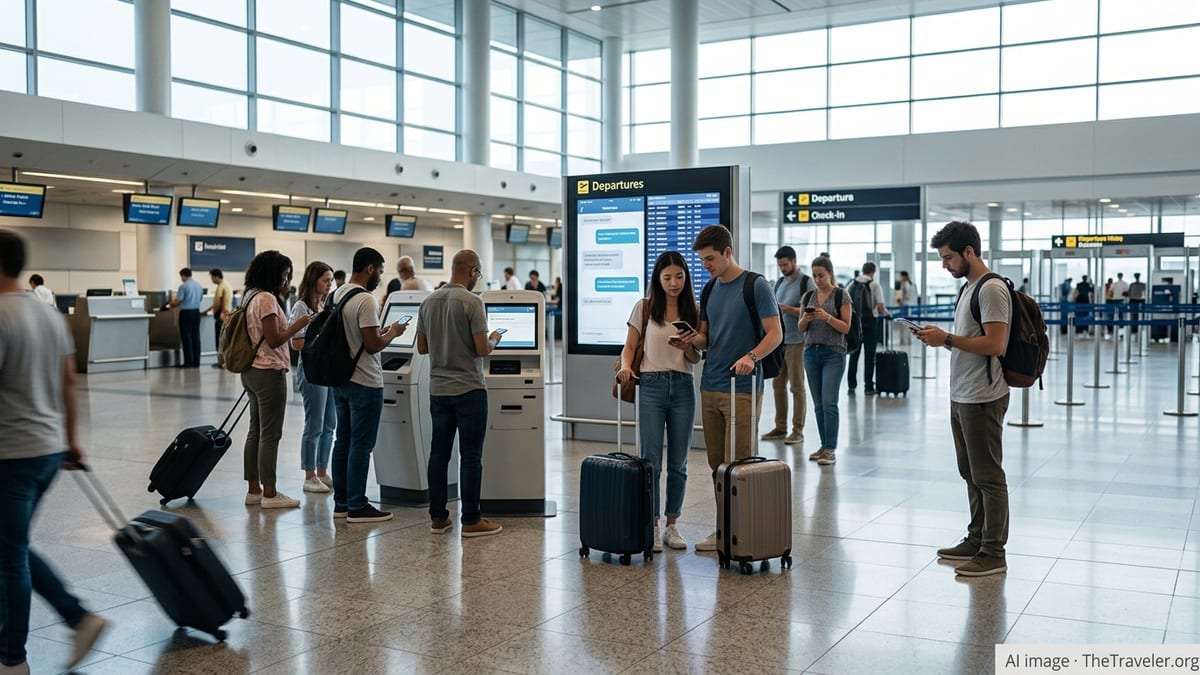
AI Steps Into the Call Center
Airline and online travel call centers have long relied on scripted phrases such as “one moment, please” to manage delays while agents search for fares, seats, or alternative itineraries. Recent guidance for English learners still teaches the phrase as a standard way to warn of a brief delay and buy time to complete a task, reflecting how embedded it is in service interactions across travel and hospitality.
New AI-driven systems are changing what happens during those pauses. Travel and hospitality training materials now note that customer-service tools can retrieve booking details, fare rules, and disruption policies in the background while an agent keeps a caller informed. Published examples of scripted dialogues for airline reservations show the traditional pattern of a human agent asking for dates and routes, then saying “one moment, please” while checking availability; in current deployments, that same search is increasingly handled by AI running behind the scenes, presenting ranked options to agents within a few seconds.
Language resources focused on customer service describe “one moment, please” as a way to manage expectations and soften the experience of being put on hold. In modern call centers, those scripted reassurances are being paired with real-time AI summaries of a traveler’s history, loyalty status, and current disruptions, which are surfaced to human staff to reduce the time needed before they can offer concrete solutions.
Faster Rebooking During Disruptions
Travel disruptions remain one of the main drivers of long waits and repeated “one moment, please” messages. Academic work on travel information systems has highlighted how earlier-generation software often required visible waiting periods while flight-search results populated, with systems explicitly telling callers to wait “one moment” as they retrieved schedules between specific airports and dates.
Recent coverage of airline technology investments indicates that carriers are upgrading these back-end systems to handle large spikes in queries during storms, air-traffic control constraints, or other disruptions. Newer AI-enabled tools pre-compute rerouting options and inventory forecasts, so an agent helping a stranded traveler can see viable alternatives as soon as they open the booking. The goal is to replace long stretches of silence with faster concrete offers for rebooking, meal vouchers, or hotel referrals, depending on the airline’s policies and the cause of the delay.
Consumer forums still document frustrations with lengthy holds when flights are canceled, but some reports indicate shorter handling times where airlines have rolled out their latest rebooking engines. In these cases, callers may still hear “one moment, please,” yet the period between that phrase and a confirmed new itinerary can drop from tens of minutes to just a few, particularly when disruptions are localized rather than systemwide.
Self-Service Tools Reduce Waiting on the Line
Beyond the call center, self-service platforms are increasingly designed to reduce the need for travelers to call at all. Travel-language training sites illustrate dialogues where customers once phoned to ask about schedules from one city to another, prompting an agent’s “one moment, please, and I’ll find out what’s available.” Many of those simple tasks have moved to airline apps and websites, where AI-assisted search can present filtered options by time, cabin, and connection pattern.
Hospitality-focused phrasebooks now acknowledge that guests “carry this sentence to the airport,” noting that similar language appears at hotel front desks, airline counters, and boarding gates. At the same time, those materials point to the growing role of chatbots and mobile messaging, which can answer basic questions about check-in times, lounge locations, or baggage allowances without putting a traveler on hold.
For more complex issues such as multi-leg itinerary changes, name corrections, or medical accommodations, airlines continue to direct passengers to staffed channels. Here, AI tools function as a triage layer, handling simple requests automatically and routing more involved cases to specialists, which can reduce queue length and the frequency with which callers hear the familiar request to “hold for a moment.”
Training Shifts in the Age of Automation
As AI takes over more of the background searching, training materials for frontline staff are beginning to shift. Recent hospitality and customer-service guides still include “one moment, please” as a core expression, but also urge workers to explain what they are doing during any pause, such as checking with a supervisor or confirming details in a reservation system.
Resources for language learners emphasize that the phrase serves to both warn of a delay and maintain politeness. In a travel context, trainers now add that the delay may involve interacting with automated tools, not just walking away from a counter or paging through printed timetables. The intention is to keep travelers informed while software runs checks that would previously have been done manually.
Airlines and travel companies are also adapting scripts to digital channels. In chat and messaging, the equivalent of “one moment, please” can be a short typed message or even a system-generated notification indicating that the request is being processed. Documentation for customer-service English points out that in these contexts, the phrase needs to be paired with visible progress indicators and, where possible, a timeline for response to prevent travelers from abandoning the interaction.
What Travelers Can Expect Next
Public information from airlines and hospitality companies suggests that investments in AI-backed customer service will continue through 2026 and beyond, with a focus on integrating call centers, mobile apps, and airport staff into a single view of each traveler’s journey. That integration is intended to ensure that, whether a traveler is speaking to an agent at a check-in counter or chatting with a bot from home, the system can access the same up-to-date information on schedules, delays, and available options.
Educational materials on customer-service language note that “one moment, please” is unlikely to disappear entirely from travel interactions, since it still signals courtesy and provides a brief cushion for staff and systems to respond. However, as search, routing, and fare calculations become more automated, the amount of time that phrase covers is expected to shrink.
For travelers, the practical impact will be measured in fewer extended holds, faster confirmations, and clearer communication across phone, web, and in-person channels. While disruptions and delays cannot be eliminated, the reliance on long, unexplained pauses is gradually giving way to shorter waits supported by real-time data, with AI aiming to ensure that “one moment” feels closer to seconds than to hours.
ShadowingEnglish customer-service practice
Airline reservation dialogue examples