


Landing at Munich Airport with a suitcase in one hand and a dirndl or lederhosen in the other, many visitors face the same question: should you go straight from the airport to the Oktoberfest tents, or head into the city first? With crowds, luggage and jet lag to juggle, the way you choose to travel from the airport can define your first day on the Wiesn. This guide walks through the main options, from the S-Bahn route and taxi prices to smart luggage storage and realistic timing, so you can step onto the Theresienwiese ready for your first Maß rather than stressed from the journey.
Get the latest updates straight to your inbox!
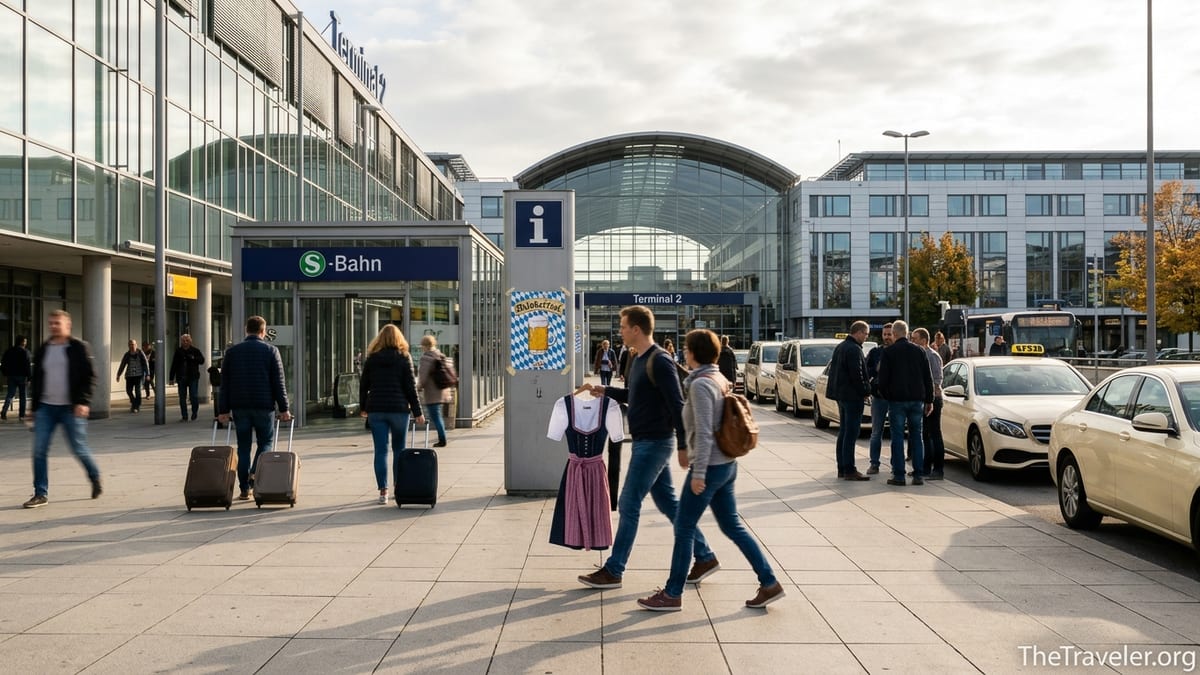
Understanding the Route: From Runway to Theresienwiese
Munich Airport (München Flughafen) lies around 35 kilometers northeast of the city center. Oktoberfest takes place on the Theresienwiese, a large fairground just southwest of Munich’s main train station. Practically every route from the airport to the beer tents funnels you through this central area, whether you arrive by train, taxi or bus. That geography matters, because it means you can think in two stages: airport to city, then city to the tents.
The most common path for independent travelers is the S-Bahn suburban train. Lines S1 and S8 run from the airport into the city, with trains typically every 10 minutes at peak times. They take roughly 40 to 45 minutes to reach Munich Hauptbahnhof, the main station that sits about a 15-minute walk from the festival grounds. From there you either walk, hop on the U-Bahn for one stop to Theresienwiese, or change to another S-Bahn stop closer to the grounds, depending on crowds and how much luggage you have.
Travelers who prefer to avoid train changes with bags often choose a taxi or private transfer. In light traffic the ride from Munich Airport to the Theresienwiese area can take 35 to 45 minutes. During busy Friday evenings or on the first Oktoberfest Saturday, it is safer to plan for up to an hour. Because a large exclusion zone is set up around the festival grounds, taxis will usually drop you a short walk away, for example near the main station, Goetheplatz or Bavariaring, rather than at the tent entrances themselves.
A third option is the Lufthansa Express Bus, which shuttles between the airport and the area around Munich Nordfriedhof and the main station. Like the S-Bahn it feeds you into the city transport network. It is especially useful if you are staying near the main station, but for most Oktoberfest visitors the S-Bahn remains the default choice because of frequency and integration with local tickets.
The S-Bahn Route: Fast, Frequent and Budget Friendly
For many Oktoberfest-goers, the S-Bahn is the best balance of cost, speed and reliability. From both Terminal 1 and Terminal 2 you follow clear green “S” signs down to the underground station “Flughafen München.” There you choose either the S1 or the S8, both of which serve the city center but via different routes. The S8 is usually a few minutes faster to the main station and passes through popular central stops such as Ostbahnhof and Marienplatz, while the S1 is handy if your accommodation is in the northwest of the city.
Ticket options vary, but most short-stay visitors use a day ticket that covers all inner zones, or the Airport Day Ticket that includes travel to and from the airport plus local journeys for the day. Prices change regularly and depend on zones and group size, but for a solo traveler the total is typically well under the cost of even the cheapest taxi. A couple or small group can save further with group day tickets that allow up to five adults on one ticket. Machines at the station can be switched to English, and you can also buy tickets through the MVV transport app if you prefer to pay digitally.
Trains during Oktoberfest get noticeably busier, especially on Friday evenings, weekends and around late afternoon when people head to evening reservations. With luggage, aim for the areas near the doors where there is space for bags or use the multi-purpose sections. On a typical arrival day, a visitor landing at 09:00 could be through passport control by 09:45, on an S8 at 10:00 and stepping onto the Hauptbahnhof platform around 10:45, leaving plenty of time to check into a nearby hotel and still make a lunch reservation in a tent.
Once you reach the city, the printed route on your ticket does not matter as long as you stay within the zones you paid for. For example, you might ride S8 to Hauptbahnhof, drop your suitcase at a hotel near the station, then take U4 or U5 one stop to Theresienwiese. Alternatively, if the U-Bahn platforms look packed, follow the crowds on foot from the south exit of Hauptbahnhof. The walk to the northern entrance of the festival grounds usually takes around 15 minutes at a relaxed pace, slightly longer in dense crowds.
Taxis and Private Transfers: Doorstep Convenience at a Price
Travelers who want to step out of the terminal and avoid navigating ticket machines often opt for a taxi or pre-booked private transfer. Official metered taxis queue outside both terminals, and under normal conditions the ride from the airport to central Munich runs to a flat or typical fare in the range that many visitors describe as the cost of several S-Bahn day tickets combined. Prices rise slightly at night or in heavy traffic, and large vans for groups or extra luggage can add a surcharge.
During Oktoberfest, a common scenario is a group of four arriving with checked suitcases early in the morning. Splitting a taxi can work out competitively per person compared with buying four individual S-Bahn day tickets, especially if you are heading to a hotel that is not directly on a train line. For example, a family staying near Bavariaring or Goetheplatz might find that a taxi delivers them within a block or two of their guesthouse without wrestling bags through station corridors and escalators.
Private transfer companies, including local chauffeur services and international platforms, allow you to book a fixed-price ride in advance. This can be helpful if you land late at night, are traveling with young children or have large sports equipment or costumes. A driver will wait in the arrivals hall with your name, assist with bags and take you straight to your accommodation. Some services offer minivans or minibuses for groups of eight or more, which are popular with stag and hen groups arriving in themed outfits who want to stay together.
What taxis and transfers cannot do during Oktoberfest is drop you at the tent doors. The city establishes a wide cordon of road closures and no-parking zones around the Theresienwiese for the duration of the festival. That means your driver will aim for a drop-off point like the main station, Goetheplatz, Poccistraße or another nearby street, usually no more than a 10 to 15 minute walk from the entrances. It is wise to check your hotel’s recommended taxi drop-off point in advance, particularly if you are arriving with small children or heavy luggage and want the shortest possible walk.
Managing Luggage: Storage at the Airport, Station and Wiesn
One of the main questions for new visitors is what to do with luggage if you go straight from the airport to the tents. Munich Airport offers left-luggage services in the main terminals, operated through airport service centers. Fees depend on the item size and storage duration, with typical pricing that feels comparable to leaving a suitcase in storage at a major European station for a day or two. For travelers with long layovers or those heading straight to Oktoberfest before an evening flight out, storing one large suitcase at the airport and only taking a small daypack into the city can make the day much easier.
Munich Hauptbahnhof also has extensive self-service lockers where you can leave bags for several hours or overnight. Sizes range from small lockers that fit hand luggage up to larger ones that can handle big suitcases. Prices are posted on each locker bank and are similar to other major German cities. A practical example: a group arriving by S-Bahn might each carry a small backpack to the tents, while locking their shared checked bags in two large lockers at the station for the day, returning after the festival closes to collect them before heading to their accommodation or an overnight train.
On or near the Theresienwiese itself, dedicated luggage storage facilities are usually set up during Oktoberfest. The festival grounds are secure, and large bags are not allowed in the tents. Official guidance encourages visitors to bring only small day bags. If you must bring a larger item, expect to be directed to a bag deposit area outside the main entrances where staff check and store bulky items for a fee. Queues can build here at peak times, which is one strong argument for arranging storage at the airport or station instead of arriving at the festival with roller suitcases.
If your hotel room is not yet ready, most hotels around central Munich will store bags for guests before check-in and after check-out. For example, a traveler staying at a mid-range hotel near the main station who lands at 08:30 might reach the hotel around 10:30, drop their suitcase at reception storage, then walk down Bayerstraße and follow the crowds to the festival. This combination of hotel storage and walking often proves the most relaxed option if your accommodation is central.
Should You Go Directly from the Airport to Oktoberfest?
Whether it makes sense to go straight from Munich Airport to the beer tents depends on your arrival time, luggage and energy level. Morning arrivals from within Europe who carry only a backpack are well placed to head straight to the festival. They can hop on the S-Bahn, arrive in central Munich around late morning and join the lunchtime atmosphere in a tent without needing to check into a hotel first. This is especially appealing for day-trippers flying in and out on the same day, who might combine airport luggage storage with a day ticket on the trains.
Long-haul arrivals are a different story. After an overnight flight from North America or Asia, many travelers underestimate how draining the journey and time difference can be. Even if you land early, a realistic timeline involves passport control, baggage claim, buying tickets and a 45-minute S-Bahn ride. By the time you emerge at Hauptbahnhof, it may already be early afternoon. Going directly to the crowded Theresienwiese with a heavy suitcase while jet-lagged can feel overwhelming, and it increases the risk of misplacing belongings or running into issues at bag checks.
A practical compromise is to plan your first day as an arrival and orientation day. Check into your accommodation, shower, change into festival clothes and perhaps visit a beer garden or smaller tent later in the afternoon rather than aiming for a big evening session on the same day you land. For example, a visitor arriving from New York at 10:00 might check into a hotel near Sendlinger Tor, take a nap and then walk the short distance to the southern entrance of the grounds in the early evening, when the lights of the rides come on and the atmosphere is lively but you are no longer hauling luggage.
There are exceptions. If you arrive with a firm reservation for a tent table that same day, you may choose to go direct. In that case, consider either storing your main suitcase at the airport or Hauptbahnhof and carrying only essential items, or booking a private transfer that takes you from the airport to your hotel, drops your bags and then continues with you to a street near the Theresienwiese. The extra cost can be worthwhile when you have a tight schedule and want to avoid the stress of dragging luggage through busy train stations.
Timing Your Journey: Realistic Schedules Around the Festival
Timing is crucial during Oktoberfest, both when you are heading into the city and when you are departing. On the way in, the busiest arrivals at the festival tend to be late afternoon and early evening on Fridays and Saturdays. If your flight allows, aim to reach the grounds before about 16:00 on weekend days to avoid the largest crowds at the entrances and on the U-Bahn platforms. Weekdays before mid-afternoon are generally calmer, with more space on trains and shorter queues at bag checks.
On departure days, remember that the journey back to the airport is not just the S-Bahn ride time. Most airlines recommend arriving at Munich Airport at least two hours before a European flight and at least three hours before long-haul departures. Experiences shared by travelers during recent Oktoberfest seasons suggest that queues at check-in and security can be longer than usual on key festival weekends. If you are leaving on a busy Sunday morning or the day after the festival ends, consider adding an extra 30 to 60 minutes to your normal buffer.
A sensible rule of thumb: work backwards from your flight departure. For a 15:00 intercontinental flight during Oktoberfest, plan to be at the airport by noon. To achieve that, you would want to board an S-Bahn from Hauptbahnhof around 10:45 at the latest, assuming a 45-minute ride and a small cushion for delays. That in turn may mean leaving the Theresienwiese by about 10:00, allowing 15 to 20 minutes to walk to the station, plus time to retrieve any luggage from a hotel or locker.
Transport disruptions can and do happen. On rare occasions, technical issues or emergencies cause S-Bahn delays or cancellations. For peace of mind, check the local transport app or station departure boards, especially if you are traveling early in the morning after a late night at the tents. If trains look disrupted and your flight is important, it may be worth paying for a taxi to the airport or at least to an alternative S-Bahn stop that is not affected. The cost of a ride share split between a group is often trivial compared with the expense of a missed flight.
Choosing the Best Option for Different Traveler Profiles
No single route from Munich Airport to Oktoberfest suits everyone. The right choice depends on your group size, budget, luggage and tolerance for crowds. Solo travelers and couples on a moderate budget usually find the S-Bahn the most attractive. It is frequent, integrated with local tickets and connects neatly with city transport. A visiting couple arriving with two carry-on bags and staying near Marienplatz, for example, can ride the S8 into town, drop bags at the hotel, then walk through the old town and down to Goetheplatz for a more relaxed southern approach to the festival grounds.
Families with young children or older travelers often prioritize minimizing changes and walking. For them, a taxi or pre-booked transfer from the airport to a hotel close to the Theresienwiese can be worth the extra cost. Consider a guesthouse on streets like Theresienhöhe or Lindwurmstraße, which are close enough to walk to the tents but far enough to allow taxis access. That way the family can settle in, leave most of their belongings in the room and then stroll the last few hundred meters to the entrance without jostling through crowded platforms with strollers or wheelchairs.
Large groups, such as corporate outings, sports clubs or bachelor parties, may book private buses or minibuses from the airport. These vehicles can park in designated coach areas on the fringes of the city or near hotels that cater to Oktoberfest groups. A common pattern is for a bus to drop everyone and the luggage at a hotel on the first ring road, then either drive them closer to the grounds later or let the group proceed by public transport for the final leg. This division keeps the bus out of the heaviest congestion while still offering the convenience of a dedicated vehicle for the airport transfer.
Budget backpackers, especially those staying at hostels or campsites on the outskirts of the city, almost always rely on public transport. For example, a traveler staying at a campground west of Munich might ride the S-Bahn from the airport into town, change to another S-Bahn or regional train out toward their campsite, drop bags, and then return on public transport to the Theresienwiese in the late afternoon. In such cases, investing in a full-day or multi-day public transport ticket usually pays off quickly compared with buying single trips.
The Takeaway
Reaching Oktoberfest from Munich Airport is straightforward once you understand the basic geography and your own priorities. For most visitors, the S-Bahn offers the best mix of speed, cost and reliability, funneling you from the airport to the main station in around 45 minutes and putting the Theresienwiese within easy reach on foot or by U-Bahn. Taxis and private transfers buy simplicity and comfort, particularly for families, older travelers or those with tight schedules and bulky luggage, even though they cannot enter the closed zone around the festival grounds.
The critical decisions revolve around what you do with your bags and whether you go straight from the airport to the tents. Airport and station luggage storage, hotel baggage rooms and festival bag deposits all exist, but each involves trade-offs between convenience, cost and queuing time. Many long-haul visitors find that checking into their accommodation first, dropping their luggage and arriving at the tents rested and lightly loaded makes for a far better first impression of the Wiesn.
Think realistically about timing, especially on departure days. Work backward from your flight time, allow for airport queues and leave extra margin for potential delays on the S-Bahn or congestion around the Theresienwiese. A calm transfer is not just about saving minutes. It is about starting or ending your Oktoberfest trip with the same spirit of relaxed enjoyment that draws millions of visitors to Munich every autumn.
However you choose to travel in from the runway to the beer tents, planning your route and luggage strategy in advance will pay dividends the moment you hear the distant music from the tents and see the lights of the rides ahead. Then your journey becomes part of the story, not a stressful hurdle before the first toast of “Ein Prosit.”
FAQ
Q1. How long does it take to get from Munich Airport to Oktoberfest by S-Bahn?
The S-Bahn ride from the airport to Munich Hauptbahnhof usually takes around 40 to 45 minutes. From there it is another 15 minutes on foot or a short U-Bahn ride to the Theresienwiese.
Q2. Is there a direct train from Munich Airport to the Theresienwiese?
No, there is no direct line from the airport to the Theresienwiese station. You normally take S1 or S8 from the airport into the city, then either walk from Hauptbahnhof or change to the U4 or U5 for one stop to Theresienwiese.
Q3. How much does a taxi from Munich Airport to Oktoberfest cost?
Exact prices vary with traffic and time of day, but a taxi to central Munich typically costs in the range that many visitors consider equivalent to several S-Bahn day tickets. Splitting the fare among three or four people can make it competitive with public transport.
Q4. Can taxis drop me directly at the beer tents?
No, during Oktoberfest car access is restricted around the Theresienwiese. Taxis and transfers will drop you on nearby streets such as around the main station, Goetheplatz or Poccistraße, usually a 10 to 15 minute walk from the entrances.
Q5. Where can I store my luggage if I go straight from the airport to the tents?
You can use left-luggage services at Munich Airport, lockers at Munich Hauptbahnhof or official luggage storage points set up near the festival grounds. Many travelers prefer airport or station storage to avoid queuing at the Wiesn with large bags.
Q6. Is it safe to take the S-Bahn with luggage during Oktoberfest?
Yes, the S-Bahn is generally safe, but it can be crowded. Keep your bags close, avoid blocking doors and consider traveling outside the absolute peak times on Friday and Saturday evenings if you have large suitcases.
Q7. Should I go directly from the airport to Oktoberfest or check into my hotel first?
If you arrive well rested with only a small bag and have limited time, going directly can work. After a long overnight flight or with heavy luggage, most visitors find it more comfortable to check into their hotel first, leave their bags and then head to the tents.
Q8. Are there extra trains running during Oktoberfest?
Public transport operators usually increase frequency on key lines serving the Theresienwiese, especially in the evenings and on weekends. Even with extra services, trains can be very busy, so allow yourself time and be patient at platforms.
Q9. How early should I leave Oktoberfest on my departure day to catch a flight?
Work backwards from your flight time. Aim to be at the airport at least two hours before short-haul and three hours before long-haul flights, then add around 45 minutes for the S-Bahn ride plus time to walk from the grounds and retrieve any stored luggage.
Q10. Do I need to buy S-Bahn tickets in advance for travel from the airport during Oktoberfest?
You do not have to buy in advance; tickets are available at machines and via the transport app. However, purchasing through the app before arrival or familiarizing yourself with the ticket options can save time and reduce stress when you land.