


More news on this day
New airspace closures across key Gulf and Middle Eastern flight corridors are prompting cancellations and diversions on Asia–Europe routes, as airlines scramble to adapt networks already strained by conflict-related restrictions.
Get the latest news straight to your inbox!
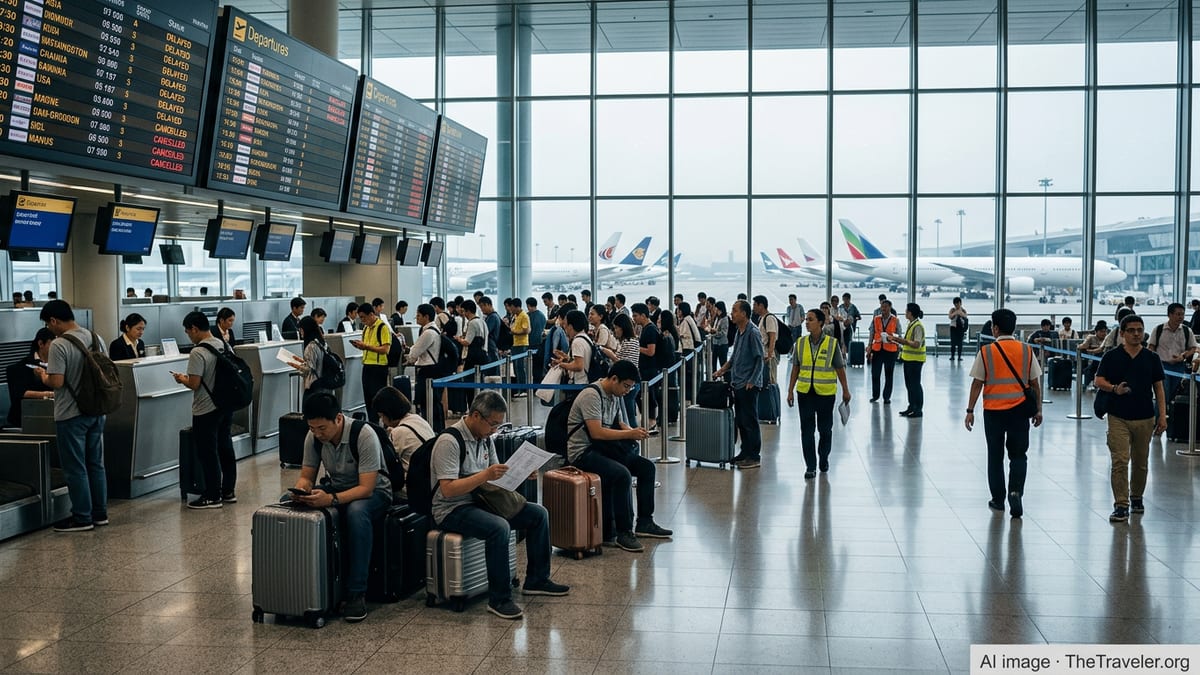
EASA Warning Tightens Restrictions Over Gulf Region
Publicly available information from European regulators shows that the European Union Aviation Safety Agency has reinstated a high-risk advisory for several Gulf flight information regions, urging carriers to avoid Bahrain, Kuwait, Qatar and the United Arab Emirates, as well as parts of the Gulf of Oman. The move follows renewed fighting linked to the United States and Iran conflict, which has repeatedly disrupted civil aviation since early 2026.
The latest conflict-zone information bulletin highlights the risk posed by missiles, drones and air defence systems in and around the Gulf, and recommends that European operators not enter the affected airspace at any altitude. While the advisory is not a blanket ban, most major carriers typically comply with such guidance, which in practice removes a large swath of airspace from routine use on some of the world’s busiest long haul corridors.
Risk-mapping platforms that track conflict zones indicate that the Bahrain, Kuwait, Doha and Emirates flight information regions have all faced periods of full or partial closure this year, squeezing traffic into remaining open corridors over Saudi Arabia and Oman. Analysts describe a highly fluid operational picture, with routings changing from week to week as notices to air missions are updated and advisories are revised.
For airlines flying between Europe and Asia, the net effect is a more complex and fragmented patchwork of available routings. Many carriers had already been avoiding Iran and Iraq, and the addition of wider Gulf restrictions further narrows options, particularly for nighttime westbound services that normally rely on the most direct great circle paths across the region.
Asia–Europe Traffic Rerouted North and South
Operational summaries produced for air navigation planners in the Asia Pacific region show how quickly flows between South and Southeast Asia and Europe have shifted since the first wave of closures early in 2026. Data for March indicated that when large sections of Iranian and neighboring airspace were unavailable, westbound night traffic was forced either north via the Caucasus and Central Asia or south along extended routes over the Arabian Sea, Oman and Saudi Arabia.
These detours add significant flying time, burn more fuel and reduce the number of rotations that airlines can operate with a given fleet. Industry assessments note that longer block times, combined with airport slot constraints in Europe and Asia, have led some carriers to trim schedules rather than stretch aircraft and crews to maintain previous frequencies.
Documents circulated to airport coordinators in March pointed to a high rate of flight cancellations across major Middle East hubs as operators reworked timetables. Slot managers for airports in Dubai, Abu Dhabi, Saudi Arabia and Oman reported that roughly a third of planned takeoff and landing slots in May were dropped, down from more than half at the height of the crisis in March and April but still a sharp reduction in capacity.
The disruption is felt well beyond the Gulf. European and Asian hubs must absorb irregular arrival patterns as rerouted flights bunch into the remaining viable corridors. Air traffic flow management units have introduced metering measures in busy segments of night traffic, particularly for dense westbound flows between South Asia and Europe, to preserve safety margins and manage congestion in constrained airspace.
Gulf Hubs Balance Cancellations With Network Recovery
While the heaviest structural changes are on long haul overflight corridors, point to point traffic into the Gulf is also adjusting. Published coverage from regional outlets indicates that the largest Gulf carriers have restored much of their networks since the first shock of the conflict, though overall July capacity remains below year-earlier levels on many routes. One major Abu Dhabi based airline is a notable outlier, with scheduled capacity reported higher than in July 2025 as it leans into transfer traffic still able to reach its hub by avoiding the most sensitive airspace.
At the same time, the pattern of cancellations has shifted toward smaller and regional operators. For example, recent updates show Central Asian carrier Air Astana suspending Dubai flights on selected days, while some Kuwaiti and Bahraini airlines have issued rolling travel advisories and schedule changes as their home airspace cycled through closure and reopening.
Earlier in the year, the most acute impact was visible in South Asia. Airport statistics from Dhaka in March recorded dozens of daily cancellations on services to Doha, Dubai, Sharjah, Kuwait City and other Gulf points after Iran, Iraq, Kuwait, the UAE, Bahrain, Qatar and Jordan temporarily shut their airspace. The sudden loss of multiple transit hubs at once cut key labour and business travel links between Bangladesh and the Gulf states.
More recently, live departure boards at some Gulf airports have shown largely stable operations, even as overflight advisories hardened. Aviation analysts point out that this apparent resilience is partly because many foreign carriers never resumed services after suspending them during the first round of hostilities, so there are fewer flights left to cancel when conditions deteriorate again.
Compressed Airspace Raises Costs and Complexity
Specialist operations briefings for business and general aviation operators describe the situation as one of “airspace compression,” where the closure of multiple flight information regions shifts almost all long haul flows into a narrow set of remaining options. With Iran, parts of Iraq, Jordan and segments of Gulf airspace intermittently unavailable, cross-regional traffic is being funneled into Saudi and Omani corridors that themselves are facing heavy demand and occasional flow restrictions.
For scheduled airlines, this compression translates into higher operating costs. Longer routings and additional fuel loads can erode margins on already thinly profitable routes, while the need to keep extra reserve fuel for possible tactical deviations adds further weight. Some carriers have responded by cutting frequencies on marginal city pairs or suspending overnight flights that would be most exposed to sudden airspace changes.
Travelers are encountering the effects in the form of extended flight times and reduced choice of departure times, especially on Europe to South Asia and Southeast Asia routes that historically transited the Middle East. Advisory services aimed at corporate travel managers recommend allowing extra connection buffers, monitoring airline waivers closely and being prepared for last minute aircraft swaps or reroutings that can affect seating and in flight services.
Insurance and risk management costs are also inching upward. Underwriters tracking conflict exposures in aviation have been repricing cover for operations that approach high risk zones, which can further disincentivize airlines from restoring pre conflict routings even when limited corridors reopen. The result is a more cautious network planning environment, in which temporary closures often have lingering after effects on capacity and connectivity.
Outlook for Summer Travel Across Asia and the Gulf
Industry data providers forecast that seat supply across the Middle East will remain volatile through the peak northern summer months. Schedules filed for July and August show most long haul Gulf carriers operating below their 2025 levels on several Europe and Asia routes, with flexibility built in to cut or add frequencies at short notice depending on the security picture and regulatory guidance.
Several regional airlines have announced phased resumptions of suspended routes, but often with conservative timetables and reduced weekly frequencies. One low cost carrier based in Oman has, for example, only recently confirmed the resumption date for flights to Kuwait, reflecting the cautious approach airlines are taking toward destinations that have experienced direct attacks or repeated airspace closures.
For passengers, the practical advice from travel agencies and airline notices remains consistent: check flight status regularly, ensure contact details are updated on bookings and be prepared for potential rerouting via alternative hubs. Travelers connecting between Europe and Asia may increasingly find themselves funneled through secondary hubs or on itineraries that detour significantly from the traditional Gulf superconnector model.
Despite the uncertainty, regional aviation bodies note that the system has so far adapted without a complete breakdown in connectivity between Asia and Europe. The combination of northern routes over central Eurasia, southern bypasses via Oman and Saudi Arabia, and selective restoration of services into the Gulf is keeping most city pairs linked, albeit with higher costs and less predictable schedules than before the conflict escalated.