


More news on this day
Holiday travel across Europe was thrown into disarray after a British Airways aircraft became immobilised on the runway at London Gatwick, triggering a burst of squawk 7700 emergency alerts, diversions and hours of delays on busy leisure routes to Spain, Greece and Portugal.
Get the latest news straight to your inbox!
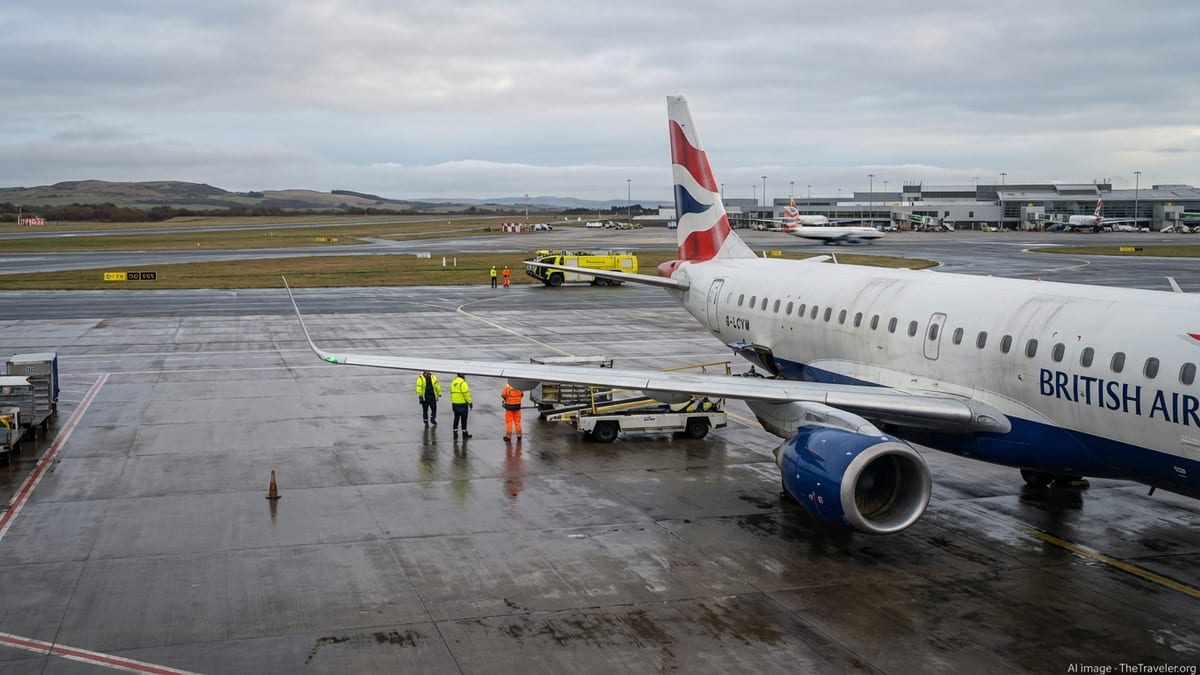
Runway Blockage Halts Landings at One of Europe’s Busiest Hubs
Publicly available flight-tracking data and social media monitoring on 14 July 2026 indicate that a British Airways service arriving at London Gatwick came to a stop on the main runway and was quickly surrounded by airport emergency vehicles. The nature of the problem on board has not been clarified in official statements, but radar traces show the aircraft remained stationary on the runway for an extended period while fire and rescue units were positioned nearby.
With the single active runway effectively blocked, arrivals into Gatwick were temporarily halted. Aviation enthusiasts following the situation in real time described the airport as “basically closed” while the incident aircraft was secured and the runway inspected. Departures were also affected as air traffic controllers adjusted spacing and re-sequenced traffic, leading to growing congestion in the busy airspace south of London.
Data from crowdsourced flight-monitoring platforms shows that, during the peak of the disruption, a significant number of inbound flights were placed in holding patterns over the south of England. Others were instructed to divert to alternate airports, including London Stansted, to avoid running critically low on fuel while Gatwick’s runway remained unavailable.
Wave of Squawk 7700 Alerts Around Gatwick
As the incident unfolded, aviation tracking communities recorded an unusual cluster of aircraft in the vicinity of Gatwick selecting transponder code 7700, the general emergency signal used worldwide to indicate an urgent situation requiring priority handling. Community reconstructions of the episode suggest that as many as nine to ten commercial flights originally bound for Gatwick were at one point squawking 7700 in the broader London area.
Discussion threads on specialist forums and flight-tracking subcommunities indicate that several of these aircraft had been holding for extended periods while awaiting news on the blocked runway. When it became apparent that the delay might exceed their fuel margins, some crews declared an emergency and diverted rather than continue circling. In such circumstances, switching to squawk 7700 is standard procedure to ensure that controllers can provide immediate priority routing.
The emergency code activations were not limited to British Airways flights, but the original runway incident appears to have acted as the trigger. Commenters tracking individual registrations noted a series of aircraft breaking off from the stacks and heading to alternates soon after the immobilised British Airways jet came to a standstill on the runway.
Severe Knock-on Delays to Spain, Greece and Portugal
The timing of the incident, at the height of the summer getaway, meant that routes between Gatwick and key Mediterranean destinations were particularly exposed. Schedule information and historical flight-status data show that British Airways and its partners operate dense banks of flights from Gatwick to Spanish coastal airports such as Malaga and Palma de Mallorca, to popular Greek gateways including Thessaloniki and island destinations, and to Portuguese holiday hubs.
With arrivals disrupted and runway capacity temporarily reduced, return services on these leisure-heavy routes quickly suffered. Aircraft arriving late into Gatwick from Spain, Greece and Portugal were unable to turn around on time for their outbound sectors, leading to rolling delays across the network. Some evening departures left hours behind schedule, while a smaller number of rotations were reportedly cancelled or re-timed to the following day.
Passenger reports collected on social platforms describe families stuck in terminals across southern Europe as ground handlers relayed updated departure times. Some travellers heading back to the United Kingdom late on 14 July and into 15 July recounted missed onward connections and overnight accommodation being arranged at short notice. Others noted that flights which did operate often did so with revised timings and, in some cases, alternative routings to ease pressure on Gatwick’s constrained runway programme.
Passengers Face Diversions, Missed Connections and Claims Questions
The disruption created a familiar cascade of practical issues for passengers. Diversions meant that some arrivals from Spain, Greece and Portugal landed at airports other than Gatwick, with customers then transferred onward by road or rebooked onto later services once aircraft and crews were repositioned. Travellers described waiting for buses, queuing for hotel vouchers and seeking clarification on luggage that had been offloaded at different airports from their original tickets.
The episode has also prompted renewed debate about passenger rights under UK and European consumer protection rules, particularly in cases where delays stem from a runway incident rather than adverse weather or air traffic control restrictions. Publicly available guidance from airlines and regulators sets out complex criteria for compensation eligibility, including whether an event is considered within an airline’s control. Many affected travellers have taken to compensation claim portals and forums to compare notes on how such incidents are typically interpreted.
Legal experts and consumer advocates commenting in recent weeks on similar large-scale disruptions at London airports have highlighted that long delays and diversions often generate a mix of compensation cases and simple reimbursement claims for meals, hotels and alternative transport. The Gatwick runway incident is expected to follow a similar pattern, with outcomes varying according to the length of each delay and the specific circumstances of each flight.
Spotlight on Gatwick’s Vulnerability to Single-Runway Incidents
The events at Gatwick have again drawn attention to the operational vulnerability of large single-runway airports when something goes wrong on the landing surface. Industry commentary in previous years has noted that any runway closure, even of relatively short duration, can trigger significant knock-on effects when movements are tightly scheduled and spare capacity is limited.
Gatwick’s role as a major base for point-to-point leisure traffic magnifies the impact. During the European summer, the airport’s timetable is heavily loaded with back-to-back departures to beach destinations in Spain, Greece and Portugal, often operated by the same aircraft cycling through multiple sectors per day. A blockage that forces holding, diversions and re-sequencing can therefore ripple through the schedule long after the initial incident has been resolved.
Aviation analysts observing the mid-July disruption suggest that the concentration of squawk 7700 alerts around London, although visually striking on online trackers, reflects both the strain on fuel planning created by extended holding and the importance of clear priority rules in congested airspace. For travellers, the episode serves as a reminder that even on apparently routine summer flights, unexpected incidents at a key hub can translate into long and uncertain journeys across the wider European network.