


More news on this day
A recent tire incident involving an American Airlines Boeing 737 at Chicago O’Hare International Airport is drawing renewed attention to how ground operations and landing-gear maintenance are managed at one of the world’s busiest aviation hubs.
Get the latest news straight to your inbox!
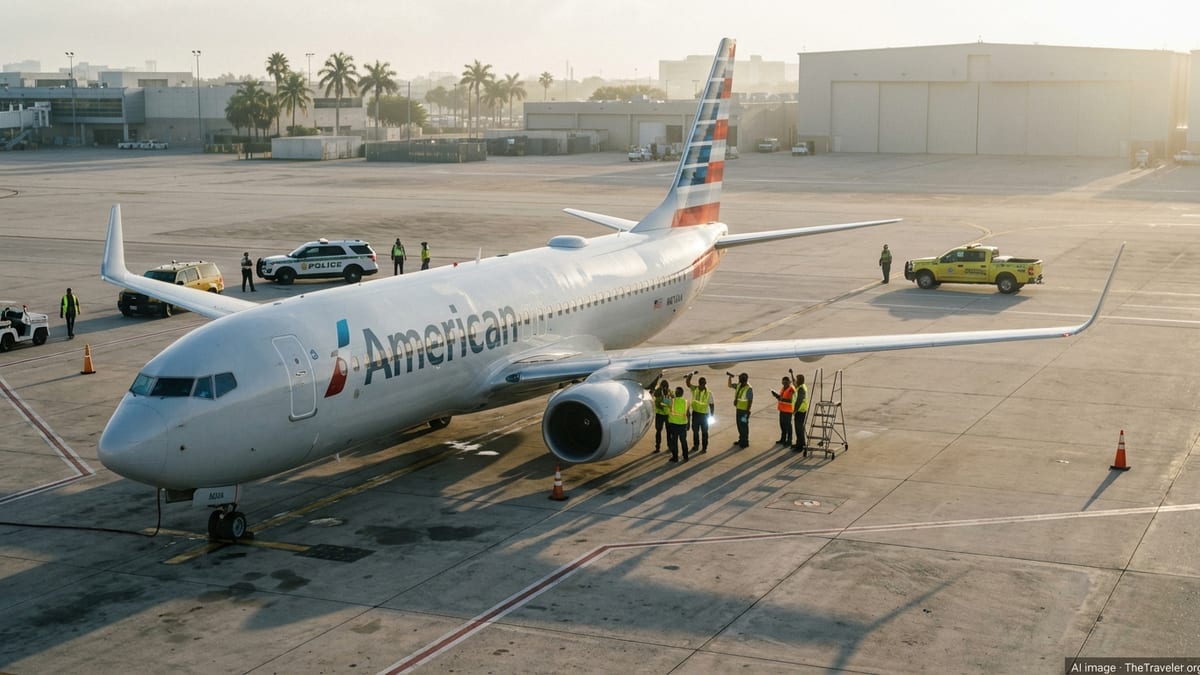
Details of the American Airlines Tire Incident
According to published coverage, an American Airlines Boeing 737 arriving from Miami experienced a tire problem after landing at Chicago O’Hare on the night of May 13, 2026. Reports indicate that two main-gear tires deflated after touchdown while the aircraft was rolling toward its gate, preventing the jet from continuing under its own power.
Publicly available information shows that the flight, identified in local reporting as American Airlines 791, landed normally on schedule before the tire issue emerged on the taxiway. The aircraft came to a controlled stop on the pavement, and airport vehicles responded to the stationary jet as standard procedures were followed.
Passengers were deplaned on the taxiway and moved by bus to the terminal, according to multiple media outlets. There were no reported injuries among the passengers or crew, and there was no indication of fire or structural damage to the aircraft beyond the affected wheels and tires.
Reports indicate that the Boeing 737 was subsequently taken out of service for inspection and maintenance. The event has been logged by federal regulators as an incident, with further review expected to focus on the condition of the landing-gear components and the sequence of events leading to the tire deflations.
How Modern Airliners Handle Tire Failures
While dramatic for those on board, tire failures on large commercial aircraft are events that the industry routinely trains for. Technical guidance and past safety reports note that multi-wheel landing-gear assemblies on jets such as the Boeing 737 are specifically designed to tolerate the loss or deflation of one or more tires without immediate loss of control, provided the failure occurs at low speed and the remaining tires and brakes remain intact.
Aviation safety databases include examples of previous wheel and tire incidents at Chicago O’Hare and other major airports, including historic wheel separations and burst-tire events that were contained without injuries. These cases have informed updates to maintenance programs, inspection intervals and operational guidelines for rejected takeoffs and abnormal landings.
Industry analyses emphasize that runway and taxiway tire issues are typically classified as ground incidents rather than full-scale accidents. Even so, they can temporarily block key taxi routes, slow the movement of other aircraft and require emergency-response resources, which is why airport and airline procedures are tightly scripted to clear the scene and recover the aircraft efficiently.
The American Airlines event at O’Hare fits within this broader pattern of contained mechanical issues. The safe rollout, absence of injuries and controlled deplaning suggest that standard training and aircraft design features functioned as intended once the tire problem was identified.
O’Hare’s Congestion Adds Pressure to Ground Safety
Chicago O’Hare is among the busiest airports in the United States, and traffic-management concerns have been in sharp focus heading into the peak 2026 travel season. Recent coverage of Federal Aviation Administration planning has highlighted measures to reduce scheduled flights at the airport during summer to ease congestion and cut delays.
In such a dense operating environment, even a single disabled aircraft on a taxiway or high-use runway can create ripple effects across the schedule. A jet stopped in place because of flat or damaged tires can force reroutes for arriving aircraft, delays for departures and increased workload for airside ground crews who must coordinate towing, inspections and passenger transfers.
Analysts note that the American Airlines tire incident underlines how minor mechanical problems can quickly intersect with airfield capacity constraints. When an aircraft becomes immobilized, decisions about whether to deplane passengers on the taxiway, tow the aircraft to a remote stand or attempt limited taxiing on remaining wheels all have implications for safety and congestion.
Observers also point to O’Hare’s history of high-profile ground and runway occurrences as part of the context shaping current safety culture. Past investigations into runway excursions, ground collisions and engine-related incidents at the airport have already led to more conservative spacing, enhanced surface-movement guidance and closer monitoring of ground operations.
Landing-Gear Maintenance and Inspection Practices
Publicly available regulatory material indicates that commercial aircraft tires and wheels are subject to strict inspection and replacement cycles, often based on a combination of calendar limits, number of takeoff-and-landing cycles and visual condition checks. Airlines operating large Boeing 737 fleets, including American Airlines, run extensive maintenance programs that specify how frequently components such as tires and brakes must be overhauled.
Safety case studies on past wheel failures show that common contributors can include wear at high cycle counts, foreign-object damage from runway debris, overloading during hard landings and temperature stress from repeated braking. In many cases, the failure manifests as a deflation rather than a complete disintegration, allowing crews to maintain directional control and stop safely.
The O’Hare incident involving the American Airlines 737 is likely to be evaluated in light of these known risk factors. Investigators typically review maintenance records, tire age and cycle counts, and any recent reports of irregular vibrations or pressure anomalies. They may also examine runway conditions at the time, including weather, surface contamination and potential debris that could have compromised the tire structure.
Industry experts often stress that even when the root cause turns out to be routine wear or a singular defect, the information feeds back into fleet-wide maintenance planning. Adjustments can include accelerated replacement intervals for certain tire positions, revised torque and inflation practices, or additional checks after hard-braking events and autobrake activations.
Broader Focus on Ground Risk Management
The American Airlines tire problem at O’Hare comes amid a period of heightened attention to runway and taxiway safety events across U.S. airports. Recent months have seen a series of ground incidents involving airliners and service vehicles, tight runway margins and aborted takeoffs, prompting renewed emphasis on surface-movement training and technology.
Airports and airlines have been expanding the use of surface radar, ground-movement guidance systems and cockpit alerts intended to reduce the risk of runway incursions and other ground conflicts. These tools, combined with procedural changes, are designed to help flight crews and ground controllers quickly identify and react to abnormal situations such as disabled aircraft, foreign objects on the runway or unexpected vehicle crossings.
Within this environment, contained events like the O’Hare tire incident are increasingly seen as opportunities to validate and refine emergency-response playbooks. The handling of passenger deplaning on the taxiway, coordination between airline operations and airport teams, and communication to other flights all become reference points for gauging how well ground-risk management systems are working.
As travel demand remains strong and major hubs like Chicago O’Hare continue to operate near capacity, analysts suggest that continued scrutiny of seemingly minor mechanical incidents will play a central role in preventing more serious events. The American Airlines Boeing 737 tire issue, while not resulting in injuries, is likely to be part of that ongoing effort to strengthen ground safety in a complex and crowded airspace system.