


More news on this day
An American Airlines Boeing 737 MAX 8 operating passenger service AA1560 diverted to Southwest Florida International Airport in Fort Myers for an emergency landing following a mid-route change, according to early flight-tracking data and initial media summaries.
Get the latest news straight to your inbox!
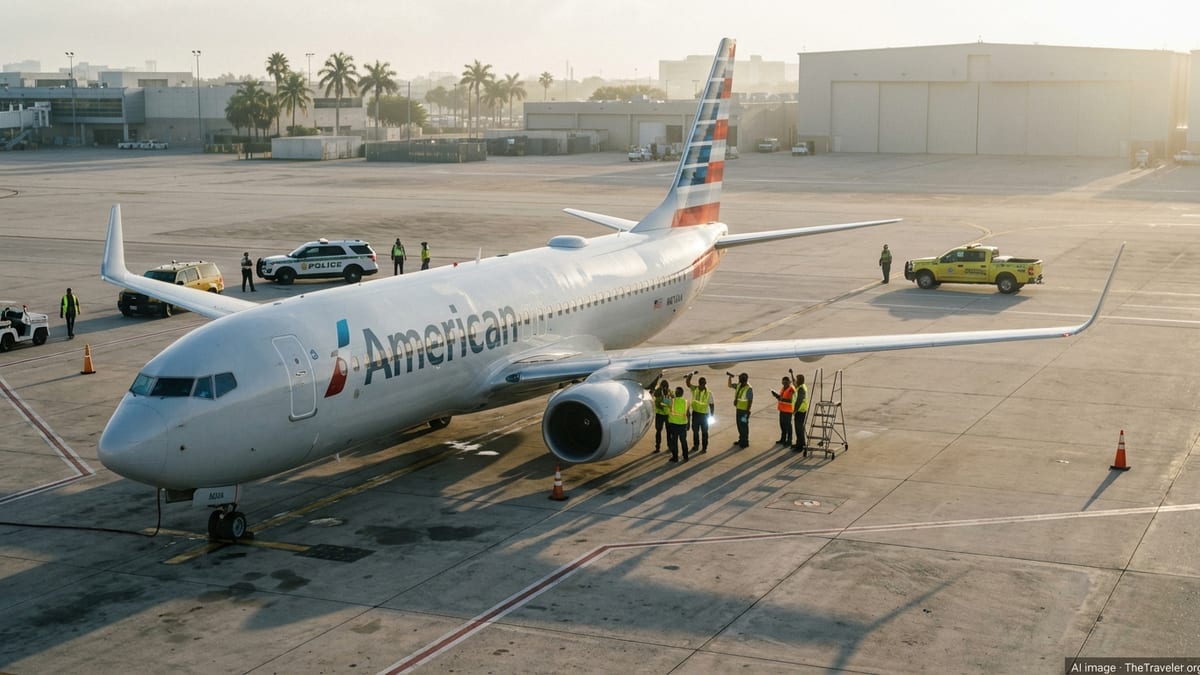
Mid-Route Diversion Interrupts American Airlines Service
Publicly available flight-tracking information shows that Flight AA1560 was operating a scheduled domestic route on Tuesday when the Boeing 737 MAX 8 altered course partway through its journey. The data indicates that the jet began a gradual descent and turned toward Fort Myers rather than continuing on its original track, a pattern that is consistent with a precautionary diversion.
Operational logs suggest the aircraft continued to broadcast normally during the event and maintained a controlled profile during its approach into Southwest Florida International Airport. The descent rate and speed recorded on tracking platforms resemble a managed arrival rather than an abrupt or unstable maneuver, which typically signals that the flight crew had time and altitude to follow standard diversion procedures.
Reports compiled from aviation data services describe the event as an emergency landing tied to an unscheduled mid-route change, rather than a routine diversion for weather or air traffic flow. As of the latest public updates, there were no indications of injuries among passengers or crew, and no immediate signs of structural damage visible in post-landing photographs shared across flight-tracking communities.
The 737 MAX 8 involved in the incident is part of American Airlines’ narrowbody fleet used heavily on domestic and short-haul international routes. The aircraft type is configured for high-frequency operations and is typically scheduled on routes connecting major hubs with sunbelt and leisure destinations, which can increase the operational impact of a single aircraft being taken out of circulation after an event of this nature.
Emergency Landing at Southwest Florida International Airport
Southwest Florida International Airport serves the Fort Myers and Cape Coral region and is accustomed to handling unscheduled diversions due to its long primary runway, multiple instrument approaches, and capacity for wide-ranging commercial traffic. Airport planning and design documents show that the facility is approved for regular operations by large narrowbody jets, including the Boeing 737 MAX family, and is integrated into national diversion planning models published for airlines and dispatchers.
According to publicly available airport diagrams and operational references, Southwest Florida International has a single main runway aligned to support prevailing winds in the region, along with full airfield lighting and modern approach aids. These capabilities make it a practical option for airline crews who need a diversion point on routes that cross the Gulf of Mexico or run along Florida’s west coast corridor.
Travelers on board AA1560 were expected to disembark in Fort Myers while the aircraft underwent standard post-incident checks. Depending on the scale of any technical evaluation, airlines in comparable events often reposition passengers to their original destination using substitute aircraft, rebookings on later services, or ground transport when distances allow. Initial schedule board snapshots circulating on aviation forums and social platforms suggested knock-on delays to subsequent rotations associated with the aircraft and crew.
For Southwest Florida International, episodes of this kind are disruptive but not unprecedented. Diversions for technical, medical, or weather-related reasons periodically funnel additional aircraft into the airport’s operational flow, prompting short-term adjustments in gate usage and ground handling while maintaining normal runway capacity for regular arrivals and departures.
What Is Known and What Remains Under Review
As of the latest available reporting, the precise reason for AA1560’s emergency diversion had not been formally detailed in technical summaries accessible to the public. Flight-tracking traces show no obvious signs of extreme altitude loss, sharp oscillations, or holding patterns that might point clearly toward a specific type of mechanical issue, which leaves room for a variety of possible scenarios, from instrument warnings to cabin-related concerns or medical needs on board.
In comparable events, airlines routinely initiate internal reviews that draw on flight data recorders, onboard diagnostic messages, and post-flight inspection reports. This process can take days or weeks before any broad conclusions are reflected in public safety databases or aviation sector reporting. At this stage, publicly available information primarily documents that an emergency was declared, the aircraft diverted, and the landing at Fort Myers was completed without public reports of injuries.
Regulators and airline safety teams typically treat any emergency landing as a data point within a larger pattern of operational performance. Even when no damage is found after an inspection, the fact that a crew elected to divert and land as a precaution often triggers additional scrutiny of aircraft systems, component reliability, and maintenance intervals, particularly for relatively young fleets such as the 737 MAX 8.
For passengers and observers, the lack of immediate detail can create uncertainty about whether the issue was minor or more serious. Industry analysts often caution that many emergency landings ultimately trace back to conservative decision-making by crews in response to sensor warnings or symptoms that do not result in lasting damage. Until more granular information becomes available, AA1560’s diversion is generally characterized as a safety-focused action rather than evidence of a known systemic fault on that specific aircraft.
Boeing 737 MAX 8 Safety Context for Travelers
The Boeing 737 MAX 8 remains under intense public scrutiny due to its earlier global grounding period, even after extensive software changes, training updates, and regulatory reviews allowed the type to return to service. Since the resumption of operations, the model has flown millions of commercial sectors worldwide, and large United States carriers, including American Airlines, have integrated it into standard fleet planning across domestic and regional networks.
Travel industry coverage focusing on diversion statistics notes that unscheduled landings affect a small fraction of total flights and occur across all major aircraft types, from regional jets to long-haul widebodies. Diversions may be prompted by factors ranging from onboard medical issues and smoke or odor reports in the cabin to conservative responses to cockpit alerts that later prove benign. While any high-profile incident involving a 737 MAX variant attracts rapid attention, experts often emphasize that individual events must be weighed against the overall safety performance of modern commercial aviation.
For travelers uneasy about flying on the 737 MAX 8, episodes such as the AA1560 diversion can reinforce existing concerns. At the same time, publicly available safety data sets from regulators and independent analysts continue to describe United States commercial aviation as one of the safest forms of transportation. Aircraft like the MAX 8 are subject to intensive oversight, repetitive inspection programs, and continuous monitoring of in-service performance indicators that can trigger fleet-wide checks if anomalies appear.
In the absence of confirmed technical findings related to AA1560, analysts stress that it is not yet possible to connect this latest diversion to any specific design or maintenance trend. The event will nevertheless be folded into ongoing monitoring of 737 MAX operations and may inform future fine-tuning of maintenance practices or training curricula if any recurrent themes emerge once the details are fully documented.
Impact on Passengers and Upcoming Travel
The diversion of AA1560 is likely to have caused delays and potential missed connections for passengers whose journeys depended on the original routing. Standard airline practice in similar situations includes providing rebooking options on later flights, offering hotel accommodations when overnight stays are required, and prioritizing onward travel for those with tight international connections or essential time-sensitive plans.
For travelers with upcoming itineraries on American Airlines or other carriers operating the 737 MAX 8, this incident serves as a reminder of the importance of buffer time between flights, especially when connecting through busy hubs or traveling during peak seasons. Travel advisers often recommend avoiding very short layovers and keeping a close watch on airline apps or departure boards on the day of travel, since schedule disruptions can cascade quickly after an aircraft is taken out of service for inspection.
Passengers concerned about aircraft type can typically see the planned model in their booking details or mobile app, although fleet substitutions may occur close to departure. Aviation experts generally encourage travelers to focus on carrier safety records and regulatory oversight frameworks rather than on individual aircraft types, noting that diversions and emergency landings are usually evidence of safety protocols working as intended.
As additional information about AA1560’s diversion becomes available through public databases, industry briefings, or updated media coverage, the event will continue to be a reference point in broader discussions about operational reliability, passenger communication, and traveler confidence in the Boeing 737 MAX 8 across United States domestic routes.