


More news on this day
American Airlines is sharpening its focus on higher-yield travelers, unveiling a multi-year plan that both expands premium seating across its fleet and restores modern seatback entertainment screens on a wide range of aircraft.
Get the latest news straight to your inbox!
Fleet Strategy Shifts Toward Premium Revenue
Publicly available planning documents and recent fleet announcements indicate that American is deep into a strategic reset designed to capture more revenue from premium cabins. The airline has been adding higher-fare seats across multiple aircraft types and pairing those changes with upgrades to inflight connectivity and onboard amenities.
Order disclosures from early 2024 showed American committing to hundreds of new Airbus, Boeing and Embraer jets, with the carrier explicitly linking those purchases to an expansion of premium seating on both mainline and regional fleets. The airline has stated that, once aircraft deliveries and cabin refreshes are complete, the number of premium seats systemwide is expected to rise significantly by the middle of the decade.
That same strategy is now being extended into retrofit programs for existing aircraft. Recent updates from the company describe how narrowbody work, particularly on Airbus A319 and A320 jets, is being used to align interiors with American’s latest premium-focused layout while maintaining high-density main cabins.
Cabin Retrofits Boost First and Extra-Legroom Seats
American’s current retrofit campaign centers on its Airbus narrowbody fleet, where the airline is increasing the size of its forward cabins and refining the overall look and feel of the interior. Information released through the airline’s newsroom shows that refurbished A319 aircraft will feature 12 premium seats, while A320 jets will offer 16, an increase over earlier configurations.
These projects are part of a broader effort to harmonize the onboard experience passengers encounter across domestic routes. Refreshed cabins are advertised as featuring new finishes, additional storage and power access at every seat, alongside high-speed satellite connectivity that covers gate-to-gate usage on most mainline flights.
On regional routes, American has outlined plans for a dual-class-only approach that removes older single-cabin aircraft and standardizes premium seating at the front of the cabin. Company communications emphasize that high-speed Wi-Fi and in-seat power will be available throughout the regional fleet, bringing those aircraft closer in feel to mainline jets and supporting the premium upsell American is targeting.
Flagship Suite and Premium Economy Lead Long-Haul Upgrade
While narrowbody retrofits proceed, American is also overhauling its widebody and long-haul narrowbody cabins around new-generation premium products. The airline has previously introduced its Flagship Suite brand for future Boeing 787-9 and Airbus A321XLR aircraft, highlighting an emphasis on privacy, direct aisle access and significantly upgraded personal space for long-haul travelers.
Investor materials and product briefings describe the Flagship Suite cabins as the anchor of a more upscale international proposition, with American signaling that premium seating on its long-haul fleet will grow markedly as these aircraft arrive. The suites are being complemented by a refreshed Premium Economy cabin offering larger seats, leg rests, enhanced headrests and expanded storage, along with upgraded soft products.
American has also detailed how the A321XLR will debut on select transatlantic and premium transcontinental routes, configured with Flagship Suite at the front and dedicated Premium Economy behind. In the main cabin, these aircraft are set to feature individual inflight entertainment screens and full power access, underscoring a return to hardware-based entertainment on higher-profile services.
Reversal on Seatback Screens After a Personal-Device Bet
For much of the last decade, American distinguished itself from key rivals by moving away from traditional seatback entertainment on domestic narrowbody jets. The carrier removed screens from most Boeing 737 and non-transcontinental Airbus A321 aircraft and promoted a streaming model that relied on customers’ own phones and tablets connected to onboard Wi-Fi.
Industry analysis and passenger commentary, however, have consistently compared that approach unfavorably with United and Delta, which have invested heavily in modern seatback systems. In parallel, American’s own long-haul aircraft continued to carry embedded screens, creating a split experience between domestic and international flying.
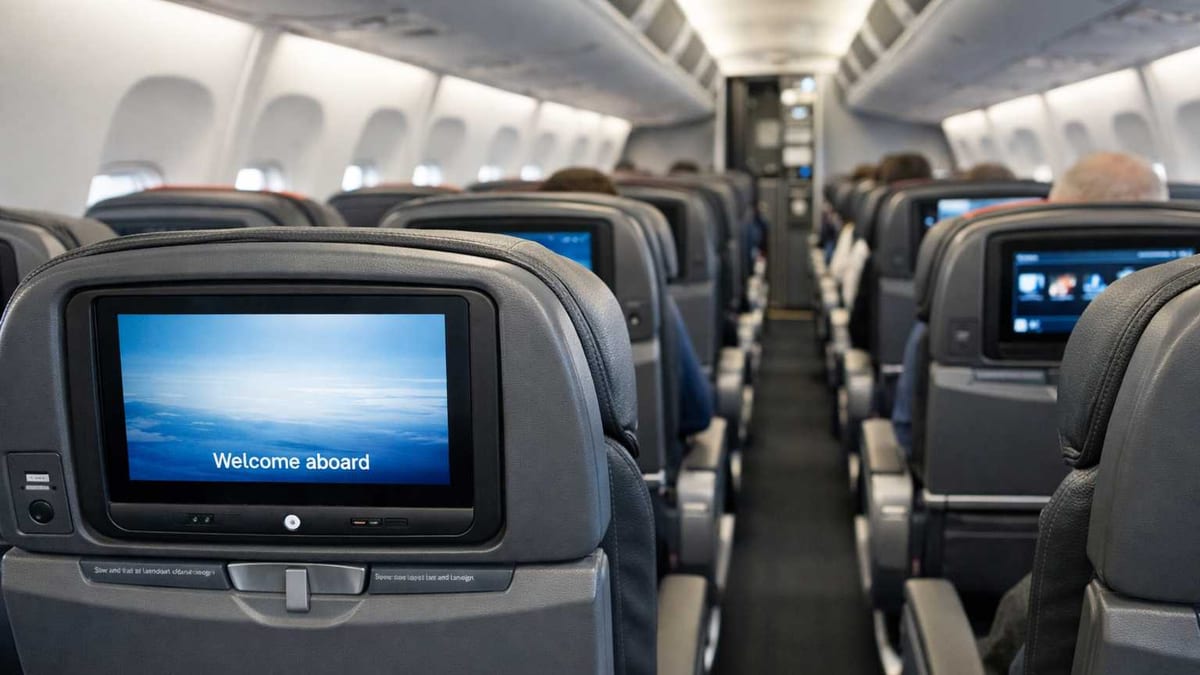
Recent communications tied to the airline’s broader product reset now point to a pivot. Drafted materials describing upcoming cabin programs indicate that American intends to reintroduce advanced seatback screens on its next generation of narrowbody aircraft and on retrofitted jets, a notable reversal from the earlier strategy of relying solely on personal devices.
The move aligns with separate plans to enhance inflight connectivity, including the use of higher-capacity satellite systems and complimentary Wi-Fi for many loyalty members. Together, the changes position onboard entertainment as a hybrid experience in which passengers can both stream to their own devices and access a curated library through an integrated seatback system.
Rollout Timeline and Competitive Implications
According to planning details that have been shared publicly, the reintroduction of seatback screens will be phased over several years and closely tied to new aircraft deliveries and large-scale retrofit lines. New Airbus A321neo and Boeing 737 MAX family jets entering the fleet late in the decade are expected to feature 4K-resolution displays at every seat, Bluetooth support for personal headphones and USB-C power alongside traditional outlets.
Retrofit programs on existing narrowbodies are described as focusing first on aircraft that already visit major hub markets where American faces the strongest competition from rivals that offer more extensive inflight entertainment. Over time, the carrier aims to create a far more consistent experience across its domestic network, narrowing the gap with competitors that market seatback screens as a core differentiator.
Analysts note that the decision to both densify premium cabins and reinvest in hardware-based entertainment could signal a broader shift in how American balances cost control with product investment. By pairing more high-yield seats with a visible upgrade such as large-format seatback screens, the airline appears to be betting that travelers will pay more for a differentiated experience even on shorter flights.
For passengers, the result is set to be a markedly different cabin from the one that defined American’s narrowbody fleet in the late 2010s and early 2020s: more seats at the front of the plane, more power and connectivity in every row, and once again, individual screens lighting up the backs of seats throughout much of the airline’s network.