


More news on this day
A widespread IT outage at American Airlines this week led to a temporary nationwide ground stop by the Federal Aviation Administration, disrupting travel for tens of thousands of passengers and underscoring persistent vulnerabilities in the carrier’s technology infrastructure.
Get the latest news straight to your inbox!
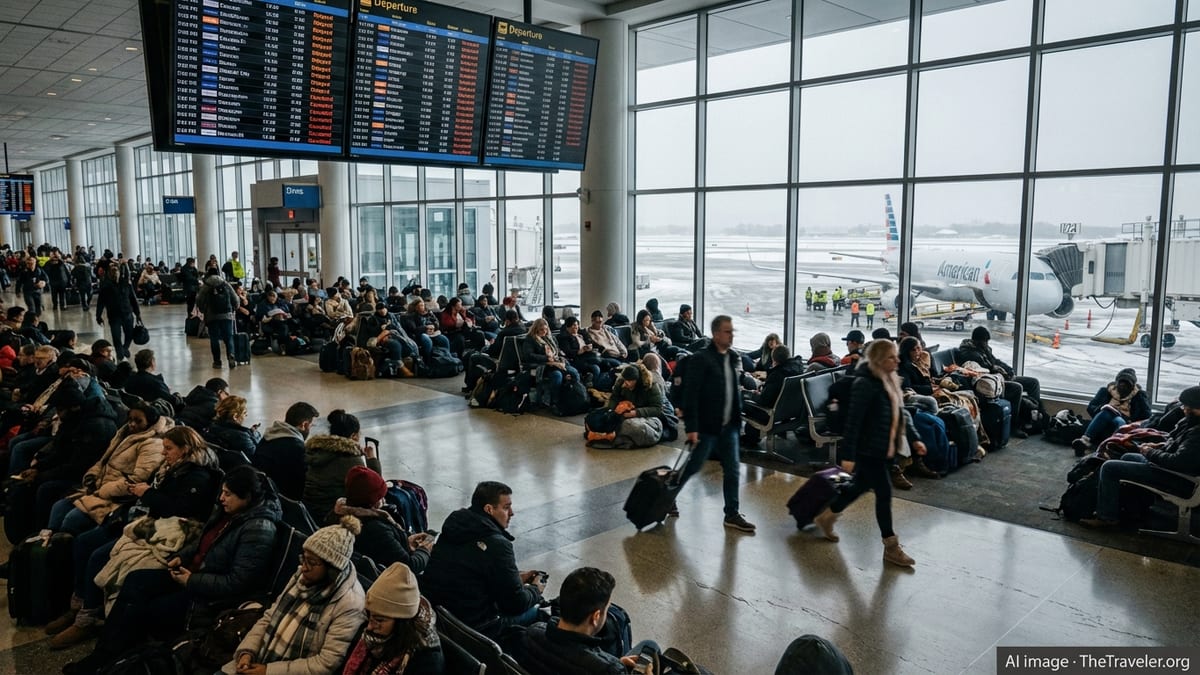
Nationwide Departures Paused After Systems Crash
According to publicly available FAA operational summaries and multiple media reports, the latest disruption unfolded on July 28, when American Airlines experienced a severe systems failure that affected flight dispatch, crew scheduling and related operational tools. The airline requested, and the FAA implemented, a ground stop on American-operated flights that were still on the ground across the United States while teams worked to restore critical services.
Posts from airport workers and travelers on aviation and airline forums described aircraft held at gates and on taxiways as flight crews reported being unable to obtain final clearances or updated flight plans. Public tracking data showed American’s departures sharply dropping during the stoppage period, while aircraft already in the air were allowed to continue to their destinations.
The pause in operations was lifted after what observers characterized as a relatively brief nationwide halt, but delays and cancellations continued to cascade through the network for hours. Hub airports such as Dallas Fort Worth, Charlotte and Phoenix experienced particularly heavy knock-on effects as aircraft and crews fell out of their scheduled rotations.
Third Technology-Linked Ground Stop in Two Years
The July incident marks at least the third occasion in roughly two years in which American Airlines has been directly associated with an FAA ground stop linked to technology problems. Publicly available coverage of a December 2024 disruption describes how a technical issue at the carrier triggered a similar nationwide pause in departures while systems were reset and flight operations gradually restarted.
In addition to these airline-specific outages, travelers on American have also been affected by broader aviation technology failures. In January 2023, a government-wide outage of the FAA’s Notice to Air Missions system temporarily halted all domestic departures, including those operated by American and its regional affiliates, adding to customer perceptions that digital fragility has become a recurring feature of modern air travel.
Industry analysts note that while weather remains the dominant source of delays in the United States, repeated IT-driven stoppages involving the same large carrier focus attention on the resilience of internal systems. American, which operates one of the world’s largest fleets, relies on a complex web of legacy and modern software to manage everything from aircraft routing to crew assignments, customer rebooking and maintenance planning.
Passenger Impact Spreads Across the Network
The immediate impact of the outage could be seen in rapidly climbing delay and cancellation counts at major hubs, according to flight-tracking data referenced in news and aviation reports. Travelers based at Dallas Fort Worth and other American strongholds described long lines, repeated gate changes and difficulty obtaining updated departure times as the airline’s internal tools were brought back online.
Public discussion boards featured accounts from customers who reported being held on board aircraft during the height of the disruption, as crews awaited confirmation that the ground stop had been lifted and that necessary operational data was available. Others described abandoning itineraries altogether, seeking seats on other carriers or rebooking for later days as it became clear that same-day connections would be difficult to salvage.
The ripple effects extended into smaller regional airports served by American’s affiliates. Because these flights depend on timely arrivals and departures at hub airports, even a relatively short nationwide ground stop can disrupt aircraft rotations and crew schedules for the rest of the operating day, leaving some communities with sharply reduced service windows.
Spotlight on Aging Infrastructure and Cyber Risk
Technology specialists quoted in prior analyses of airline outages have long warned that large carriers operate on intricate, layered IT stacks that are difficult to modernize without risking operational instability. Publicly available background on American’s history of disruptions, including a significant systems failure in the 2010s, indicates that the airline has grappled for years with the challenge of integrating newer tools with older core platforms.
The latest incident also renews attention to potential cyber and security risks. While there is no public indication that the July outage was caused by malicious activity, aviation observers highlight that any event capable of prompting a nationwide ground stop illustrates how dependent the system has become on centralized digital infrastructure. That dependence, they note, heightens the importance of rigorous testing, redundancy and rapid rollback plans for software changes.
Government watchdogs have separately pointed out that close coordination between airlines and the FAA is required whenever a major carrier suffers an IT disruption. In some scenarios, published oversight reports explain, airlines may ask the FAA to assist with traffic management measures such as ground stops while they stabilize their systems, both to preserve safety margins and to prevent congestion from compounding the disruption.
What Travelers Can Expect After the Outage
Travel guidance issued by American in recent months for other large-scale disruptions suggests a familiar pattern for customers after this latest event. Passengers whose flights were canceled or significantly delayed are typically offered rebooking on later departures, with change fees waived for affected dates and city pairs, while those who choose not to travel may receive credits under the airline’s standard policies.
Even after the ground stop is lifted, the network can remain unsettled, with aircraft and crews out of position and some routes temporarily short of capacity. Travel industry experts recommend that passengers monitor their reservations closely through airline apps and airport displays, remain flexible about routing and departure times, and build in additional connection time when flying through heavily affected hubs in the days immediately following a major disruption.
For American Airlines, the latest IT failure intensifies scrutiny of ongoing investments in technology reliability and contingency planning. As peak summer travel continues, the carrier faces pressure from customers and investors alike to demonstrate that lessons from repeated outages are being applied to reduce the risk of yet another ground stop tied to its internal systems.