


More news on this day
American Airlines is facing renewed scrutiny of its technology resilience after an IT breakdown linked to a third-party vendor disrupted operations and delayed roughly 1,100 flights, underscoring how dependent modern air travel has become on complex digital systems.
Get the latest news straight to your inbox!
A Brief Outage, Widespread Disruption
Publicly available flight-tracking data and news coverage indicate that a recent glitch affecting American Airlines’ core IT systems forced a short-lived halt to departures and triggered a wave of delays across its network. While the full ground stop lasted only a matter of hours, the shock rippled through schedules for the rest of the day, ultimately affecting about 1,100 flights.
The disruption stemmed from a failure involving a vendor-provided technology platform that American relies on for key operational tasks, including flight planning and crew management. When connectivity to those systems faltered, aircraft that were already in the air continued to their destinations, but many departures on the ground were unable to proceed until manual workarounds were put in place and systems were brought back online.
Reports show that cancellations at American remained relatively limited compared with the volume of delayed flights, reflecting an effort to preserve the schedule by holding aircraft rather than scrapping large numbers of departures. Even so, many travelers experienced missed connections, long queues at airport customer-service desks and difficulty rebooking through congested call centers and mobile channels.
American described the incident in public statements as the result of a technology issue, not a security breach or cyberattack, mirroring the language used by other airlines after similar disruptions. The carrier said systems were restored and that operations had largely recovered by later in the day, though residual delays persisted into subsequent flights.
Part of a Pattern of Aviation IT Failures
The latest breakdown at American did not occur in isolation. In July 2024, a faulty software update from cybersecurity firm CrowdStrike caused a global IT outage that hit Windows-based systems at airlines, airports, banks and hospitals. That incident forced Delta Air Lines, United Airlines and American to issue temporary ground stops, ultimately canceling or delaying thousands of flights in the United States and abroad.
Industry analyses of the July 2024 event show that American recovered more quickly than some rivals, yet still suffered hundreds of cancellations and delays as systems were restored and crews and aircraft were repositioned. In its subsequent financial reporting, the airline acknowledged that the global technology outage significantly affected operations and contributed to irregular operations costs and customer-service challenges.
Aviation experts note that large carriers are now deeply intertwined with a web of third-party technology suppliers, from cybersecurity firms to flight-planning vendors and reservation-system providers. A misconfigured software update or outage at any one of these partners can cascade rapidly across an airline’s own networks, affecting everything from check-in kiosks to crew scheduling.
Beyond vendor incidents, the sector has seen other technology flashpoints in recent years, including outages at major air-traffic and telecommunications systems that temporarily restricted flights into key hubs. For American, additional disruptions have been linked to infrastructure issues such as damaged fiber-optic lines that impaired communications at Dallas Fort Worth, one of its primary bases.
Why a Single Glitch Can Ground an Airline
The scale of disruption from a relatively brief IT failure reflects the complexity and tight coupling of modern airline operations. A large carrier like American coordinates thousands of daily flights, tens of thousands of crew members and millions of passengers through a tightly choreographed network. Schedules are built on precise aircraft rotations and duty-time limits for pilots and flight attendants.
When an IT system at the center of that network fails, operations can quickly lose visibility into where crews are, which aircraft are ready for departure and whether key safety and maintenance checks have been completed. Even if the technical fix is applied in hours, the resulting operational backlog can take much longer to unwind as crews hit their contractual or regulatory time limits and aircraft are left out of position for subsequent flights.
Analysts say that airlines have invested heavily in automation to improve efficiency, but that these same systems can become single points of failure when not backed by robust redundancy and manual contingency plans. During major outages, airline staff often resort to paper-based procedures and phone calls to coordinate flights, a labor-intensive approach that inevitably slows the operation.
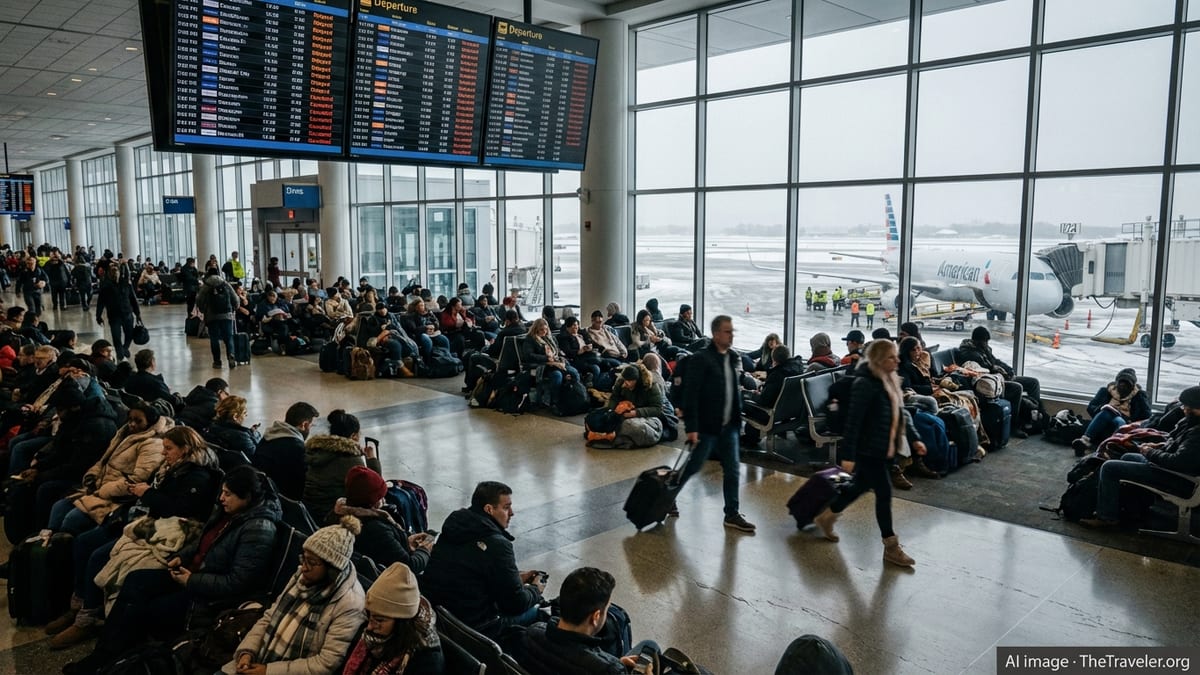
At airports, that slowdown is visible to travelers in the form of mounting departure boards filled with delays, long waits for gate assignments and aircraft that sit parked as ground crews await clearance to begin boarding. Even a relatively small share of a day’s schedule affected at a hub can create knock-on problems across a carrier’s entire network.
Could It Happen Again?
Technology and risk specialists say there is little doubt similar incidents will recur, not only at American but across the global airline industry. Carriers operate huge, interconnected digital ecosystems built over decades, often combining legacy mainframe applications with newer cloud-based tools and external software as a service. This patchwork can be resilient in some ways but also introduces numerous failure points and integration challenges.
Regulatory and industry assessments following the July 2024 global outage have highlighted concerns about concentration risk, in which multiple airlines and airports depend on a relatively small number of underlying IT and cybersecurity providers. When a single vendor’s update fails, the impact can spread rapidly across many carriers at once, leaving few alternative pathways to keep flights moving.
Experts argue that airlines will need to push for more rigorous testing of software updates, improved rollback mechanisms and clearer options for delaying or staging deployments to mission-critical systems. There is also growing focus on building independent backup systems, including the ability to switch quickly to secondary data centers or separate platforms if a vendor outage occurs.
For American and its peers, the challenge is to make those investments while managing cost pressures in a highly competitive market. Some improvements, such as enhanced redundancy in crew-management and dispatch systems, are expensive and complex to implement across global networks. Others, including better incident response planning and clearer passenger communication when outages occur, may be less costly but still require sustained attention.
What Travelers Can Expect Going Forward
Despite the disruption caused by the latest incident, American and other major carriers have stressed that aviation remains one of the safest forms of transportation, with multiple safeguards to prevent technical issues from undermining flight safety. Most recent outages have affected scheduling and customer service functions rather than critical onboard systems.
Travel specialists say, however, that passengers should be prepared for occasional technology-related disruptions to persist. During large-scale outages, it is common for call centers and mobile apps to become overwhelmed, making it difficult to rebook quickly. Travelers on tight connections or complex itineraries are often most exposed to cascading delays when a carrier’s network experiences irregular operations.
In response to rising scrutiny, airlines have expanded policies that allow fee-free changes or refunds in the event of major IT failures, particularly when disruptions are clearly within the carrier’s control. Publicly available information from regulators also indicates a growing appetite to examine how airlines plan for and mitigate technology risks, including expectations around customer care during extended disruptions.
For now, the delayed 1,100 flights at American stand as another reminder that the convenience of highly digitized air travel comes with vulnerabilities. As airlines, vendors and regulators weigh new safeguards, millions of passengers remain directly exposed to what happens when the systems keeping flights on schedule suddenly go dark.