


More news on this day
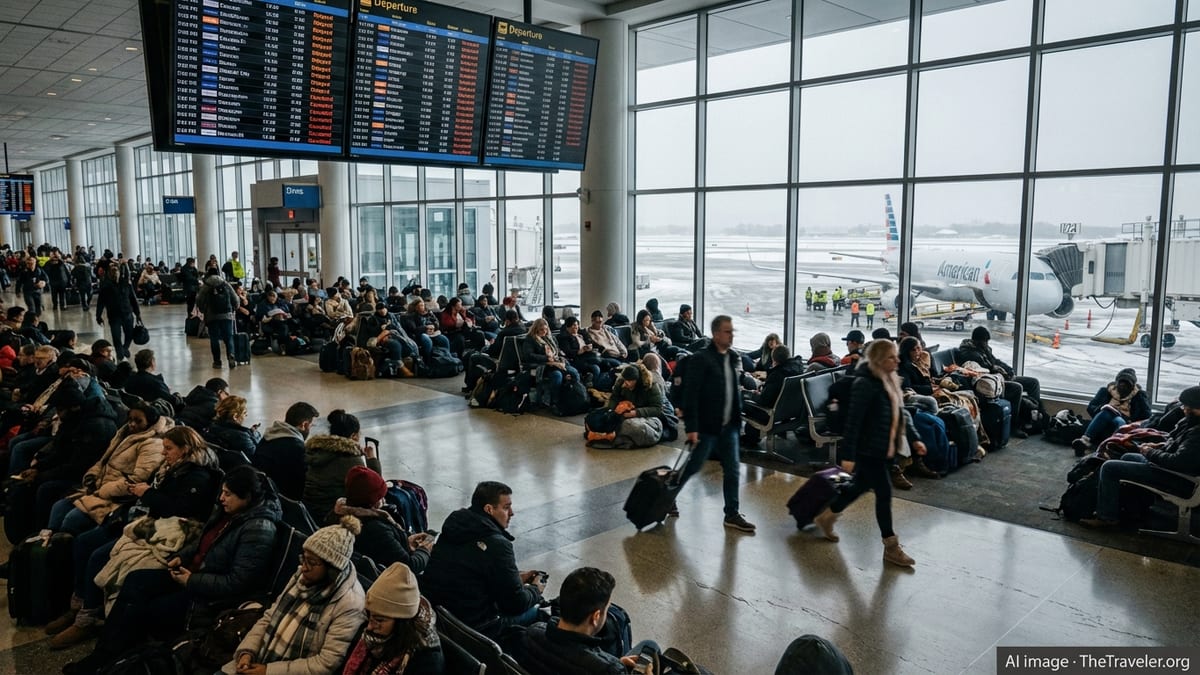
Travelers at Washington’s Reagan National Airport faced cascading delays and cancellations after a technology disruption affecting American Airlines’ QR code-based systems triggered what observers described as an aviation meltdown, with roughly one in three departures scrapped and lines snaking through terminals.
Get the latest news straight to your inbox!
QR Code Strategy Backfires Amid System Turbulence
Publicly available data on Monday showed American Airlines experiencing an unusually high rate of cancellations at Ronald Reagan Washington National Airport, with estimates placing the figure at around 34 percent of the carrier’s schedule. The disruption coincided with reports of difficulties scanning mobile boarding passes and QR codes at security checkpoints and boarding gates, creating choke points across the terminal.
American Airlines has spent recent years promoting a largely digital journey, encouraging passengers to rely on QR code boarding passes stored in its mobile app or digital wallets. According to information on the airline’s own platforms, the carrier pitches mobile passes as a seamless way to move through the airport, provided local screening points and gate systems are configured to accept them. When that ecosystem functions, passengers can move from check-in to boarding with minimal paper involved.
On this occasion, travelers arriving at Reagan National encountered the opposite experience. Social media posts and passenger accounts described boarding systems struggling to recognize QR codes, agents reverting to manual processing, and aircraft left waiting at gates while manifests and seat assignments were rebuilt. The backlog compounded through the day, as each delayed departure limited the carrier’s ability to reposition aircraft and crews for later flights.
Observers noted that the outage underscored a central vulnerability in the industry’s shift to mobile-first travel. When digital tokens serve as the primary means of passenger identification and boarding, any breakdown in scanning hardware, connectivity, or back-end software can quickly ripple across an entire operation, particularly at a hub or focus city with tight schedules like Reagan National.
Reagan National’s Tight Operating Environment Amplifies Disruption
Reagan National occupies a constrained footprint on the edge of downtown Washington, with limited runway capacity, strict slot controls, and tightly choreographed arrival and departure windows. Aviation reference materials portray the airport as one of the nation’s most capacity-sensitive fields, where even modest disruptions can push operations out of alignment for hours.
Under ordinary circumstances, the airport’s slot system and high-frequency shuttles to major East Coast markets allow airlines to maintain a brisk cadence of short-haul flights. That structure leaves little room for error when an airline encounters system problems. As cancellations mount, open gates remain occupied, incoming aircraft circle or divert, and crews struggle to remain within their regulated duty limits.
On the day of the QR code-related fallout, reports from passengers suggested that other airlines at Reagan National were affected primarily by knock-on congestion rather than outright system failures, while American bore the brunt of cancellations. That asymmetry fueled questions about the resilience of the carrier’s internal technology and contingency planning for its Washington operation, which functions as a key spoke in its East Coast network.
For local travelers, the impact was immediate. People attempting to commute between Washington and business hubs such as New York, Boston, and Chicago encountered abrupt cancellations, lengthy phone wait times, and fully booked later departures. Some passengers recounted rerouting through Washington Dulles or Baltimore, adding hours and complexity to trips that normally take less than an hour in the air.
Passenger Experience Frays as Rebooking Options Shrink
As cancellations climbed, rebooking proved increasingly difficult. Publicly available flight status boards showed dense clusters of red next to American’s departures from Reagan National, while remaining flights on competing carriers filled rapidly. With aircraft and crews out of position, the standard playbook of shifting affected travelers to the next departure often was not available.
Accounts shared online described customers queued at service counters stretching deep into concourses, waiting to secure hotel vouchers, meal credits, or alternative routings. Many reported receiving automated notifications of cancellations without clear explanations, followed by generic offers to rebook through airline apps that were themselves sluggish under heavy demand.
Consumer advocates pointed to the episode as another example of how technology that is designed to streamline travel can, without robust backup plans, magnify stress when it fails. Passengers who had relied solely on mobile passes found themselves improvising, screenshotting QR codes, hunting for printers, or asking agents for paper boarding documents as systems were rebooted.
Travel forums also highlighted confusion over compensation rights. Guidance circulated reminding travelers that reimbursement typically depends on whether disruptions are classified as within the airline’s control, such as crew scheduling or software failures, or as external events like severe weather or air traffic restrictions. In a complex outage involving both local congestion and carrier-specific IT issues, that distinction can be difficult for passengers to parse in real time.
Questions Raised Over Airline Tech Resilience
The disruption at Reagan National added to a growing body of incidents that have drawn attention to airline technology infrastructure. Industry coverage in recent years has documented situations where software bugs, scheduling platform glitches, or electronic flight bag issues have forced carriers to ground flights or revert to manual processes, sometimes for hours at a time.
Analysts observing the latest turbulence argued that American’s heavy reliance on QR code-based and app-driven workflows at its Washington operation may have contributed to the scale of the meltdown when problems emerged. If gate agents, ground staff, and passengers all depend on the same set of digital tools, a single failure can create a bottleneck affecting check-in, security, boarding, and departure control.
Some aviation commentators suggested that the Reagan National episode is likely to intensify scrutiny from policymakers and consumer groups regarding the robustness of airline IT systems. The Washington location, coupled with the visibility of a roughly one-third cancellation rate for a major carrier on a single day, ensured that the disruption drew national attention across travel and business media.
Industry observers noted that carriers have poured significant investment into smartphone apps, automated rebooking tools, and biometrics, but have not always matched those advancements with equally visible contingency measures. For travelers, the question emerging from the Reagan National turmoil is whether airlines will now prioritize redundant systems, clear communication protocols, and simpler fail-safes such as easy access to paper documentation when digital strategies falter.
Travelers Look for Practical Workarounds
In the wake of the meltdown, frequent travelers using Reagan National exchanged advice on how to navigate future disruptions. Common suggestions included monitoring multiple nearby airports, such as Washington Dulles and Baltimore/Washington International, to widen rebooking options, as well as keeping an eye on real-time flight tracking services that aggregate cancellation and delay statistics by carrier and airport.
Many travelers indicated they intend to arrive earlier at Reagan National on peak travel days, particularly when weather or national airspace issues could interact with carrier-specific constraints. Others described a renewed preference for carrying printed confirmations and requesting physical boarding passes at kiosks or counters, even when QR code passes are functioning normally.
For residents and business travelers in the Washington region, the events at Reagan National served as a reminder that aviation systems remain highly interconnected and, at times, fragile. While digital check-in and QR code boarding have made air travel more efficient under normal conditions, the American Airlines disruptions at the airport showed how quickly that convenience can unravel when key systems fail.
As schedules at Reagan National gradually stabilized, attention turned to what changes might follow. Whether through software upgrades, new backup procedures, or adjustments in how digital tools are deployed at slot-constrained airports, the pressure is likely to mount on airlines to demonstrate that their technology-first strategies can withstand the stress of real-world disruptions without leaving thousands of passengers stranded in the terminal.