


More news on this day
A sinkhole discovered near a main runway at New York City’s LaGuardia Airport on Wednesday has forced the closure of a critical stretch of pavement, triggering hours of delays and hundreds of cancellations at one of the nation’s busiest air hubs.
Get the latest news straight to your inbox!
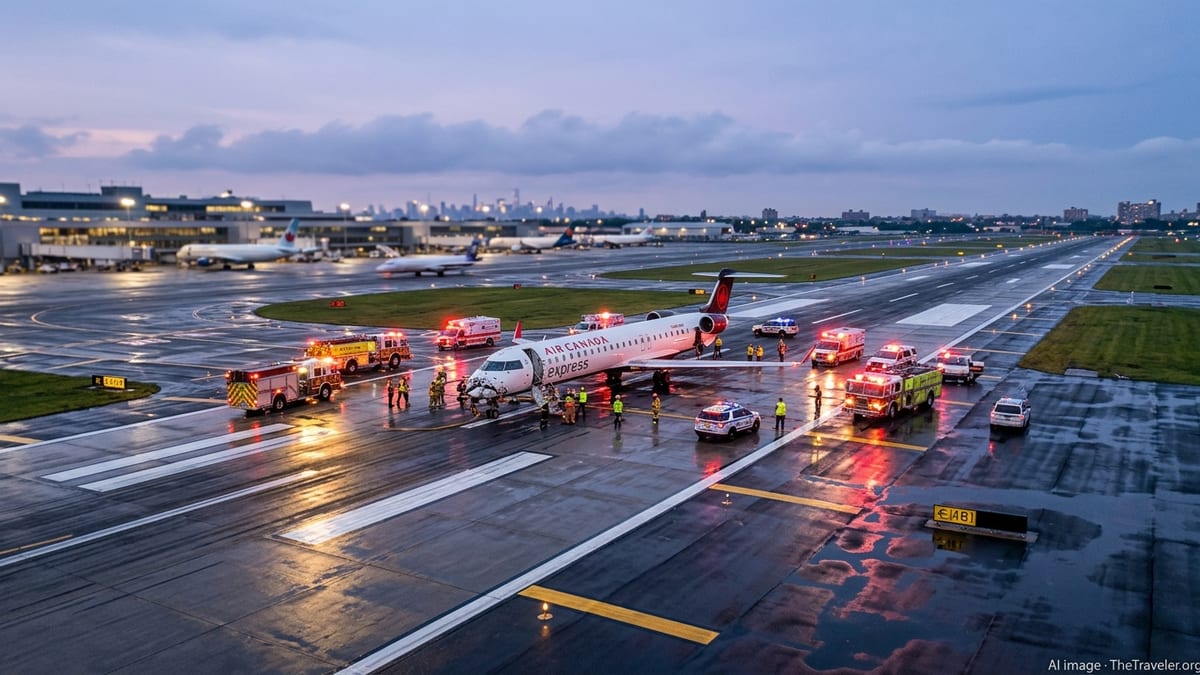
Runway 4/22 Closed After Routine Inspection Discovery
Publicly available information shows that the disruption began late Wednesday morning, May 20, when airfield crews conducting a routine inspection spotted a depression near Runway 4/22, one of LaGuardia’s two primary runways. Reports indicate that the hole was located on or adjacent to a taxiway at the runway’s edge, close enough to active operations that the Port Authority of New York and New Jersey ordered an immediate shutdown of the strip.
Coverage from multiple outlets describes the affected area as a sinkhole rather than a surface pothole, prompting emergency pavement assessments and excavation work on the airfield. Images shared by local broadcasters show construction vehicles and crews clustered around the damaged section of pavement, with portions of the runway environment cordoned off as engineers work to determine the extent of the subsurface void.
Runway 4/22 normally handles a significant share of LaGuardia’s daily traffic, particularly during certain wind and weather conditions. With that runway removed from use without warning, air traffic managers were left to funnel arrivals and departures through the remaining runway configuration, constraining capacity at an airport already known for tight operating margins.
Preliminary reports indicate that there were no injuries and no aircraft incidents linked to the appearance of the sinkhole. The disruption has been driven entirely by precautionary closures and the operational knock-on effects of suddenly losing a major piece of runway infrastructure.
Ground Delays and Cancellations Ripple Across the Network
Flight-tracking data cited in published coverage shows that the runway closure quickly translated into a ground delay program for LaGuardia, as the Federal Aviation Administration reduced the rate of inbound traffic to match the airport’s temporarily diminished capacity. According to aggregated data from services such as FlightAware, airlines operating into and out of LaGuardia recorded close to 200 cancellations and a similar number of significant delays by late Wednesday.
Average departure delays reportedly climbed to around an hour and a half, with many flights held at their origin airports rather than being allowed to depart into already constrained New York airspace. Some travelers described being kept on aircraft for extended periods before returning to gates, while others reported day-of cancellations that forced rebooking for Thursday or later.
Because LaGuardia serves as a major node in domestic networks for carriers including Delta Air Lines, American Airlines, and United Airlines, the impact was not limited to New York. Disruptions in Queens sent shockwaves through connecting schedules around the country as aircraft and crews were left out of position. Afternoon and evening banks in cities as far away as Dallas, Chicago, and Atlanta saw schedule changes that publicly available information links back, at least in part, to the constrained operations at LaGuardia.
Passengers were urged through airline channels and public advisories to monitor their flight status closely and to anticipate longer than usual waits, particularly as the sinkhole incident coincided with periods of unsettled weather in the New York region.
Weather Compounds Disruption at Congested Airfield
Reports indicate that the timing of the incident could hardly have been worse from an operational standpoint. The sinkhole discovery came on a day when forecasters were already calling for thunderstorms in the New York metropolitan area, a combination that further limited the airport’s usable arrival and departure windows.
Publicly available FAA information shows that when convective weather enters the region, LaGuardia often operates under flow restrictions even under normal conditions. With one runway out of service, planners were forced to stack additional spacing between flights, reducing throughput at exactly the moment when demand remained high and meteorological conditions were deteriorating.
Travel industry analysts note that LaGuardia’s compact footprint and lack of parallel runway systems leave little buffer when unexpected infrastructure issues arise. Unlike larger fields with multiple long runways and extensive taxiways, LaGuardia operates on a relatively small piece of reclaimed shoreline, which can make recovery from any disruption slower and more complicated.
The combination of runway loss and weather meant that delays extended well beyond the immediate discovery window. Some flights scheduled for the evening peak saw their departure times pushed back repeatedly before ultimately being canceled, according to traveler reports and airline status boards.
Engineers Race to Stabilize Pavement and Assess Risk
Construction and engineering teams were dispatched to the affected section of Runway 4/22 shortly after the sinkhole was identified. Published coverage indicates that crews moved quickly to excavate around the void, stabilize the subgrade, and evaluate whether nearby pavement had been undermined by subsurface erosion or water movement.
Specialists in airfield pavement note that sinkholes at airports can stem from a variety of causes, including aging stormwater or drainage systems, compromised utility corridors beneath the surface, or deeper geologic vulnerabilities. LaGuardia’s airfield sits on a combination of infill and historic marshland along the Flushing Bay shoreline, a setting that has long required intensive maintenance to manage settlement and subsurface water.
In the short term, the response has centered on isolating and repairing the visible damage to return at least partial use of the runway as quickly as safety standards allow. That work typically involves removing cracked pavement, backfilling and compacting the subsurface layers, and installing new, reinforced asphalt or concrete capable of withstanding repeated aircraft loads.
Longer term, the incident is expected to prompt a broader structural review of the runway environment. Aviation analysts suggest that authorities may expand inspections around Runway 4/22, reexamine drainage and utility maps, and consider whether additional ground-penetrating surveys are needed to identify any other weak spots before they evolve into larger voids.
Renewed Focus on Resilience at a Critical Gateway
The sinkhole has arrived at a time when LaGuardia is already in the spotlight for its ongoing transformation from aging facility to modernized gateway. Recent terminal rebuilds and airside projects have significantly upgraded the passenger experience, yet the sudden failure of critical pavement underscores how vulnerable legacy infrastructure can remain beneath the surface.
Transportation researchers point out that LaGuardia consistently ranks among the nation’s more delay-prone airports, owing to its constrained runway layout, high demand, and dense surrounding airspace. An unexpected closure of one of its two main runways magnifies those structural challenges, leaving little flexibility to absorb shocks without cascading disruption across the broader network.
Travel industry observers say the incident is likely to feed into wider policy discussions about infrastructure resilience at major coastal airports, many of which face rising maintenance demands linked to aging construction, heavy use, and increasingly volatile weather. While sinkholes of this type remain relatively rare on active runways, the scale of the impact from a single localized failure at LaGuardia offers a vivid illustration of how small physical defects can produce outsized consequences for travelers.
For now, publicly available information suggests that the priority remains returning Runway 4/22 to safe service and clearing the backlog of disrupted flights. Passengers with upcoming trips through LaGuardia are being advised through airline channels to allow extra time, remain flexible with travel plans, and stay alert for further schedule adjustments as repairs continue and operations gradually normalize.