


More news on this day
Amsterdam’s postcard-perfect canals, lined with gabled houses and world-famous museums, are facing mounting pressure as visitor crowds, clogged waterways and rising travel congestion intensify debates over how much tourism the compact Dutch capital can bear.
Get the latest news straight to your inbox!
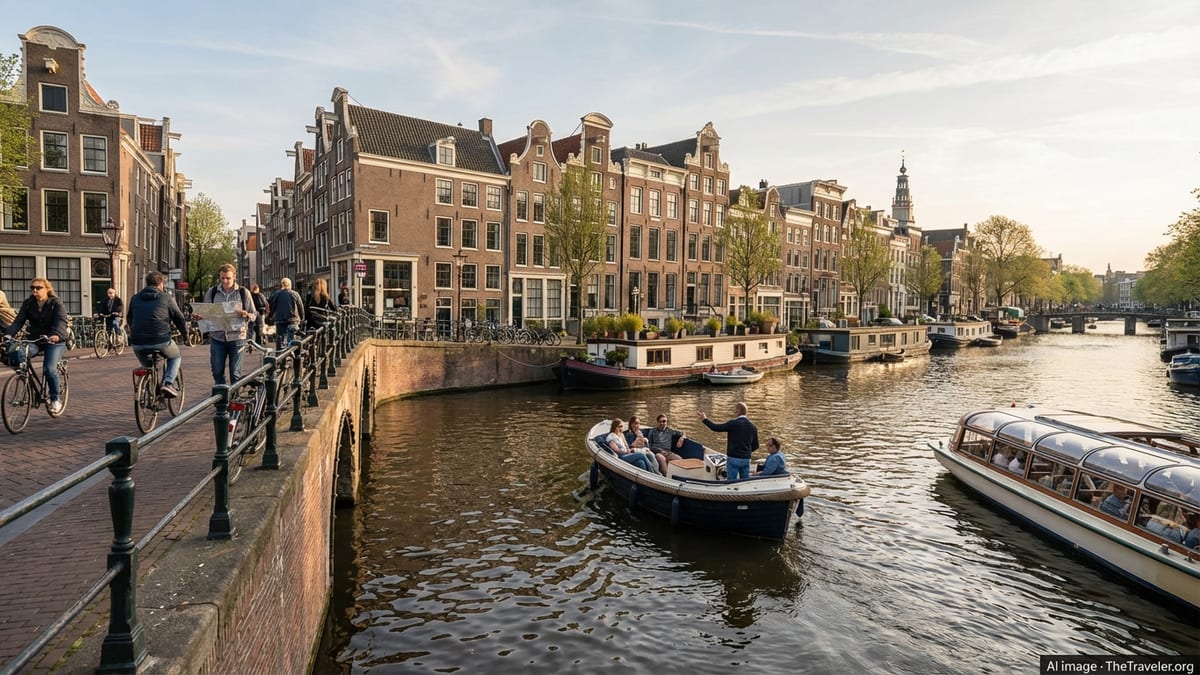
Visitor Numbers Surge Back, Straining a Compact Canal City
Recent visitor forecasts for Amsterdam show that tourism has not only rebounded after the pandemic but is again pushing against the city’s self-imposed limits. Research from the city’s statistics office indicates tens of millions of overnight stays and day trips annually across the wider metropolitan area, with the historic centre absorbing a disproportionate share of those crowds. The canal belt, a UNESCO World Heritage site, is among the most visited districts, funnelling tour groups, canal boats, bikes and trams through streets originally designed for horses and handcarts.
Publicly available information shows that local policymakers have set caps on hotel beds and are exploring further limits on the volume of visitors entering the old centre. Planning documents for the visitor economy up to 2026 describe a deliberate strategy to manage growth rather than simply promote it, reflecting a wider European trend of cities reassessing mass tourism. In Amsterdam’s case, the challenge is amplified by the city’s small footprint and tightly packed historic waterways, where even modest increases in visitor traffic are quickly felt.
Reports indicate that residents in canal districts have raised concerns about late-night noise, waste, overcrowded trams and packed pavements that make everyday errands difficult. At peak moments in high season, narrow bridges and quays become chokepoints as pedestrians, cyclists and delivery vans compete for limited space. The result is a sense that the celebrated liveability of the Dutch capital is being eroded in the very neighbourhoods that attract visitors in the first place.
Analysts of urban tourism note that Amsterdam now finds itself at a crossroads between a volume-driven visitor model and a more selective approach that emphasises cultural depth and higher-value trips. The city’s current trajectory suggests a gradual pivot toward the latter, but the pace and scope of change remain contested among businesses, residents and regional stakeholders who rely on visitor spending.
Canal Cruises, Cruise Ships and Choked Waterways
The canals that once powered Amsterdam’s Golden Age commerce now carry an almost continuous procession of sightseeing boats, party vessels and shared cruises. Local impact assessments point to congestion at popular junctions, where multiple tour boats queue for bridge clearances, creating delays not only for visitors but also for essential services and residents who rely on waterborne logistics. Noise from amplified music on some private and charter boats has added to tensions with people living along the waterways.
At the maritime edge of the city, larger cruise tourism is under particularly intense scrutiny. Published coverage in Dutch outlets highlights a policy pathway that seeks to sharply reduce sea and river cruise calls at the central Passenger Terminal over the coming years, with plans to relocate large-ship operations to facilities outside the historic core by the mid-2030s. Port documents outline interim steps, including tighter caps on cruise calls and a requirement for vessels to plug into shore power rather than run engines while docked.
These moves follow years of debate over whether cruise passengers bring sufficient economic benefit to justify their environmental and spatial footprint. Analyses cited in recent reports suggest that cruise visitors often spend less per day than city-break tourists staying in hotels, while contributing significantly to emissions, canal-side crowding and pressure on local transport. In response, the city is leaning toward a model that privileges longer stays over brief mass arrivals from the waterfront.
On the canals themselves, Amsterdam has already limited licences for tour boats and introduced stricter rules around noise, alcohol and safe navigation. Authorities are also advancing technical solutions such as electric propulsion for commercial vessels to reduce emissions and disturbance. Together, these steps aim to preserve the atmosphere of the canal belt as a living neighbourhood while keeping its signature waterborne sightseeing experiences viable.
Hotels, Taxes and the Cost of a Night on the Canal Ring
Amsterdam’s approach to managing visitor pressure increasingly targets where and how people stay in the city. Media coverage across Europe notes that the capital now has one of the continent’s highest tourist taxes, with hotel guests paying a percentage surcharge on top of room rates. In June 2026, local political plans surfaced to raise this levy further over several years toward a significantly higher rate, signalling that price instruments are becoming a central tool in the tourism debate.
Separately, new hotel construction has been largely frozen under a policy that allows only limited exceptions when an older property closes and capacity is effectively swapped. Euronews and other outlets report that the city aims to prevent the total number of hotel beds from rising, arguing that infrastructure such as public transport, waste collection and public space has already reached a saturation point in many central districts.
While these measures may ease pressure on the canal belt and neighbouring quarters, they also reshape the economics of visiting Amsterdam. Higher nightly costs and scarcer central accommodation may nudge some travellers toward shorter stays, alternative districts or even other cities in the Netherlands. Tourism analysts warn that if mainstream accommodation becomes too expensive or constrained, demand can spill into unregulated short-term rentals, potentially tightening an already pressured housing market for residents.
The fiscal revenues generated by higher visitor taxes are being closely watched by advocacy groups, which argue they should be channelled into maintaining historic infrastructure, reinforcing canal quays and investing in cleaner transport. With parts of the city’s 17th-century quay walls already under strain and requiring expensive reinforcement works, the link between tourism income and long-term preservation of the canal landscape is becoming a central part of the policy conversation.
Red-Light District, Erotic Centre Plans and Shifting Flows
Few areas illustrate Amsterdam’s overtourism dilemma more vividly than De Wallen, the historic red-light district where narrow alleys meet some of the city’s oldest canals. Over the past decade, the quarter has transformed into a round-the-clock spectacle for international stag parties and social media sightseers, often to the frustration of sex workers and residents. Publicly available policy papers describe the area as overburdened by excessive crowds, street drinking and nuisance behaviour that undermines safety and dignity.
To rebalance this part of the city, plans have been developed for a new erotic centre away from the medieval core. The official project outline envisions a modern, regulated complex offering windows, entertainment and support services, with the dual aim of improving working conditions and reducing crowd pressure on De Wallen’s historic canals and streets. However, the proposal has triggered strong reactions in potential host neighbourhoods, where residents fear importing the very problems the project is intended to solve.
According to Dutch media reports, political support for the erotic centre has wavered, resulting in delays and fresh consultations ahead of municipal elections. This uncertainty leaves the red-light district in a holding pattern, with existing restrictions on guided tours and street alcohol sales only partially easing congestion. For now, De Wallen remains a magnet for low-cost party tourism that bucks the city’s ambition to highlight art, heritage and local life instead of nightlife excess.
Urban planners warn that without a clear outcome on the erotic centre and broader mobility measures, canal-front streets in the old core may continue to serve as a pressure valve for competing interests. The tension between maintaining an authentic, lived-in neighbourhood and accommodating global curiosity about Amsterdam’s liberal reputation remains unresolved, keeping the red-light district at the heart of the city’s struggle with overtourism.
Protecting Golden Age Heritage While Keeping the City Moving
Beneath the crowds and congestion lies a deeper question about how Amsterdam can protect its 17th-century canal ring, world-class museums and intimate streetscapes while functioning as a modern, mobile city. Engineering reports over the past several years have highlighted structural problems in quay walls and bridges that were never designed for today’s combination of delivery vans, tourist coaches and constant foot traffic. Emergency repairs and long-running construction sites around the canals are now a familiar sight.
The visitor economy vision for the coming decade, as outlined in municipal strategy documents, seeks to couple tourism management with large-scale investment in sustainable mobility. Proposals range from expanding public transport links to outlying districts and regional towns to better cycling routes that encourage visitors to explore beyond the central ring. There is also a growing emphasis on digital tools that can steer people to lesser-known museums, parks and waterfronts, relieving pressure on marquee attractions like the Rijksmuseum, the Van Gogh Museum and the Anne Frank House.
Observers note that Amsterdam is moving closer to a “quality over quantity” tourism model that favours longer, culture-focused stays over short, party-oriented trips. Measures such as restrictions on holiday rentals, communication campaigns discouraging nuisance tourism and stricter rules on smoking and drinking in public aim to reset expectations about what kind of behaviour is welcome in the city. Whether this strategy will reduce congestion in practice remains an open question, but it signals a deliberate shift in how Amsterdam presents itself to the world.
For travellers, the evolving policies mean that experiencing the city’s golden heritage and canal charm may increasingly involve planning visits outside peak times, accepting higher prices and venturing beyond the traditional tourist grid. For residents, the hope is that such changes will gradually restore the balance between everyday life and the enduring draw of Amsterdam’s waterways, ensuring that the canals remain not just a backdrop for photographs but a functioning, resilient heart of the city.