


More news on this day
Train passengers across parts of the United Kingdom faced significant disruption on Saturday after an emergency services incident on a busy stretch of railway forced operators to slow trains, reroute services and warn of extended journey times.
Get the latest news straight to your inbox!
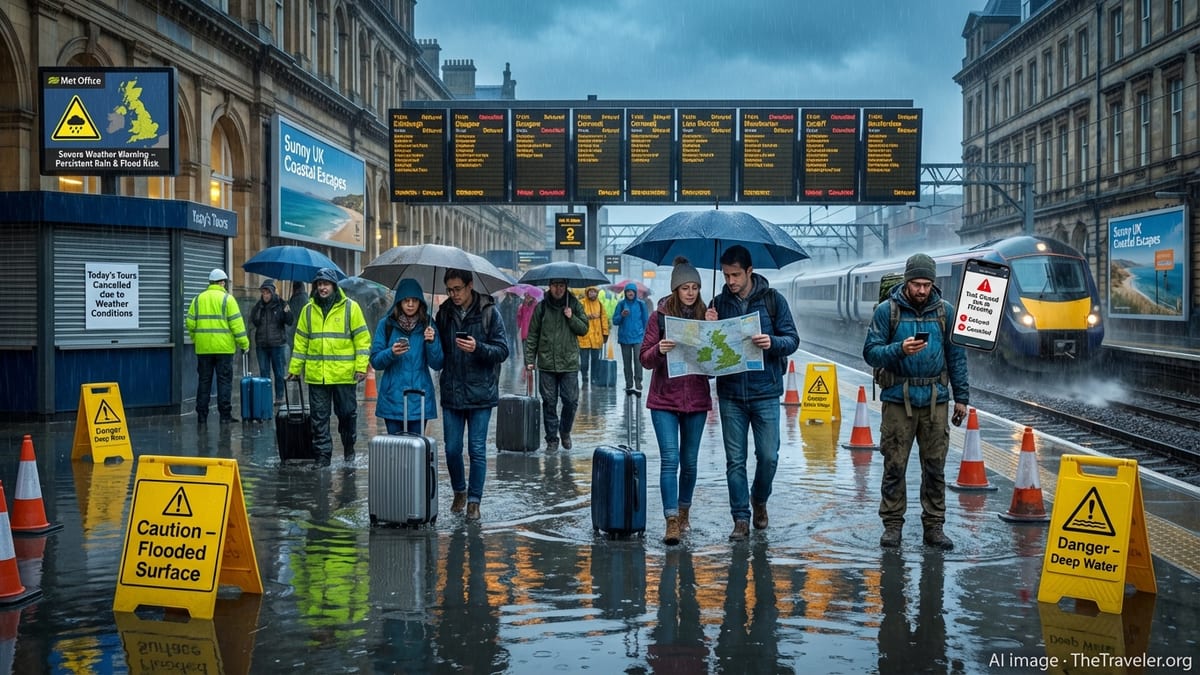
Emergency response slows services on key Scottish corridor
Public information from National Rail Enquiries indicates that trains between Westerton and Dalmuir, on a key route serving Glasgow and communities to the west of the city, were ordered to run at reduced speed on Saturday evening while emergency services dealt with an incident close to the line. The disruption was first reported shortly before 20:00 local time, with journey planners flagging potential delays and cancellations on services using the corridor.
The affected stretch is used by multiple regional and commuter operators, meaning relatively short speed restrictions can quickly ripple across wider timetables. Slower running reduces the number of trains that can safely pass through each hour, creating bottlenecks that can leave rolling stock and crew out of position as the evening peak builds.
Service updates described the incident as ongoing for several hours, with estimates suggesting an impact until later in the evening as rail control teams worked through a backlog of delayed trains. Passengers were advised through journey planners and station departure boards to check services before setting out and to allow additional time for their journeys.
While full details of the circumstances were not immediately available, the language used in rail alerts signalled that emergency responders were working in the vicinity of the tracks. In recent years, similar wording in rail industry communications has often been associated with serious medical emergencies or incidents involving people near the line, situations in which trains must be slowed or halted while responders work.
Knock‑on delays for long‑distance intercity routes
The localised disruption around Glasgow fed into a broader pattern of delays across parts of the long‑distance network on Saturday. Real‑time information from intercity operator dashboards showed select Anglo‑Scottish services curtailed or heavily delayed, with trains between London, the English Midlands and central Scotland altered as controllers sought to keep traffic moving.
In some cases, northbound services from London Euston were shown as terminating short of their planned Scottish destinations, turning around at intermediate hubs such as Preston to free up trains and crews. Southbound trains from Edinburgh were also reported as starting their journeys further south than scheduled, a typical tactic used during disruption to rebuild a workable timetable on the busiest core sections of line.
For passengers, these operational decisions translated into missed connections, platform changes and crowded alternative services. Rail companies encouraged travellers whose plans were flexible to postpone non‑essential trips or to use later trains, and reminded ticket‑holders that they could board earlier or later services where capacity allowed.
The pattern reflects how a single constraint on the network, such as an emergency incident on a busy section of double track, can cascade across hundreds of miles of railway. Even after the immediate emergency is resolved, timetables can take hours to stabilise as trains and crews return to their planned working diagrams.
Other incident‑related suspensions highlight a challenging summer
The latest disruption in Scotland came against a backdrop of several incident‑related interruptions to rail services in Europe in recent days. In Italy, infrastructure manager updates on Saturday reported sections of the Rosarno to Eccellente line still suspended between Tropea and Ricadi after a trackside fire, with shuttle arrangements and replacement services required on the scenic coastal route in Calabria.
Separate notices in central Italy highlighted earlier suspensions on the Rome to Grosseto corridor after the theft of copper cabling, underscoring how criminal activity can compound the operational challenges posed by weather, infrastructure faults and emergency incidents. In both cases, technicians were reported to be working on repairs while traffic was diverted where possible.
Recent months have also seen several high‑profile rail accidents in Europe and Asia, including collisions and derailments that triggered large‑scale emergency responses and network‑wide stoppages. Those events prompted renewed public debate about rail safety, passenger information and how quickly services should resume after a serious incident.
Transport analysts note that while such major accidents remain rare relative to the volume of daily rail traffic, even minor incidents that require intervention on or near the tracks can create significant disruption, particularly on intensively used commuter and intercity corridors operating close to capacity.
Passenger experience and advice for disrupted journeys
For travellers caught up in Saturday’s disruption, the most immediate impact was time. Extended waits on platforms, unplanned changes to routes and the possibility of missing events or connections elsewhere are common features of incident‑related delays. Families with luggage, tourists unfamiliar with the network and passengers with mobility needs can find these situations particularly stressful.
Rail operators in Britain typically respond by lifting some ticket restrictions, allowing passengers to use alternative services or different train companies at no extra cost when severe disruption is declared. Journey planners and station screens are updated frequently, but information can lag behind fast‑moving events, leaving passengers relying on staff announcements and social media for the latest details.
Travel planners suggest that anyone heading to or from affected areas build in additional time, avoid the last train of the evening where possible, and keep flexible tickets or digital passes to retain options if routes change. For longer itineraries that depend on tight rail connections, such as links to airports or ferries, contingency plans and travel insurance become more important during periods of heightened disruption risk.
Accessibility advocates also emphasise the need for clear, early communication when incidents occur, including information on step‑free alternatives, rail‑replacement buses and staff assistance at interchange stations. Without this, disabled passengers and those with young children can find themselves stranded or forced into unsuitable last‑minute route changes.
Focus on resilience as networks adapt to unplanned events
Beyond the immediate travel headaches, the latest incident once again highlights how reliant modern rail systems are on finely balanced timetables and uninterrupted infrastructure. Academic research into metro and commuter operations has shown that even short unplanned disruptions can create disproportionate delays as trains bunch together, headways widen and recovery patterns become irregular.
In response, infrastructure managers and operators across Europe have been investing in more sophisticated disruption‑management tools, from real‑time traffic modelling to automated timetable rescheduling. Trial projects in several major cities aim to predict how quickly services can recover after an incident and to identify the most effective combinations of short‑turning trains, express running and temporary shuttle services.
There is also growing attention on the role of passenger information during emergencies. Communication teams increasingly seek to strike a balance between providing timely, transparent updates and respecting privacy or legal constraints around sensitive incidents, particularly those involving individuals on or near the tracks.
For now, rail travellers are likely to continue facing occasional days like Saturday, when a single emergency near the line can reverberate through busy summer schedules. As networks grow busier and more complex, industry observers expect that resilience planning, cross‑border information sharing and investment in both infrastructure and operations will be central to reducing the impact of inevitable unplanned events on passengers.