


Arriving at Antalya Airport, most visitors face the same question: what is the easiest and fairest way to reach Antalya city centre? With a modern tram line, several municipal bus routes, the Havaş airport shuttle, metered taxis and a wide range of private transfers, the choice can feel overwhelming, especially after a long flight. This guide explains each option in clear, practical terms, using current information and real examples so you can choose what best fits your budget, luggage and arrival time.
Get the latest updates straight to your inbox!
Orientation: Antalya Airport and the City Layout
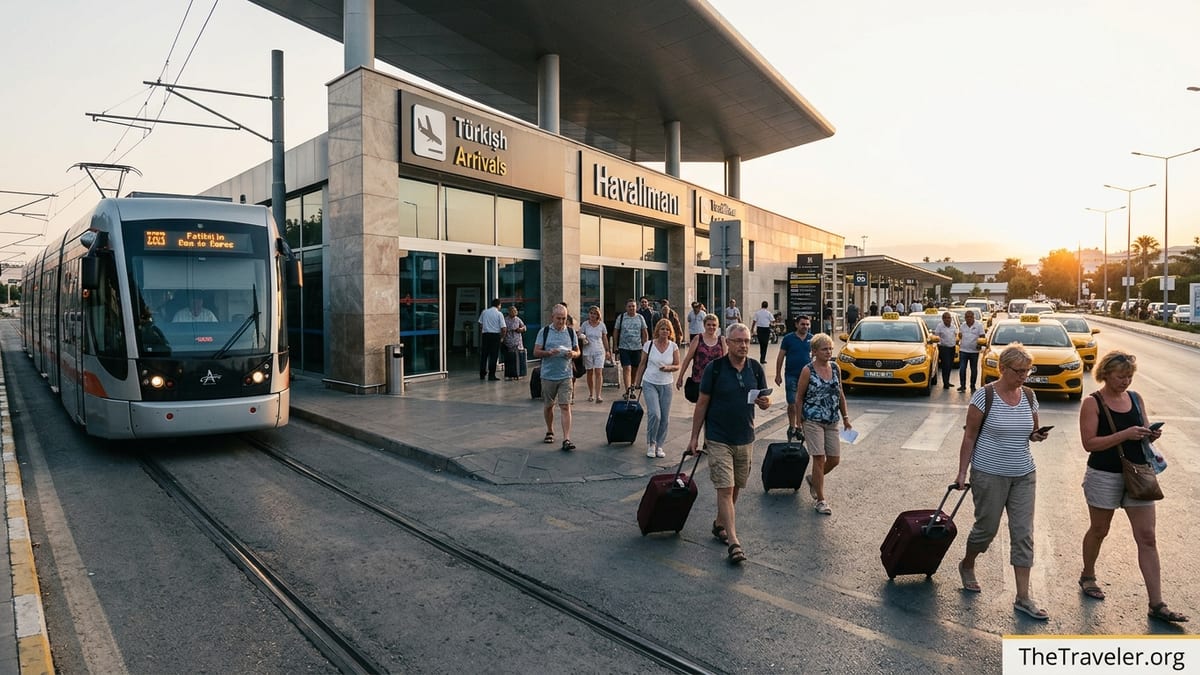
Antalya Airport (AYT) lies roughly 13 to 15 kilometres east of Antalya’s historic centre, Kaleiçi. There are three passenger terminals, two international and one domestic, but all landside exits funnel towards the same main road and ground transport area. A free internal shuttle connects the terminals if you land at one and depart from another. For city transfers, you will follow signs for taxis, buses and the Antray tram just outside each terminal building.
Antalya’s city centre stretches along the coast. When locals talk about “merkez” or “city centre,” they usually mean the area around Kaleiçi, Cumhuriyet Meydanı and the nearby Atatürk and Işıklar avenues. To the west is the long Konyaaltı beachfront, and to the east are Lara and Kundu, where many large resort hotels sit. The airport tram and Havaş shuttle primarily serve the central area, while resort districts often need a second leg by bus or taxi.
Travel times from the airport to the central districts are relatively short. The tram takes around 35 to 45 minutes to reach stops near the old town. Municipal buses and the Havaş shuttle usually need 35 to 50 minutes depending on traffic. A taxi in light traffic can do the journey in 25 to 35 minutes, but during busy summer evenings it can be closer to 45 minutes. These differences matter when you arrive late, travel with children or carry bulky luggage.
Ticketing also shapes your decision. Local public transport uses the Antalyakart smart card system, but in recent years contactless bank cards have been increasingly accepted on trams and buses. Visitors on a short city break can often rely on their bank card for tram and bus rides, while those staying longer or travelling as a group may find it worth buying and loading an Antalyakart at the airport tram stop or main bus stops in town.
Tram: The Cheapest Direct Option for Light Luggage
The modern Antray tram is one of the most economical and predictable ways to reach Antalya city centre from the airport. The airport branch of Line 1 runs from the airport stop, signed as “Havalimanı,” through several residential areas towards the city’s transport hubs and central districts. From the airport, many visitors ride as far as the city centre stops near Muratpaşa or change to the heritage tram or local buses if their hotel is closer to the old harbour or Konyaaltı.
As of mid 2026, a single tram ride from Antalya Airport into the city typically costs the equivalent of only a few Turkish lira for holders of the Antalyakart, with contactless bank card fares slightly higher but still very low by European standards. Exact fares can change with inflation, but a visitor can expect to spend less than the price of a coffee in a city café for the whole ride. You validate your card or tap your contactless bank card on the yellow validator at the station before boarding or immediately after entering the tram, depending on the specific gate layout at the airport stop.
Tram frequency varies across the day. Daytime services usually run every 10 to 15 minutes, while late evenings can drop to intervals of 20 minutes or slightly more. The ride from the airport into the heart of the city takes around 35 to 40 minutes. During morning and late afternoon rush hours, trams may be crowded with commuters. Outside peak times, you can usually find standing room easily and a decent chance of sitting, especially if you board at the airport terminus where the tram is still relatively empty.
The tram works best if you have manageable luggage: a suitcase and a cabin bag per person is generally fine, as there are open standing areas and some space by the doors. Large sports equipment or multiple heavy suitcases can be awkward in busy carriages. One common real-world scenario is a solo traveller arriving mid-afternoon with just a backpack and a small wheeled bag. In that case, tapping a contactless card at the airport tram stop and riding straight to a central station can be both the fastest and cheapest way into town, often quicker than waiting for a bus or negotiating a taxi queue.
Municipal Buses: Wide Coverage and One-Ticket Journeys
Antalya’s municipal buses, operated under the metropolitan municipality, provide another budget-friendly link between the airport and the city. The best known airport lines are 600, 800 and 400. Line 600 typically connects the airport with the intercity bus terminal (Otogar) north of the centre, passing through key urban areas on the way. Line 800 serves the coastal corridor towards Lara and sometimes onward towards Konyaaltı via central Antalya, while Line 400 focuses on specific suburban and seasonal demand. Together, these routes give you more options if your hotel is not directly near a tram stop.
In 2025 the municipality introduced a “single ticket” policy on these airport lines, which means you pay a standard city fare instead of a higher airport special tariff. That change has remained in place into 2026, making bus 600, 800 and 400 some of the cheapest airport transfers in any major Mediterranean resort city. You pay using an Antalyakart or, on most vehicles, a contactless bank card. Drivers do not usually accept cash, so having a card ready is important.
Journey times by bus from Antalya Airport to the central districts are generally in the 40 to 50 minute range, with traffic adding variability. A real example: a morning arrival at 09:00 might see bus 600 reach the Otogar in around 40 minutes, from where you can transfer to another municipal bus down to the old town in about 15 minutes more. In the late afternoon, the same route can stretch to an hour or more if traffic is heavy on the main arteries into town.
The buses can be better than the tram for travellers headed to areas like Lara Beach or neighbourhoods not directly served by the tram. Many local hotels on the eastern side of the city sit directly along or near routes used by bus 800, which allows guests to step off almost at the door. However, luggage space is more limited than on an airport coach. At busy times, passengers with large suitcases may find themselves standing in the aisle. If you arrive late at night, note that bus frequencies drop and some routes may not operate as frequently, so checking approximate times in the Antalyakart mobile app or with airport information staff can help.
Havaş Airport Shuttle: Simple and Luggage Friendly
The Havaş shuttle bus is an official airport coach service designed for air travellers. It operates between Antalya Airport and central points in the city, including major shopping centres, university stops, the intercity bus station and popular landmarks such as the 5M Migros shopping mall close to Konyaaltı. Compared with municipal buses, the Havaş shuttle makes fewer stops and uses larger, coach-style vehicles, which makes it more comfortable if you have bulky luggage or simply want a straightforward route without changes.
Recent fare information suggests that a one way ticket on the Antalya Airport to city Havaş shuttle is in the region of a couple of hundred Turkish lira, making it more expensive than a city bus or tram but still affordable for most visitors. You typically pay the driver or a ticket staff member in Turkish lira, and many services also accept card payments, though carrying some cash is sensible in case of technical issues. Tickets are sold per person, so a family of four will pay four times the single fare, often approaching the cost of a budget private transfer.
Timetables are tied closely to flight arrivals rather than a rigid clock schedule. In practice, this means shuttles leave the airport shortly after clusters of flights land, particularly from major European hubs. During the busy summer season, the frequency is higher, sometimes aligning with late night or early morning arrivals. Travel time into the city is typically around 45 minutes, depending on traffic and how many intermediate stops are served on a given run.
For many first-time visitors, the Havaş bus is a comfortable compromise between a cheap municipal bus and an expensive taxi. A realistic scenario: a couple arriving around midnight with two large suitcases can roll their bags to the Havaş stand, buy tickets on the spot and board a coach with underfloor luggage storage. They avoid the crowds and standing room of a city bus, spend less than on a taxi, and are dropped close to central points where they can either walk or take a short cab ride to their hotel.
Taxis: Fastest Door to Door, With Metered Fares
Taxis wait at official ranks directly outside each terminal, usually in well organised queues managed by airport staff. Vehicles are yellow and belong to a cooperative that operates under rules set by the municipality and airport authority. Inside the taxi, you will see a taximeter mounted near the dashboard, and at the rank itself there is typically a large signboard listing approximate fixed prices to common destinations such as Kaleiçi, Konyaaltı, Lara and major resorts close to the city.
Typical fares from Antalya Airport to the city centre fall in a broad band that reflects inflation and fuel costs. In mid 2026 many visitors report paying roughly the equivalent of 15 to 25 euros in Turkish lira to reach central Antalya, though exact figures vary with exchange rates and any night or holiday surcharges. The price to nearby resort areas like Lara Beach is often slightly lower, while longer trips to Konyaaltı or beyond cost more. Always confirm that the driver either uses the meter from the start or agrees clearly to follow the official fixed price list.
In light traffic, a taxi run to the centre can be as short as 25 minutes. During high summer weekends, the same journey can extend to 40 or even 50 minutes, especially in the early evening when locals and tourists alike are on the move. For families with small children, elderly travellers or anyone arriving with several heavy bags, the convenience of being dropped at the hotel door is significant. A realistic example: a family of four arriving at 21:00 with two large checked bags and two smaller suitcases may find that a taxi, even at the upper end of the fare range, feels worthwhile to avoid transferring with children and luggage on buses or trams.
Official airport taxis are generally reliable, but as in any large tourist destination, it pays to be attentive. Before you set off, check that the meter is on if your ride is metered, and keep the address of your accommodation written clearly, ideally in Turkish. Many drivers know major hotels and central landmarks but may be less familiar with small guesthouses in Kaleiçi’s narrow lanes. In that case, drivers often stop at the nearest accessible point, and you may walk the last few minutes through pedestrian streets lined with restaurants and boutique hotels.
Private Transfers: Convenience and Price Certainty
Private transfer companies are very active around Antalya Airport, offering pre-booked cars or minibuses from the terminal to virtually any hotel or resort along the coast. These services range from simple sedans to larger vans for families and groups. You typically book online in advance, receive a confirmation with your driver’s details, and then meet your driver in the arrivals hall where they hold a sign with your name.
Prices for private transfers depend on distance, vehicle type and season, but for a basic car from the airport to central Antalya, the cost is often in the same general bracket as a taxi or slightly higher. Where private transfers become especially competitive is for families or small groups. For example, three or four friends travelling together might pay a single fixed price comparable to or only slightly above a taxi fare, but they avoid uncertainty about the meter, enjoy guaranteed space for luggage and often benefit from door to door service to harder to reach addresses.
For late-night arrivals, private transfers can provide peace of mind. Knowing that a driver will be waiting when you emerge from customs, regardless of delays, removes the stress of wondering whether the last Havaş shuttle has left or whether municipal bus services are still running. This is especially useful if you are continuing on to coastal destinations such as Kemer, Belek, Side or Alanya, which require at least an hour or more of additional driving beyond Antalya itself.
Travelers with special requirements, such as child seats, extra luggage capacity for sports equipment or mobility assistance, also often choose private transfers. Many providers allow you to request these extras during booking, sometimes for a modest additional fee. For example, a family arriving for a cycling holiday with four large bike boxes would struggle to fit into a standard taxi but can arrange a private minibus with sufficient cargo capacity and have everything loaded straight from the terminal curb.
Comparing Cost, Time, Luggage and Late Night Options
When choosing how to get from Antalya Airport to the city centre, it helps to think in four dimensions: cost, journey time, luggage handling and how late you arrive. On cost, the ranking is clear. The tram and municipal buses are the cheapest, typically costing the equivalent of little more than a few units of local currency per person. Havaş sits in the middle, affordable but several times the price of a tram ticket on a per person basis. Taxis and private transfers are the most expensive, though the per person cost becomes more reasonable when shared among several passengers.
On journey time, taxis and private transfers are usually fastest, particularly outside rush hours, since they take you directly to your door. The Havaş shuttle offers a relatively quick ride along major roads with limited stops, often arriving in central areas in under an hour even at busier times. Municipal buses and the tram can be slower due to frequent stops and indirect routing, but for many city centre hotels the difference in arrival time compared with a taxi may be only 10 to 15 minutes.
Luggage is where the dedicated airport options show their strength. Havaş coaches and private transfers offer underfloor or dedicated luggage space, making them more comfortable for large suitcases or sports equipment. Taxis cope well with typical holiday baggage but may struggle with very large or numerous items, in which case a minivan taxi or private van is preferable. Trams and municipal buses are best suited to light to medium luggage. Boarding with a single suitcase and a backpack is common and accepted, but pushing multiple large bags into a crowded tram at rush hour is difficult and can be stressful.
Late-night arrivals demand special thought. While Antalya is a busy airport with flights throughout the evening, public transport frequencies drop after about midnight. The tram and some bus lines may still run, but waits lengthen and planned maintenance or seasonal timetable changes can affect availability. The Havaş shuttle tends to match late arrivals on busy routes, yet services are less dense than during the day. In practice, visitors landing between roughly 23:00 and 05:00 often lean towards taxis or pre-booked private transfers, especially if they are unfamiliar with the city or travelling with children.
Realistic Scenarios: Which Option Should You Choose?
Consider a solo backpacker landing at 14:00 on a weekday with a single carry-on backpack and a budget hotel near the tram corridor in Muratpaşa. For this traveller, the tram is an obvious choice. After exiting customs, they follow the signs to the Antray stop, tap a contactless bank card at the validator, and board the next tram towards the city. In around 35 minutes they step off close to their hotel, having spent very little and avoided traffic congestion.
Now imagine a couple arriving at 22:30 with two large suitcases and a hotel booked in the narrow streets of Kaleiçi. They could technically use the tram and then walk through the old town, but cobblestones and steps make hauling suitcases awkward. A taxi or private transfer becomes more appealing. With a taxi, they roll their bags to the official rank, confirm the approximate fare to their hotel using the posted price board, and enjoy a 30 to 40 minute ride straight to the nearest point where the car can stop. From there they walk a short distance through the atmospheric lanes into the pedestrianised core.
For a family of four landing at 01:00 in peak summer, with two adults, two children, and multiple bags, late-night convenience and predictability matter more than marginal cost savings. In that scenario a pre-booked private minivan transfer is often the best solution. The driver tracks the flight, meets them in the arrivals hall, loads the luggage and drives directly to their resort, whether it is in central Antalya, Lara, Belek or further along the coast. The all-in price, when divided by four, can be close to what they would pay for separate Havaş tickets plus a final short taxi ride.
Finally, think about a budget-conscious visitor planning a week in a central guesthouse who arrives mid-morning. This traveller might take the Havaş shuttle into town, enjoying luggage storage and a comfortable seat, then transfer to a short tram or bus ride to reach their accommodation. Compared with a taxi, they save a noticeable amount of money, accept a slightly longer journey, and still avoid the most crowded points of the city bus network.
The Takeaway
Antalya Airport is well connected to the city centre, and travellers have a spectrum of options that cater to different budgets, comfort levels and schedules. The Antray tram and municipal buses are extremely economical and work best for travellers with light luggage who arrive during the day and are comfortable navigating public transport. The Havaş shuttle offers a simple, luggage friendly option at a moderate price, linking the airport with several central hubs.
Taxis and private transfers deliver speed and convenience, especially appealing for late-night arrivals, families, and those carrying bulky bags or heading to specific resorts. While they cost more, they remove uncertainty and often reduce door to door travel time. Real-world examples show that there is no one “best” option for everyone. The right choice depends on where you are staying, what time you land, how much you are carrying and how confident you feel about using local transport.
Whichever mode you choose, plan the basics before you fly: know roughly where your accommodation sits on the city map, note whether it lies near a tram line or bus corridor, and decide in advance how much you are willing to spend to avoid changes or late-night waits. With that preparation, the trip from Antalya Airport to the city centre can be straightforward, giving you more time and energy to enjoy the Mediterranean coast.
FAQ
Q1. How long does it take to get from Antalya Airport to the city centre?
The journey usually takes 25 to 45 minutes by taxi, around 35 to 45 minutes by tram, and 35 to 50 minutes by municipal or Havaş bus, depending on traffic.
Q2. What is the cheapest way to reach Antalya city centre from the airport?
The cheapest options are the Antray tram and municipal buses such as line 600, which use standard city fares that are very low by international standards.
Q3. Can I pay for the tram or bus from Antalya Airport with a contactless bank card?
On most trams and many municipal buses you can pay with a contactless bank card, although using a local Antalyakart can provide slightly better fares and easier transfers.
Q4. Is the Havaş shuttle bus worth it compared with the city bus?
Havaş costs more than a city bus but offers coach-style comfort, more space for luggage and a simpler route with fewer stops, which many travellers find worth the extra cost.
Q5. How much does a taxi from Antalya Airport to the city centre cost?
Typical fares fall within a band similar to 15 to 25 euros in Turkish lira, depending on exact destination, traffic, time of day and any official surcharges.
Q6. Are taxis at Antalya Airport safe and regulated?
Yes, taxis at the official ranks belong to licensed cooperatives, use meters or official price lists, and are regulated by the municipality and airport authorities.
Q7. Do public transport services run late at night from Antalya Airport?
Some tram and bus services do run late, but frequencies decrease after about midnight, so late-night travellers often prefer taxis or pre-booked private transfers.
Q8. Which option is best if I have a lot of luggage or sports equipment?
Havaş coaches, taxis and pre-booked private transfers handle large or bulky luggage better than regular trams or municipal buses, especially during busy periods.
Q9. How do I get from Antalya Airport to Konyaaltı or Lara Beach?
For Konyaaltı and Lara, you can combine tram or bus with a local bus or short taxi ride, or book a direct taxi or private transfer for a simpler but more expensive journey.
Q10. Should I book an airport transfer in advance or decide on arrival?
If you arrive late at night, travel in a group or carry bulky luggage, booking in advance is wise; daytime solo travellers with light bags often decide between tram, bus or taxi after landing.