


For many visitors, Antalya begins at the airport taxi queue. Yet just a few meters away, the city’s AntRay tram line offers a cheaper and often easier route straight into the centre, old town, and bus station. This guide walks you step by step through using the Antalya Airport tram, from buying a ticket to handling luggage and choosing when the tram is smarter than a taxi.
Get the latest updates straight to your inbox!
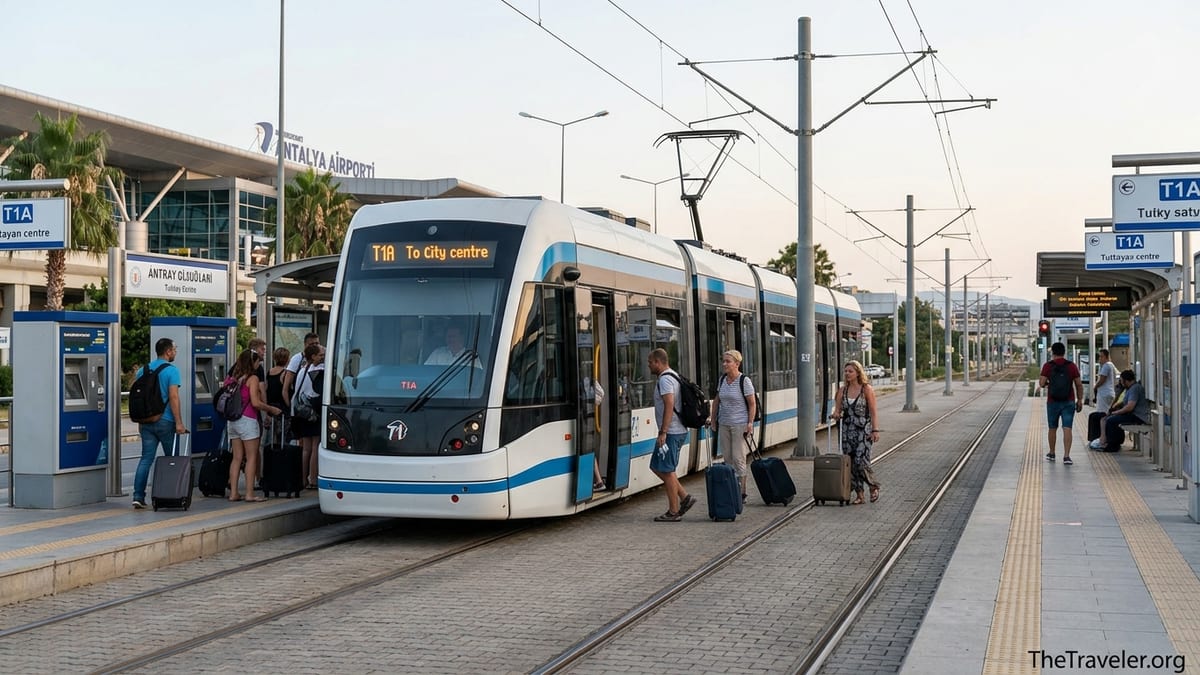
How the Antalya Airport Tram Works
Antalya’s modern AntRay tram network is the backbone of the city’s public transport, and one branch of the main T1 line runs directly through Antalya Airport. The airport is served by the T1A line, which links the terminals with central Antalya and the main Otogar bus station, while the T1B branch continues in the opposite direction toward EXPO and outlying districts. For most arriving tourists heading to the city centre, old town Kaleiçi, or Konyaaltı, T1A is the line to look for.
The tram platforms are just outside the terminals. There is a signed AntRay / tram stop near Terminal 1 and the domestic terminal, with a short walk or shuttle connection if you arrive at Terminal 2 or the newer Terminal 3. Once at the stop, you pass through turnstiles and board modern low-floor trams similar to those in many European cities. Services typically run every 8 to 12 minutes during the day, with a roughly 30 to 40 minute ride into the centre depending on your final stop and time of day.
Unlike airport buses that can get caught in heavy traffic on the coastal highway, the tram benefits from its own right of way for most of the journey. This makes journey times more predictable, which is especially useful after a long flight or when you are heading back for a tight departure. The same AntRay network is also useful beyond the airport run, connecting to shopping streets, residential areas, and eventually to the Otogar for onward buses to resorts such as Kas, Kemer, Alanya, and Side.
Operational hours can change, but at the time of writing the airport tram usually runs from early morning around 06:00 until roughly 23:30 at night, with slightly less frequent services later in the evening. If your flight lands around midnight or in the very early hours, you should be prepared to use a taxi or pre-booked transfer instead.
Tickets, AntalyaKart & Paying with Contactless
The AntRay tram uses the same ticketing system as Antalya’s municipal buses: the AntalyaKart. This is a reloadable plastic smartcard accepted on all trams and most public buses in the city. There are AntalyaKart machines at the airport tram stop where you can buy a physical card and add balance in Turkish lira. The machine interface usually has an English option and works much like a typical metro top-up kiosk: first choose to buy a card, then feed in cash notes to load credit.
For short stays, visitors often choose between buying a card or simply tapping a contactless bank card. Currently, a standard adult ride paid with AntalyaKart on the tram is around 40 to 45 Turkish lira, while airport information and recent local sources generally quote similar single-ride fares from the airport to the city centre using the same tariff as other urban trips. The card itself has an initial purchase cost which is higher than a single ride. This makes AntalyaKart good value if you expect to ride public transport several times, for example staying a week in Konyaaltı and commuting daily into Kaleiçi or using buses to reach the Otogar for a day trip.
If you prefer not to buy a dedicated card, almost all newer turnstiles on the airport line accept international contactless credit and debit cards. In practice, many recent visitors have tapped a Visa or Mastercard directly on the reader and entered with no problem. The system charges each tap as a single ride, so a family of four would each need to tap their own physical card or phone wallet at the turnstile. This is important to remember if you only have one card between several people, as the gates usually will not allow multiple entries from a single tap.
For a concrete example, a solo traveller arriving from Berlin might buy an AntalyaKart at the airport for around the cost of two or three tram rides, then load 200 TL of credit. They use the tram to Kaleiçi on arrival, another tram to the Otogar the next day to catch a bus to Kas, and then several local bus rides in the following days. The same balance comfortably covers all of these journeys. A short-stay couple on a weekend break, by contrast, often just tap a contactless bank card at the airport, ride into the centre, and later use a taxi back when leaving at 05:30, removing the need to manage card balances at all.
Airport Stops, Routes & Getting to the City Centre
The AntRay airport stop is clearly signed as “Havalimanı / Airport” on route maps. From here, the T1A line runs westward toward the city, passing several suburban and commercial stops before reaching the inner districts and finally the main bus station. Key stops for visitors include Topçular and Demokrasi for local neighborhoods, and then Sinan and Üç Kapılar for access to the historic centre and old town.
For most tourists heading to Kaleiçi, the usual strategy is to ride the tram from Havalimanı to either Sinan or Üç Kapılar. Sinan is a popular choice because it sits on the edge of the central grid of streets and is within a short walk of many boutique hotels and guesthouses. From Sinan, you can roll a suitcase downhill towards Hadrian’s Gate or the marina area in around 10 to 15 minutes. Üç Kapılar is even closer to the actual old town gate area, and some travellers prefer this stop if their accommodation is very central and they do not mind a slightly busier platform.
Those connecting to long-distance coaches will usually stay on board past the centre until the line reaches Otogar, the main intercity bus station. From the airport, this ride takes around 35 to 40 minutes in normal conditions. It is a straightforward trip: you board at Havalimanı, stay on the same tram, and then follow signs for your bus company or platform on arrival. This is especially convenient if you are continuing directly from the airport to resorts further along the coast using private coach companies.
Heading in the opposite direction from the airport, the tram continues toward Pınarlı ANFAŞ, Kurşunlu, and eventually EXPO. This direction is less relevant for most short-term visitors, but it can be useful if you are staying near the large exhibition and fair areas or attending events at the ANFAŞ fairground, which has its own station. In all cases, network maps displayed at stations and inside trams show the full list of stops in both directions, so you can double-check your direction before boarding.
Travel Time, Frequency & Realistic Scenarios
From Antalya Airport to central stops such as Sinan or Üç Kapılar, the tram typically takes around 30 to 40 minutes. In practice, travellers often report timing their journey at about 35 minutes door-to-door from the airport platform to walking off the tram in the centre, assuming a normal daytime schedule. There is no need to worry about road congestion delaying your arrival, which is an important factor in high season when the coastal highway and approaches to the old town can become clogged with tour buses and taxis.
During the day, trams generally run every 8 to 12 minutes, which means that even if one is crowded, another empty one is usually close behind. Early mornings and late evenings may see longer gaps, and the last departures from the airport are generally shortly before midnight. As an example, someone landing from London at 19:00 in July may clear passport control by 20:00 and reach the platform to find a tram arriving within a few minutes. By 20:40, they are typically stepping off at Sinan and walking toward their hotel, having spent less than an hour from aircraft door to city street.
Contrast that with a family arriving on a busy Saturday afternoon in August. While a taxi door-to-door might be slightly quicker in pure travel time, they could spend 20 minutes or more queuing at the taxi rank, then another half-hour stuck in dense traffic near the Lara turn-off and coast road. The tram, following its segregated route, offers a more predictable 35-minute ride. The difference becomes even more pronounced when unexpected traffic incidents or temporary road closures come into play.
One caveat: if you have a very early flight out of Antalya, such as a 06:00 departure, the tram may not start early enough to be a realistic option. In that case you will likely need a taxi or pre-arranged transfer. Similarly, for very late arrivals after the last tram has departed, the taxi line or ride arranged through your hotel remains your only practical public option.
Using the Tram with Luggage, Strollers & Bikes
The AntRay airport line is designed with travellers in mind, and the trams are low-floor vehicles with wide doors. This makes boarding with suitcases, backpacks, and strollers reasonably straightforward. Once on board, luggage goes in the open standing areas near the doors rather than on dedicated racks. In practical terms, most passengers place one suitcase between their legs or beside a handrail, while holding smaller bags or backpacks. During busy times, you may need to shift slightly to allow others to pass through the doorway area.
Large, rigid suitcases that are typical for a one or two week beach holiday are generally fine as long as you can maneuver them yourself. If you are a solo traveller with two very heavy cases and a cabin bag, you might find navigating the short walk from arrivals to the platform plus the step onto the tram somewhat tiring, particularly in summer heat. Families with small children and strollers usually manage well, as the doors are wide and there is level boarding from the platform, similar to modern European tram systems.
Certain items have specific rules. Foldable bicycles are allowed if they are in a bag or cover and do not obstruct passengers. Larger non-folding bikes are usually restricted to off-peak hours and may be prohibited during rush periods. Electric scooters are typically allowed only when folded and carried, not ridden inside stations. Wheelchairs are accepted, and trams have designated spaces with fold-up seats and grab bars for passengers with reduced mobility. Those with mobility issues often find the tram easier than climbing in and out of a minibus or managing steep steps on older buses.
If you are carrying very bulky sports equipment, such as surfboards or multiple golf bags, a taxi or pre-booked minivan may be more comfortable. While it is technically possible to stand with such items near the doors, you may struggle to keep them out of the way during peak times. For a typical holiday set-up of one checked suitcase and a carry-on per person, however, the tram handles luggage without difficulty, and many tourists with rolling hard-shell suitcases use it daily between the airport, centre, and hotels along the tram corridor.
When the Tram Beats a Taxi (and When It Does Not)
For budget-conscious travellers, the cost difference between the AntRay tram and an airport taxi is significant. A standard local taxi ride from the airport to the city centre or Kaleiçi is often many times the price of a single tram fare per person. For example, at recent typical rates a central city taxi might cost the equivalent of 20 to 30 euros, while two tram rides for a couple might total well under 5 euros combined. For solo travellers, backpackers, and students, that saving can easily cover a meal or museum entry on arrival.
The tram also wins on predictability. Traffic into Antalya can be heavy, especially in July and August or on public holidays. While taxis can become stuck in jams near major junctions, the tram maintains its schedule along dedicated tracks, so your arrival time in the centre is much more certain. This is particularly helpful if you are aiming to catch a specific intercity bus at Otogar or meeting a tour operator at a set time in town. Additionally, the tram experience is more transparent for visitors who might worry about taxi scams or confusion over meters. The fare is fixed by the transit system, and you pay at the turnstile, not to a driver.
On the other hand, taxis and private transfers are still better choices in some situations. If you are staying far from a tram stop, for example in a resort deep into the Lara or Kundu areas or along the Konyaaltı beachfront beyond walking distance, you may end up needing a taxi anyway from the nearest tram station. Late-night arrivals after tram service ends naturally favor taxis. Families with very young children, a lot of luggage, or mobility issues might also prefer the door-to-door ease of a car even at a higher cost, especially in hot weather or after a long-haul flight.
A practical compromise used by many travellers is to take the tram for the long airport-to-city segment, then hail a short taxi for the last one or two kilometers. For instance, a couple staying in a small guesthouse up the hill from the old harbour might ride to Üç Kapılar and then use a short taxi hop if they find the climb with suitcases too tiring. The combination still significantly undercuts the cost of a taxi all the way from the airport and avoids most of the traffic-prone sections of the route.
Practical Tips, Safety & Peak Times
Using the AntRay tram is generally considered safe and straightforward, but a few practical tips can make the experience smoother. First, keep your AntalyaKart or contactless card ready before you reach the turnstiles to avoid blocking the line, especially when several flights have just arrived. If you are travelling with companions, agree on a meeting point on the platform in case one person passes the gate and another has trouble with payment or the card reader.
Inside the tram, keep an eye on personal belongings as you would in any busy urban transport system. Petty theft is rare but possible in very crowded conditions, so carry backpacks on your front and keep handbags zipped. Suitcases should be positioned close to you, ideally against the wall or between your legs. Avoid leaving bags near doors without contact in case someone tries to grab-and-go when the doors open. In practice, most rides on the airport line are filled with families, locals commuting, and other tourists headed to central hotels, and the overall atmosphere is relaxed.
Peak times vary by season. During the summer tourist peak, late morning and early evening trams from the airport can be particularly busy as charter flights arrive in clusters. Locals heading home from work can also fill trams around traditional rush hours. If you land at a time when a large group from a package tour joins the platform, it can be worth letting that tram go and taking the next one, which is often much quieter and only a few minutes behind. Early afternoon and late evening services tend to be calmer, offering more space for your luggage and a better chance of grabbing a seat.
Language is generally not a barrier. While announcements inside the tram are primarily in Turkish, station names are clearly displayed on digital screens and on route maps. Many staff at the airport tram stop, including security and ticket inspectors, are used to dealing with international visitors and can communicate basic directions in English or with simple gestures. If in doubt, you can show the name of your stop, such as “Sinan” or “Otogar”, written on your phone screen to confirm you are heading in the right direction.
The Takeaway
For most visitors arriving in Antalya, the AntRay tram from the airport offers an appealing balance of price, convenience, and predictability. It gets you from the terminal doors to central stops like Sinan, Üç Kapılar, and Otogar in around half an hour, costs only a fraction of the typical taxi fare, and integrates smoothly with the wider AntalyaKart public transport network. With low-floor vehicles and frequent services, it is a comfortable choice for travellers with typical holiday luggage and a straightforward way to get a feel for the city on first arrival.
That said, the tram is not ideal for every situation. Very late or very early flights, remote hotel locations well away from any tram stop, or particularly heavy or awkward luggage still make taxis or private transfers the more sensible option. Many travellers end up mixing both: tram for the main leg of the journey, then a short taxi ride for the final stretch to a hilltop hotel or beachfront resort.
If you are happy to roll your own suitcase for a short walk, do not mind sharing a carriage with locals and other tourists, and want to keep your airport transfer cost low and transparent, the AntRay airport tram is often the best way to begin or end your time in Antalya. With a little preparation on tickets, stops, and timing, it can turn what might have been a stressful arrival into an easy glide straight into the heart of the city.
FAQ
Q1. Does the Antalya Airport tram run 24 hours a day?
The tram does not run 24 hours. It usually operates from early morning around 06:00 until late evening, with the last services from the airport typically leaving before midnight. Always check the current timetable close to your travel date, especially for very early or late flights.
Q2. Can I pay for the AntRay tram with a contactless bank card?
Yes, most airport tram turnstiles accept contactless Visa and Mastercard bank cards and many mobile wallets. You tap your card on the reader at the gate just like an AntalyaKart. Each passenger needs their own card or device, because one card cannot normally be tapped multiple times for several entries in quick succession.
Q3. How much does the tram from Antalya Airport to the city centre cost?
Fares can change, but a single adult ride with an AntalyaKart is generally in the range of a few dozen Turkish lira, and recent examples place it around the low-40 lira mark. Paying with a contactless bank card is usually similar. This is significantly cheaper than taking a taxi from the airport to the centre.
Q4. Which tram stop is best for the old town Kaleiçi?
Most visitors heading to Kaleiçi use either Sinan or Üç Kapılar stops. Sinan offers a gentle walk down into the central streets and suits many small hotels and guesthouses. Üç Kapılar is closer to Hadrian’s Gate and some very central properties. The best stop depends on the exact address of your accommodation.
Q5. How long does the tram take from Antalya Airport to the centre?
In normal conditions, the ride from Havalimanı (Airport) to central stops like Sinan or Üç Kapılar takes about 30 to 40 minutes. Because the tram runs on its own tracks, it is less affected by road traffic, so travel time is usually more reliable than by bus or taxi during rush hours.
Q6. Is the tram a good option if I have large luggage?
Yes, the low-floor trams are designed to accommodate suitcases and airport passengers. Standard checked bags and cabin luggage are easy to manage, and there is space near the doors to stand with them. If you have multiple very heavy cases, large sports equipment, or mobility difficulties, a taxi or private transfer may still be more comfortable.
Q7. Does the tram go to the main bus station (Otogar)?
Yes, the T1A line that serves the airport continues through the city to the Otogar, Antalya’s main intercity bus station. You can ride directly from the airport to Otogar without changing trams, then connect to long-distance buses to coastal resorts and inland towns.
Q8. Should I buy an AntalyaKart or just use my bank card?
If you plan to use public transport several times during your stay, buying an AntalyaKart and loading credit can be convenient and may offer access to integrated fares across buses and trams. For a very short visit with only one or two tram rides, many travellers find it simpler to tap a contactless bank card at the gate and avoid managing card balances.
Q9. Is the Antalya Airport tram safe for solo travellers at night?
The tram is generally considered safe, and many solo travellers use it without issue, especially in the early evening. As with any public transport, stay aware of your belongings, avoid displaying valuables, and sit near other passengers. For very late arrivals close to the end of service, some solo travellers prefer the security of a door-to-door taxi or a hotel-arranged transfer.
Q10. How do I know which direction tram to take from the airport?
At the airport station, look for T1A services heading toward the city centre and Otogar. Station displays and platform signs show the final destination, and maps indicate the sequence of stops. If you are unsure, you can confirm by asking staff or showing the name of your desired stop, such as “Sinan” or “Üç Kapılar”, on your phone.