


With only two to four days in Guatemala, most travelers choose between basing themselves in colonial Antigua or heading straight to the volcanic bowl of Lake Atitlán. Antigua offers a compact, walkable city of cobbled streets, historic churches, cafés and volcano excursions. Lake Atitlán is about its villages and vistas: a ring of lakeside communities scattered beneath steep mountains and volcanoes, where sightseeing is more dispersed and days are shaped by boat schedules and the wind on the water.
Get the latest updates straight to your inbox!
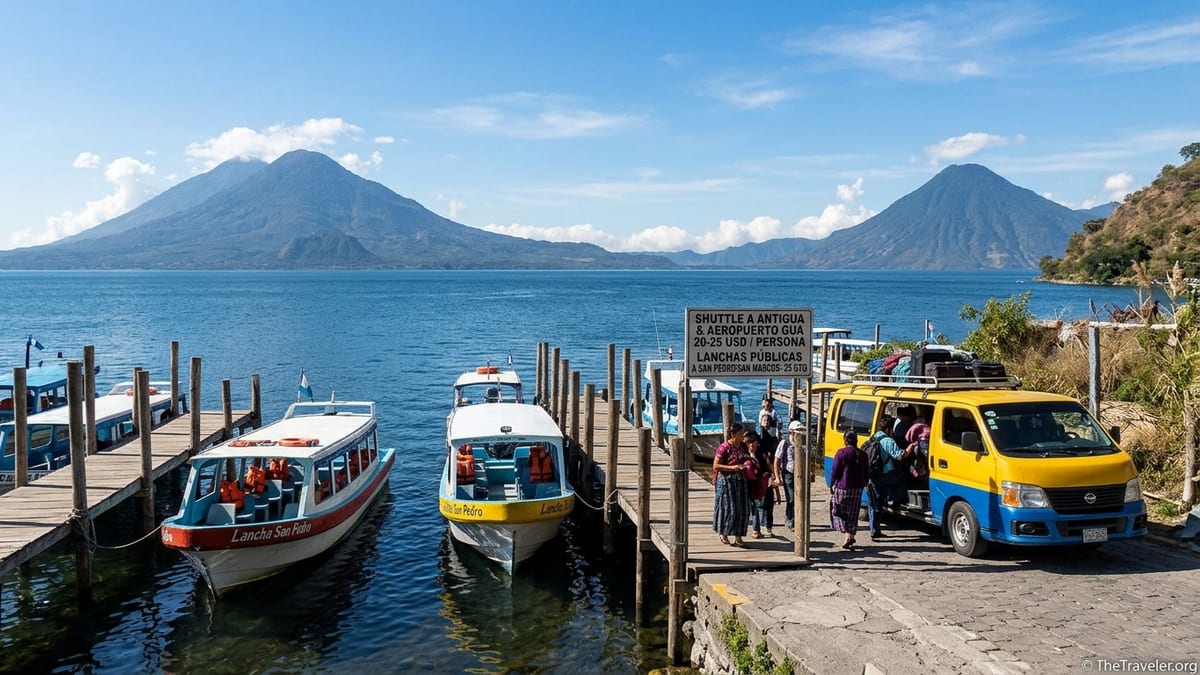
Getting There: Airport Transfers and Travel Time
Guatemala’s international gateway is La Aurora International Airport (GUA) in Guatemala City. Shared shuttle companies advertise direct airport-to-Antigua services from about 20 to 25 US dollars per person, with a road journey of roughly 60 to 90 minutes depending on traffic. Several operators publish multiple daily departures and confirm that shuttles can be booked both in advance and on arrival at counters just outside the terminal. Private cars or minibuses for one to three passengers are typically quoted from about 40 to 60 US dollars total for the same route, a worthwhile upgrade if you arrive late at night or want to go straight to a specific hotel.
Reaching Lake Atitlán from the airport by road takes longer. Companies that run from Guatemala City to Panajachel, the main gateway town, publish shared-shuttle travel times of around 3.5 to 4.5 hours depending on traffic leaving the capital and conditions on the Inter-American Highway. Recent schedules show fares from around 35 to 45 US dollars per person for this direct route, with only one or two departures per day. Private transfers from the airport to Panajachel commonly start in the region of 140 to 180 US dollars per vehicle for two people, rising with group size and late-night pickups.
If you route via Antigua, which many travelers do to break the journey, shuttle operators list Antigua to Panajachel shared services at around 20 US dollars per person with advertised journey times of about 3 hours. Several tourism companies and hostels in Antigua sell these tickets, with typical departures in the morning and early afternoon. Private Antigua to Panajachel transfers for one to three people are widely advertised from roughly 70 to 90 US dollars per vehicle. In practice, allow at least 2.5 to 3.5 hours for the Antigua–Panajachel segment in either direction to account for congestion leaving Antigua, mountain curves and occasional roadworks.
The critical consequence for a short trip is lost sightseeing time. Choosing Antigua only means you can be checked into your hotel and out exploring the historic center a couple of hours after landing. Choosing Lake Atitlán as your first base usually means at least half a day in transit from the airport, more if your final destination is not Panajachel but a smaller village across the water.
Boats, Wind and the Realities of Getting Around Lake Atitlán
Panajachel is the road hub, but the heart of Lake Atitlán lies across the water in San Pedro La Laguna, San Marcos La Laguna, Santa Cruz La Laguna and other villages that line the shore. Public lanchas, the small fiberglass boats that function as local ferries, depart from Panajachel’s docks throughout the day. Recent schedules compiled by local tourism bodies and boatmen’s associations describe first departures around sunrise and a practical end of regular services between about 4:30 pm and 5:00 pm, depending on route and season.
Current fare boards at the main dock in Panajachel list crossings from Panajachel to San Pedro La Laguna at roughly 25 quetzales per person for visitors, with shorter hops such as Panajachel to Santa Cruz or San Marcos priced a little lower but still in the 20 to 25 quetzal range for foreigners. These are one-way prices paid in cash directly to the boat operator. Travel times vary by route and intermediate stops: Panajachel to San Pedro is usually quoted at around 30 to 40 minutes, while Panajachel to San Marcos or Santa Cruz can be closer to 15 to 25 minutes. Private charter boats can be arranged on the spot or via hotels and cost significantly more, with typical quotes from around 200 to 300 quetzales for a short trip and more for night crossings.
The lake’s famous afternoon wind, known locally as the Xocomil, is a crucial detail for planning. Local safety campaigns and resident-run information sites describe the wind building most frequently in the early afternoon during the rainy season, kicking up choppy waves that make crossings slower and wetter and, in strong episodes, unsafe for small overloaded lanchas. After a serious accident in 2026 in rough afternoon conditions, authorities and locals have renewed advice to prioritize morning crossings when the water is calmer, to wear life jackets where provided and to sit low and centrally in the boat.
If your international flight arrives late afternoon and you take a shuttle to Panajachel, you may well reach the dock after the last convenient public boat has departed. At that point, your options are to pay for a private lancha at a higher price, travel by road around the lake to villages accessible by land, or spend the night in Panajachel and continue in the morning. For a two or even three-day stay, an unplanned overnight in Panajachel can effectively cost you half a day of lakeside time and add unbudgeted transport costs.
Scenery and Sights: Compact Antigua vs Dispersed Lake Villages
Antigua’s appeal is density. Within a 10 to 15 minute walk of the central plaza you find baroque church facades like La Merced and San Francisco, the ruins of former monasteries, pastel facades backed by views of Agua Volcano and a concentration of cafés, rooftop bars and restaurants. Cerro de la Cruz, the hillside lookout northeast of the center, is a straightforward walk from town and rewards the short climb with a postcard panorama of Antigua’s grid of terracotta roofs framed by Volcán de Agua in the background.
Just outside the city, working coffee farms such as Finca Filadelfia and smaller fincas in the surrounding hills offer tours that combine short walks through plantations, tastings and explanations of Guatemala’s coffee production. Pacaya Volcano excursions depart from Antigua in the early morning or early afternoon, usually by shuttle to the trailhead and then a guided hike of around 1.5 to 2.5 hours uphill depending on chosen route. Many operators advertise the chance to walk on cooled lava fields, roast marshmallows over hot vents and enjoy views of neighboring volcanoes, weather permitting.
At Lake Atitlán, the main draw is the scenery from multiple angles rather than a single historic center. Panajachel has a lakeside strip along Santander Street with sunset bars and views of San Pedro, Tolimán and Atitlán volcanoes across the water, but the town itself feels more like a busy transport hub and commercial center. San Juan La Laguna, accessible by boat from Panajachel or San Pedro, is known for its cooperatives: textile workshops, natural-dye demonstrations and women-run art galleries line the steep streets rising from the dock. Santa Cruz La Laguna clings to the northern slopes and offers one of the most dramatic perspectives, with walking paths and hotel terraces looking directly across to the southern volcanoes.
For viewpoints, many visitors climb to Mirador Kaqasiiwaan above San Juan La Laguna, a stepped trail that winds up the ridge to a wooden viewing platform with open views of the lake and the volcanic skyline. Others choose the Indian Nose hike above Santa Clara and San Juan, a short pre-dawn climb used by local guides to reach a ridge-top outlook in time for sunrise. Each of these requires either pre-arranged guiding or at least organizing a tuk-tuk or pickup from the dock, so a morning of sightseeing on the lake usually involves chaining together boat rides, short road hops and walking.
Altitude, Hiking Effort, Hazards and Safety Advice
Both Antigua and Lake Atitlán sit at altitude, which affects hiking effort and evening temperatures. Antigua lies at roughly 1,530 meters above sea level, while Panajachel and the lakeshore are higher, around 1,560 to 1,600 meters, with villages higher on the slopes such as Santa Cruz and some neighborhoods of San Pedro rising several hundred meters above the lake. For fit travelers the difference is modest, but those sensitive to altitude may feel slightly more breathless on steep staircases in San Juan or the trails above Santa Cruz than when strolling Antigua’s flat streets.
Hiking volcanoes like Pacaya and Acatenango from Antigua involves significantly greater elevation gains and colder temperatures at the top. Pacaya’s main routes rise to over 2,500 meters and Acatenango’s summit is above 3,900 meters. Local tour operators and Guatemala’s disaster-response agency emphasize preparing for cold and wind at elevation, wearing proper footwear and traveling only with reputable, registered guides. Fuego Volcano, visible from Antigua and Acatenango, is an active volcano with periodic eruptions, and official alerts sometimes restrict access to certain routes. Travelers should always check current status with their tour company or national and municipal tourism information offices before booking.
Around Lake Atitlán, the main natural hazard is the lake itself during high wind or storms. The 2026 lancha accident in rough Xocomil conditions highlighted the risks of overloaded boats and the importance of life jackets. Local authorities and community groups now urge visitors to choose boats that carry appropriate safety gear, to avoid crossings in obviously rough conditions and to favor morning travel on days with unstable weather. Trails around the lake can be steep and sometimes muddy in the rainy season, particularly shortcuts between villages used by locals. For sunrise viewpoints such as Indian Nose, municipal advisories and local tour cooperatives recommend hiring a local guide and avoiding walking in the dark without one, partly because of occasional reports of opportunistic theft on isolated paths.
Urban safety considerations differ between Antigua and the lake villages. Antigua’s central grid is heavily patrolled and remains one of the country’s most visited destinations, with national tourism authorities consistently describing it as relatively safe in daylight and early evening for normal city precautions: avoiding dim, deserted streets late at night, watching bags in crowded markets and using licensed taxis or known rideshares after dark. At Lake Atitlán, Panajachel’s central streets and main waterfront are busy and generally feel safe to walk in the early evening, but isolated stretches of shoreline paths and quiet alleys in smaller villages can be riskier after dark. Official travel advisories from several foreign governments encourage visitors in Guatemala to avoid walking alone at night in quiet areas anywhere in the country, and that is sensible guidance to apply in both Antigua and Atitlán.
Where to Stay: Neighborhood Feel, Nightlife and Convenience
In Antigua, most travelers choose to stay within a 5 to 10 minute walk of Parque Central. Midrange boutique hotels in restored colonial houses, such as those clustered around 4a and 5a Avenida, often charge from about 70 to 150 US dollars per night for a double room, depending on amenities and season. Budget hostels and guesthouses a little farther from the square advertise dorm beds from around 12 to 20 US dollars and basic private rooms from 30 to 50 US dollars. Staying central means you can walk to nearly all cafés, restaurants, Spanish schools and tour agencies, and nightlife consists of wine bars, craft beer spots and low-slung music venues that close at or before local curfews.
Panajachel offers the greatest variety of lakeside accommodation within easy reach of road transport, from simple rooms behind the main street to larger hotels near the eastern end of town with manicured gardens and pools. Midrange double rooms often range from around 50 to 120 US dollars per night, with cheaper hospedajes closer to Santander Street from roughly 20 to 35 US dollars. The town is spread out but still walkable, with tuk-tuks filling the gaps. Nightlife centers around bars and small clubs near the main street, and some lakeside hotels emphasize quieter, family-friendly environments away from the late-night noise.
San Pedro La Laguna has long been a backpacker hub, with a concentration of budget hostels and lakeside bars on the lower streets near the docks. Dorm beds can be found from roughly 10 to 18 US dollars and simple double rooms from 25 to 40 US dollars. The atmosphere is lively, especially on weekends, with late music and social hostels. For those seeking calm, San Marcos La Laguna leans toward yoga retreats and wellness lodges, many of them perched on the slopes above the lakeshore with direct water access. Prices here can be higher, with double rooms at popular retreat-style properties often starting around 70 to 120 US dollars, trading nightlife for tranquility, meditation platforms and vegetarian cafés.
When it comes to transport convenience, Antigua and Panajachel are the most practical bases for a short stay. Both are directly connected to Guatemala City by road and serve as shuttle hubs for onward travel. San Pedro and San Marcos require at least one lake crossing at each end of your journey, which can add 30 to 60 minutes each way plus the risk of delays in poor weather or after the last public boats stop. For a two-day stay at the lake, basing yourself in Panajachel or Santa Cruz with reliable daytime boat connections can maximize your usable sightseeing hours.
Sample Itineraries for 2, 3 and 4 Days
With only two full days based in Antigua, a realistic plan for a couple arriving on a midday flight might look like this. Day one: arrive at La Aurora, take a pre-booked shuttle for about 20 to 25 US dollars per person or a private car for around 50 US dollars total and check into a central hotel by mid-afternoon. Spend the rest of the day wandering the historic center, visiting one or two church ruins and catching sunset from a rooftop terrace. Day two: dedicate the morning to a Pacaya excursion or a coffee farm tour, each costing roughly 25 to 45 US dollars per person including transport, then spend the afternoon walking up to Cerro de la Cruz and exploring markets and cafés. On the morning of departure, you can usually reach the airport in around 1.5 hours including a buffer for traffic.
A two-day Lake Atitlán stay works best if you travel directly from the airport and base yourself in Panajachel or one nearby village. For example, on day one you might arrive in Guatemala City early, take a pre-arranged shared shuttle around mid-morning to Panajachel for about 35 to 45 US dollars per person and reach the lake by mid-afternoon. After check-in, you could stroll Santander Street, book your boats for the next day and enjoy sunset from the waterfront with views of the volcanoes. Day two could then be a full lake circuit by lancha: morning boat to San Juan La Laguna for cooperative visits and the Mirador Kaqasiiwaan hike, then on to San Pedro or San Marcos for lunch and a swim before returning to Panajachel on an early afternoon boat to stay ahead of the wind and secure connections.
For a combined three or four-day plan, the key trade-off is the time absorbed by transfers. A three-day version might use day one to go from the airport to Antigua, explore the city, then take an early shared shuttle the next morning to Panajachel for about 20 US dollars per person, arriving late morning or midday. That effectively divides your second day between road travel and a half-day on the lake. Day three would allow one focused lake excursion before returning to Guatemala City or Antigua. In this scenario, at least 6 to 8 hours of your short trip are spent in vans.
With four days, the combined itinerary becomes more comfortable. Day one: arrive and transfer to Antigua. Day two: full day in Antigua with a Pacaya or coffee-farm excursion. Day three: early shared shuttle or private transfer to Panajachel, midday arrival and afternoon in one or two nearby villages. Day four: morning lake viewpoints or swimming, then an early afternoon shuttle back toward Guatemala City or Antigua for your outbound flight. Even then, two of your four travel days will be partially dominated by transfers, so this combined plan suits travelers who accept that trade-off in exchange for experiencing both environments.
Typical Short-Trip Budgets: Couples vs Backpackers
Price structures in Antigua and around Lake Atitlán are similar for food and basic services, with transport and excursions being the biggest variables on a 2 to 4-day itinerary. For a midrange couple spending two nights in Antigua, a realistic cost outline might include a central boutique hotel at around 100 US dollars per night, totaling 200 US dollars for lodging, shared airport shuttles at about 40 to 100 US dollars combined depending on whether you choose shared or private, two moderately priced restaurant meals per day at about 12 to 20 US dollars per person per meal, and one paid excursion such as a Pacaya tour at around 35 to 50 US dollars per person. Added up, two nights could come to roughly 450 to 650 US dollars for the couple, excluding shopping.
For backpackers in Antigua, staying in a hostel dorm at around 15 US dollars per night and eating mostly at local comedores or street-food stands at 4 to 7 US dollars per meal, two nights might cost roughly 30 US dollars for lodging, 50 to 70 US dollars for shared shuttles in and out, 50 to 80 US dollars total for food and perhaps 30 to 45 US dollars for one budget tour, for a total in the neighborhood of 160 to 220 US dollars. Walking everywhere keeps local transport costs minimal, aside from the occasional tuk-tuk or taxi at a few dollars a ride.
At Lake Atitlán, a midrange couple spending two nights split between Panajachel and San Marcos might expect lodging from about 60 to 120 US dollars per night, or 120 to 240 US dollars total, shared shuttles from the airport and back via Antigua or Guatemala City in the range of 150 to 200 US dollars combined, and lancha rides and tuk-tuks between villages adding 25 to 50 US dollars across the stay. Food costs are similar to Antigua, so budgeting 60 to 100 US dollars per day for the two of you covers restaurant meals and café stops. Adding a guided sunrise hike or structured workshop in San Juan could add 25 to 50 US dollars per person. Overall, a two-night lake stay for a couple could plausibly land around 450 to 700 US dollars.
Backpackers basing in San Pedro or Panajachel can trim this further, with dorm beds at roughly 10 to 18 US dollars and basic meals from street stalls and local eateries from 3 to 6 US dollars. Over two nights, that might mean spending 20 to 36 US dollars on lodging, 150 to 180 US dollars on return shuttles to the lake for one person if using formal tourist services, and around 40 to 70 US dollars on food. Public lanchas for a couple of days of hopping between villages might add 15 to 25 US dollars in total. In this case, two nights at the lake could be feasible in the 220 to 300 US dollar range for a solo traveler, with the caveat that transport from the capital is the biggest fixed cost.
Who Should Choose Which: Tailored Recommendations
For first-time visitors to Guatemala with only two or three days, Antigua is generally the safer and more efficient choice. Its proximity to La Aurora Airport limits time lost in transit, and the walkable historic center delivers a concentrated introduction to Guatemala’s architecture, food and café culture with relatively straightforward logistics. Families with younger children often appreciate being able to walk to dinner, return easily to their hotel for naps and avoid late-afternoon boat rides on choppy water. Pacaya and coffee-farm excursions also give a taste of the country’s landscapes without committing to very long drives or early wake-ups.
Lake Atitlán, on the other hand, suits travelers who can spare at least three full days on the ground and prioritize scenery, photography and relaxed village-hopping. Photographers and landscape lovers will value sunrise and sunset light on the volcanoes, the reflections on calm morning water and the varied viewpoints from hillsides above San Juan, Santa Cruz or San Marcos. Hikers comfortable with early starts and modest altitude can factor in a sunrise hike such as Indian Nose or a longer ridge walk above the lake, while still enjoying afternoons of swimming, kayaking or visiting weaving cooperatives.
For those arriving on late international flights, Antigua has a clear advantage. Shared and private shuttles meet nightly arrivals at La Aurora, and reaching your hotel usually takes around an hour, even at 10 or 11 pm. In contrast, attempting to reach Lake Atitlán on the same night risks arriving in Panajachel after public boats stop running, forcing a costly private lancha or an unplanned roadside hotel. Unless you have pre-booked a safe, reputable private transfer all the way to your specific lakeside hotel and confirmed nighttime access, it is usually wiser to spend the first night in Antigua and continue to the lake the following morning.
Ultimately, with only two to four days, the choice comes down to whether you prefer your Guatemala experience concentrated within a few walkable blocks framed by colonial arches and church facades, or stretched across boat docks, steep village streets and constantly shifting views of a volcanic lake. Both Antigua and Lake Atitlán showcase the country’s beauty and culture, but understanding the transport realities and time costs will help you choose the base that makes those short days feel full rather than rushed.