


Few travel products split opinion quite like the big red hop on hop off bus. For some travelers, it is the perfect low stress way to sweep past a city’s icons in an afternoon. For others, it is the very definition of a tourist trap: expensive, crowded, and only skimming the surface of a place. The truth sits somewhere in between, and it depends heavily on where you are going, how long you have, and what kind of traveler you are.
Get the latest updates straight to your inbox!
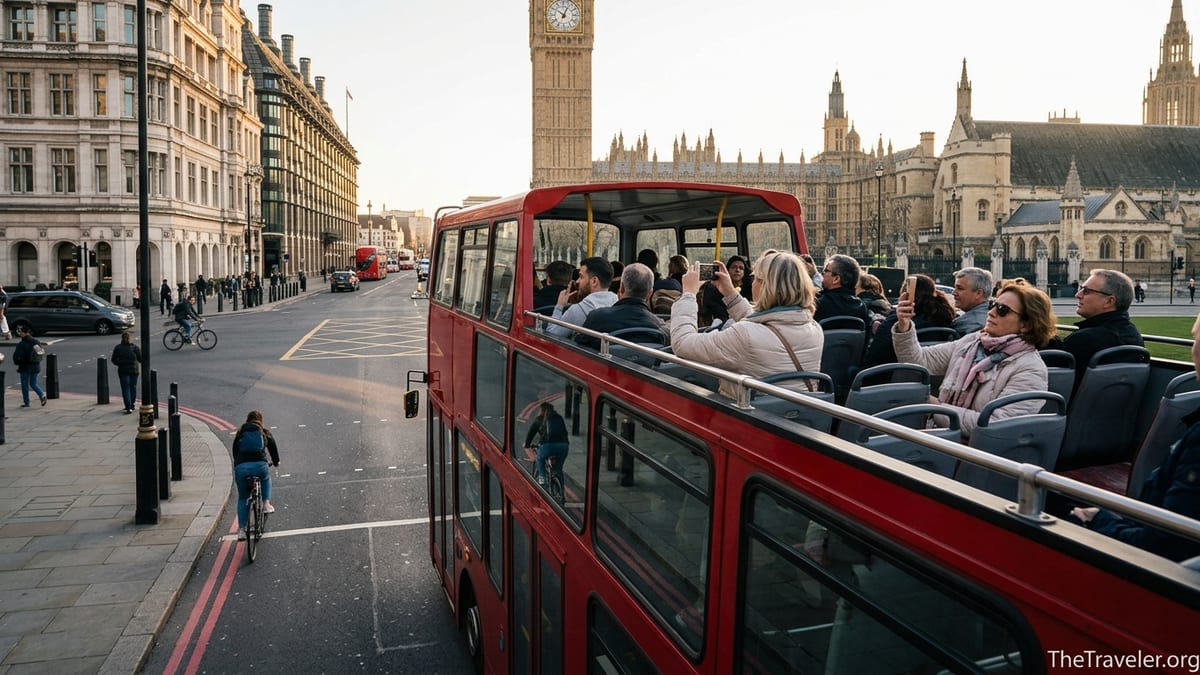
What Big Bus Tours Actually Are in 2026
When people talk about “big bus tours,” they are usually referring to open top hop on hop off sightseeing buses run by brands like Big Bus Tours, City Sightseeing, Tootbus, and local operators licensed under those franchises. These buses follow fixed loops around major sights, from Times Square to Brooklyn Bridge in New York and from Westminster to the Tower of London in the UK capital, with recorded commentary and the option to get off and back on along the route.
Tickets are typically sold in time blocks rather than by distance, usually 24, 48, or 72 hours. In London, for example, recent comparisons show 24 hour adult tickets starting around the equivalent of the high 20s in pounds for basic access, with higher tiers adding extras like Thames river cruises and walking tours. In New York, 1 day passes with companies such as Big Bus and TopView tend to cluster around the high 70s in US dollars for a classic loop of Manhattan, with add ons for Brooklyn or night tours.
The core promise is simple: buy one ticket, get curated sightseeing transport that doubles as a rolling city overview. Drivers stick to a loop, buses arrive every 10 to 30 minutes depending on traffic and season, and you plug in headphones for audio in multiple languages. In practice, the experience can feel very different depending on the city, the weather, and how you use the ticket.
Understanding how these tours fit into a city’s broader transport and tour landscape is the first step in deciding whether they are a smart buy or a tourist trap for your specific trip.
The Real Costs vs Just Using Public Transport
At face value, hop on hop off buses look expensive next to normal public transport. In London, recent traveler comparisons point out that a 24 hour hop on hop off ticket at around 45 pounds can be almost ten times the capped cost of unlimited city buses in a day, which is just over 5 pounds when you tap in with a contactless card. Similarly, in New York, a 1 day sightseeing bus pass at around 79 dollars sits in stark contrast to a 2.90 dollar subway ride or a 34 dollar 7 day unlimited MetroCard.
However, the price gap is only part of the story. A sightseeing ticket folds transport, orientation, light commentary, and sometimes extra tours into one product. In London, Big Bus higher tier passes, for example, have bundled a one way river cruise on the Thames and themed walking tours into the price on recent brochures. In cities like Lisbon, franchise operators sell combined tram and bus products that pair an atmospheric heritage tram loop to Belém with the bus circuit, which some visitors treat as a moving city introduction.
The question is whether you will truly use what you are paying for. If you are in New York for three days, already plan to buy a subway pass, and will spend most of your time walking Midtown, Greenwich Village, and Brooklyn neighborhoods, then paying for a bus loop that mostly runs streets you would otherwise walk can feel like unnecessary duplication. On the other hand, if you are in Washington DC for one full day and want to see the Mall, the memorials, and Georgetown without juggling bus transfers, the price starts to look more like a flat fee for efficiency and reduced decision making.
Thinking of these buses as a value calculation rather than a raw price comparison usually gives a clearer answer. If the ticket replaces several point to point journeys, includes extras you would otherwise pay for, and helps you cover ground you would not manage by yourself, it can justify its cost. If not, the same money can usually buy much richer experiences like a small group walking tour or museum guide.
Where Big Bus Tours Shine: Short Stays and First Impressions
Big bus style tours tend to work best in specific scenarios. One of the clearest is the compressed city break: think a 24 hour layover in London or a weekend in New York. Travelers who have used a hop on hop off loop on a short London visit often describe boarding at Victoria or Marble Arch, riding an entire circuit past Buckingham Palace, Westminster Abbey, the London Eye, St Paul’s Cathedral, and the Tower of London in roughly two to three hours, and stepping off with a mental map of the city that would have taken a full day of Tube rides and guesswork to build.
In New York, most operators focus on two main loops that thread through Downtown and Uptown Manhattan. Recent guides note that what looks like a compact grid on a map becomes far more sprawling at street level. A bus loop connecting Times Square, the Empire State Building, the Flatiron, SoHo, the 9/11 Memorial, and back up the West Side can turn what would be a patchwork of subway lines and long walks into a single, continuous orientation ride. Travelers on tight itineraries often use the ride time to decide where they want to come back later on foot.
These buses are also a practical option for visitors who find intense urban navigation stressful. Families traveling with young children, older travelers who prefer to minimize stairs, and guests worried about safety after dark in a new city may appreciate having a clearly branded, predictable vehicle to fall back on. In Cape Town, for example, some travelers report feeling more comfortable using a structured hop on hop off route to see Table Mountain, the V&A Waterfront, and beach suburbs than stitching it together with a mix of taxis and local minibuses.
Finally, there is the simple appeal of effortless sightseeing. On a mild day in Paris or Barcelona, sitting on the upper deck with a light breeze as you cross the Seine or roll down Passeig de Gracia can be a pleasure in itself. If your goal for that afternoon is relaxed, low effort sightseeing rather than deep cultural immersion, a bus loop can genuinely deliver value in the form of comfort and convenience.
Common Complaints: When Big Bus Feels Like a Tourist Trap
For every traveler who swears by a hop on hop off tour, there is another who vows never to board one again. Reading through recent reviews and traveler discussions, a few patterns appear repeatedly. Overcrowding is near the top of the list. On popular routes in peak season, it is common to see long lines at stops such as the Tower of London or near Times Square. By the time the bus arrives, there may be only a handful of seats on the open top deck, which is what most people came for in the first place.
Delays and irregular service are another consistent frustration. In cities with heavy traffic, the advertised frequency of every 15 or 20 minutes can stretch considerably. Travelers in London and New York, for instance, report waiting half an hour or more at stops during busy periods, watching several crowded buses pass before being able to board. When you have paid for a 24 hour ticket that started at noon, losing an hour at a bus stop feels like losing a real chunk of value.
Quality of commentary also varies widely between operators and cities. Some loops offer enthusiastic live guides who throw in local tips and humor. Others rely entirely on pre recorded audio that can feel generic, misaligned with what you are seeing out the window, or too focused on broad trivia. In some reviews of international franchise operators, travelers describe commentary that talks more about attractions five minutes away than the streets they are currently passing, which undermines the idea that you are getting meaningful insight for your money.
Then there is the question of authenticity. For independent minded travelers, being herded to the same set of photo stops as every other first timer can feel more like being processed than exploring. In highly walkable cities such as central Lisbon or Prague, where trams and public transport provide easy access to major sights, some locals and repeat visitors see hop on hop off buses less as a helpful service and more as a way to channel tourists into a packaged version of the city that is convenient for operators but offers shallow engagement.
Comparing Big Bus Tours With Alternatives
To decide whether a big bus tour is worth it for you, it helps to compare it directly with the other ways you could spend the same time and money. A straightforward alternative in most cities is to pair public transport with a guided walking tour. In London, for example, you might take a regular red city bus along the Strand and Fleet Street for a fraction of the cost of a sightseeing loop, then meet a local guide for a focused two hour walk around Westminster or the City. In New York, a subway ride to Lower Manhattan plus a neighborhood walking tour around the Financial District and Brooklyn Heights costs far less than a full day bus pass but can deliver deeper context.
Small group or theme tours are another option. Instead of a general bus loop, you could book a food tour in Lisbon’s Baixa and Mouraria, a street art walk in Berlin, or a history focused tour of Washington DC’s monuments. These often match or slightly exceed the price of a 24 hour hop on hop off ticket but offer intensive time in a specific area with a guide who specializes in that subject. Many travelers who have tried both formats report feeling that specialized tours give them stories and recommendations they still remember years later, while bus commentary fades quickly.
Private drivers and taxis can also rival or undercut hop on hop off prices in some destinations, especially for families or groups. In Bangkok, for instance, arranging a car and driver for a day to shuttle a family between temples, markets, and river ferries can be comparable in cost to four individual bus passes, while giving total control over timing and stops. In less congested cities where taxis are inexpensive, stringing together point to point rides can be more flexible and comfortable than waiting at designated bus stops.
That said, hop on hop off buses do occupy a genuine middle ground between full independence and fully guided tours. They reduce the need for route planning and navigation while still allowing some freedom to decide where and how long to stop. The key is to recognize when that middle ground suits your priorities and when it is simply an expensive way to replicate what public transport or a targeted tour could do better.
How to Tell if a Big Bus Tour Is Worth It for Your Trip
Turning the big bus question from abstract debate into a clear decision is easier if you run through a few practical filters. First, look at your time in the city. If you have less than two full days and are visiting a place with widely spread sights, such as Los Angeles or Dubai, a structured loop can help you see a lot quickly. If you have four or five days in a compact city center like Amsterdam, Prague, or central Lisbon, you probably do not need a sightseeing bus to cover distances you can easily walk or navigate by tram.
Next, think about your energy level and mobility. Travelers with limited mobility, those recovering from illness or injury, or parents juggling strollers and nap schedules often get more value out of door to door style transport than agile backpackers. If climbing metro stairs, deciphering ticket machines, or shepherding children through crowds would sap your enjoyment, paying extra for a bus that handles those logistics may be worth every dollar. Conversely, if you are comfortable hopping on any local tram or bus and enjoy getting a little lost, the structure of a hop on hop off route might feel restrictive.
Budget is another clear filter. Add up the realistic alternatives: a day’s worth of metro and bus rides, plus perhaps a two hour walking tour, and compare that total to the sightseeing bus price you are seeing on recent booking platforms. If the bus is significantly more expensive and you are traveling long term or on a tight budget, that money might be better spent on museum entries, meals, or a unique excursion. If you are on a short once in a decade trip where time matters more than cash, spending extra for simplicity can be rational.
Finally, consider your travel style. If you enjoy structure, checklists, and being certain you have “seen” the main sights, the tick box nature of big bus routes may suit you well. If you care more about lingering in a single café, chatting to locals, and finding out what is down side streets not announced on an audio track, you are likely to find more satisfaction in less scripted forms of city exploration.
Real World City Examples: London, New York, and Beyond
London is one of the clearest test cases for the “worth it or tourist trap” question. Several major operators compete for the same central routes past Buckingham Palace, Piccadilly Circus, and the Tower. Recent online discussions among travelers highlight a stark cost comparison: around 45 pounds for a 24 hour hop on hop off ticket versus a daily fare cap of a bit over 5 pounds on regular buses. Locals point out that you can ride ordinary double decker buses along scenic routes, such as those that cross Westminster Bridge or roll past St Paul’s, and pair that with the Tube for a fraction of the cost. On the other hand, some visitors praise the big buses for helping them hit the key sites in one jet lagged afternoon, especially when combining the loop with an included Thames cruise.
In New York, experiences are similarly mixed. Guides published in 2026 describe sightseeing buses as “compress the city” tools that work best for first timers with limited days. Some travelers report that riding a full loop from Midtown through Lower Manhattan, then swapping to an Uptown route, gave them a coherent picture of Manhattan’s layout they struggled to build from the subway alone. Others complain of long waits at busy stops in Times Square, intense summer heat on the top deck, and commentary that adds little beyond what a good guidebook or app would provide, all for a price that quickly exceeds a week’s unlimited metro pass.
In cities where public transport is less intuitive for visitors, hop on hop off tours sometimes play a different role. In Cape Town, as mentioned earlier, or in parts of the Middle East, travelers sometimes choose structured bus routes because they feel safer or more predictable than experimenting with unfamiliar minibus or taxi systems. In contrast, in highly walkable historic centers like Lisbon’s Baixa or Prague’s Old Town, some repeat visitors describe the buses as unnecessary overhead and suggest investing instead in well regarded food walks, history tours, or simply following curated self guided routes.
Looking at these examples together, a pattern emerges. The same product can be a lifeline for one traveler and an overpriced distraction for another. The deciding factors are usually how comfortable you are with local transport, how short your trip is, how spread out the city’s attractions are, and how much you value a narrated overview versus deeper time in fewer places.
The Takeaway
Big bus hop on hop off tours are neither always worth it nor always a tourist trap. They are tools. Used in the right circumstances, they can turn a disorienting arrival into a pleasant, structured introduction to a city, let a family with jet lag see the skyline without wrestling strollers through metro stations, or help a nervous first time traveler feel anchored while still getting out of the hotel. They can bundle a handful of extras, like short river cruises or guided walks, into a single product that simplifies planning.
Used in the wrong circumstances, they can drain a day’s budget on what is essentially a slow moving city bus that never goes into the neighborhoods where locals actually spend their time. Long queues, inconsistent frequencies, weak commentary, and mid summer heat on the upper deck can quickly turn the promise of “effortless sightseeing” into a frustrating, generic experience that feels disconnected from the real life of the city.
If you are considering a big bus ticket, start by looking at how long you will be in town, how far apart the main sights are, and how confident you feel using local transport. Compare the ticket price with what a day of public transport plus a focused tour would cost. Read a handful of recent reviews for your specific city, not just the brand, and pay attention to comments about crowds, wait times, and audio quality in the season you plan to travel.
In the end, the safest rule of thumb is to treat hop on hop off buses as a one time overview tool rather than the backbone of your entire visit. Use them, if you choose to, on your first day to get your bearings. Then step off, wander, and let the city reveal itself at street level, where the real magic of travel still happens.
FAQ
Q1. Are hop on hop off big bus tours good value for money?
They can be, but only in specific situations. They tend to offer better value for first time visitors on short trips in spread out cities, where the ticket replaces multiple taxi or rideshare journeys and doubles as an orientation tour. If a city is compact and has excellent public transport, the same money is often better spent on a local walking tour and standard transit passes.
Q2. In which cities do big bus tours make the most sense?
They make the most sense in destinations where major sights are widely spaced and public transport can feel confusing for newcomers. Examples include New York for a Manhattan overview, Washington DC for monuments spread along the Mall, Dubai for distant clusters of attractions, and Cape Town for visitors who want a structured way to see scattered coastal and city sights without navigating unfamiliar minibus systems.
Q3. When are big bus tours usually a waste of money?
They are often poor value in cities with compact historic centers and strong tram, metro, or bus networks. In places like central London, Amsterdam, Lisbon, or Prague, you can reach most key sights easily on foot or via inexpensive public transport. In these cases, a hop on hop off ticket can become an expensive way to replicate journeys you could do yourself while missing out on smaller streets and local encounters.
Q4. How do big bus tours compare to guided walking tours?
Big bus tours offer breadth while walking tours offer depth. Buses are better for covering long distances and seeing many landmarks quickly, but commentary is usually broad and sometimes generic. Walking tours focus on a single neighborhood or theme and give more detailed stories, local tips, and interaction with a guide. For many travelers, a combination works well: a bus loop early in the trip for orientation, then one or two walking tours for deeper understanding.
Q5. Are hop on hop off buses a good option for families with children?
They can work well for families, especially with young kids who tire quickly or find crowded metros overwhelming. The ability to sit, watch the city go by, and hop off near major sights without navigating complex transfers is attractive. However, parents should factor in weather, as open top decks can be very hot in summer or exposed in rain, and consider whether ticket prices for multiple children still fit the family budget.
Q6. How accessible are big bus tours for travelers with limited mobility?
Many modern sightseeing buses offer low floor access, ramps, and priority seating, and some operators publish accessibility statements detailing which stops and vehicles are step free. For travelers who prefer to avoid metro stairs or long walks between scattered sights, this can be a significant advantage. That said, upper decks are usually accessible only by stairs, so travelers who cannot climb them will be limited to lower deck views, which can be more obstructed by traffic and reflections.
Q7. What time of year is best for using an open top big bus tour?
Spring and autumn often offer the best combination of comfortable temperatures and clear views. In peak summer, upper decks can be uncomfortably hot in cities like New York or Rome, and buses may be extremely crowded. In winter, cold winds and rain can make open air seats unpleasant, even if operators offer partial covers. Checking typical seasonal weather for your destination before booking is a smart move.
Q8. Should I ride a full loop or hop on and off frequently?
Riding at least one full loop without getting off is often the most efficient way to gain an overview and hear the entire commentary once. After that, you can choose a few specific stops to explore more deeply. Constantly hopping off at every landmark can leave you spending much of your ticket time waiting for the next bus rather than actually sightseeing.
Q9. How can I avoid the worst tourist trap aspects of big bus tours?
To avoid the biggest pitfalls, research your chosen operator for recent complaints about crowding and delays, travel outside the absolute peak midday hours when possible, and treat the bus as a tool for orientation rather than your only way of seeing the city. Buying tickets directly from official channels, rather than from aggressive street hawkers around main squares, also reduces the risk of paying inflated prices or ending up on a lower quality route.
Q10. Is it better to book a big bus tour in advance or on the day?
Booking in advance can secure promotional prices and save time at ticket booths, especially in popular cities during high season. However, buying on the day gives you flexibility to respond to weather and energy levels. A reasonable compromise is to decide only once you have arrived, checked the forecast, and seen how walkable the city feels, then purchase either online the night before or at a clearly signed sales point if you still feel a bus will add value.