


Standing on the Naples seafront on a clear day, it is hard to believe that much of the bay’s gentle curve hides one of the most closely watched volcanic areas on Earth. The Phlegraean Fields, or Campi Flegrei, begin just west of the city and stretch around Pozzuoli in a landscape of craters, fumaroles and hot springs. In recent years, increased seismic activity and ground uplift have put this restless caldera under a global spotlight. For travelers planning a few days in Naples, the question naturally arises: is it still worth visiting the Phlegraean Fields, and under what conditions does it make sense to go?
Get the latest updates straight to your inbox!
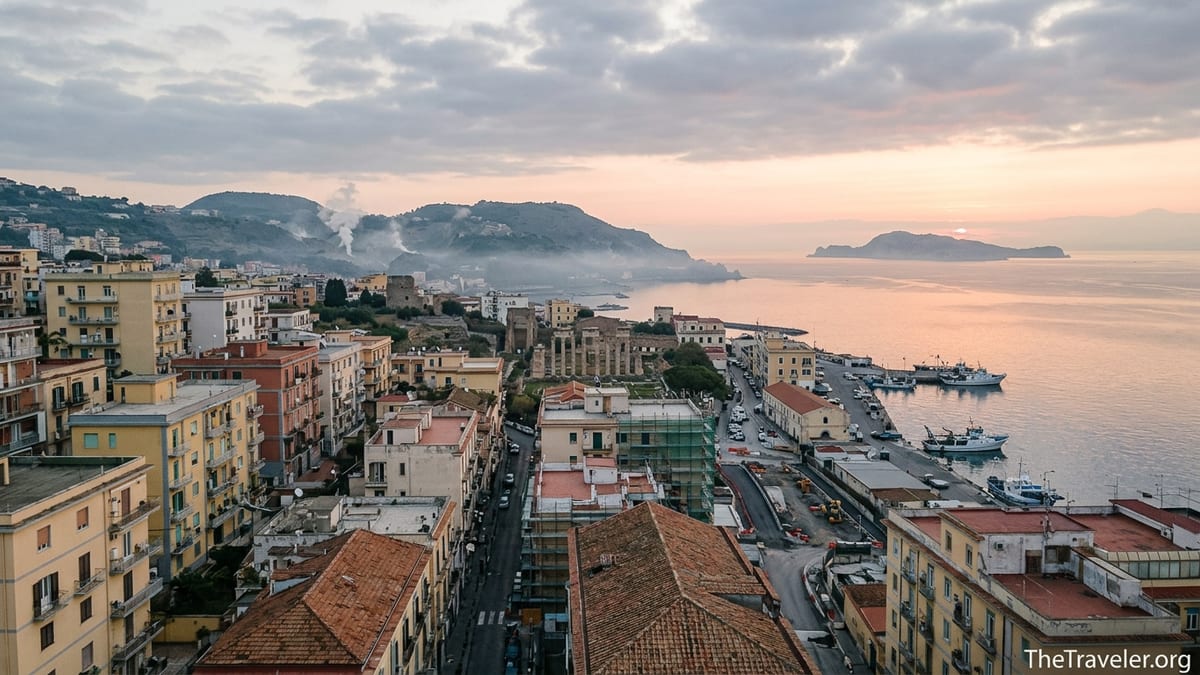
Understanding What and Where the Phlegraean Fields Are
The Phlegraean Fields are not a single mountain-shaped volcano but a wide volcanic caldera that underlies much of the coastline west of Naples, including the town of Pozzuoli and parts of the Bay of Naples. Instead of a classic cone, visitors encounter low hills, ancient craters, warm fumaroles and thermal springs woven into everyday urban life. Roman ruins, fishing harbors and apartment blocks sit on land that has slowly risen and fallen over centuries.
For a visitor staying in central Naples near Piazza Garibaldi or the historic center, the nearest part of the caldera is only about 10 to 15 kilometers away. In practice this usually means heading toward Pozzuoli, the main gateway town. A typical route is the Cumana suburban railway from Montesanto station, which brings you to Pozzuoli in around 20 to 30 minutes, or a regional train from Napoli Piazza Garibaldi. Some travelers opt for guided half-day tours by minivan that combine Pozzuoli’s archaeological sites with viewpoints over the volcanic landscape.
The area contains several distinct micro-destinations that matter to travelers: the historic center and waterfront of Pozzuoli; the Roman archaeological complex known as the Macellum or Temple of Serapis; the amphitheater and stadium ruins; lakes such as Averno and Fusaro; and a scattering of spa hotels and thermal clubs on the way toward Baia and the island of Ischia. None of these alone rival Pompeii or the center of Naples, but together they offer a striking, lived-in view of how people coexist with an active caldera.
It is important to distinguish between the caldera as a whole and specific sites inside it. The famous Solfatara crater, once the most obvious “volcano visit” in Pozzuoli, remains officially closed to the public following a fatal accident in 2017 and ongoing safety concerns. Travelers can no longer walk among its steaming vents with a ticket at the gate, even if online reviews or old blog posts suggest otherwise. Instead, visits now focus on accessible urban and archaeological locations on the caldera’s surface rather than entering active geothermal craters.
The Current Risk Picture: Alert Levels, Quakes and Practical Impact
In recent years Campi Flegrei has been in a renewed phase of unrest marked by bradyseism, the slow uplift and subsidence of the ground caused by changes in underground fluids and magma. Since around 2005, monitoring agencies have recorded more than a meter of uplift in parts of Pozzuoli, alongside swarms of small earthquakes, occasional stronger shocks and increased gas emissions. These are the factors that drive headlines about a “restless supervolcano” and understandably give travelers pause.
Italy’s Civil Protection Department currently maintains a yellow alert level for the Phlegraean Fields, which indicates heightened attention and ongoing unrest but not an imminent eruption. This status is based on continuous monitoring of seismicity, ground deformation and gas chemistry by the Vesuvius Observatory and national scientific institutes. Researchers emphasize that while the activity is significant and must be taken seriously, the most likely short-term hazards for residents and visitors are localized earthquakes, the opening of new fumaroles or ground fractures, and gas emissions in specific low-lying spots rather than a large explosive event.
On the ground, visitors may notice concrete consequences of this unrest. In June 2026, for example, sections of the Naples Metro Line 2 serving the Campi Flegrei and Pozzuoli area were temporarily closed because the bradyseism and gas concentrations complicated safe operations. Drivers sometimes encounter roadworks where ground cracks have appeared after heavy rain and tremors. Periodic local evacuation drills and siren tests are part of normal life. For a traveler, these phenomena translate into possible transport disruptions, short-term closures of specific streets or buildings and a higher likelihood of feeling small tremors during a stay.
Authorities regularly update emergency plans, including detailed red and yellow zones and evacuation procedures for residents. Tourists are not the primary focus of these plans but benefit indirectly from the same monitoring systems. Sensible visitors treat the area much like one would treat a region with moderate earthquake risk: by staying informed through accommodation hosts or local news, knowing basic earthquake safety behavior, and understanding that the underlying risk is managed but not eliminated.
Which Parts Are Open, Closed or Restricted Right Now
One of the biggest sources of confusion for visitors is the status of individual volcanic attractions. The headline change is that the Solfatara crater in Pozzuoli, once an iconic stop for bus tours, remains closed to tourist visits. The site shut in 2017 after a tragic incident involving unstable ground near a boiling mud area and has not reopened, in large part because a new, more stringent safety plan has not yet been implemented. Even though some websites still describe wandering freely among sulfur vents and mud pools, those descriptions are outdated.
Instead, travelers currently experience the Phlegraean Fields largely through accessible urban and archaeological sites that lie within the caldera. In Pozzuoli’s historic center, the so-called Temple of Serapis, actually a Roman marketplace, offers a visible record of the ground’s rise and fall over centuries. Three marble columns carry bands of holes bored by marine mollusks, marking periods when the structure stood partially under the sea before land uplift raised it again. Visiting this open-air site gives a vivid, low-risk sense of the caldera’s breathing without entering hazardous geothermal terrain.
The Flavian Amphitheater in Pozzuoli, one of the largest in Italy after the Colosseum and the amphitheater in Capua, is open to tours and can be comfortably combined with a walk along the waterfront. Here, the volcanic story is more indirect: the amphitheater’s stone and brickwork were quarried from local tuff and lava deposits, and sections of the structure reveal the porous, yellowish rock typical of Campanian volcanic eruptions. Tickets are usually modest compared with Pompeii, and crowd levels are significantly lighter, especially on weekdays.
Elsewhere in the caldera, access is more nuanced. Some minor fumarole fields and hot springs on the edges of Pozzuoli’s residential districts are cordoned off and visible only from a distance. Lakes such as Averno and Fusaro are generally open for walking and dining along the shore, subject to ordinary local regulations and occasional closures after heavy rains or subsidence events. Bathing in uncontrolled hot springs is not a mainstream option, unlike in some Icelandic or Japanese volcanic areas; visitors typically use regulated spa facilities inside hotels or private clubs where safety and water quality are managed.
Why Travelers Still Choose to Go: Value, Atmosphere and Experiences
Despite the unrest and closures, many travelers still carve out half a day or a full day to explore the Phlegraean Fields while based in Naples. One practical reason is value. Compared with flagship sites like Pompeii and the Amalfi Coast, Pozzuoli and its surroundings typically see fewer tour buses and lower prices. A coffee in a bar facing the harbor, a plate of fried seafood on the seafront promenade or a taxi ride within town often cost less than in central Naples or Sorrento, even in the high season.
Equally important is atmosphere. Pozzuoli feels distinctly local, with residents shopping at covered markets, children playing in small piazzas and fishermen tending boats beneath the caldera walls. The volcanic story is present but not overwhelming: you might feel a faint sulfur smell in certain streets on humid days or see steam drifting from a fenced-off patch of earth, yet life around continues calmly. For many visitors, that coexistence between the ordinary and the extraordinary becomes the lasting memory of the trip.
Concrete experiences usually revolve around a simple combination: taking the train from Naples in the morning, visiting the Temple of Serapis and the amphitheater, then enjoying a leisurely seafood lunch with views of the Bay of Pozzuoli and the island of Procida or Ischia. Travelers with more time might add a late afternoon walk along Lake Averno, historically thought by the Romans to be an entrance to the underworld, where vineyards now climb the crater walls and small wine estates occasionally offer tastings. These are low-intensity, culturally rich activities that suit visitors who enjoy urban wandering more than check-list sightseeing.
Another draw is the chance to see, in real time, how a community manages ongoing volcanic risk. Information boards, emergency assembly point signs and occasionally visible monitoring equipment remind visitors that this is one of the best-instrumented volcanic systems in Europe. For geology enthusiasts and curious travelers, combining a day in the Phlegraean Fields with a separate visit to Vesuvius or the National Archaeological Museum in Naples creates a deeper narrative about the region’s explosive past and present.
Who Should Prioritize a Visit and Who Might Skip It
Deciding whether the Phlegraean Fields are “worth it” depends heavily on a traveler’s interests, time and tolerance for uncertainty. Visitors who are fascinated by geology, volcanoes or the intersection of human settlement and natural hazard will find the area uniquely compelling. For them, seeing uplifted Roman columns, feeling a minor tremor while standing in a modern piazza, or watching steam drift from hillside vents can be powerful, real-world encounters with earth science.
Cultural travelers with more than three full days in Naples often appreciate the slower, less touristed character of Pozzuoli and neighboring areas. If you have already planned the classics such as Pompeii, the historic center of Naples and perhaps a day trip to the islands or the Amalfi Coast, then allocating a half day to the Phlegraean Fields can round out the picture of the bay. In particular, those interested in Roman engineering will enjoy comparing the amphitheater and marketplace in Pozzuoli to the more famous ruins at Pompeii and Herculaneum.
On the other hand, visitors with very limited time in Naples, such as a single full day before a cruise departure, may find that the extra commuting and potential for minor transport disruption make the Phlegraean Fields a lower priority. For them, staying within central Naples or focusing on Pompeii delivers more immediate impact. Similarly, travelers who are acutely anxious about earthquakes, or who would find any noticeable tremor deeply unsettling, might be more comfortable choosing destinations where seismicity is lower and less talked about.
Families with small children or people with limited mobility should factor in that pavements in parts of Pozzuoli can be uneven due to subsidence and constant repairs. Strollers and wheelchairs may need to navigate patches of rough ground around older monuments. While this is not dramatically worse than in other historic Italian towns, it is another aspect of everyday life shaped by the caldera beneath.
How to Visit Responsibly and Stay Informed
For travelers who decide the Phlegraean Fields belong on their Naples itinerary, a few grounded practices can improve safety and enjoyment. Booking flexible transport and keeping an eye on local news in the days before a visit helps anticipate temporary closures of metro segments or streets. If you plan to use the Naples Metro or the Cumana line, ask your accommodation host the evening before whether any sections near Campi Flegrei or Pozzuoli are currently suspended and what alternatives locals are using.
On arrival in Pozzuoli, it is wise to note the green emergency assembly point signs that mark squares and open areas designated for gathering in case of an earthquake strong enough to prompt evacuation from buildings. While the probability of a significant event during a short visit remains low, understanding where people would naturally go if sirens sound contributes to personal preparedness. In restaurants and hotels, a quick glance at evacuation diagrams posted near exits can be helpful, just as it would be in any seismic region.
Travelers should strictly respect barriers and warning notices around fumaroles, cracks and hot ground. It can be tempting to step closer for a photo when a patch of steaming earth lies just beyond a fence, but both the temperature of the gases and the stability of the surface can change quickly. The 2017 accident at Solfatara, which occurred when visitors moved into an unstable area and the ground suddenly gave way, is a sober reminder that the line between attraction and hazard is thin in active geothermal fields.
If a trip coincides with an earthquake swarm that generates media attention, the best course is to follow instructions from local authorities, avoid underground spaces where advised and be prepared to adjust plans. Hotels in Naples and Pozzuoli are accustomed to answering questions about seismic episodes and can usually provide clear, calm guidance. In most past swarms, daily life in the city has continued with minor disruptions, though some residents temporarily leave the immediate red zone of the caldera until the most intense shaking subsides.
The Takeaway
The Phlegraean Fields occupy a rare space in world travel: a densely populated, culturally rich coastal region built directly atop a large, active volcanic system that is currently in a phase of heightened unrest. For visitors to Naples, this creates both an opportunity and a dilemma. On one hand, the area offers powerful, concrete encounters with geology and history, from uplifted Roman structures to fumaroles steaming above apartment blocks. On the other, recent seismic swarms, visible ground deformation and the long-term closure of the Solfatara crater underline that this is not a theme park but a living hazard zone.
For most travelers with a few days in Naples, a carefully planned visit to Pozzuoli and the more accessible parts of the Phlegraean Fields is still a reasonable and rewarding choice. It works best for those who are curious about Earth processes, comfortable with a modest level of uncertainty and willing to stay informed about local conditions. Visitors should approach the experience with humility, respecting barriers, listening to local advice and accepting that plans may change if seismic activity intensifies.
If your time is very short, your tolerance for risk extremely low or your nerves easily rattled by talk of earthquakes, you may prefer to focus on the many other highlights around the Bay of Naples. The region offers an abundance of world-class sites that do not sit inside an active caldera, from the royal palace at Caserta to the coastal paths of the Sorrento Peninsula. Skipping the Phlegraean Fields is a valid choice, and no single trip can capture everything this complex region contains.
Ultimately, the question of whether the Phlegraean Fields are worth visiting during a trip to Naples has no universal answer. It is a personal calculation shaped by your interests, your time and your comfort with a landscape that is beautiful, historically layered and scientifically restless. Approached with awareness and respect, a day among these “burning fields” can deepen your understanding of Naples far beyond the postcard views of the bay.
FAQ
Q1. Are the Phlegraean Fields currently open to tourists?
The wider Phlegraean Fields area, including Pozzuoli and its archaeological sites, is open, but specific high-risk sites such as the Solfatara crater remain closed to the public.
Q2. Is it safe to visit Pozzuoli given the recent earthquakes?
Authorities maintain a yellow alert level, which indicates unrest but not an imminent eruption. Visiting is generally considered acceptable if you stay informed, follow local advice and respect any temporary closures.
Q3. Can I walk inside the Solfatara crater like older guidebooks suggest?
No. The Solfatara tourist site has been closed since 2017 after a fatal accident and has not reopened. You should avoid any unofficial access points or offers to enter restricted areas.
Q4. What is the best way to reach the Phlegraean Fields from central Naples?
Most visitors use suburban trains such as the Cumana line from Montesanto station or regional trains from Napoli Piazza Garibaldi to Pozzuoli, or they join organized half-day tours by minivan.
Q5. What can I realistically see in half a day in the Phlegraean Fields?
In a half day you can typically visit the Temple of Serapis, the Flavian Amphitheater and the Pozzuoli waterfront, and enjoy a meal overlooking the bay, with time for a short stroll through the old town.
Q6. Should I worry about a major eruption during my visit?
The probability of a large eruption during a short stay is considered low, but the caldera is in a restless phase. The more relevant short-term risks are local earthquakes, gas emissions and minor ground fractures.
Q7. How can I stay updated on the situation while I am in Naples?
Ask your hotel or apartment host for current information, keep an eye on local news and pay attention to any notices from municipal authorities about transport changes or civil protection exercises.
Q8. Are there any special precautions families with children should take?
Families should watch children closely near waterfronts, archaeological ruins and any fenced geothermal areas, avoid stepping beyond barriers, and be prepared for uneven pavements caused by subsidence and repairs.
Q9. Is visiting the Phlegraean Fields a good alternative to Vesuvius?
It is more a complement than a direct alternative. Vesuvius offers a classic cone and crater experience, while the Phlegraean Fields provide a broader, lived-in caldera landscape with fewer crowds and a stronger sense of everyday life.
Q10. When might it be better to skip the Phlegraean Fields?
You might skip them if you have only one full day in Naples, are very anxious about earthquakes, or visit during a period of intense seismic swarms that cause widespread local disruption.