


Few public spaces on earth are as instantly recognizable as St Peter’s Square in Vatican City. Whether you glimpse it on a Christmas Eve broadcast, from the window of a tour bus crossing the Tiber, or under your own feet at sunrise, the vast oval framed by Bernini’s colonnades has a way of etching itself into memory. More than three centuries after it was completed, this is still one of the world’s most stage-like, symbolic and emotionally charged urban rooms.
Get the latest updates straight to your inbox!
A Stage Built to Embrace the World
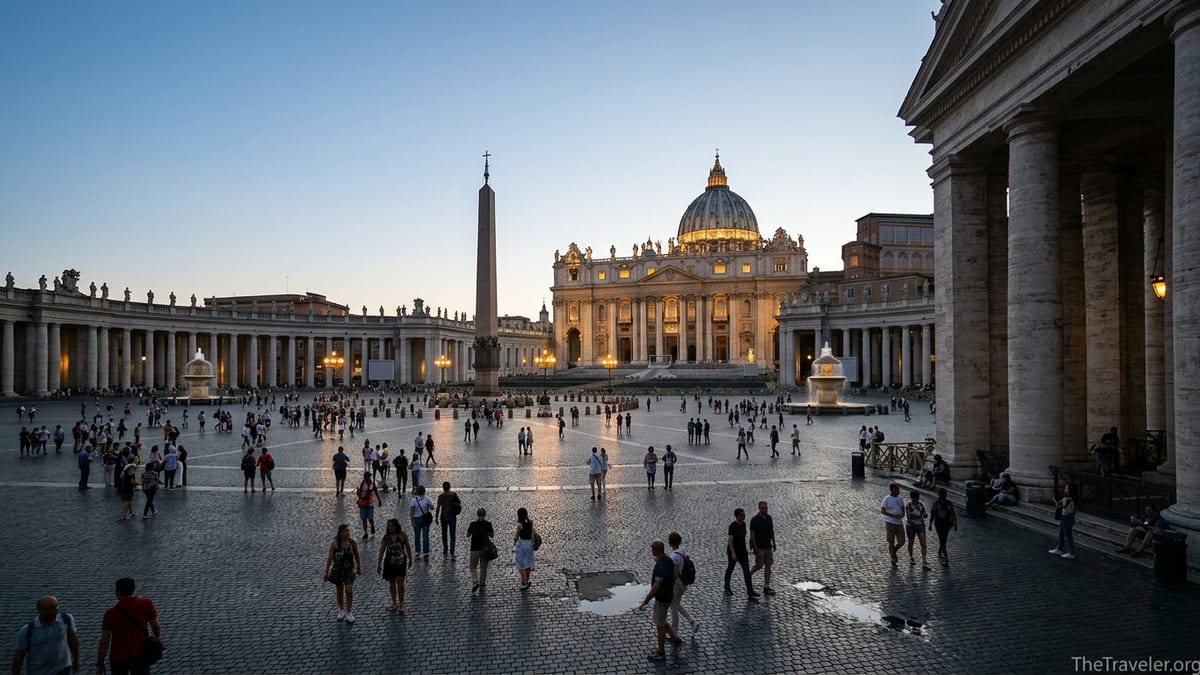
Stand in the middle of St Peter’s Square on a quiet morning and it can feel curiously intimate for a space that routinely holds tens of thousands of people. That paradox is the result of Gian Lorenzo Bernini’s 17th century design, which transformed an awkward, irregular forecourt into an immense yet coherent piazza between 1656 and 1667. Instead of a rigid rectangle, he created a two-part composition: a trapezoidal apron right in front of the basilica and, beyond it, a great oval defined by sweeping colonnades, like two open arms reaching into Rome. Today the square stretches roughly 340 meters at its widest point, but the curves guide your eye and your body gently inward, not out toward the city.
Those famous Tuscan colonnades are not just decoration. They are architecture with a clear psychological aim. Bernini spoke of them as the “maternal arms” of the Church, welcoming the faithful, doubters and the simply curious alike into a shared space. Each arm consists of four deep rows of columns, 284 in total, rising to about 16 meters and topped with 140 larger-than-life statues of saints carved by Bernini’s assistants. When you arrive from Via della Conciliazione, the modern processional avenue from the Tiber, your first impression is of a monumental screen of stone. But as you step into the oval, those same columns recede to the edge of your vision, and the center opens around you like an amphitheater.
Travelers notice the effect immediately. Walk in during a midweek lull, perhaps around 9 am outside of peak season, and you may find only a few school groups and nuns crossing the flagstones. Yet the square still feels full, because the circular geometry and the encircling colonnades keep your attention on the center, where the Egyptian obelisk and twin fountains anchor the scene. This carefully orchestrated sense of enclosure is one reason visitors often describe feeling “held” by St Peter’s in a way they do not in many other grand plazas.
Bernini even played with optics to heighten that embrace. On the pavement, near each side of the obelisk, a small round disk marks a spot where the four rows of columns line up perfectly and seem to collapse into a single row. Guides still pause here with groups, inviting people to step on the stone and watch the colonnade suddenly thin. It is a subtle reminder that this is a space meant to be experienced from the human eye level, not only admired in photographs from above.
Symbolism You Can Walk Through
St Peter’s Square is also a three-dimensional catechism, filled with symbols that work even if you know nothing of Catholic theology. The 25-meter-tall red granite obelisk at the center once stood in the Circus of Nero, where tradition holds that the apostle Peter was martyred. In the late 16th century it was moved to its present position, then later absorbed into Bernini’s design as a focal point. Today, travelers often use it as a rendezvous point: guides ask groups to meet “by the obelisk” before a papal audience, and independent visitors arrange to find each other in its shadow, perhaps leaning on the low stone balustrade as they scan the crowd.
Flanking the obelisk are two later fountains, whose constant movement and sound soften the otherwise hard, open space. On a hot Roman afternoon, you will see children edging as close as they can to the spray while adults take photographs from the slightly raised platforms around each basin. When the sun is low, the fountains throw misty halos of light, and at night they are illuminated in a way that turns them into quiet beacons guiding people toward the basilica steps.
Even the paving tells a story. Radiating from the base of the obelisk, stone lines trace out the points of a compass, a reminder that this square receives pilgrims from every direction on earth. In recent Jubilee years the Vatican has also installed temporary signage and art in the square that highlight key themes, from mercy to environmental stewardship. During the 2025 Holy Year, for example, special wayfinding panels helped direct pilgrims in multiple languages toward the Holy Door of the basilica and to confession and adoration areas, turning the piazza into both a spiritual and logistical hub for an estimated tens of millions of visitors moving through Rome over 12 months.
Secular travelers may not register every layer of symbolism, but most feel its weight. Many first-time visitors report that the square is where the scale and continuity of the Catholic Church becomes tangible. You may walk in with a skip-the-line ticket on your phone, but as you cross the threshold from the cobbled streets of Borgo into Bernini’s oval, you are moving through a space shaped by emperors, popes, architects and anonymous laborers across almost two millennia. The symbolism is not confined to plaques and inscriptions; it is embedded in the way the space moves your body from margin to center.
Where Global History Plays Out in Public
Unlike many great historic squares that have become little more than backdrops for coffee tables and souvenir stands, St Peter’s Square remains an active stage for events that make world news. Weekly papal audiences, major liturgies at Christmas and Easter, canonizations and special gatherings such as World Youth Day or the closing of a Jubilee Year all unfold here. In 2025, as the Holy Year drew pilgrims from around the world, Vatican officials estimated that roughly 3 million people attended papal events inside the city-state, with peak days seeing the square and surrounding streets completely saturated.
For travelers, this living function means the square can feel radically different from one visit to the next. Arrive for the Sunday Angelus at noon and you will find the space filled to the base of the columns, with people clutching small Vatican flags, rosaries purchased from nearby Borgo Pio shops, or simply their phones held high to film the Pope’s appearance at the Apostolic Palace window. The atmosphere is closer to a peaceful rally than a silent sanctuary: a swirl of different languages, occasional chants from organized groups, and waves of applause that roll across the cobblestones when the papal white cassock appears.
Come instead on a rainy winter evening, when most tour groups have retreated to Trastevere trattorias, and St Peter’s Square feels like a different city. The lamps along the colonnades cast long, broken reflections across the wet paving stones, and you may share the entire oval with only a handful of umbrella-clutching visitors and a cluster of Swiss Guards at their posts. Photographers prize these hours, not just for the atmosphere but for the relative freedom to set up a tripod on the edge of the square without tripping over selfie sticks.
Living history can also mean disruption. On some Wednesdays and feast days, security barriers and metal detectors are pushed further out along Via della Conciliazione, and police checkpoints extend into surrounding streets. Tourists who arrive expecting a simple stroll into the piazza sometimes find sections temporarily closed while the Vatican Gendarmerie and Italian police sweep the area. Yet this heightened choreography is part of what keeps St Peter’s functioning as a genuine civic theater, capable of welcoming heads of state one day and high-school pilgrimage groups the next.
A Daily Choreography of Crowds and Quiet
From dawn until late evening, St Peter’s Square cycles through distinct moods that reward repeat visits. Early risers who walk in from central Rome around 7 am, perhaps after grabbing a cappuccino from a bar near Castel Sant’Angelo, often have the square nearly to themselves. At this hour, most tour buses have not yet arrived, and the security lines for the basilica are short. Local workers cross the piazza briskly, a few priests and Vatican employees thread through side gates, and street cleaners zigzag across the cobbles tailoring the space for the day ahead.
By mid-morning, the rhythm shifts. Tour groups begin to arrive in waves, often dropped by coaches on Via della Conciliazione and shepherded by guides holding colored flags, tablets or whimsical markers (from plastic flowers to miniature statues of St Peter) above their heads. Independent travelers, including many staying in nearby Prati or Trastevere, converge on the square after morning visits to the Vatican Museums. Security for the basilica entrance, tucked beneath the right-hand colonnade, can stretch in a long U-shape across the piazza. On busy days in spring and autumn, visitors without guided-entry privileges report waits anywhere from 30 minutes to two hours to clear the airport-style scanners before stepping toward Michelangelo’s dome.
Afternoons can be surprisingly tranquil in certain seasons, especially in the heat of summer when many people retreat indoors. The broad stone paving grows bright and hot, sending those still in the square in search of shade along the colonnades. Here you see another side of the space: impromptu picnics perched on low steps, families consulting guidebooks to decide whether to climb the dome, and elderly pilgrims simply sitting and watching the play of light between the columns. Local vendors, who are not allowed to set up stalls in the square itself, work the perimeter selling bottles of water that climb toward a few euros as temperatures rise, along with rosaries, fridge magnets and disposable shawls for those caught off guard by the basilica’s dress code.
After dark, particularly outside of major holiday periods, St Peter’s Square settles into a calmer, almost contemplative state. The basilica facade glows warm against the night sky, while the colonnades create deep bands of shadow. Couples wander slowly across the emptying space, stopping to photograph the dome or to watch the fountains under their spotlights. The main access points are gently closed off late in the evening, a change from earlier decades when you could pass through the square at any hour. For many travelers, this night-time encounter, away from midday crowds, is the moment when they finally grasp why a place built to hold so many people can also feel profoundly personal.
How Security, Access and Tourism Shape the Experience
Most visitors first experience St Peter’s Square not as an abstract architectural masterpiece but as a place they have to navigate: through security queues, crowd-control barriers and a tangle of Vatican and Italian jurisdictions. While the square belongs to Vatican City, it is policed jointly by the Vatican Gendarmerie and Italian forces such as the Polizia di Stato and Carabinieri, particularly during high-profile events. That cooperation is visible on the ground, where uniformed officers from both sides of the border manage the flow of pilgrims through metal detectors and temporary cordons.
On a regular weekday, you can typically enter the main oval of the square freely from Via della Conciliazione without passing through security. Barriers and scanners are concentrated at the right-hand side where the line forms for St Peter’s Basilica. Yet during papal audiences, canonizations or state visits, the secure perimeter may expand significantly. Checkpoints can move outward to create a buffer zone that stretches across neighboring streets, with access controlled by tickets issued by the Prefecture of the Papal Household. Travelers sometimes underestimate how early they need to arrive: on busy Wednesdays, people with free audience tickets often begin queuing at the barricades before 7 am to secure seats closer to the papal route.
Security has gradually tightened over the last two decades, shaped by global concerns and by specific incidents elsewhere in Europe. Large backpacks and suitcases are now discouraged or, on some days, simply refused at checkpoints around the square, sending unprepared travelers back toward hotels in Prati or Termini. Drone restrictions are enforced, and plainclothes officers blend with the crowd. For most visitors these measures register only as a slightly longer wait in line and the sight of sniffer dogs occasionally patrolling the colonnades, but they are a reminder that this is both a sacred space and a soft target woven into the daily traffic of a modern capital.
Tourism infrastructure further conditions how people experience the piazza. Licensed guides leading small-group tours of the Vatican Museums often coordinate timed entries that allow participants to bypass the longest basilica lines by exiting directly toward St Peter’s. Independent travelers, by contrast, may discover through trial and error that visiting the basilica first thing in the morning, then crossing the square to the Museums with a prebooked entry later in the day, minimizes both waiting and fatigue. Accommodation choices also matter: staying within walking distance means you can visit the square multiple times at different hours, rather than compressing it into a single, crowded midday slot.
Why the Space Still Feels Relevant in the 21st Century
With so many historic city squares around the world competing for attention, from Beijing’s Tiananmen to Mexico City’s Zocalo, it is worth asking why St Peter’s continues to loom so large in the global imagination. Part of the answer lies in media. More than most public spaces, this piazza is regularly broadcast worldwide: on Christmas Eve as the Pope celebrates Midnight Mass in the basilica, on Easter Sunday as he delivers the Urbi et Orbi blessing to crowds clustered beneath the colonnades, or during extraordinary moments, such as the white smoke of a papal conclave drifting above the square as tens of thousands watch in real time.
Another part is the way the space accommodates both faith and curiosity without demanding either. For devout pilgrims who save for years to visit Rome, walking across St Peter’s Square can be a culmination and a homecoming. For secular travelers, the same walk can be a lesson in how architecture shapes human behavior, or simply an unforgettable vantage point for photographing one of the most famous domes on earth. The square’s design does not segregate these experiences; it layers them. A teenager taking selfies by the obelisk may stand a few meters from a group of elderly parishioners singing quietly with their parish priest, each finding in the space something that speaks to their expectations.
Crucially, St Peter’s has remained adaptable. While its stone geometry has changed little since Bernini’s time, the way the Vatican uses the square has evolved with technology and culture. Large LED screens mounted along the colonnades carry close-ups of papal liturgies so that people at the back can see, while discreet speaker systems relay translations and commentary in multiple languages. Temporary seating rises and disappears in days for major events, leaving the paving open again between them. Environmental initiatives have also crept in: recent Holy Years have seen increased emphasis on recycling points and public transport guidance in and around the square, reflecting wider debates on sustainable pilgrimage and mass tourism.
For many modern visitors, the most striking thing is not the square’s scale but its civility. Even on days when it is shoulder-to-shoulder full, there is an underlying order, a shared understanding that this is a space of both spectacle and respect. Parents steer strollers carefully between tour groups; volunteer stewards in colored vests help lost pilgrims find the correct sector for their tickets; street performers who clog other parts of central Rome are largely absent here. That blend of grandeur and groundedness, of global attention and local routine, helps explain why so many travelers leave Rome with mental images of St Peter’s that feel strangely personal.
The Takeaway
St Peter’s Square endures as one of the world’s most iconic public spaces because it seamlessly fuses architecture, symbolism, history and everyday life. Bernini’s stone “arms” still embrace pilgrims and tourists in much the same way they did in the 17th century, yet the square is anything but frozen in time. It remains a working forecourt to the headquarters of a global church, a venue for events that command international headlines, and a place where anyone can simply stand still and watch centuries of meaning unfold in front of them.
For travelers, this means that no two encounters with St Peter’s are quite the same. The square you cross at dawn on a winter weekday is not the square you squeeze into for a papal blessing in high summer, nor the one you may wander through under a light spring rain. What does remain constant is the way this space, despite its vastness and its fame, invites each person who enters to find a point of connection: with faith, with history, with architecture, or simply with the quiet realization that some places really do live up to their reputation.
FAQ
Q1. Is there a fee to enter St Peter’s Square?
There is no charge to enter St Peter’s Square itself; it is an open public space. You only encounter security checks and possible queues if you want to enter St Peter’s Basilica or attend a ticketed event such as a papal audience or special Mass.
Q2. What is the best time of day to visit St Peter’s Square?
Early morning and late evening usually offer the most pleasant experience, with softer light and thinner crowds. Visiting around 7 to 9 am often means shorter lines for the basilica, while after-dinner strolls give you a more contemplative atmosphere and beautiful night-time views of the dome and colonnades.
Q3. Do I need a ticket to attend the Sunday Angelus in the square?
You do not need a ticket to be in the square for the Sunday Angelus at noon. Access is generally open, though you may pass through basic security checks. Tickets are required for some larger liturgies and for most Wednesday papal audiences, which you can request in advance from the Prefecture of the Papal Household or through your parish or tour provider.
Q4. How early should I arrive for a papal audience in St Peter’s Square?
On busy days, many visitors aim to arrive 2 to 3 hours before the scheduled start time to clear security and find good positions. For a Wednesday audience that begins around 9 am, for example, it is common for people to begin queuing at the barriers from about 7 am, especially in spring, summer and during Jubilee years when pilgrim numbers are higher.
Q5. Can I just walk through the colonnades, or are there restricted areas?
Most of the colonnade walkways are open to the public and make lovely shaded passages around the edge of the square. However, certain sections near Vatican offices and entrances may be roped off or guarded, and during special events some gates are closed or used only by ticket holders and staff. Signs and security personnel on site make these boundaries clear.
Q6. Are there dress code rules for visiting the square?
There is no strict dress code enforced in the open square itself, and you will see a mix of casual and more formal clothing. However, if you plan to enter St Peter’s Basilica or attend a Mass, you must follow the Vatican dress code, which generally requires shoulders and knees to be covered and forbids beachwear, very short shorts and low-cut tops.
Q7. Is St Peter’s Square accessible for visitors with limited mobility?
Yes, the square is largely flat and paved, making it relatively easy to navigate with wheelchairs, mobility scooters or strollers. There are some gentle slopes near the basilica steps, and crowd density during major events can be challenging, but in general the Vatican and Italian authorities try to accommodate visitors with disabilities, including by reserving certain sectors or entrances during papal events.
Q8. Can I buy food and drinks in or near St Peter’s Square?
There are no food stalls or cafes inside the square itself, as it is treated as a sacred and ceremonial space. However, you will find numerous cafes, gelaterias and small restaurants on nearby streets such as Via della Conciliazione and in the Borgo and Prati districts. Street vendors around the perimeter often sell bottled water, simple snacks and basic items like umbrellas or shawls.
Q9. Is photography allowed in St Peter’s Square?
Photography is generally allowed and widely practiced in the square, including for personal and non-commercial use. Tripods are usually tolerated when crowds are light, but security staff may ask you to move or adjust if your equipment obstructs movement during busy periods or official events. Drone use is prohibited due to security regulations.
Q10. How long should I plan to spend in St Peter’s Square?
If you are only passing through on your way to the basilica or museums, you might spend 20 to 30 minutes crossing the square and taking a few photos. To really appreciate the space, observe the crowd dynamics and explore different viewpoints under the colonnades, many travelers find that setting aside at least one full hour, or even returning at a different time of day, makes the experience far more rewarding.