


The Phlegraean Fields, or Campi Flegrei, are one of the most fascinating and complex volcanic areas in Europe, sitting just west of Naples and beneath everyday neighborhoods, harbors and cafés. For first-time visitors, the mix of raw geology, high population density and ongoing seismic unrest can be both thrilling and unsettling. Understanding what the Phlegraean Fields are, how they are monitored and what visiting actually looks like on the ground in 2026 will help you decide whether to go, how to prepare and how to move around safely and respectfully.
Get the latest updates straight to your inbox!
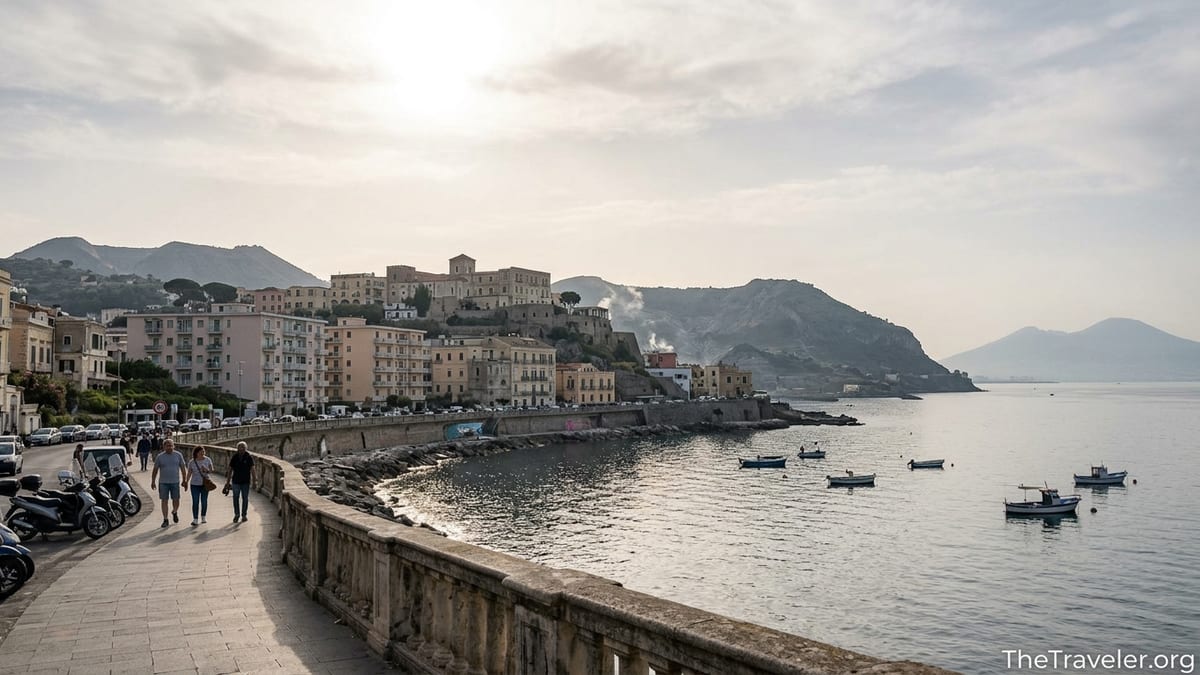
Understanding Where You Are: A Living Volcanic Caldera
The Phlegraean Fields are not a single cone-shaped volcano but a wide volcanic caldera stretching under Pozzuoli, parts of western Naples, the shoreline and the sea. Over the last 15,000 years it has produced dozens of eruptions that created craters, low cones and lakes such as Averno and the Astroni crater. Today, more than half a million people live within and around this volcanic system, which makes it one of the most closely watched in the world.
For a first-time visitor, the key point is that this is a “living” geological system. Since the 1960s the area has gone through several episodes of bradyseism, a slow rise and fall of the ground that can lift entire neighborhoods by more than a meter over a few decades. In the current cycle, which began around 2005, civil protection authorities report more than 150 centimeters of uplift in parts of Pozzuoli, accompanied by frequent small earthquakes that locals feel as rattling windows or brief shaking.
Daily life continues despite this background activity. On a typical weekday morning in Pozzuoli you might see commuters at the Cumana railway station, fishermen mending nets at the harbor and school groups walking near the Rione Terra, all above an active volcanic field. For visitors, the takeaway is that you are entering an ordinary Italian coastal district that happens to sit on extraordinary geology, and you should treat both aspects with equal respect.
Because of this dual character, the Italian Civil Protection Department has maintained an official “yellow” alert level for years. This does not mean an eruption is expected; rather, it signals that the volcano is in a state of unrest that requires close monitoring and clear communication with residents and visitors. When you read about the Phlegraean Fields in international media, knowing this context will help you interpret headlines that can sometimes exaggerate the term “supervolcano.”
Current Activity, Alert Levels and What That Means for Tourists
As of mid 2026, Campi Flegrei remains in an elevated state of unrest, with swarms of small earthquakes and ongoing ground uplift measured by Italian monitoring networks around Solfatara and the nearby Pisciarelli area. Seismometers routinely detect hundreds of small events per month, most too weak to feel, interspersed with occasional earthquakes around magnitude 3 to 4 that locals notice. Research published in 2025 and 2026 discusses how these patterns reflect pressurization of the shallow hydrothermal system, but they do not automatically imply that a major eruption is imminent.
For visitors, the practical effect of this activity is visible in signage, drills and occasional short-term closures rather than in dramatic volcanic scenes. You may see yellow and red civil protection information boards in Pozzuoli showing evacuation routes, and you might hear loudspeaker tests or siren drills during national exercises such as the “Campi Flegrei 2025” simulation. Hotels and B&Bs increasingly keep printed leaflets in guest rooms explaining what to do in case of stronger earthquakes or an official alert, much like tsunami or hurricane instructions in other parts of the world.
In recent years, civil protection authorities have updated and refined evacuation plans for the red and yellow zones around Campi Flegrei, including detailed maps for the municipalities of Pozzuoli, Bacoli and western Naples, and twinning agreements with other Italian regions that would host evacuees if necessary. For a short-term visitor staying in Naples or Pozzuoli, the main implication is that there are clear, rehearsed procedures that would come into play long before a dangerous eruption. It is sensible to ask your accommodation which zone you are in and where the nearest assembly point is, the same way you would check fire exits in a hotel.
Importantly, there is currently no public access to any active eruption site within the Phlegraean Fields, because there is no ongoing eruption. The “activity” you are likely to experience is subtle: occasional tremors, minor steam vents in restricted areas and news coverage of scientific studies or civil protection exercises. If you are interested in seeing actual lava fountains or fresh lava fields, you would need to look to other volcanic destinations such as Sicily’s Etna or Iceland’s Reykjanes Peninsula, rather than Campi Flegrei.
What Is Open, What Is Closed and How to See the Landscape
One of the most important practical points for first-time visitors is that some of the most famous features of the Phlegraean Fields are currently closed to the public. The Solfatara crater at Pozzuoli, long known for its fumaroles and boiling mud, has been closed since a fatal accident in 2017 in which a family fell into a collapsed area of hot ground. As of 2026, this closure remains in effect, and you cannot enter the paid Solfatara tourist site. You may, however, glimpse parts of the crater rim and rising steam from surrounding roads such as Via Coste d’Agnano, where local residents still walk dogs and drive past the hidden volcano beneath.
Other parts of the volcanic system remain accessible and make for rewarding visits. Lake Averno, a quiet circular lake in an old crater, can be reached by bus or car from Pozzuoli and offers a flat walking path fringed by reeds, vineyards and small trattorie. Travelers often combine a stroll here with lunch at a lakeside restaurant serving seafood pasta and local Falanghina wine from the Campi Flegrei appellation. Nearby, the Roman ruins of Cuma and the so called “Antro della Sibilla” give a sense of how ancient cultures understood and mythologized this fuming landscape.
Another notable site is the Astroni crater, a former hunting reserve that is now a WWF-managed nature reserve when open. Access has varied in recent years because of fire risk, storm damage and administrative constraints, so it is essential to check the current situation with local tourist offices in Naples or Pozzuoli before planning a visit. When open, visitors typically pay a modest entrance fee and follow marked nature trails that descend into the crater floor, passing through oak and Mediterranean scrub while still standing inside the broader Campi Flegrei caldera.
Within Pozzuoli itself, the Rione Terra, an ancient quarter on a volcanic promontory, has undergone extensive restoration and offers guided visits through underground Roman streets and early Christian sites. Even though it is not a steaming crater, it is one of the most evocative places to grasp how human history and volcanic ground are layered together. A common day plan for visitors staying in Naples is to ride the Cumana train from Montesanto station to Pozzuoli, explore the Roman amphitheater and Rione Terra, enjoy lunch by the harbor and, if time allows, continue by bus to Lake Averno before returning in the evening.
Staying Safe: Practical Risk Awareness for Visitors
Although the probability of a major eruption during a short trip is low, Campi Flegrei is an active volcanic area, and you should approach it with the same common-sense risk awareness you would use in an earthquake or hurricane zone. Start by familiarizing yourself with the Italian Civil Protection color codes: green for normal, yellow for attention, orange for pre-alert and red for full alert. As of mid 2026 the area is in yellow, which means scientists have detected persistent changes in seismicity, ground deformation and gas emissions, but no eruption is expected in the short term.
Before you travel, it is wise to register with your home country’s travel alert system if available and to skim recent updates from reputable news outlets and Italian authorities in the weeks leading up to your trip. If you arrive during a period of heightened seismic swarms, you may experience several noticeable earthquakes in a single day. In these situations, follow the same drop-cover-hold guidance used worldwide: move away from façades or balconies when outdoors, protect your head from falling objects indoors and expect brief power cuts or train delays rather than catastrophic damage.
In an unlikely scenario where authorities raise the alert level to orange or red while you are in the area, you would receive information from multiple channels: smartphone alerts for Italian SIM users, TV and radio broadcasts, municipal loudspeakers in affected neighborhoods, and instructions from hotel staff. Evacuation plans for the red zone around Campi Flegrei involve moving residents out of the area by bus and private cars over roughly three days, directed toward pre-assigned host regions elsewhere in Italy. As a visitor, your role would be simple: keep calm, follow official instructions, travel light and stay in touch with your embassy or consulate.
Even at the current yellow level, stay clear of unauthorized fumaroles, unmarked steaming ground or informal “shortcuts” into fenced volcanic sites. Do not attempt to climb into closed areas such as Solfatara for a better photograph, and be wary of anyone offering unofficial access in exchange for cash. The tragedy that led to Solfatara’s closure is a reminder that seemingly solid ground can conceal fragile crusts above boiling mud or steam, a hazard that even experienced locals can underestimate.
Planning Your Visit: Where to Stay, How to Get Around and What It Costs
For most travelers, the Phlegraean Fields are a day trip or short stay combined with time in Naples, the Amalfi Coast or the islands of Ischia and Procida. A common approach is to base yourself in central Naples, where mid-range hotels near Piazza Municipio or the historic center often start around the equivalent of 120 to 180 euros per night in high season, and then ride local trains to Campi Flegrei for specific excursions. The Cumana and Circumflegrea rail lines connect Naples with Pozzuoli, Bagnoli and other stops in roughly 20 to 40 minutes depending on origin.
If you prefer a quieter base, consider staying in Pozzuoli or Bacoli. Here you will find smaller family-run hotels and guesthouses, often with sea views toward the islands, starting from roughly 80 to 130 euros per night outside peak August holidays. Many have experience answering questions about volcanic risk, and some display civil protection maps in reception. Having staff who know the local territory can be reassuring if you feel uncertain about tremors or news reports during your stay.
Transport within the Campi Flegrei area combines regional trains, local buses and, for more flexibility, taxis or rental cars. A single regional train ticket from Naples to Pozzuoli typically costs just a few euros, while local ANM or EAV buses around Pozzuoli and Bacoli are similarly inexpensive. Travelers who want to link Lake Averno, Cuma and lesser-known thermal sites in a single day often choose to hire a taxi by the hour or arrange a private driver through their hotel for a half-day rate, which may run to roughly 120 to 200 euros depending on distance and waiting time.
Guided tours that market the “Campi Flegrei experience” range from group half-day excursions including Pozzuoli’s Roman amphitheater and Lake Averno to custom geology-focused itineraries led by volcanology students from Naples’ universities. Group tours from Naples might cost in the region of 60 to 100 euros per person including transport and site entries, while private specialist tours can be substantially higher. When comparing options, ask explicitly which sites are currently open, whether any part of the route passes close to restricted areas like Solfatara and how the guide plans to handle any seismic events during the outing.
Experiencing the Culture of a Volcanic Coastline
Beyond the science and the risk, the Phlegraean Fields are first and foremost a lived-in cultural landscape. The volcanic soils support vineyards that produce distinct white and red wines labeled Campi Flegrei DOC, often made from native grapes such as Falanghina and Piedirosso. Tasting these wines at a small winery on the slopes above Pozzuoli, with the Bay of Naples on one side and the subtle curve of the caldera on the other, is a way to connect the unseen forces underfoot with the flavors in your glass.
The coastline itself is pocked with thermal traces. In the neighborhood of Bagnoli, former industrial zones sit beside hot springs that once fed grand bath complexes, while in nearby Agnano modern thermal spas continue a centuries-old tradition of using volcanic waters for wellness. Visiting one of these spas, where day passes might cost 30 to 50 euros depending on facilities, can be a relaxing counterpoint to walking around ruins and craters. Just be sure to follow staff instructions and respect any temporary closures linked to seismic swarms.
Local cuisine makes frequent, if understated, references to the landscape. Seafood dominates menus in Pozzuoli’s harbor, but you will also see dishes baked in wood-fired ovens that draw on historic geothermal cooking traditions, even if the heat now comes from gas or wood rather than steam vents. Restaurants sometimes reference ancient names like “Cuma” or “Averno” in their branding, turning mythic gateways to the underworld into cozy pizzerias and trattorie serving families and visitors side by side.
As you walk through these neighborhoods, remember that residents are accustomed to living with both the benefits and anxieties of an active volcanic area. Some may roll their eyes at foreign media’s fascination with “supervolcanoes,” while others will speak candidly about nights shaken by earthquakes or concerns about property values. Listening respectfully and avoiding sensational questions about catastrophic eruptions will help you connect more meaningfully with people whose home is your temporary destination.
The Takeaway
Visiting the Phlegraean Fields for the first time is as much about adjusting your expectations as it is about checking specific sites off a list. You will not find an open lava lake or a dramatic smoking cone, and one of the most iconic craters, Solfatara, remains firmly closed as a reminder of how deceptive volcanic ground can be. What you will encounter is a densely inhabited coastal region layered with Roman ruins, quiet crater lakes, vineyards and working-class neighborhoods, all sitting on a restless piece of Earth that scientists monitor with exceptional care.
If you approach Campi Flegrei with basic risk awareness, an understanding of the current yellow alert context and a willingness to follow rules around closures and access, there is no reason to avoid the area outright. Combine modest geological curiosity with respect for local routines, and your experience is likely to be shaped more by seafood lunches overlooking Pozzuoli’s harbor, walks around Lake Averno and conversations with residents than by tremors or sirens. In the end, the Phlegraean Fields are a place where the extraordinary hides beneath the ordinary, and seeing that coexistence up close is what makes a visit truly memorable.
FAQ
Q1. Is it safe to visit the Phlegraean Fields right now?
As of mid 2026, Italian authorities keep Campi Flegrei at a yellow alert level, which means unrest but no imminent eruption is expected. Tourist visits to open areas like Pozzuoli, Lake Averno and nearby archaeological sites continue, provided you follow official guidance, respect closures such as Solfatara and stay informed through reliable news and local advice.
Q2. Can I visit the Solfatara crater during my trip?
No. The Solfatara tourist site in Pozzuoli remains closed to the public following a fatal accident in 2017 and ongoing safety concerns. You may see parts of the crater and steam from nearby roads, but entering the site itself is not permitted, and you should avoid anyone offering unofficial access.
Q3. What should I do if there is an earthquake while I am there?
If you feel shaking, move away from façades or balconies when outside, and indoors protect yourself from falling objects by sheltering under sturdy furniture or against an interior wall. Expect short-lived disruptions such as train delays rather than widespread damage, and follow any instructions from local authorities, hotel staff or civil protection announcements.
Q4. How will I know if the alert level changes during my visit?
Changes in alert level are widely reported on Italian television, radio and news outlets and are communicated by the Civil Protection Department and local municipalities. Hotels, tour operators and transport companies also receive updates and pass them on to guests. If you use an Italian SIM, you may receive civil protection alerts on your phone in the event of a serious escalation.
Q5. Where is the best place to stay to explore Campi Flegrei?
Many visitors choose to stay in central Naples for broader sightseeing and take day trips by train to Pozzuoli and Lake Averno. Others prefer basing themselves in Pozzuoli or Bacoli, where smaller hotels and guesthouses offer easier access to crater lakes, Roman sites and coastal walks within the volcanic area itself.
Q6. Do I need special equipment or clothing to visit the Phlegraean Fields?
You do not need technical gear, but comfortable walking shoes, a light jacket, sun protection and a small daypack are useful for exploring crater lakes and ruins. If you plan to visit nature reserves like Astroni when open, treat them like any other hiking area: bring water, check weather forecasts and follow marked paths and reserve regulations.
Q7. Are guided tours recommended, or can I visit independently?
You can visit independently using regional trains and buses, especially for Pozzuoli, Lake Averno and Cuma. However, guided tours led by local experts or geology enthusiasts can add depth by explaining the hidden volcanic structures, recent seismic activity and civil protection plans, which are not immediately obvious when you walk through ordinary streets and harbors.
Q8. How likely is a major eruption during a short holiday?
Scientific studies indicate that while Campi Flegrei is in a state of unrest, large explosive eruptions are rare on human timescales. The probability of such an event during a week-long trip is low, and any significant escalation would typically be preceded by clear signals that authorities monitor closely. It is sensible to stay informed, but there is no need for constant anxiety during a short visit.
Q9. Can I combine a trip to the Phlegraean Fields with other nearby sights?
Yes. Many travelers pair Campi Flegrei with Naples’ historic center, Pompeii and Herculaneum, the Amalfi Coast or the islands of Ischia and Procida. For example, you might spend one day exploring Pozzuoli and Lake Averno, another day at Pompeii, and a third relaxing on Ischia, all within short ferry or train rides of each other.
Q10. What is the most respectful way to talk with locals about the volcano?
Approach the topic with sensitivity, recognizing that residents live with both routine tremors and media attention. Instead of asking about catastrophic “supervolcano” scenarios, you might ask how people stay informed, what drills are like or how life has changed during recent seismic swarms. Listening more than you speculate will usually lead to more open and thoughtful conversations.