


Few landscapes shape a traveler’s imagination like the Bay of Naples, where daily life unfolds in the shadow of two of the world’s most closely watched volcano systems: the Phlegraean Fields and Mount Vesuvius. Choosing between them is not just a matter of ticking off a bucket‑list sight. It means deciding what kind of volcanic encounter you want: the raw unease of a restless supervolcano under a dense city, or the classic image of a smoking cone above ancient ruins.
Get the latest updates straight to your inbox!
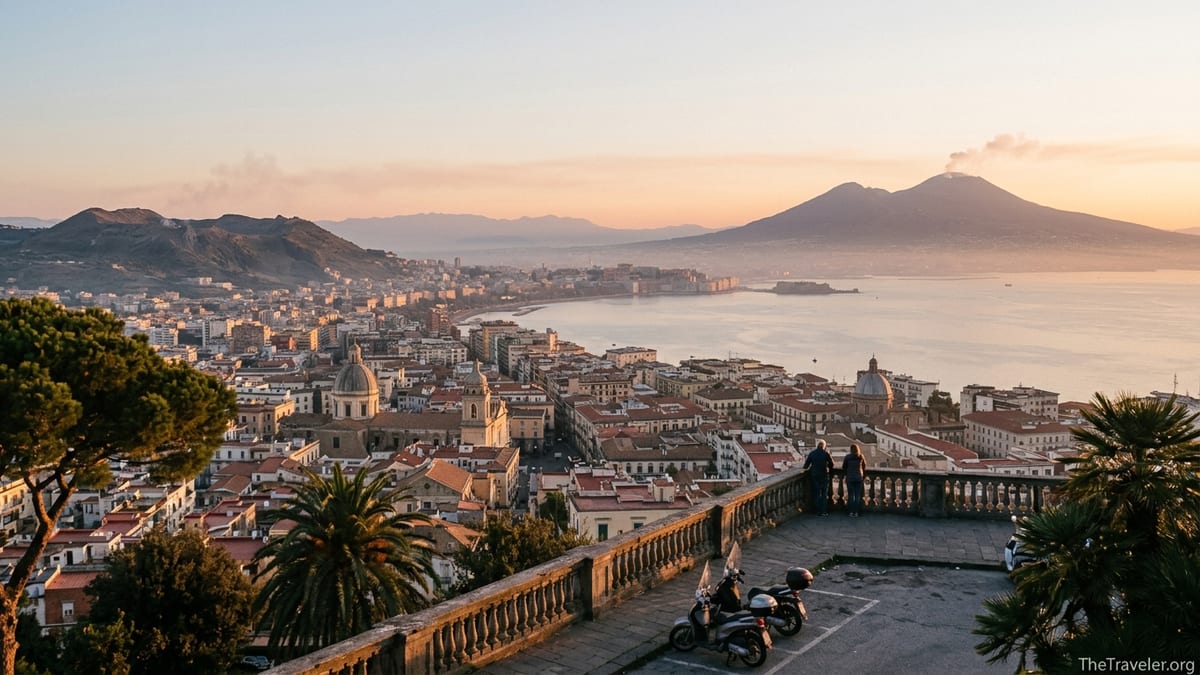
Two Very Different Volcano Stories
The Phlegraean Fields, or Campi Flegrei, are not a single peak but a vast volcanic caldera stretching west of Naples around Pozzuoli and Bacoli. Much of it looks deceptively ordinary: apartment blocks, seaside promenades, football pitches. Yet this entire urban area sits inside a volcano that has produced massive eruptions in the distant past and is currently in a phase of unrest, with recurring earthquake swarms and ground uplift. For visitors, the shock often comes from realizing that everyday Italian life continues right on top of a high‑risk zone.
Mount Vesuvius, by contrast, is almost theatrical in its clarity. The cone is visible from much of Naples and from the Sorrento and Amalfi coasts, an unmistakable backdrop above the blue of the Gulf. Its fame rests on the AD 79 eruption that buried Pompeii, Herculaneum and surrounding towns, a story you can literally walk through in the excavations. Vesuvius today is classed at a green alert level by Italian monitoring agencies, which means constant scientific observation but no current signs of impending eruption, and a well‑developed national park infrastructure for visitors.
In practical terms, a trip to the Phlegraean Fields feels like slipping behind the scenes of a disaster documentary that has not yet happened. A Vesuvius excursion feels more like a classic excursion into history: climb a volcano, peer into the crater, then descend to streets and frescoes frozen in time. Both are powerful, but they leave different emotional marks.
For many travelers, the choice comes down to whether they are more drawn to the idea of witnessing a living, unsettled caldera intertwined with a modern metropolis, or to the iconic storytelling power of Vesuvius and Pompeii. Understanding what you will actually see on the ground can make the decision easier.
Current Safety, Access and What Is Actually Open
Campi Flegrei has been in an elevated state of seismic unrest in recent years. Residents in Pozzuoli and nearby neighborhoods have experienced swarms of small to moderate earthquakes and noticeable ground uplift, prompting evacuation drills, new emergency plans and occasional temporary closures of public buildings. Visitors may notice signs explaining civil protection procedures, information posters about evacuation routes, and even practice exercises. This backdrop of real risk management can be unnerving but also makes the area compelling for travelers who follow earth sciences or climate risk.
For decades, one of the most dramatic visitor experiences in the Phlegraean Fields was Solfatara, a steaming crater at Pozzuoli with fumaroles, boiling mud and the distinctive smell of sulfur. The site has been closed to the general public since a fatal accident in 2017 and has not yet fully reopened as of mid‑2026, despite ongoing discussions about securing and restoring access. That means many of the photographs you might see in older guidebooks, with tourists walking between hissing vents, no longer reflect present reality. Most travelers now experience Campi Flegrei through its towns, coastal viewpoints, archaeology and sporadic viewpoints over fumarolic zones, rather than a single, neatly packaged “volcano park.
Mount Vesuvius, meanwhile, is comparatively straightforward to visit. The volcano lies within Vesuvius National Park, and the usual visitor experience involves a bus or minivan transfer up to a car park below the summit, then a steep but short walk on a gravel path along the crater rim. The summit area is generally open, weather and maintenance work permitting, and path conditions and alerts are displayed at ticket booths and on official channels. The main challenge is crowding at peak times: tour buses from Naples, Sorrento and cruise ships can mean lines and limited quiet at viewpoints.
If you want the greatest reliability of access, Vesuvius currently has the advantage. Travelers can plan a day that combines Vesuvius with Pompeii or Herculaneum and be reasonably confident that the core experiences will run, aside from occasional closures due to wind, rain or trail maintenance. Campi Flegrei visits require more flexibility and local checks, particularly if there has been a recent seismic swarm or civil protection exercise that affects transport or public spaces.
Emotional Impact: Living Risk vs Legendary Catastrophe
One of the most powerful aspects of visiting the Phlegraean Fields is the sense that you are moving through a community living with real‑time volcanic risk. In the port of Pozzuoli you might see families strolling the waterfront while small fishing boats unload their catch, even in weeks when local news is full of reports about minor quakes. Apartment blocks have been reinforced, evacuation plans updated, and educational campaigns rolled out, yet cafés and pizzerias are busy at night. Travelers who talk with local residents often come away struck by this blend of fatalism and pragmatism.
The emotional impression is not built on spectacular viewpoints alone but on details: a primary school where children practice evacuation drills, posters explaining what to pack if the government orders a temporary relocation, or conversations with hotel staff who have lived through previous “bradyseismic” episodes of ground uplift. Experiencing a tremor while staying in Pozzuoli, even a light one, can leave a far deeper impression about volcanic risk than any textbook description.
Vesuvius, in contrast, hits hardest through its history. Standing in Pompeii’s Forum, with Vesuvius looming in the background, travelers confront how quickly a thriving town was destroyed. The plaster casts of victims, the carbonized loaves in a bakery oven, and the ruts left by carts in basalt streets collectively create a vivid narrative of sudden catastrophe. Many visitors report that the AD 79 story feels more tangible and disturbing once they stand in those spaces, especially after climbing the crater and looking back towards the ruins.
In short, Campi Flegrei makes you think about the present and future. Vesuvius makes you confront the past. The bigger impression depends on whether you are more affected by real‑time anxiety and resilience, or by the weight of a legendary disaster that shaped our understanding of volcanoes.
What You Actually See: Landscapes, Craters and Ruins
Visually, the Phlegraean Fields can be subtle. From the train window between Naples and Pozzuoli, the caldera looks like suburbs, hills and patches of Mediterranean scrub. The volcanic story reveals itself in fragments: the exposed yellow tuffs in road cuttings, thermal baths that draw on hot groundwater, and the odd abandoned building where ground movement has damaged foundations. A short taxi ride up into the hills above Pozzuoli rewards you with wide views over the caldera and the Bay of Naples, especially near the Sanctuary of San Gennaro, where you can sense the scale of the collapsed volcanic basin.
Without Solfatara open, travelers often focus on archaeological sites that showcase how ancient peoples lived with the Phlegraean volcanoes. The partially sunken Roman market, or macellum, at Pozzuoli tells a striking story of gradual ground movement: columns have marine boring marks that show how the floor was once below sea level and later uplifted. Nearby, the Flavian Amphitheater, one of Italy’s largest Roman arenas, sits on volcanic ground and offers an atmospheric, less crowded alternative to Rome’s Colosseum, with intact underground passages and seating tiers.
Vesuvius offers a much more immediately recognizable volcanic landscape. Once you reach the upper parking area, the path to the crater winds up through light ash and lava gravel. On clear days, the view from the crater rim sweeps over Naples, the islands of Capri and Ischia, and inland toward the Apennines. Looking into the crater itself, you will see a steep bowl of ash and rock with fumaroles gently steaming from the inner walls, a reminder that Vesuvius is dormant, not extinct. The contrast between the peaceful summit and its violent history can be disorienting.
Below Vesuvius, the archaeological sites are the main stage. Pompeii is vast, and a detailed visit can easily absorb a full day. Herculaneum, smaller and closer to the water, often feels more intimate, with multi‑storey houses and preserved wooden elements that give a sense of domestic life. For many travelers, walking these streets with Vesuvius in view crystallizes the whole experience. The volcano becomes more than a shape on the horizon; it is an active character in the story.
Logistics, Costs and Crowd Levels
From central Naples, both Vesuvius and Campi Flegrei are straightforward to reach, though in different ways. To access the Phlegraean Fields, many visitors use the regional train from Napoli Piazza Garibaldi or Montesanto to Pozzuoli, typically spending under an hour and paying only a few euros. Once in Pozzuoli, you can explore the historic center on foot and use local buses or taxis to reach viewpoints and nearby archaeological sites. Staying overnight in Pozzuoli or Bacoli is increasingly popular among travelers seeking a quieter base than central Naples while still being close to the city.
Vesuvius usually requires a combination of train and transfer. Many visitors ride the Circumvesuviana or Campania Express train from Naples or Sorrento to stations like Ercolano or Pompeii, then connect to a shuttle bus or prebooked minivan up the volcano. Tours that bundle transport, summit access and a guided visit to Pompeii or Herculaneum are widely sold in Naples, Sorrento and on cruise ships, with prices often ranging from modest group tours to higher‑priced private excursions. Independent travelers should factor in online reservation systems for crater access, which are sometimes required to manage visitor numbers.
In terms of crowds, Vesuvius and Pompeii are firmly on the global tourist circuit. At peak times, you may find yourself in a slow procession up the crater path, and popular houses in Pompeii can require short waits. The Phlegraean Fields, by contrast, feel under‑visited by international standards. Outside a few weekends and local festivals, Pozzuoli’s archaeological sites are rarely jammed, and you are more likely to share them with Italian school groups or local families than with large coach parties. For travelers who prefer lower key experiences, this quieter atmosphere can make Campi Flegrei especially appealing.
Accommodation prices reflect this difference. Hotels and guesthouses in Pozzuoli and Bacoli often cost noticeably less than comparable properties in Sorrento or central Naples, especially outside peak summer. That makes the Phlegraean area attractive for travelers on midrange budgets who still want sea views and good transport connections, while day‑tripping to Naples or the islands.
Science, Monitoring and Learning Opportunities
Both Campi Flegrei and Vesuvius are among the most closely monitored volcano systems on the planet, and that scientific presence can become part of the travel experience. Around the Phlegraean Fields, you may notice monitoring equipment such as GPS stations, seismometers and gas‑sampling points, often discreetly placed on public buildings or in fenced areas. Information campaigns from Italian civil protection regularly explain what these installations do and how the data feed into risk assessments and emergency planning.
For visitors interested in earth sciences, this intense monitoring is a unique chance to see how a modern society coexists with serious volcanic and seismic hazards. Local museums in Naples and the surrounding area frequently host exhibitions about past eruptions, from the Bronze Age through the 1538 Monte Nuovo eruption in the Phlegraean Fields to the 20th‑century activity of Vesuvius. Talking with local guides, particularly those with geology training, can transform a walk along a waterfront or crater rim into a lesson about caldera dynamics, magma systems and ground deformation.
On Vesuvius, the link between research and tourism is most obvious in the presence of guides at the crater, some of whom are licensed to explain basic geology, recent monitoring results and what the various instruments on the slopes measure. While much of this information is simplified for general audiences, it still gives travelers a sense of the balance between promoting access and respecting risk. Many guided excursions to Vesuvius and Pompeii now weave in questions about how authorities would respond to a future eruption, and what evacuation plans exist for the densely populated areas around the volcano.
Travelers who build time for museums and conversations into their itineraries often report that understanding the science behind these landscapes deepens their emotional response. The knowledge that monitoring networks have detected ground uplift in the Phlegraean Fields or that historical records document multiple eruptions of Vesuvius in the last few centuries makes the scenery feel less static and more alive.
Which Volcano Leaves the Bigger Impression?
When travelers compare notes after visiting both Campi Flegrei and Vesuvius, patterns emerge in what they remember most vividly. Those who favor the Phlegraean Fields usually talk about the strangeness of ordinary life unfolding on top of an active caldera, the sense of walking on unstable ground, and the conversations they had with residents who calmly describe living through earthquake swarms or evacuation drills. Even without a marquee crater site currently open, the combination of subtle geological signs, archaeology and present‑day risk gives Campi Flegrei a slow‑burn, haunting quality.
Fans of Vesuvius, by contrast, tend to emphasize clear, dramatic moments: the panoramic view from the crater rim on a bright day, the physical sensation of climbing through ash and gravel, and the impact of seeing Pompeii’s plaster casts and frescoed villas in person. The volcano itself, with its scarred summit and occasional faint fumaroles, provides the iconic photos that many travelers imagine when they plan a trip to southern Italy. For travelers who only have one full day and want a classic experience, Vesuvius plus Pompeii or Herculaneum remains a strong choice.
Age, interests and travel style also play roles. Families with children or first‑time visitors to the region often gravitate to Vesuvius, where the narrative of Pompeii is easy to understand and infrastructure is straightforward. More seasoned travelers, science enthusiasts or those returning to the Bay of Naples might find Campi Flegrei more compelling precisely because it is less polished and more entangled with current risk. It feels like stepping into an unfolding story rather than visiting a finished chapter.
If your priority is a powerful sense of place combined with smooth logistics, Vesuvius usually leaves the stronger immediate impression. If you are willing to seek out less obvious clues and sit with a little unease, the Phlegraean Fields may linger longer in your thoughts.
The Takeaway
Choosing between the Phlegraean Fields and Mount Vesuvius is ultimately about the kind of story you want your trip to tell. Vesuvius offers a sharp, memorable arc: a morning climb to a classic volcanic crater, sweeping views over the Bay of Naples, then an afternoon among the ruins of Pompeii or Herculaneum where the consequences of an ancient eruption are frozen in stone and ash. The infrastructure is clear, the narrative is powerful, and the photographs are likely to look exactly as you imagined.
The Phlegraean Fields demand more from the traveler but repay the effort with nuance. You are unlikely to come away with a single dramatic crater photo. Instead, your impressions will be scattered across a waterfront where fishing boats bob over a restless caldera, Roman columns that bear the scars of rising and falling seas, and quiet streets where evacuation routes are marked on lampposts. The emotional impact builds slowly, shaped as much by human resilience and modern emergency planning as by fumaroles or ash.
If you have time, experiencing both makes for one of the most thought‑provoking volcanic journeys available anywhere. Start with Vesuvius for the iconic summit walk and the extraordinary archaeology of Pompeii, then spend at least a day in Pozzuoli and its surroundings to understand what it means to live with a supervolcano in the 21st century. Together, they offer a rare, layered perspective on how humans remember, forget and adapt to the power of the Earth beneath their feet.
FAQ
Q1. Is it safe to visit the Phlegraean Fields right now?
Local authorities closely monitor seismic activity and communicate alerts. Most visits are uneventful, but travelers should check recent news, follow official guidance and stay flexible if conditions change.
Q2. Can I still visit the Solfatara crater in Pozzuoli?
As of mid‑2026, Solfatara remains closed to regular tourist visits following a fatal accident and ongoing safety concerns. You can view parts of the area from a distance, but direct access is generally not available.
Q3. Do I need to book tickets in advance for Mount Vesuvius?
Advance reservations are often required or strongly recommended for summit access, especially in high season. Many travelers book timed entry and transport through tour operators or official channels to avoid disappointment.
Q4. Which is better for families, Campi Flegrei or Vesuvius?
Vesuvius, combined with Pompeii or Herculaneum, usually works better for families thanks to clearer infrastructure and storytelling. Campi Flegrei tends to suit older children and adults interested in geology and modern risk.
Q5. How much time should I allocate to each volcano?
A typical Vesuvius and Pompeii day runs from morning to late afternoon. For Campi Flegrei, many travelers spend a full day exploring Pozzuoli, nearby archaeological sites and viewpoints, with an overnight stay adding depth.
Q6. Can I visit both Vesuvius and the Phlegraean Fields in one trip?
Yes. With Naples as a base, you can dedicate one day to Vesuvius and Pompeii or Herculaneum and another to Campi Flegrei. This combination offers a rich contrast between historical catastrophe and present‑day volcanic risk.
Q7. Are guided tours necessary, or can I visit independently?
Independent visits are possible for both areas, but guided tours can add valuable context. Around Vesuvius and Pompeii, guides help interpret history, while in Campi Flegrei they can explain subtle geological signs and local risk management.
Q8. What should I wear for a visit to Mount Vesuvius?
Wear sturdy, closed‑toe walking shoes with good grip, layered clothing suitable for wind at the summit, sun protection and bring water. The path is short but steep and covered in loose ash and gravel.
Q9. Is public transport sufficient to reach Campi Flegrei?
Yes. Regional trains connect Naples with Pozzuoli, and local buses and taxis cover shorter distances. Services can be busy at commuter times, so allowing extra time and checking schedules locally is wise.
Q10. Which destination offers better views over the Bay of Naples?
Vesuvius provides a classic high‑altitude panorama from the crater rim. Campi Flegrei offers lower but atmospheric viewpoints from coastal hills and promenades. Many travelers find the Vesuvius summit views more dramatic overall.