


To most visitors, the Phlegraean Fields are a hazy name on a map west of Naples, maybe a day trip to Pozzuoli for seafood, ruins and sea views. Yet under those harbors, piazzas and hillside neighborhoods stretches one of the most closely monitored volcanic systems on the planet, a restless caldera where the ground itself slowly rises and falls. The reality of travel here in 2026 is not just postcard sunsets over the Bay of Pozzuoli, but a landscape quietly shaped by thousands of years of eruptions, ongoing seismic unrest and a sophisticated civil protection system that locals live with every day.
Get the latest updates straight to your inbox!
A Supervolcano Hiding in Plain Sight
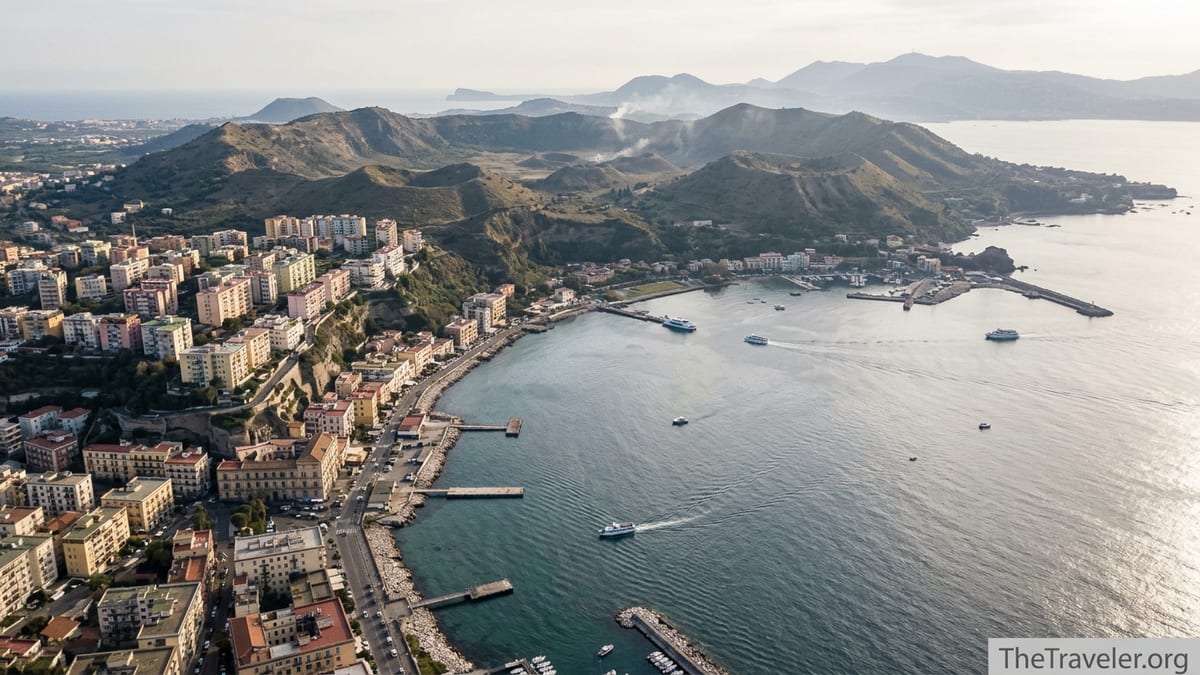
Few travelers realize that the Phlegraean Fields, or Campi Flegrei, are not a single volcano but a vast collapsed caldera about 13 kilometers across, stretching from the western suburbs of Naples through Pozzuoli to the Tyrrhenian Sea. From street level it looks like a string of fishing harbors, low hills and modern apartment blocks. Only when you stand on the waterfront in Pozzuoli and look back at the wide bowl of land around you does it become obvious that you are standing inside the remnants of a volcanic depression shaped by enormous eruptions in the distant past.
Geologists regard Campi Flegrei as one of the most hazardous volcanic systems in Europe because of its size and its location beneath a densely populated urban area. Past eruptions have ranged from small local events to the massive Campanian Ignimbrite eruption roughly 39,000 years ago, which spread ash across large parts of the Mediterranean. Today, research centers in Italy and abroad track seismic activity, gas emissions and ground deformation here almost continuously, feeding into real-time risk assessments that inform how authorities manage daily life in the area.
For visitors, the striking part is how ordinary the caldera looks. You can drink an espresso on Via Napoli in Pozzuoli, with children playing along the seafront promenade, unaware that the pavement beneath them has slowly risen by several meters since the mid twentieth century. Apartment blocks, metro lines, and shopping centers have been built within a volcanic field that specialists continue to describe as in a state of “unrest,” even though no eruption has occurred since the sixteenth century.
This contrast between apparent normality and underlying volatility shapes everything from building regulations to tourism infrastructure. When you book a hotel in Pozzuoli or the western neighborhoods of Naples, you are not simply choosing between sea views and city views. You are deciding where to sleep inside a caldera that civil protection agencies have mapped into color coded zones for evacuation in the event that unrest escalates.
The Ground That Breathes: Bradyseism in Everyday Life
One of the most unusual phenomena in the Phlegraean Fields is bradyseism, the slow rising and sinking of the ground as fluids and magma move underground. This is not a theoretical concept for locals. During the bradyseismic crises of the early 1970s and again from 1982 to 1984, the center of Pozzuoli rose by several meters, enough to damage buildings and force tens of thousands of residents to leave historic neighborhoods near the port.
You can see physical evidence of this “breathing” at the remains of the ancient Roman market in Pozzuoli, often called the Macellum or Serapeum. Three marble columns carry a distinct band of holes left by marine mollusks that once lived under the sea surface, proof that the ground and the coastline have moved up and down relative to the water level over centuries. Guides sometimes point out that these marks sit well above today’s high tide, a visible timeline of slow vertical movement that continues today, monitored by modern GPS stations scattered across the caldera.
In the current unrest phase that has been ongoing, the ground in parts of Pozzuoli has been rising at rates measured in centimeters per year. Seismic swarms, sometimes with hundreds of small earthquakes in a month, have become part of the background of life. Many residents can tell you where they were during a magnitude 4 event that rattled windows in late 2024 or early 2025. Hotels in the historic center occasionally report guests coming to the lobby at night after a noticeable tremor, while staff, used to such episodes, check news bulletins from the national geophysical institute rather than panic.
For travelers, bradyseism rarely disrupts itineraries directly, but it explains a number of small surprises: cracks in the pavement that keep being patched, scaffolding on older buildings under constant repair, and in some cases, subtle tilts in floors of historic structures. It also underpins the visible presence of monitoring equipment, from small yellow instruments bolted near church steps to fenced off geophysical stations on hillsides, each quietly tracking the slow movement of the ground beneath your feet.
Why Famous Sites Like Solfatara Are Still Closed
Many guidebooks still list Solfatara di Pozzuoli as a must see attraction, a steaming volcanic crater with fumaroles and bubbling mud pools that for decades served as an easy introduction to the Phlegraean Fields. Visitors who show up today often find locked gates and faded signs. The site has been closed to the general public since a fatal accident in 2017, when parts of the crater floor collapsed. Since then, ongoing seismic unrest and legal investigations have kept the area off limits, and as of mid 2026 there is no clear timeline for full reopening.
This closure catches many travelers by surprise, especially those relying on older printed guidebooks or blog posts that predate the accident. Taxi drivers still receive requests to go to Solfatara from cruise passengers docking in Naples or travelers staying in the historic center. In practice, most drivers will explain that access is restricted and suggest alternatives such as the Flavian Amphitheater in Pozzuoli, the volcanic lake of Averno, or a circuit of the smaller craters and viewpoints around Agnano and the Piscina Mirabilis Roman cistern.
There are still ways to experience the geothermal and volcanic character of the area, but they are more controlled than before. In the Agnano district, for example, some spa facilities use naturally heated mineral waters fed by the same hydrothermal system that powers fumaroles at Solfatara. Day spas there may offer entrance for roughly 25 to 40 euros, giving visitors a sensory link to the volcanic underworld in a safer, supervised environment. Elsewhere, structured guided tours run by local associations sometimes include viewpoints of the Pisciarelli fumarole area from public roads, but access to the active vents themselves is typically restricted due to gas emissions and unstable ground.
Understanding that Solfatara remains closed also highlights the broader safety culture that now surrounds Campi Flegrei. Authorities have become more cautious about allowing unsupervised access to zones where ground conditions can change with little warning. This does not mean that travel to the region is inherently unsafe, but it does require visitors to verify the current status of individual sites through local tourism offices or accommodation hosts rather than relying on outdated travel literature.
Civil Protection Plans You Are Quietly Part Of
Behind the scenes of any trip to the Phlegraean Fields is a detailed civil protection framework that almost no short term visitor hears about. The Italian Civil Protection Department maintains a national level volcanic risk plan for Campi Flegrei, coordinated with the Campania region, the city of Naples and the municipalities around Pozzuoli. This plan divides the area into zones based on potential exposure to pyroclastic flows, ash fall, and ground deformation, and it outlines evacuation routes, assembly points and communication strategies.
As a visitor, you automatically become part of this system as soon as you check into a hotel in Pozzuoli or board the Cumana railway that runs along the bay. Many accommodations in the so called red zone, the highest risk area in the event of an eruption, receive information packets from local authorities summarizing what to do in case of elevated alerts. In practice, this might be as simple as a sheet at the reception desk in Italian and English, explaining that if sirens sound or SMS alerts are issued, guests should follow staff instructions and move toward designated gathering points.
Occasional civil protection drills underline how real these plans are. In late 2025, a large scale exercise coordinated between municipalities tested communication lines and simulated evacuation procedures. Residents in certain neighborhoods practiced leaving their homes and moving toward preassigned locations, while schools and hospitals ran through their own protocols. Tourists who happened to be in the area that day might have seen more police vehicles and volunteers in high visibility vests than usual, but for locals such drills are a normal part of life in a volcanic region.
For travelers, the existence of these plans is both reassuring and instructive. It shows that Italian authorities treat the hazard seriously and do not assume that decades of quiescence guarantee safety. At the same time, it suggests that responsible travel here includes a basic awareness of your surroundings. Taking a moment to notice evacuation signage in your hotel corridor or asking your host how alerts would be communicated in an emergency can provide clarity without causing alarm.
Living History: How Past Crises Still Shape the Streets
Another aspect most visitors miss is how profoundly past unrest episodes have reshaped the urban fabric of the Phlegraean Fields. The bradyseismic crisis of 1982 to 1984, in particular, left marks that are still visible today in the layout of neighborhoods and the presence of partly abandoned structures along the waterfront of Pozzuoli. When seismic swarms intensified and the ground rose rapidly during that period, authorities evacuated tens of thousands of residents from the historic Rione Terra district and other low lying zones.
Walking through Pozzuoli today, you may notice modern residential areas such as Monterusciello, built inland to house families relocated from the older, more vulnerable parts of town. Broad streets, uniform apartment blocks and large green spaces give these districts a very different feel from the tight alleyways near the port. This is not just a case of postwar urban planning; it is a direct response to volcanic risk, an attempt to place residents on more stable ground and further from potential eruption vents or ground rupture zones.
The Rione Terra itself, perched on a tufa promontory overlooking the sea, remained almost entirely abandoned for years after the evacuations, its buildings empty and looted. In recent decades, major restoration projects have turned parts of the district into an archaeological and cultural site, with guided tours through underground Roman streets and panoramic terraces above. When you join one of these tours, often priced around 10 to 15 euros, you are not just visiting a Roman colony. You are also stepping into a neighborhood that was frozen in time by a modern volcanic emergency.
Similar stories play out elsewhere in the caldera. Around the shores of Lake Averno and Lake Fusaro, you can find Roman ruins that were submerged or warped by ancient ground movements, as well as twentieth century structures adapted repeatedly to subtle changes in elevation and shoreline. Even the location of local train stations and highway ramps reflects a careful balance between serving the present day population and acknowledging that the ground beneath may not stay exactly where it is in the coming decades.
Subtle Signs of Unrest: What Travelers Actually Notice
Despite the scientific attention on Campi Flegrei, most visitors notice only the most obvious manifestations of its unrest. The smell of sulfur near fumarolic areas, warm pavement in certain spots on cooler days, and occasional media reports about small earthquakes are among the few direct clues that something unusual lies beneath. Yet with a more observant eye, you can pick up a range of subtle signals that set this landscape apart from other coastal destinations.
One clear example is the distribution of hot springs and fumaroles. Around the Pisciarelli area on the outskirts of Pozzuoli, steam vents that were once a minor curiosity have intensified over the last two decades, prompting authorities to restrict direct access. You may see plumes of steam rising from a hillside as you pass by in a taxi or bus on the ring road, with warning signs and fencing indicating that the ground is unstable. Thermal anomalies like these are among the indicators that scientists watch closely for changes in the hydrothermal system feeding the caldera.
Another sign is the frequency of minor seismic events reported in local news bulletins. Italian media occasionally cover nights when several small earthquakes are felt across the western suburbs of Naples, prompting residents to sleep with doors ajar to avoid being trapped by potential deformation of frames. Hotels and guesthouses sometimes reassure nervous guests the next morning, explaining that quakes around magnitude 2 or 3 are relatively common in the area and that structural safety checks form part of building regulations here.
Even public art and local storytelling reflect the caldera’s restlessness. Photography exhibitions in Naples and Pozzuoli have documented cracked streets, tilted doorways and improvised repairs across several bradyseismic cycles, while local cultural associations maintain archives of newspaper clippings and personal accounts from the 1980s crisis. If you attend a community event or festival in Pozzuoli and start a conversation with an older resident, you may soon hear first hand stories of evacuation buses, temporary housing inland, and the surreal experience of watching the harbor slowly change shape as the seabed lifted.
How to Visit Responsibly in an Active Caldera
Visiting the Phlegraean Fields responsibly does not require specialized knowledge, but it does benefit from a mindset that respects both the scientific reality of the hazard and the lived experience of local communities. One practical step is to stay informed. Before and during your trip, you can check general information on volcanic alert levels published by Italian authorities and follow local news to understand whether seismic swarms or other unusual events are occurring.
On the ground, simple behaviors make a difference. Stick to marked paths in natural and archaeological areas, especially around crater rims and near fumaroles, where ground can be thin or thermally altered. If a section of trail or a viewpoint is cordoned off, treat that boundary as essential, not optional. Guides and wardens are often responding to very specific, up to date data about gas concentrations or soil stability that may not be obvious to a casual observer.
Choosing reputable local operators for tours is another way to travel wisely. Established guides working with official permits typically receive regular briefings on current conditions and safety procedures. A guided walk around the volcanic lakes or a day exploring the archaeological layers of Rione Terra with such an operator may cost a little more than a self organized visit, but it supports trained professionals who act as intermediaries between scientists, authorities and the visiting public.
Finally, remember that for residents this is not an exotic destination but home. When media reports highlight potential scenarios for future eruptions, they can create anxiety on the ground, especially among those who lived through earlier crises. As a visitor, acknowledging that reality, avoiding sensationalist language and listening respectfully when people share their stories helps maintain a more balanced conversation about risk and resilience in one of Europe’s most complex volcanic landscapes.
The Takeaway
Most visitors arrive in the Phlegraean Fields expecting another picturesque corner of coastal Campania and leave with memories of good food, archaeological marvels and sea breezes at sunset. What they rarely grasp is how exceptional this landscape is beneath the surface, both geologically and socially. Here, an active caldera underpins commuter rail lines and apartment towers, bradyseism quietly reshapes harbors, and civil protection plans extend to every hotel reception desk, whether guests realize it or not.
Understanding these hidden dimensions does not mean approaching Campi Flegrei with fear. Instead, it invites a deeper appreciation of how communities negotiate living on restless ground. From the scars of past evacuations visible in Pozzuoli’s urban fabric to the closed gates of Solfatara and the subtle presence of seismic sensors in public squares, the region tells a story of adaptation, vigilance and everyday life in the shadow of potential future change.
If you come prepared to notice these layers, your experience will go far beyond a standard day trip. You will see the Roman columns of the Serapeum not just as ruins but as markers of a breathing Earth, the modern neighborhoods inland as monuments to resilience, and the calm surface of the Bay of Pozzuoli as the visible edge of a vast volcanic system. In doing so, you join a long line of observers, from ancient writers to contemporary scientists, who have tried to understand what it means to live and travel atop one of the world’s most intriguing volcanic fields.
FAQ
Q1. Is it safe to visit the Phlegraean Fields right now?
Italian authorities currently allow normal daily life and tourism in the Phlegraean Fields, even as they monitor ongoing unrest. For visitors, this generally means that travel is considered acceptable, provided you follow local guidance and pay attention to any official alerts or instructions from accommodation providers and tour operators.
Q2. What should I do if there is an earthquake while I am in Pozzuoli or western Naples?
If you feel an earthquake, move away from windows and unsecured objects, and take cover under a sturdy table or next to an interior wall until the shaking stops. Afterwards, follow the instructions of local authorities or hotel staff. Small quakes are common, but if a stronger event occurs, official channels such as civil protection messages and local news will provide guidance.
Q3. Can I still visit Solfatara crater as a tourist?
As of mid 2026, Solfatara remains closed to regular tourist visits following a fatal accident in 2017 and continuing safety concerns related to unstable ground and gas emissions. Travelers should not plan on accessing the crater interior and should instead ask local tourism offices or guides about current alternatives, such as viewpoints from public roads or visits to other volcanic and archaeological sites in the area.
Q4. How will I know if there is a change in the volcanic alert level?
Changes in alert level are communicated by Italian authorities through official bulletins, civil protection channels and the media. Hotels and local tour operators also receive updates and are expected to inform guests if any change affects normal activities. As a visitor, you can rely on your accommodation and organized tour providers to relay important information, but checking local news periodically can provide additional reassurance.
Q5. Do I need special equipment or clothing to visit the Phlegraean Fields?
No special equipment is required for typical visits. Comfortable walking shoes are recommended for exploring archaeological sites, crater rims and uneven streets. If you plan to visit thermal areas or lakes, carry water, sun protection and layers for changing weather, just as you would elsewhere in coastal Campania. Any specific safety gear needed for specialized excursions will usually be provided by licensed tour operators.
Q6. Are there areas tourists should avoid within the caldera?
Tourists should respect all restricted zones and signage, particularly around fumarolic areas like Pisciarelli and any sections of trails or crater rims that are fenced off. Entering closed areas to get closer photographs is strongly discouraged, as ground conditions can be unstable and gas concentrations may fluctuate. Remaining on marked paths and in authorized viewpoints is the best way to stay safe.
Q7. How do local people feel about living on a restless volcano?
Local attitudes range from pragmatic acceptance to deep concern, often shaped by personal or family experience of past crises. Many residents grew up with earthquakes and civil protection drills and see them as part of everyday life. Others, especially those who lived through the large evacuations of the 1980s, carry vivid memories of disruption. Visitors will find that people are generally willing to talk about these experiences if approached respectfully.
Q8. Will travel insurance cover a volcanic emergency in Campi Flegrei?
Coverage varies by policy and provider. Some travel insurance plans include natural hazard related disruptions, while others exclude volcanic activity or treat it as a special case. Before traveling, it is advisable to read the fine print of your policy or contact your insurer directly to ask how cancellations, evacuations or extended stays due to volcanic unrest would be handled.
Q9. Are there guided tours that explain the science behind the Phlegraean Fields?
Yes, several local guides and associations offer tours focused on the geology and history of Campi Flegrei. These may include visits to sites like the Serapeum in Pozzuoli, the Flavian Amphitheater, volcanic lakes and panoramic viewpoints, often combined with explanations of bradyseism, monitoring networks and past crises. Booking such a tour can provide a much deeper understanding than visiting individual sites on your own.
Q10. If conditions worsened suddenly, would tourists be evacuated along with residents?
Yes. Civil protection plans for Campi Flegrei are designed for everyone in the affected zones, including visitors. Hotels, hostels and other accommodations are integrated into local emergency frameworks and would be expected to assist guests in reaching assembly points or evacuation routes if authorities issued such an order. Keeping your identification documents handy and following staff instructions would be key in that unlikely scenario.