


Landing at Stockholm Arlanda, you have two main ways to reach the city: the fast but pricey Arlanda Express train, or the slower, cheaper airport buses operated by Vy Flygbussarna. The best choice depends less on pure speed and more on your budget, group size, arrival time and where in Stockholm you are actually going. This guide breaks down both options, with up to date prices and concrete scenarios so you can decide which Stockholm airport transfer truly fits your trip.
Get the latest updates straight to your inbox!
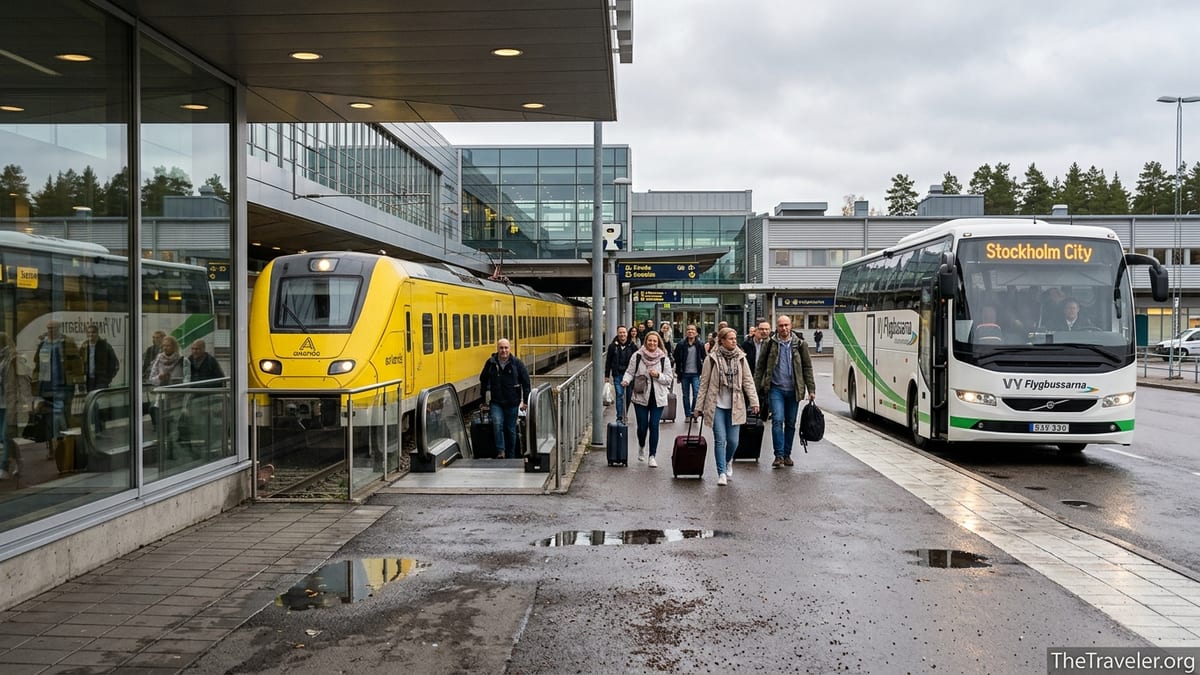
Overview: How Arlanda Express and Airport Buses Compare
Stockholm Arlanda Airport sits about 40 kilometers north of central Stockholm. Your two headline options into town are the Arlanda Express train and the Vy Flygbussarna airport coaches. Both run frequently, accept card payments and are easy for first-time visitors to use, but they deliver very different experiences and price points.
Arlanda Express is the premium, non-stop train link between the airport and Stockholm Central Station. The journey takes around 18 minutes platform to platform, making it the quickest way into the city for most travelers. Trains run roughly every 15 minutes for most of the day and early morning to late at night, and the train stops directly beneath the main terminal area at Arlanda and beneath the main concourse at Stockholm Central.
Vy Flygbussarna airport buses are the main budget alternative. They connect Arlanda with Stockholm Cityterminalen, the long-distance bus station that is physically attached to Stockholm Central Station, in about 40 to 50 minutes depending on traffic. Buses depart around every 10 to 20 minutes most of the day, and tickets are significantly cheaper than the train, especially if bought online in advance.
In practice, Arlanda Express tends to suit solo business travelers, anyone on a tight timetable, and visitors staying right by Stockholm Central. Flygbussarna works better for budget-conscious travelers, families, and anyone who doesn’t mind a slightly longer ride to save money. The rest of this article digs into the numbers and use cases so you can see where you fit.
Current Prices, Schedules and Travel Times
Prices change, but as of mid 2026 there is a clear gap between the cost of the fast train and the airport buses. Arlanda Express typically charges several hundred Swedish kronor for a standard one-way adult ticket, with various discounts if you book early, travel off-peak, or travel in a pair or group. For example, online campaigns often bring a one-way adult price down if you buy at least a few days ahead, while two adults traveling together can pay a reduced per-person fare compared with buying two separate tickets at the last minute at the station.
Arlanda Express runs non-stop between Arlanda’s dedicated stations and Stockholm Central in about 18 minutes. Trains operate from early morning to after midnight, with departures usually every 15 minutes during the day and every 30 minutes late at night. The time saving compared with other public options is real: door to door, many travelers find they can be at a hotel near Central Station within 35 to 45 minutes of stepping off the plane if passport control and baggage claim are smooth.
Vy Flygbussarna airport coaches are much less expensive on a per-person basis. A typical web price in 2026 for an adult single between Arlanda and Stockholm City is about 129 SEK, with a return ticket priced around 209 SEK when bought online. Youths aged roughly 8 to 25 pay less, and up to two small children can ride free with a paying adult. Buying online or in the app is usually 10 to 20 percent cheaper than paying onboard or at a kiosk.
Flygbussarna buses run from the main terminals at Arlanda to Cityterminalen and other city suburbs. The journey to central Stockholm usually takes between 40 and 50 minutes. While the timetable is relatively frequent, real-world travel time can be influenced by traffic, especially on weekday mornings into the city and late afternoons heading back to the airport. For most visitors arriving midday or in the evening, the bus time is predictable enough to plan around.
Comfort, Onboard Experience and Ease of Use
The experience of riding Arlanda Express feels closer to a short intercity train than to commuter rail or a metro. Trains are modern, bright and quiet, with luggage racks, power outlets by many seats, and plenty of space for suitcases. Seats are arranged airline-style, with two seats on each side of the aisle, and there is usually room to work on a laptop or simply relax. The ride is smooth and, because the train travels on a dedicated line without intermediate stops, there is little sense of starting and stopping.
Wayfinding is another strong point. At Arlanda, yellow Arlanda Express signs lead you from the arrivals hall via lifts or escalators directly to the platforms under the terminals. At Stockholm Central, the train arrives at dedicated platforms beneath the main station. From there, escalators and elevators lead straight up to the central concourse, metro (Tunnelbana) and regional trains. For a jet-lagged visitor stepping into Sweden for the first time, it is one of the easiest airport train links in Europe to navigate.
Vy Flygbussarna coaches offer a different kind of comfort. Modern coaches have comfortable, reclining seats, overhead luggage racks, and large under-floor compartments for big suitcases. Free Wi-Fi is commonly available, and buses are air-conditioned. Because you board at ground level just outside each terminal, there is no need to deal with elevators or escalators; many travelers with heavy luggage or strollers find it easier simply to roll everything straight onto the bus.
At Cityterminalen in central Stockholm, buses pull into a covered terminal connected to Stockholm Central by indoor walkways and escalators. The walk between your bus gate and the main train and metro hall usually takes around five minutes. Wayfinding signs are clear, but first-timers should allow a bit of extra time to orient themselves, especially in winter when coats and luggage make moving through crowds slightly slower.
Which Option Is Cheaper for Your Situation
From a cost perspective, the airport bus usually wins for almost every traveler except those traveling alone who are buying well-discounted Arlanda Express tickets in advance. Consider a long-weekend visit by a solo traveler: a same-day, flexible Arlanda Express return bought on arrival can cost several times more than a Flygbussarna return purchased in the app, while the time saving is around 20 to 30 minutes each way. If that visitor is staying in Södermalm or Kungsholmen and needs to transfer to the metro anyway, it is easy to justify saving the cash and taking the bus.
For couples and small groups, the math becomes more nuanced. Arlanda Express often runs “2-for-1” or pair discounts where two adults traveling together pay a lower per-person fare. For example, two adults arriving on a Friday afternoon and staying right by Stockholm Central might find that a discounted pair ticket on Arlanda Express costs somewhat more than two single Flygbussarna tickets but cuts journey time almost in half. If they value an extra hour of sightseeing or an easier arrival after a long-haul flight, they may decide it is worth the premium.
Families and budget travelers tend to get the best value from Vy Flygbussarna. A couple traveling with two children under eight can often bring the kids for free on the bus, paying only for the two adult tickets. On Arlanda Express, children usually get reduced fares, but the total still adds up quickly for four people. Over a return journey, the difference can easily reach the price of a family meal in Stockholm or tickets to a museum like the Vasa or ABBA museum.
Another cost factor is how much public transport you will use once in the city. Many visitors buy a multi-day Stockholm public transport card from SL for unlimited travel on metro, trams and buses. That card does not cover Arlanda Express or the commercial airport buses, but it does cover the local commuter train from the city to Märsta plus the connecting public bus to Arlanda, as well as some night buses. If you already plan to buy a transport pass and have a bit more time, using the pass to reach the airport instead of paying separately for Arlanda Express or Flygbussarna can be the absolute cheapest option of all.
Location, Connections and Where You Are Staying
Both Arlanda Express and Vy Flygbussarna bring you into roughly the same central area of Stockholm, but the exact arrival points differ slightly and can matter depending on where you are staying. Arlanda Express arrives deep under Stockholm Central Station, essentially at the heart of the rail hub. This is ideal if you have a train connection onward to Gothenburg, Malmö, Uppsala or other Swedish cities, or if your hotel is within a short walk of Central Station, such as around Vasagatan, Norrmalm, or the large business hotels facing the waterfront.
Vy Flygbussarna buses arrive at Cityterminalen, Stockholm’s main bus terminal, which is physically attached to the same Central Station complex but sits slightly to one side. To reach the main rail concourse or metro lines, you follow signs through indoor corridors and escalators. For most travelers this adds five minutes of walking but does not require going outdoors. Several Flygbussarna routes also serve other parts of the city beyond the central terminal, such as Kista or Brommaplan, which can be handy if your hotel is in those suburbs and you prefer to avoid changing in the center.
If you are staying in Gamla Stan, the Old Town, both Arlanda Express and Flygbussarna leave you one metro stop away or about a 15 to 20 minute walk with luggage, depending on your route through the cobblestone streets. Travelers booked in Södermalm often hop onto the green metro line from T-Centralen or take a taxi from outside the station. In these cases, the choice between train and bus has little impact on final door-to-door time; the key differences remain price and comfort.
Travelers catching early-morning ferries from Frihamnen or Värtahamnen sometimes find the bus slightly more straightforward, as there are direct or simple bus connections from Cityterminalen, whereas from the Arlanda Express platforms you still need to walk up through the station before catching local buses or trams. Either way, you should allow ample buffer time if a cruise or long-distance train departure is at stake.
Speed, Reliability and When Time Really Matters
When your schedule is tight, Arlanda Express is hard to beat. With dedicated tracks, no intermediate stops, and frequent departures, it is designed to keep airport access separated from much of the conventional rail network. In normal conditions the ride is about 18 minutes and only rarely suffers significant delays. This makes it the go-to option for people flying in for a same-day meeting in Stockholm’s financial district, or for travelers who have only a few hours between landing and an onward long-distance train.
Consider a traveler landing at Arlanda at 08:15 on a winter weekday with a 10:15 train from Stockholm Central to Oslo. Factoring in passport control, a short wait for checked luggage, and a 10 to 15 minute walk from the arrivals hall to the train platform, Arlanda Express gives them a realistic chance of being at Central Station before 09:30, allowing time for a coffee and a calm platform change. Doing the same journey by bus in rush-hour traffic would be riskier; a minor delay on the motorway could eat up the necessary buffer time.
During off-peak times, late evenings or on Sundays, the time advantage of Arlanda Express remains, but the margin matters less. A Saturday afternoon bus into town without heavy traffic may take only 40 minutes door to door from the terminal to Central Station, meaning the difference compared with the 18-minute train ride shrinks once you factor in waiting, boarding and walking within the stations.
In winter, reliability also includes how easy it is to board. Snow and ice can slow road traffic, but Sweden is generally well prepared and airport buses remain robust even in poor weather. The train line to Arlanda is also well maintained, though heavy storms or infrastructure issues can occasionally impact service. Checking real-time information on arrival is always sensible, but in most seasons both options operate smoothly enough that you can choose based on cost and convenience rather than fear of disruption.
Tickets, Payment and Practical Details
Arlanda Express tickets can be purchased in several ways: via the official website or app, at yellow ticket machines in the terminal and at Stockholm Central, or by scanning a QR code at the platform. Sweden is effectively cashless, so you should plan to pay by credit or debit card or through mobile wallets. Buying in advance online often unlocks campaigns like off-peak fares, youth discounts or non-refundable “early bird” tickets tied to a specific departure window, while fully flexible tickets cost more but allow you to board any train on the chosen date.
At the airport, once you have your ticket or QR code, you simply walk through the wide automatic gates to the platform, scan the code if needed, and board the next train. Onboard staff may perform spot checks, so you should keep your ticket available. If you are unsure which stop to use at Arlanda, staff and signs will direct you to the correct station for your terminal, but most travelers simply follow the general Arlanda Express signage as trains serve both Arlanda North and South stations.
Vy Flygbussarna airport bus tickets are equally easy to buy. The cheapest prices are usually found in the company’s app or on its website, where you choose your route (for example, Arlanda Airport to Stockholm City) and receive a QR code that can be scanned when boarding. You can also buy tickets at machines in the terminals, at some convenience stores, or directly from the driver with a card. Tickets are normally flexible within a window of several months, meaning you do not need to pick a specific departure time, which is convenient if your flight is delayed.
Both Arlanda Express and Vy Flygbussarna allow normal suitcases, cabin bags and backpacks without extra fees, as long as you can handle them yourself. Oversized sporting equipment may be subject to space limitations, but in practice travelers with skis or bulky gear routinely use both services. If you crave door-to-door convenience or are traveling with mobility issues, taxis and pre-booked private transfers are also widely available at Arlanda, but these come at a higher cost than either the train or the airport buses.
How Arlanda Express and Airport Buses Compare With Local Public Transport
Beyond Arlanda Express and Flygbussarna, there is a third category of transfer: regular public transport run by SL, Stockholm’s regional transport authority. The main options are the commuter train from Stockholm Central to Arlanda Central station, and a combination of commuter train to Märsta plus local bus to the terminals. These routes are much cheaper than Arlanda Express but more complicated, especially for first-time visitors with luggage.
The SL commuter train uses the same tracks between Stockholm and Arlanda as some long-distance services and typically takes just under 40 minutes from Central Station to Arlanda Central. However, there is a separate access fee charged for using the airport station, which significantly increases the cost compared with a normal city journey. Many locals instead use the combination of metro or commuter train to Märsta and then bus 583 to Arlanda, which is fully covered by ordinary SL tickets or passes. Door to door, that route can take around an hour, sometimes more.
For a tourist visiting Stockholm for a few days, the choice between Arlanda Express and Flygbussarna usually comes down to balancing simplicity and cost against time. If you are staying right by Stockholm Central, have a midrange budget and value a quick, straightforward arrival, Arlanda Express is a strong choice. If you are comfortable navigating a bus terminal, do not mind an extra 20 to 30 minutes of travel, and want to save the equivalent of a nice dinner or multiple museum entries, the airport buses are usually the smarter pick.
Regular public transport becomes interesting mainly for money-conscious travelers who are in Stockholm long enough to fully leverage a multiday SL travel card or who have already used Stockholm transport before and know the system. For someone arriving late at night after a transatlantic flight, wrangling a combination of buses and commuter trains is often more effort than it is worth compared with walking out of the terminal and hopping on the first bright yellow Arlanda Express train or clearly branded Vy Flygbussarna coach.
The Takeaway
If speed and simplicity are your top priorities, Arlanda Express clearly wins. You leave the terminal, follow the yellow signs, and 18 minutes after departure you are under Stockholm Central Station, ready to walk to nearby hotels or connect to metro and national trains. For business trips, tight connections or short city breaks where every hour counts, the extra cost can be easy to justify.
If keeping costs under control matters more, Vy Flygbussarna airport buses are usually the better fit. A single adult ticket from Arlanda to Stockholm City bought online costs a fraction of many same-day train tickets, and families benefit from free travel for small children. The bus takes longer, especially in peak traffic, but for most visitors the extra 20 to 30 minutes is a reasonable trade-off for the money saved.
Ultimately, choosing between Arlanda Express and the airport buses is about matching your transfer to the rest of your trip. Think about where your accommodation is, how much luggage you have, what time you land, and whether you are traveling solo or with others. Decide whether you would rather buy the fastest route into the city or stretch your budget a little further for Stockholm’s restaurants, museums and ferries. With a clear idea of the pros and cons, you can step off the plane at Arlanda already knowing which way to turn.
FAQ
Q1. How long does Arlanda Express take from the airport to Stockholm Central?
Arlanda Express takes about 18 minutes from Arlanda Airport to Stockholm Central Station, not including the short walk from the terminal to the platform.
Q2. How long does the airport bus take between Arlanda and central Stockholm?
Vy Flygbussarna airport buses usually take around 40 to 50 minutes between Arlanda and Stockholm Cityterminalen, depending on traffic and time of day.
Q3. Which option is cheaper, Arlanda Express or the airport bus?
The airport bus is generally much cheaper per person than Arlanda Express, especially if you buy tickets online and are traveling with family or in a group.
Q4. Is Arlanda Express worth the extra cost?
Arlanda Express is worth it if you value speed and convenience, have a tight schedule, or are staying right by Stockholm Central Station and want the simplest possible transfer.
Q5. Can I use my Stockholm public transport card on Arlanda Express or Flygbussarna?
No. SL public transport cards do not cover Arlanda Express or Vy Flygbussarna. They do cover regular commuter trains and buses operated by SL, including routes via Märsta.
Q6. Where do the airport buses arrive in central Stockholm?
Vy Flygbussarna buses arrive at Cityterminalen, the main bus terminal in central Stockholm, which is directly connected to Stockholm Central Station by indoor corridors and escalators.
Q7. Are both Arlanda Express and the airport buses easy to use with luggage?
Yes. Arlanda Express trains have dedicated luggage racks and wide aisles, while the airport buses have under-floor storage and overhead racks for smaller bags.
Q8. Do I need to buy tickets in advance?
You do not need to buy tickets in advance for either option, but purchasing online or in the official apps can be cheaper and saves time at the airport, especially in busy periods.
Q9. Which option is better for families with children?
Families often find the airport buses better value because young children can travel free with an adult and the overall ticket cost is lower, though Arlanda Express is slightly faster.
Q10. What is the absolute cheapest way to get from Arlanda to Stockholm?
The cheapest way is usually to use regular SL public transport, such as commuter train or metro to Märsta plus local bus 583 to Arlanda, but this takes longer and involves more changes than Arlanda Express or the airport buses.