


Stockholm is a city that prizes efficiency, and nowhere is that more visible than in the 18 minutes it takes to ride the Arlanda Express between Stockholm Arlanda Airport and the central station. For many visitors, this non-stop train is their very first encounter with Swedish infrastructure: clean carriages, punctual departures and a journey that seems to be over almost as soon as it starts. But speed alone does not explain why Arlanda Express became the default “fast track” between runway and city. Its rise is the result of strategic planning, smart branding and a clear promise to travelers who value time above all else.
Get the latest updates straight to your inbox!
A Dedicated High-Speed Link Built for 18 Minutes
When Arlanda Express opened in 1999, it was designed from the outset as a pure airport rail link rather than just another commuter train that happens to serve the airport. The dedicated Arlanda Line connects Stockholm Central Station with the airport using separate tracks engineered for higher speeds than the surrounding suburban network. Arlanda Express trains today cover the roughly 38 kilometers between city and airport in about 18 minutes non-stop, which is consistently faster than any other public option.
By comparison, Stockholm’s commuter train from Arlanda Central Station to Stockholm Central typically takes around 38 minutes and makes multiple stops along the way. Airport coaches such as Flygbussarna usually need 35 to 45 minutes to cover the same route, depending heavily on traffic on the E4 motorway. Even a taxi or ride-hailing car that might look quick on a map often takes 35 minutes or more in light traffic and longer at peak hours. In this context, the clockwork 18-minute run of Arlanda Express stands out as uniquely fast and predictable.
The trains themselves are built to accelerate and brake quickly while remaining comfortable. Although the line allows speeds of up to around 200 km/h on certain stretches, the company often prioritizes a smooth ride over absolute top speed so that passengers can stand safely with luggage or work on laptops without being jolted. The result feels like a short, calm glide rather than a rollercoaster sprint, which further reinforces the sense that this is a premium dedicated service rather than just a fast commuter train.
For time-pressed travelers, these design choices matter in very concrete ways. A business traveler landing from New York on a winter morning can realistically be standing on the platform at Stockholm Central less than half an hour after clearing passport control, even with a short walk from Terminal 5 down to the Arlanda North station. That same traveler taking a bus or taxi in snowy or rush-hour traffic could easily see that transfer time double.
Frequency and Reliability That Beat Airport Traffic
Speed on paper is only part of the story. Arlanda Express also built its reputation on reliable, metro-style frequency. Trains typically run every 15 minutes for most of the day between Stockholm Central and the airport’s Arlanda South and Arlanda North stations, and early morning or late evening services still operate at regular, easily understandable intervals. For travelers, this means there is rarely a need to check a timetable in detail: if you just missed a train, another is usually only a short wait away.
That frequency is a practical advantage when flights are delayed or luggage takes longer than expected. A traveler whose flight lands 20 minutes late at 17:30 does not have to worry about missing a specific departure and waiting half an hour or more. Instead, they walk downstairs and join a flow of passengers who simply board the next Arlanda Express that arrives. By contrast, regional and commuter trains via Arlanda Central usually run at 30-minute intervals, and long-distance trains that stop at the airport are timed primarily for intercity travel rather than airport connections.
Reliability also benefits from being independent of Stockholm’s road network. Anyone who has watched the queue of taxis and airport buses inch along the E4 during a Friday afternoon snowstorm understands the appeal of a train that is largely unaffected by traffic jams and minor weather disruptions. While Sweden’s winters can sometimes impact rail operations, Arlanda Express and the infrastructure owner have strong incentives to keep this flagship airport link running, and delays are generally less frequent and less severe than on the roads.
A practical example: a traveler catching a 09:00 flight from Stockholm Arlanda might choose the 07:05 Arlanda Express from Central Station, arriving around 07:23. That leaves ample time for security and a coffee. If the same traveler chose an airport bus scheduled at 07:00, any traffic incident on the motorway could compress that comfortable buffer into a stressful dash to the gate. For many, paying extra for the Arlanda Express is essentially an insurance policy against those last-minute traffic surprises.
Positioning, Branding and the Premium Time-Saver Image
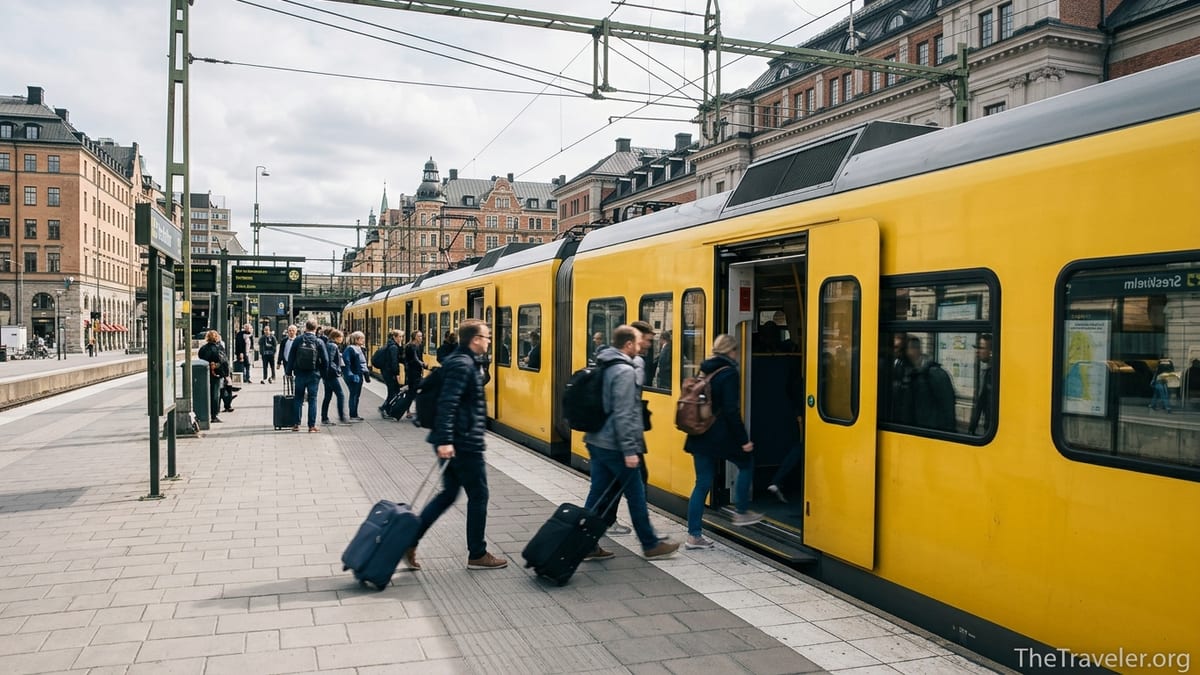
From the beginning, Arlanda Express has been marketed very explicitly as the fastest, most convenient way into Stockholm, and that consistent message has shaped traveler expectations. At Stockholm Central Station, the Arlanda Express platforms are well signposted and integrated into the main concourse. There is a dedicated lounge area with staff and self-service ticket machines, and the bright yellow trains themselves are visually distinctive. At the airport, clear signage points arriving passengers toward Arlanda North and Arlanda South stations just below the terminals.
This visual and physical presence supports a straightforward mental equation for visitors: “yellow train equals quickest option.” Many first-time travelers arriving at Arlanda with luggage and perhaps some jet lag will default to the most obvious, clearly explained solution. While a cheaper journey via SL public transport and a connection at Märsta might save several hundred kronor, it requires more steps: finding the right bus outside the terminal, then transferring to a commuter train, and navigating Stockholm’s ticketing system. Arlanda Express reduces this mental overhead to a simple two-step: buy ticket, take train.
Pricing plays into this positioning. A standard adult one-way ticket on Arlanda Express is typically in the region of 320 to 340 SEK, with various discounts for early online purchase, return tickets within a set time frame, youth, students, seniors, or groups sharing the same journey. That pricing deliberately places the train as a premium product, clearly above Flygbussarna coaches (often around 119 to 149 SEK one-way if booked in advance) and far above the cheapest public transport combinations that may cost under 50 SEK with an SL travel card.
For many visitors paying several thousand kronor or more for an international flight and accommodation in central Stockholm, that premium for the Arlanda Express is framed as a small additional outlay in exchange for certainty and speed. Travel blogs and local guides often describe it as the “splurge” choice: not the cheapest, but the quickest and simplest. Over time, this message has become self-reinforcing, with tour operators, conference organizers and universities routinely telling incoming guests: “Take the Arlanda Express to Central Station; it takes 18 minutes.”
Comparing the Alternatives: Why It Remains the Fastest Choice
To understand why Arlanda Express continues to dominate the “fastest option” segment, it helps to compare it in concrete terms with each of the main alternatives. The first competitor is the Stockholm commuter train that serves Arlanda Central Station via SL’s Pendeltåg system. This train links the airport to Stockholm Central in roughly 38 minutes and also continues toward Uppsala in the other direction. However, passengers boarding or alighting at Arlanda Central must pay a special station access fee, which is added on top of the normal SL ticket price. This makes the direct commuter train from the airport surprisingly expensive given its longer travel time, and it still lacks the non-stop convenience and branding of Arlanda Express.
Then there are regional and long-distance trains, operated by companies such as SJ, that happen to stop at Arlanda Central on their way to or from other cities. At certain times of day, travelers going straight from the airport to places like Uppsala, Gävle or even further north may find these services the most efficient option. But for those whose final destination is central Stockholm, these trains rarely beat Arlanda Express on speed or frequency. They are scheduled around intercity patterns, not tailored exclusively to flight arrival waves.
On the road, airport coaches like Flygbussarna compete primarily on price and coverage. Coaches run every 15 to 30 minutes between the airport and Cityterminalen, adjacent to Stockholm Central Station, in about 35 to 45 minutes. For a solo budget traveler landing at a quiet time of day, the combination of a lower fare and a direct route to the city bus terminal can be compelling. Yet that value proposition hinges on relatively uncongested roads. In practice, especially in winter or during Friday afternoon rush hour, many passengers report journey times stretching toward an hour.
Taxis and ride-hailing services add another variable. A fixed-price taxi from Arlanda to central Stockholm often costs the equivalent of 600 to 800 SEK or more, depending on company and time of day. Split between three or four travelers, that can compete with or even undercut individual Arlanda Express tickets while delivering door-to-door convenience. But journey time is again dominated by motorway traffic. During peak periods, a taxi that looks competitive on Google Maps can end up stuck in the same queues as airport buses. For travelers who simply want the fastest way to reach T-Centralen, the 18-minute train retains a distinct advantage.
Designing the Passenger Experience for Speed and Ease
Beyond pure travel time, Arlanda Express has refined the small details of the passenger experience to shave off minutes and reduce friction. Platforms at both Stockholm Central and the airport are accessible directly via escalators and elevators from the main concourses, so travelers are not forced into long detours through car parks or side tunnels. Clear bilingual signage in Swedish and English guides passengers from baggage claim to the train in a matter of minutes.
On board, the layout is optimized for short-haul airport use. There are generous luggage racks near the doors, ample space overhead and wide aisles that allow passengers with suitcases to move in and out quickly. Seats are configured to allow comfortable laptop use or a brief rest but do not encourage long stays, reflecting the sub-20-minute journey time. Power outlets and good mobile coverage on most of the route mean business travelers can quickly check emails or arrange their onward plans before arrival.
Ticketing has also evolved with speed in mind. Arlanda Express tickets can be bought at staffed counters, from machines at the stations, via a mobile app or directly at the platform gates with contactless bank cards in many cases. That gives travelers arriving without Swedish kronor the reassurance that a major credit or debit card will suffice. When you step off a long-haul flight, being able to tap a card at a barrier and walk straight onto the next train feels markedly faster than locating a ticket office or figuring out local travel cards.
The stations within the airport further highlight the focus on swift transfers. Arlanda South serves Terminals 2, 3 and 4, while Arlanda North is directly under Terminal 5. Passengers transferring between terminal areas can even ride Arlanda Express between the two stations free of charge, a one-minute hop that saves a longer walk through the SkyCity complex. This positioning underpins the perception that the train is tightly integrated into the airport’s fabric rather than an afterthought.
Environmental Performance and the “Climate Smart” Argument
In a country that takes climate policy seriously, Arlanda Express has also benefited from being able to frame itself as a greener choice than cars or taxis. Airport rail links in Sweden generally draw power from an electricity grid that is heavily supplied by hydropower, nuclear and an increasing share of wind, resulting in relatively low average emissions per kilowatt-hour. For each passenger who chooses the train instead of a solo taxi ride, there is a tangible reduction in per-person emissions for the airport-city leg of their trip.
Travelers increasingly encounter this argument in practical ways. Corporate travel policies in many Scandinavian companies now explicitly encourage or even require employees to use rail between Arlanda and central Stockholm where feasible, and internal booking tools often highlight Arlanda Express as the default airport transfer. Conference organizers promoting “climate smart” meetings in Stockholm routinely instruct international guests: “From Arlanda, take the Arlanda Express to the central station, then walk or use local public transport to your hotel.”
For individual visitors, the emissions benefit is balanced against price and convenience. An eco-conscious solo traveler who might otherwise have chosen a taxi may find it easy to justify the Arlanda Express fare when they consider both time saved and reduced environmental impact. Even those who opt for cheaper public transport often use the train and bus combination rather than a taxi for similar reasons. Still, in the specific niche of “fastest connection,” Arlanda Express can credibly argue that it offers both the quickest transfer and a relatively low-carbon footprint compared to private cars.
The environmental framing is also visible in how Stockholm positions itself internationally. Promotional materials from universities and city authorities often underline how quickly and sustainably visitors can reach downtown via train. Being able to cite an 18-minute electric rail link aligns neatly with Sweden’s broader reputation for environmentally conscious infrastructure and helps reinforce the narrative of Stockholm as a modern, green capital.
When the Fastest Option Is Worth the Premium
Choosing Arlanda Express is ultimately about how much a traveler values time, predictability and simplicity over cost. For a business traveler flying in for a single high-stakes meeting near Stockholm Central Station, the calculation is straightforward. If a 320 to 340 SEK ticket saves 20 to 30 minutes and removes uncertainty about traffic, that cost is small relative to the value of arriving on time and unstressed. The same logic applies to conference delegates whose schedules are tightly packed and who may be unfamiliar with the city’s transport system.
Families or groups, however, often run the numbers differently. Two adults and two teenagers buying individual Arlanda Express tickets may be looking at more than 1,000 SEK for a round trip between airport and city. In those scenarios, group discounts on the train, an airport coach, or even a pre-booked fixed-price taxi can make more financial sense. Yet many still choose Arlanda Express at least in one direction, often on arrival, when the convenience of a non-stop train to the central station feels most valuable after a long flight.
There are also concrete cases where Arlanda Express is the only practical fast option. Very early flights on weekends, for example, may coincide with reduced frequency on commuter trains and local buses, while still seeing regular Arlanda Express departures and some airport coaches. Travelers leaving central Stockholm at 04:30 for a 07:00 departure may find that the express train and a handful of taxis are essentially their only realistic modes of transport. In winter, when snow or icy conditions create unpredictable queues on the motorway, the reliability advantage of rail can be even more pronounced.
For visitors who want to experience Stockholm’s broader public transport network, there is no rule that says you must commit to one option for the entire trip. A common strategy is to take Arlanda Express into the city on arrival, then use a cheaper combination of buses and commuter trains on departure once you have learned how the system works. This approach gives you the benefit of a stress-free first impression while still letting you experiment with more budget-conscious options later.
The Takeaway
Arlanda Express did not become Stockholm’s fastest airport train by accident. Its success rests on a clear design brief: connect the city’s main station and its primary international airport in under 20 minutes, with frequent departures, straightforward ticketing and an experience that feels simple even to a first-time visitor. The result is a premium service that consistently outpaces commuter trains, airport coaches and taxis in terms of pure door-to-station speed and reliability.
For travelers choosing how to travel between Arlanda and central Stockholm, the key is to be honest about your priorities. If you value every minute, prefer to avoid traffic and appreciate a seamless, well-signposted journey, Arlanda Express remains the obvious “fast lane” into the city. If budget is more important and your schedule is flexible, you might opt for Flygbussarna, a regional train or a carefully planned public transport route instead.
What is striking, however, is how firmly Arlanda Express has embedded itself in the city’s identity. Ask a Stockholm local or read the travel information for a major event, and you will almost always see the same line: “Take the Arlanda Express; it takes 18 minutes.” In a city that prides itself on punctuality and understated efficiency, that promise has become part of the standard welcome to Sweden’s capital.
FAQ
Q1: How long does the Arlanda Express take between Arlanda Airport and Stockholm Central?
The Arlanda Express takes about 18 minutes non-stop between Stockholm Arlanda Airport and Stockholm Central Station under normal operating conditions.
Q2: How much does a typical one-way Arlanda Express ticket cost?
A standard adult one-way ticket is usually in the range of 320 to 340 SEK, with various discounts available for early purchase, return tickets, youth, students, seniors and groups.
Q3: How often do Arlanda Express trains run?
Arlanda Express trains generally run every 15 minutes for most of the day, with slightly reduced frequency early in the morning and late at night.
Q4: Is Arlanda Express faster than taking a taxi or airport bus?
Yes. While a taxi or airport coach can sometimes be competitively quick in light traffic, the 18-minute non-stop train journey is usually the fastest and is not affected by road congestion.
Q5: Where does the Arlanda Express stop at the airport?
Arlanda Express serves two stations at the airport: Arlanda South for Terminals 2, 3 and 4, and Arlanda North directly beneath Terminal 5.
Q6: Can I use Arlanda Express to travel between terminals at Arlanda Airport?
Yes. You can ride Arlanda Express between Arlanda South and Arlanda North free of charge, which is a quick way to move between terminal areas outside the security zone.
Q7: Is the Arlanda Express included in Stockholm’s regular SL public transport tickets?
No. Arlanda Express is operated separately and is not covered by SL tickets or travel cards. You need a dedicated Arlanda Express ticket to use this service.
Q8: Is Arlanda Express accessible for travelers with luggage and mobility issues?
Yes. Stations have elevators and escalators, and trains provide level boarding in most carriages, wide aisles and luggage racks designed for airport travelers.
Q9: How does Arlanda Express compare environmentally to taxis or private cars?
Because it is powered by electricity from Sweden’s relatively low-carbon grid, Arlanda Express usually has significantly lower per-passenger emissions than a solo taxi or private car.
Q10: When might it make sense to choose another option instead of Arlanda Express?
Travelers on a tight budget, families or groups who can share a taxi fare, or visitors with flexible schedules may prefer cheaper options such as airport coaches, regional trains or combinations of SL buses and commuter trains.