


For many travelers, the first big question about the South Caucasus is not whether to go, but where to start. Armenia and Georgia sit side by side on the map, share centuries of intertwined history and are often bundled into the same itinerary. Yet on the ground they feel strikingly different. If you only have time for one country, which destination is more likely to stay with you long after you fly home?
Get the latest updates straight to your inbox!
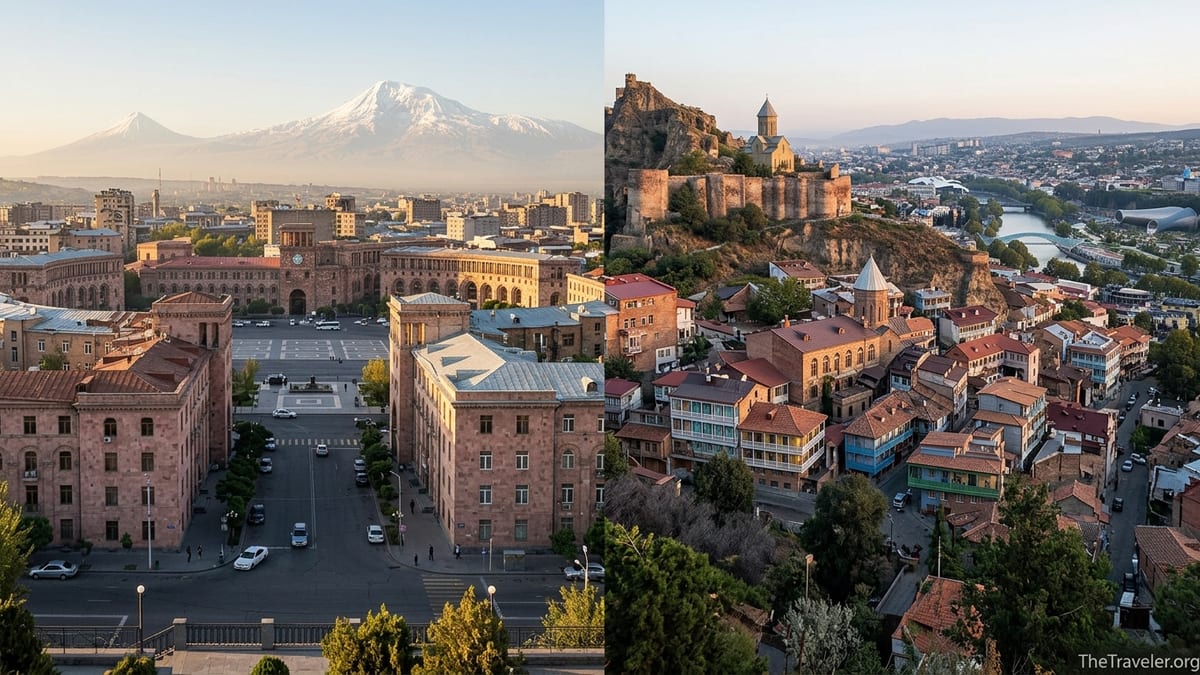
First Impressions: Energy vs Intensity
For most visitors, Georgia’s capital Tbilisi and Armenia’s capital Yerevan shape that crucial first impression. Tbilisi hits you with energy: pastel Art Nouveau balconies leaning over cobbled lanes, sulfur bathhouses steaming by the river, and a nightlife scene that has turned the city into a low-cost Berlin for many Europeans. On a spring evening, café terraces in neighborhoods like Vera and Vake are full of laptop-toting remote workers and young locals hopping between wine bars.
Yerevan, by contrast, feels more concentrated and introspective. Its center is compact and built largely from rose-colored volcanic tuff, which gives the city its “pink city” nickname. There is a ritualistic quality to evenings in Republic Square, where families and couples gather around the singing fountains before drifting to wine bars along Saryan Street. Instead of Tbilisi’s rough-edged bohemia, Yerevan’s vibe is a mix of Soviet-era sturdiness and a deep, often emotional connection to history.
Travelers often describe Tbilisi as the more immediately “fun” city and Yerevan as the more emotionally resonant. An evening hopping between natural wine bars in Tbilisi’s old town and a day-trip from Yerevan to the 4th-century Geghard Monastery and Greco-Roman Temple of Garni will make this contrast tangible: Georgia leads with hedonism and hospitality, Armenia with heritage and reflection.
Both capitals are very walkable in their historic cores, reasonably well served by rideshare apps and public buses, and increasingly oriented toward international visitors. English is widely understood in Tbilisi’s tourist and business districts; in Yerevan, you will hear more Russian, but younger Armenians in cafés, galleries and hostels usually manage in English, especially in central areas.
Costs, Visas and Accessibility
On price, the two countries are still among the best-value destinations in wider Europe, though Georgia has become noticeably more expensive over the past few years as tourism has boomed. A decent mid-range double room in central Tbilisi now typically runs the equivalent of 60 to 90 US dollars per night, with boutique options higher, especially in summer. In Yerevan, similar comfort can often be found for 45 to 70 dollars, and simple guesthouses in smaller Armenian towns under 30 dollars are still common.
Day-to-day costs reflect the same pattern. In Tbilisi, a sit-down dinner for two with a shared salad, a couple of classic dishes like khachapuri and khinkali, and a carafe of house wine might come to 25 to 40 dollars, depending on neighborhood and wine choice. In Yerevan, two people can eat substantial local food with a glass of wine or beer each for closer to 18 to 30 dollars in casual restaurants away from the most touristy spots. Public transport in both capitals is cheap: metro and buses usually cost well under one dollar per ride, while taxis and rideshares across town rarely exceed 4 to 6 dollars unless you hit traffic or surge pricing.
Visa rules are a major point in Georgia’s favor for many nationalities. Citizens of dozens of countries, including the United States and most of Europe, can stay visa-free in Georgia for up to 365 days. Armenia also offers visa-free or visa-on-arrival access to many travelers, but typically for shorter periods such as 180 days per year, which is more than enough for a vacation but less flexible for long-stay digital nomads. Georgia has also introduced a requirement for travel medical insurance with a minimum coverage level, which most mainstream travel insurers now meet automatically.
Getting between the two countries remains straightforward. There are direct flights between Tbilisi and Yerevan, but most budget-conscious travelers opt for the overland route: daytime buses, shared minivans and overnight trains crisscross the border. As of mid-2026, a seat on a standard bus between the capitals typically costs in the range of 15 to 25 dollars, and the journey takes 6 to 8 hours depending on the route and border traffic. Trains are slower but more comfortable for those who like to wake up in a new city.
Safety, Stability and Practical Realities
Both Armenia and Georgia regularly surprise first-time visitors with how safe they feel on the street. Violent crime against tourists is rare in both, and petty theft is much less of a problem than in many larger European cities. Solo travelers, including many women, report feeling comfortable walking in central Tbilisi districts and in Yerevan’s core late into the evening, as long as they follow the usual urban common sense.
The bigger consideration is regional security and political context. Georgia is politically turbulent but has avoided direct conflict on its territory in recent years. Protests in Tbilisi sometimes fill Rustaveli Avenue, but these are mostly peaceful and heavily policed. Day-to-day life in the main tourist areas continues normally, and foreign travelers rarely feel directly affected beyond occasional traffic disruption.
Armenia’s risk profile is more complicated because of its unresolved tensions with neighboring Azerbaijan. Western governments currently advise against travel to areas close to the eastern border, especially parts of the Gegharkunik and Syunik regions. For most visitors, this primarily means being cautious when planning trips far southeast or northeast of Yerevan and checking local advice regarding mountain routes. The main tourist circuits around Yerevan, Lake Sevan, Dilijan, Gyumri and the classic monasteries remain calm and heavily frequented.
Insurance is advisable for both destinations, not only for medical coverage but also for evacuation and trip interruption given the shifting geopolitical climate. In practical terms, however, travelers on the ground in 2025 and 2026 have continued to report smooth experiences: reliable ATMs in cities, widely accepted bank cards in mid-range hotels and restaurants, and helpful locals who step in quickly if there is any confusion.
Culture, History and the Emotional Impact
If you are the sort of traveler who measures a trip by how long it lingers in your mind, Armenia has a powerful argument. Christianity arrived early here, and the country’s stone churches, khachkar cross-stones and clifftop monasteries are not just monuments but markers of survival. A day trip from Yerevan to the Garni Temple, the only standing Greco-Roman colonnaded temple in the region, followed by the rock-hewn Geghard Monastery, condenses two thousand years of religious and imperial history into a single valley.
Further afield, the Tatev Monastery complex, perched on a basalt plateau above a canyon in Syunik Province and reached by one of the world’s longest reversible cable cars, often appears in travelers’ accounts as the moment their trip “clicked” emotionally. The combination of vertiginous scenery and the knowledge that monks once studied, copied manuscripts and debated theology here centuries before European travelers mapped the Caucasus creates a sense of weight that is hard to replicate.
Georgia’s historical impact is more diffuse but no less real. The country’s identity is strongly tied to wine: archaeological evidence suggests that organized winemaking has been practiced here for thousands of years, and you feel that continuity in family-run wine cellars around the Kakheti region, where grape juice still ferments in clay qvevri buried in the ground. Sitting at a supra, a traditional Georgian feast, while a tamada (toastmaster) leads emotional toasts to love, ancestors and the land, many visitors report feeling pulled into a living tradition rather than simply observing a performance.
In short, Armenia often hits the heart through solemn beauty and remembrance, while Georgia does it through warmth, hospitality and celebration. Both leave an impact, but the flavor is different. Travelers interested in genocide history, Soviet legacy and early Christian heritage tend to find Armenia particularly affecting. Those drawn to living folk traditions, music, feasts and the social side of culture often come home raving about Georgia.
Landscapes, Outdoor Adventures and Small-Town Charm
On pure variety of landscapes within a short distance, Georgia is hard to beat. From Tbilisi you can drive a few hours north on the Georgian Military Highway to Stepantsminda (Kazbegi), where you will find the iconic Gergeti Trinity Church sitting under the snowcapped peak of Mount Kazbek. Westward lie the Black Sea beaches and party atmosphere of Batumi, while the Svaneti region offers medieval stone towers against alpine backdrops and multi-day trekking routes between villages like Mestia and Ushguli.
Adventure activities follow naturally from this geography. Paragliding in mountain resorts such as Gudauri, horseback riding in Tusheti, and skiing in winter all attract outdoors-oriented visitors. Prices remain reasonable compared with Western Europe: tandem paragliding flights, for instance, typically cost the equivalent of 55 to 90 dollars, and full-day small-group tours from Tbilisi to Kazbegi or the wine region of Kakheti usually run 40 to 80 dollars per person depending on group size and inclusions.
Armenia’s landscapes are less dramatic on a map but surprising on the ground. Lake Sevan, one of the largest high-altitude lakes in the region, sits about an hour and a half from Yerevan and feels almost like a mild seaside resort, with simple fish restaurants, monastery-topped peninsulas and families renting pedal boats in summer. The forested Dilijan National Park, often dubbed “Little Switzerland,” is a favorite for weekend hikes and guesthouse stays, while the gorges around Garni showcase basalt “organ pipes” and canyon walks that feel unexpectedly wild.
If you enjoy road trips and quiet viewpoints more than adrenaline, Armenia may have the edge. Distances are shorter and roads radiate from Yerevan like spokes, which makes it easy to base yourself in the capital and hire drivers or join small tours for day trips. A private driver for a full-day loop to sites like Khor Virap, Noravank and Areni wine cellars can often be arranged for under 80 to 100 dollars total, which becomes very economical if you are sharing costs as a couple or small group.
Food, Wine and Nightlife
Food is a highlight in both countries, but again the tone differs. Georgian cuisine has become something of a global darling, and you will quickly understand why. Dishes like khachapuri (cheese-filled bread, sometimes topped with egg and butter), khinkali (juicy soup dumplings), pkhali (vibrant vegetable pâtés with walnuts) and mtsvadi (grilled meat skewers) are hearty, shareable and perfectly matched with the country’s aromatic wines. A casual meal in Tbilisi often turns into an hours-long feast as plates keep arriving.
Armenian food is more understated but no less satisfying. Think herb-rich salads, grilled meats, dolma wrapped in vine leaves, creamy spas soups and lavash bread pulled from wood-fired tonir ovens. Yerevan’s wine bar scene has expanded quickly, with many spots along Saryan Street pouring local Armenian vintages made from indigenous grape varietals like Areni. Ordering a cheese board and a flight of Armenian reds here is an easy way to experience how the country’s wine scene is catching up with its neighbor’s.
Nightlife is where Georgia, particularly Tbilisi and Batumi, clearly pulls ahead. Tbilisi’s underground club scene, set in old factories and basements, has earned it a reputation among electronic music fans, and the city’s bars stay busy well into the small hours, especially on weekends. In Batumi, casinos, beach clubs and high-rise hotels cater to a mix of regional tourists and locals on summer holidays.
Yerevan’s evenings are more low-key but increasingly lively. Rooftop bars with views of Mount Ararat’s silhouette, casual beer gardens and a handful of late-night clubs draw a younger crowd on Fridays and Saturdays. You will typically find fewer all-night options than in Tbilisi, but also a more relaxed and accessible scene for travelers who prefer wine conversations and live music to packed dance floors.
Infrastructure, Language and Ease of Travel
Georgia has a longer track record of catering to mass tourism, and it shows. Tbilisi offers a wide range of accommodations from 10-dollar-a-night hostels with organized walking tours to international chains and smart boutique hotels. Intercity travel is straightforward: trains connect major cities, and a dense network of minibuses called marshrutkas links Tbilisi with almost every regional town. Ride-hailing apps are widely used in cities, and English-language signage has improved across airports, metro systems and main tourist sites.
Armenia’s infrastructure is catching up quickly but still feels more intimate. Yerevan has a smaller, simpler metro and bus network, and while signage in English appears at key stations and attractions, outside the capital you may rely more on offline maps and human help. Guesthouses and small family-run hotels dominate in regions like Syunik, Tavush and Lori. For many travelers, this intimacy is part of the charm: homestay-style accommodations where the owner brings out homemade preserves at breakfast can become some of the trip’s most enduring memories.
In both countries, organized day tours are easy to arrange from the capitals. In Tbilisi, you will find agencies on or near Rustaveli Avenue offering small-group trips to Kazbegi, Mtskheta, Kakheti and the cave city of Uplistsikhe, often for 40 to 70 dollars including transport and a guide. In Yerevan, similar kiosks cluster around Republic Square and central avenues, advertising day tours to Lake Sevan, Dilijan, Garni and Geghard, or down toward Khor Virap and Noravank. Prices are comparable to, or slightly cheaper than, Georgian equivalents.
Language barriers are manageable in both destinations. In Georgia, English is quite common among younger city residents working in hospitality; Russian is understood, but less politically neutral than in the past. In Armenia, Russian remains widely spoken alongside Armenian, and English is common in the tourism sector in Yerevan but thinner in rural areas. Learning a few basic local phrases in either language earns quick goodwill and often opens doors to more personal encounters.
The Takeaway: Which Country Leaves a Bigger Impact?
If your mental image of the perfect trip leans toward mountain adventures, wine-fueled feasts and buzzing nightlife, Georgia is more likely to lodge itself in your memory. The combination of dramatic highland scenery, generous visa rules, and a well-established tourism ecosystem makes it an easy win for first-time Caucasus visitors who want variety with minimal friction.
If instead you are drawn to dense layers of history, smaller scale and intense moments of quiet reflection, Armenia may leave the deeper mark. Standing alone among the khachkars at Noratus Cemetery by Lake Sevan, or watching sunset light up the stone at Khor Virap with Mount Ararat in the background, many travelers describe a sense of intimacy they struggle to find in more crowded destinations.
For most people with enough time, the most honest answer is “both.” A classic two-week loop that divides days between Tbilisi, the Georgian mountains and wine country, then shifts to Yerevan and Armenia’s monasteries and lake region, offers a rare chance to experience two distinct cultures in a compact area. The border between them is easy to cross, and the contrast enhances each side.
If you truly must choose one, use your own travel style as a compass: Georgia for energy, variety and social experiences; Armenia for contemplation, heritage and an unexpectedly powerful emotional undertow. Either way, your first trip to the Caucasus is unlikely to be your last.
FAQ
Q1. Is Georgia or Armenia safer for solo travelers?
Both are generally very safe for solo travelers, including women, in main cities and tourist regions. Georgia has slightly more developed tourist infrastructure, while Armenia often feels quieter and more close-knit. In both countries, avoid border zones with current advisories, keep normal city awareness and check your government’s latest guidance before you go.
Q2. Which country is cheaper: Armenia or Georgia?
Armenia is usually a bit cheaper overall, especially for accommodation and food. Mid-range hotels and restaurant meals in Yerevan and regional towns often cost 10 to 20 percent less than similar options in central Tbilisi or major Georgian resorts. That said, both countries remain excellent value compared with Western Europe or North America.
Q3. Where is the food better, Armenia or Georgia?
It depends on your taste. Georgia tends to impress visitors with bold, hearty dishes and a huge variety of cheeses, breads and walnut-based salads. Armenia’s cuisine is more subtle and herb-driven, with excellent grilled meats, fresh salads and oven-baked lavash. Most travelers end up loving both and remember specific meals rather than choosing a winner.
Q4. Can I visit both Armenia and Georgia in one trip?
Yes. Many travelers combine the two, often flying into one capital and out of the other. Overland buses, shared minivans and trains run between Tbilisi and Yerevan, with typical journey times of 6 to 10 hours depending on the route. A 10 to 14 day itinerary is enough to sample both capitals plus a couple of regional highlights in each country.
Q5. Do I need a visa for Georgia or Armenia?
Citizens of many countries, including the United States, Canada and most of Europe, can enter Georgia visa-free for up to a year and Armenia visa-free or with visa on arrival for shorter stays. Rules change, so always verify the exact requirements and permitted stay for your nationality through official government or embassy sources before booking flights.
Q6. Which country is better for hiking and outdoor adventures?
Georgia usually wins for pure outdoor variety. Regions like Kazbegi, Svaneti, Racha and Tusheti offer high mountain trails, multi-day treks and winter sports. Armenia has excellent hiking too, especially around Dilijan, Tatev and the volcanic highlands, but the infrastructure is more low-key and routes slightly less marked. If trekking is your main goal, start with Georgia.
Q7. Is it easy to get around without speaking the local language?
Yes, in most tourist contexts. In both countries, staff in hotels, hostels, tour agencies and many restaurants in the capitals speak at least basic English. Outside major cities, you will rely more on gestures, translation apps and sometimes Russian, but locals are generally patient and helpful. Learning a few basic phrases in Georgian or Armenian is appreciated.
Q8. When is the best time to visit the Caucasus?
Late spring and early autumn are ideal for both countries. May, June, September and early October usually bring mild temperatures in the cities and good conditions in the mountains. July and August can be very hot in Tbilisi and Yerevan and crowded in popular resorts. Winter is best if you want skiing or snow landscapes but expect some remote mountain roads to be closed.
Q9. Which capital should I choose if I only have a long weekend?
If nightlife, café culture and variety are your priorities, Tbilisi is the better long-weekend choice, with easy day trips to nearby wine country or historic towns. If you care more about compact size and intense historical sites, Yerevan works beautifully for three to four days, with half-day trips to Garni, Geghard or Lake Sevan very manageable from the city center.
Q10. Is it possible to travel independently, or do I need tours?
You can travel independently in both countries using a mix of public transport, ride-hailing apps, trains and occasional private drivers. Many travelers choose organized day tours for specific remote sites or when time is short, but there is no requirement to join a group. Booking one or two guided excursions and exploring the rest on your own is a popular and practical compromise.