


More news on this day
As the Iran war continues to reshape security and airspace across the Middle East, Jordan finds itself in a delicate position: politically stable and comparatively calm, yet increasingly exposed to regional missile threats and aviation disruptions that matter to travelers planning visits in the coming weeks.
Get the latest news straight to your inbox!
Jordan’s Security Picture in a Volatile Neighborhood
Jordan has long marketed itself as a comparatively safe gateway to the Middle East, even when neighboring countries faced conflict. That reputation is now being tested by the 2026 Iran war, which has drawn in states across the region and triggered wide-ranging missile and drone exchanges. While Jordan is not a battlefield, it has been drawn into the security equation through its role in regional air defense and its proximity to Israeli, Syrian and Iraqi airspace.
Publicly available analyses of the conflict indicate that Jordanian territory has been targeted by Iranian missile and drone salvos aimed at American and allied facilities since late February. Defensive systems have intercepted the vast majority of these projectiles, but debris has been reported in sparsely populated areas. So far, there are no widely reported incidents of tourist sites such as Petra, Wadi Rum or the Dead Sea being directly affected, yet the risk profile for the country as a whole has shifted upward.
Open-source defense monitoring and security advisories describe Jordanian forces on heightened alert, particularly in the country’s north and east, where foreign military installations are located. For travelers, this may translate into occasional road closures, visible military patrols and temporary restrictions around certain zones, especially near air bases and along the Syrian and Iraqi borders.
Despite these pressures, there have been no sustained reports of civil unrest linked to the Iran war inside Jordan’s main visitor hubs. Amman, Aqaba and key archaeological sites have remained largely calm, with daily life continuing under an elevated but orderly security posture.
Airspace, Flight Disruptions and Access Routes
The single most significant impact of the Iran war on travel to Jordan has been in the skies. Regional coverage by international media and aviation trackers shows that the coordinated United States and Israeli strikes on Iran at the end of February triggered a chain reaction of temporary airspace closures, rerouted flights and mass cancellations from the Gulf to the Eastern Mediterranean.
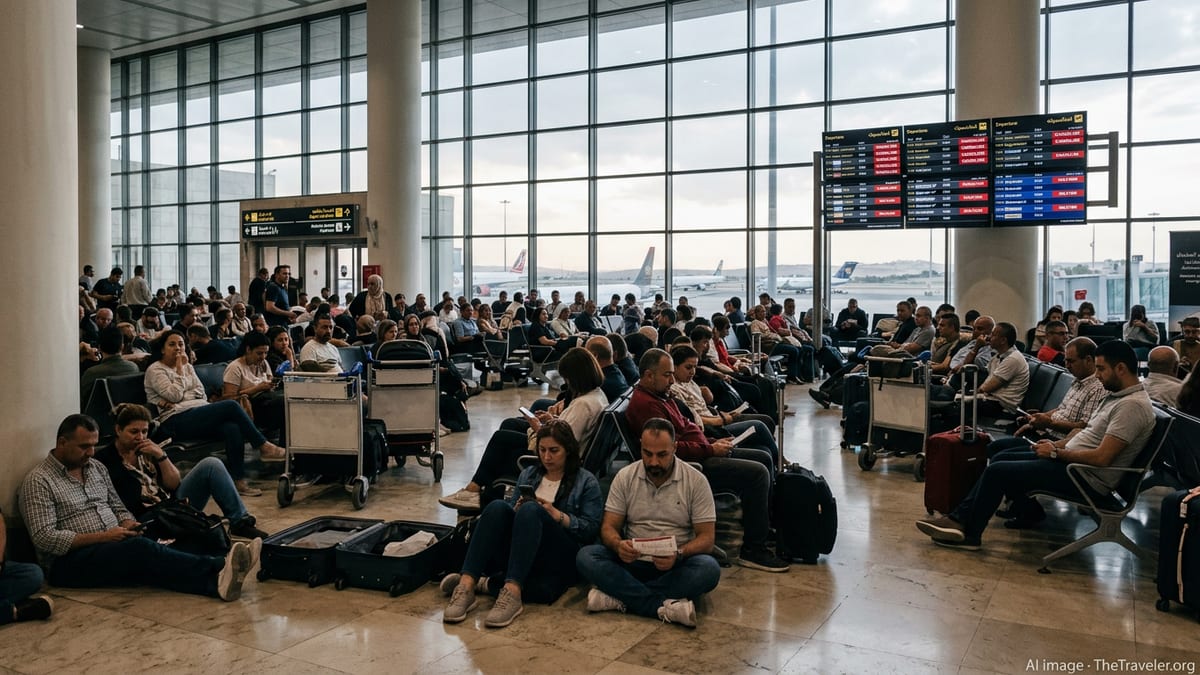
Jordan’s geographic position between Israel, Syria, Iraq and Saudi Arabia makes its skies part of the broader regional traffic network. When Iran and its allies launch large-scale missile or drone barrages, airlines often reroute aircraft away from potential conflict corridors. On peak escalation days, this has translated into delayed or canceled flights into and out of Amman’s Queen Alia International Airport as carriers adjust routings or pause operations pending risk assessments.
Aviation risk advisories compiled for corporate and government travelers recommend monitoring not only Jordan-specific notices but also developments affecting Israeli, Lebanese, Syrian and Iraqi airspace. Disruptions elsewhere can ripple into Jordan’s schedules, even if its own airports remain technically open. Travelers are being urged to allow extra time for connections, avoid tight same-day onward itineraries and keep flexible tickets where possible.
For those using Jordan as a land bridge to the Palestinian territories or Israel, the picture is even more fluid. Border crossings and onward routes can be affected at short notice by flare-ups around the West Bank, Gaza or southern Syria, as well as by broader ceasefire negotiations between Israel, Iran and Lebanese actors.
How Official Advisories Currently Frame the Risk
Government travel advisories monitored in late June describe Jordan in cautious but differentiated terms. Many Western and Asian states continue to rate most of the country as relatively safe for essential or informed travel, while specifying higher-risk zones along the borders with Syria and Iraq. These advisories typically recommend against non-essential travel near frontier areas where missile debris or cross-border fire is more plausible.
Several governments have, at various points since February, ordered non-essential diplomatic staff and dependents to leave missions across the region, including in Jordan. This does not necessarily imply an imminent threat to tourists but underlines concern about the possibility of further regional escalation, especially if ceasefires between Israel, Iran and Hezbollah-linked forces fray.
Private-sector security assessments also highlight the gap between generalized regional headlines and local realities. Analysts note that Jordan’s intelligence and security services remain among the most experienced in the region, and that the monarchy has moved quickly in previous crises to contain spillover from conflicts in Syria and Iraq. At the same time, they stress that no air defense system is perfect and that the current war involves long-range weapons that can overshoot their intended targets.
Against this backdrop, most advisories fall short of a blanket “do not travel” message for Jordan. Instead, they call for heightened vigilance, careful route planning and close monitoring of regional developments in the days leading up to any trip.
Practical Considerations for Tourists on the Ground
For visitors who decide to go ahead with travel to Jordan, the practical experience is likely to be shaped less by direct physical danger than by uncertainty and inconvenience. Hotels, guides and tour operators in Amman, Petra and Aqaba have remained open, seeking to reassure guests while adapting to fluctuations in arrivals tied to flight schedules.
Travel risk consultants advise that visitors maintain contingency plans in case of sudden airspace restrictions. That can include holding a backup routing via a different hub, having access to emergency funds to cover extra nights if outbound flights are postponed, and ensuring that travel insurance explicitly covers disruptions linked to regional conflict rather than only conventional delays.
On the ground, basic precautions include registering with one’s embassy where that service is offered, sharing itineraries with relatives or friends, and staying informed via reputable international and regional news outlets. In the event of a major regional escalation or new missile salvos, travelers may be advised to shelter indoors away from windows and avoid unnecessary movement until authorities indicate that the immediate threat has passed.
Those planning self-drive itineraries or independent trips to more remote areas should keep in mind that some desert highways double as strategic routes. Security forces may implement checkpoints or temporary closures without advance notice, particularly at night. Organized tours and local drivers are typically better placed to navigate these changes and receive real-time updates.
Balancing Reward and Risk for Upcoming Trips
Jordan’s combination of UNESCO World Heritage sites, desert landscapes and relative political stability has long made it a mainstay of Middle East tourism. That appeal has not disappeared, but the Iran war has added a layer of regional risk that travelers cannot ignore. Decisions about whether to proceed now or postpone are increasingly framed as a personal calculus that weighs appetite for risk against flexibility in travel plans.
For some, the current environment may be an acceptable risk, especially if they are seasoned travelers comfortable with dynamic security situations and able to remain flexible with dates and routes. For others, particularly families with small children or those with limited capacity to absorb last-minute changes, deferring travel until ceasefires and de-escalation efforts solidify may feel more prudent.
What is clear is that safety assessments for Jordan can no longer be separated from the wider regional picture. Missiles fired hundreds of kilometers away, negotiations over maritime chokepoints such as the Strait of Hormuz, and shifting front lines in Lebanon or Gaza can all have second-order effects on a trip to Amman or Aqaba within days. Planning a visit now requires close attention to this fast-moving landscape right up to the day of departure.
As of late June 2026, the best description of Jordan for travelers is a country that remains fundamentally welcoming and functional, yet operating under the shadow of a conflict next door. Anyone considering travel should review the latest official advisories from their home country, follow regional developments closely and build flexibility into their itineraries in case the security and aviation picture changes again at short notice.