


More news on this day
From Singapore to Jakarta, Southeast Asia’s biggest gateways are racing to add runways, terminals and transit capacity, unleashing a new phase of post-pandemic recovery in ASEAN aviation.
Get the latest news straight to your inbox!
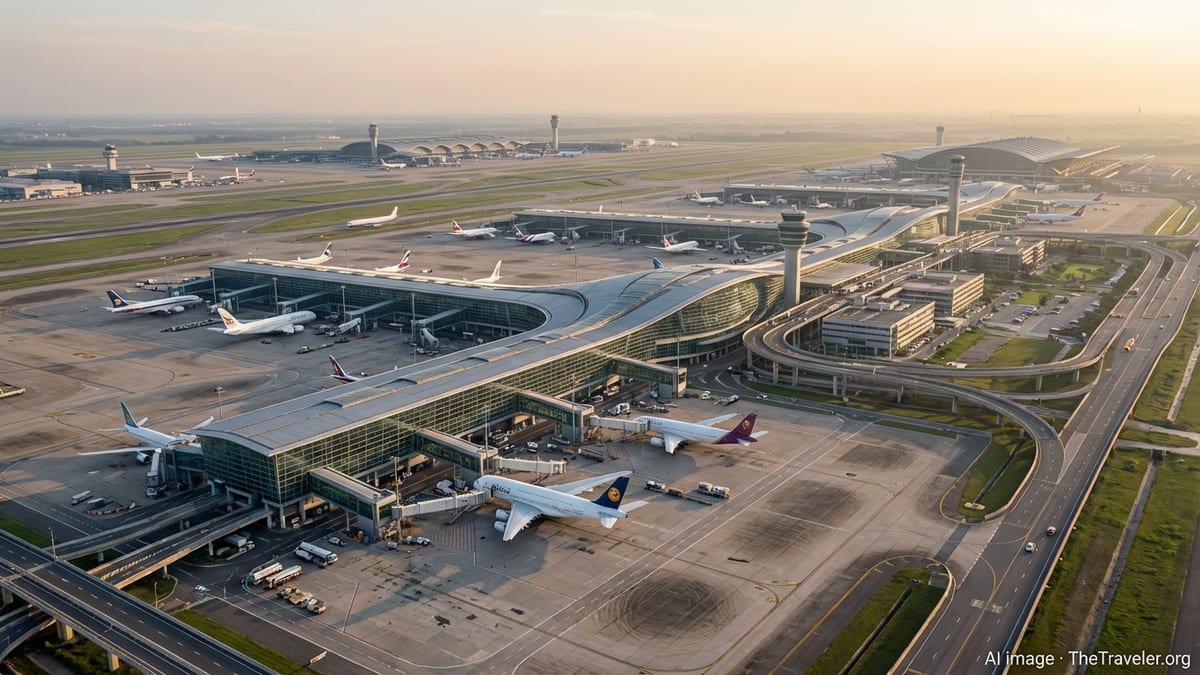
Singapore’s Terminal 5 Puts Changi Back in the Global Big League
Singapore has reactivated one of the world’s most ambitious airport projects, with Changi Airport’s Terminal 5 moving from design review to full construction. Publicly available information shows that work on the mega-terminal, part of the wider Changi East development, is scheduled through the early 2030s and will eventually lift the hub’s handling capacity toward around 140 million passengers a year, roughly doubling its pre-pandemic throughput.
Recent budget announcements in Singapore indicate that several billion Singapore dollars in additional funding have been earmarked for Changi’s expansion, underlining the government’s long-term bet on aviation and hub-and-spoke connectivity. Planning documents highlight a super low energy terminal design, extensive rooftop solar power and automated systems that are intended to cut operating costs while accommodating higher volumes of transfer traffic.
For transit travelers, the impact will be felt in scale and scheduling flexibility rather than in a single dramatic opening date. Terminal 5 is planned to operate in the mid-2030s, with incremental capacity increases at existing terminals and supporting infrastructure coming online earlier. Analysts note that by committing to T5 at this stage of the recovery cycle, Singapore is positioning itself to capture the next wave of growth in long haul and regional transfer flows across the Indo-Pacific.
Malaysia and Thailand Double Down on Competing Super-Hubs
Malaysia and Thailand are responding with their own mega-airport strategies, seeking to defend and grow their share of ASEAN connecting traffic. In Kuala Lumpur, the KLIA master plan under Malaysia Airports Holdings includes proposals for new terminals, expanded satellite buildings and a possible fourth runway, with long-term projections pointing to capacity of up to about 140 million passengers per year. Parliamentary disclosures show that authorities are reviewing the timing and phasing of these works in line with traffic growth.
Operational enhancements are already under way. Malaysia’s civil aviation regulator has highlighted improvements to the triple-runway system at KLIA and more efficient approach and departure procedures, measures that are designed to extract more capacity from existing infrastructure even as physical expansion is studied. Combined with ongoing upgrades at the budget-focused KLIA2 terminal, Kuala Lumpur is quietly reinforcing its role as a lower-cost alternative to Changi for both ASEAN and long haul connections.
Thailand’s flagship Suvarnabhumi Airport is undergoing one of the most aggressive expansions in the region. The opening of a third runway and a midfield satellite terminal has already lifted flight handling capacity, and Airports of Thailand has unveiled a multiyear investment program exceeding 200 billion baht for additional works. Official project briefs describe a planned South Terminal, eastern terminal expansion and future fourth runway that together are expected to push annual capacity toward 120 to 150 million passengers over the next decade.
Thailand is also advancing plans to transform U-Tapao, south of Bangkok, into a fully fledged third airport for the capital region. Government strategy papers envision capacity of up to 60 million passengers a year there in the longer term, integrated with a high-speed rail link to Bangkok’s existing airports. If realized on schedule, this airport triangle would give the Bangkok area one of the largest combined systems of runways and terminals in Asia.
Vietnam’s Long Thanh Leads a New Wave of Greenfield Mega-Projects
Vietnam is pushing ahead with one of Southeast Asia’s most closely watched greenfield hubs, Long Thanh International Airport outside Ho Chi Minh City. Government decisions and investor reports indicate that Phase 1 is targeted for substantial completion around late 2025, with technical test flights and equipment installation continuing into 2026 ahead of commercial operations in the first half of that year.
Phase 1 of Long Thanh is designed to handle tens of millions of passengers annually, relieving pressure on the severely constrained Tan Son Nhat Airport in central Ho Chi Minh City. Subsequent phases, according to planning documents, would add terminals and runways in stages, lifting overall capacity well beyond 100 million passengers and positioning Long Thanh as a major ASEAN and trans-Pacific transfer point.
The project is part of a wider Vietnamese infrastructure push that includes new expressways and upgraded secondary airports across the country. For airlines and travelers, Long Thanh’s layout and airfield capacity are expected to enable more reliable slot availability, shorter delays and better connectivity between regional and long haul services, particularly for journeys linking Northeast Asia, Southeast Asia and Australia.
Indonesia, Brunei and Other ASEAN States Join the Expansion Wave
Beyond the headline projects in Singapore, Thailand, Malaysia and Vietnam, other ASEAN countries are pressing ahead with their own multi-billion dollar airport schemes. In Indonesia, government and operator statements outline a pipeline of expansions at Jakarta’s Soekarno Hatta International, Bali’s Ngurah Rai and a series of secondary hubs, many of them adding new terminals or extending runways to handle more widebody aircraft and international services.
Brunei has pursued a more modest but strategically important program at Brunei International Airport, completing terminal upgrades and exploring further enhancements to support regional connectivity between Borneo, the Malay Peninsula and the wider ASEAN network. Elsewhere, the Philippines, Cambodia and Laos are advancing new-build and relocation projects for their main gateways, with Manila, Phnom Penh and Vientiane all preparing to shift or expand airport capacity.
Taken together, these projects amount to a rolling construction boom that is reshaping the physical map of ASEAN aviation. While timelines differ and some schemes face cost or land-acquisition challenges, the overall direction is clear: governments and airport operators across the bloc are planning for far higher traffic volumes than before the pandemic, with a particular focus on supporting transfer and transit flows.
Transit Traffic Surges as Capacity Bottlenecks Ease
The payoff is already visible in passenger numbers. Data from airport operators and international industry bodies show that ASEAN hubs have moved close to or beyond their 2019 traffic levels, with several reporting record monthly volumes in late 2024 and early 2025. Recovery has been driven not only by local outbound demand and inbound tourism but also by a sharp rebound in connecting traffic linking South Asia, Oceania, Northeast Asia and Europe through Southeast Asian hubs.
As new runways and satellite terminals come online, chronic bottlenecks that once constrained peak-hour operations are starting to ease. At Suvarnabhumi, the third runway has increased hourly movement capacity, allowing more banks of connecting flights and reducing the risk of missed connections. At KLIA and Changi, upgraded airfield and terminal systems are improving turnaround times and enabling airlines to schedule tighter yet more reliable connections.
For transit travelers, the competitive dynamic among ASEAN hubs is translating into broader route choices and, in many cases, more aggressive pricing. Network carriers based in Singapore, Bangkok, Kuala Lumpur, Jakarta and Ho Chi Minh City are each seeking to lock in transfer traffic flows with expanded schedules, new city pairs and refreshed cabin products, betting that the region’s combined mega-airport capacity will underpin growth well into the 2030s.
Industry observers caution that capacity additions need to be matched with investments in air traffic management, border processing and intermodal links to fully realize their benefits. Nonetheless, the current wave of multi-billion dollar airport expansions across Singapore, Malaysia, Vietnam, Thailand, Indonesia, Brunei and their neighbors is already pushing ASEAN transit travel to a striking new peak, repositioning the region as one of the world’s most dynamic aviation crossroads.