


More news on this day
Asia’s aviation network is facing one of its most turbulent early-summer periods in years, with more than 6,600 flights reportedly cancelled as heavy monsoon rains, typhoon threats, airspace rerouting and geopolitical friction converge across the region’s busiest corridors.
Get the latest news straight to your inbox!
Monsoon Rains Swamp Hubs From Mumbai to Guangzhou
Seasonal weather patterns are combining with stronger than usual rainfall to batter airline schedules across South and East Asia. Public meteorological outlooks for the 2026 southwest monsoon point to intense episodes of heavy rain and localised flooding in India and neighbouring countries, while China’s southern provinces brace for successive rounds of torrential downpours and potential typhoon landfalls. Airports serving megacities such as Mumbai, Kolkata, Guangzhou and Shenzhen have already seen waves of ground stops and arrival restrictions, with knock-on delays rippling across domestic and regional networks.
Reports from Indian aviation specialists indicate that Mumbai and other coastal gateways typically face their heaviest operational stress in July and August as the monsoon peaks. In practice this means repeated runway inspections, tighter spacing between aircraft and extended periods where only one runway can be kept open, reducing capacity for both arrivals and departures. Airlines have responded by pre-emptively trimming schedules, cancelling lower-yield services and consolidating passengers onto fewer flights to preserve resilience on trunk routes.
Further east, publicly available weather bulletins for southern China describe a sustained spell of heavy rain stretching from late June into early July, prompting heightened flood and typhoon preparedness across Guangdong, Guangxi and Hainan. As rainfall totals mount, aircraft turnarounds slow, and crews, ground handlers and air traffic controllers face mounting pressure, nudging carriers to scrub flights rather than risk compounding delays. Short-haul services into and out of secondary airports are proving especially vulnerable.
These weather-driven disruptions have coincided with the start of Asia’s peak summer travel season, magnifying the impact on passengers. With load factors already high, rebooking options are limited, and observers note that a single evening of intense storms can force airlines to cancel dozens of rotations, adding quickly to the regional tally.
Typhoon Threats and Fragile Infrastructure Expose Vulnerabilities
In addition to steady monsoon rainfall, the first significant tropical systems of the northwest Pacific season are beginning to form, threatening island and coastal hubs from the Philippines and Taiwan to Japan’s Ryukyu chain. Historical data shows that even a glancing blow from a typhoon can force the closure of multiple airports for several hours or longer, with carriers cancelling large portions of their domestic and regional schedules as a precaution.
Preparedness plans published by airport operators in East Asia typically call for staged responses as wind speeds rise, including the suspension of widebody operations, the towing of aircraft to secure stands and the shutdown of exposed gates. Once these measures are activated, departures are curtailed sharply and inbound flights must divert or be cancelled altogether. Given the dense web of connections linking East Asian hubs, a storm-triggered ground halt can cause schedule disarray thousands of kilometres away as aircraft and crews are left out of position.
Analysts note that some airports remain constrained by limited runway capacity, older drainage systems and crowded terminal infrastructure, which reduces their ability to recover quickly once a storm passes. Prolonged weather disruptions at such facilities translate directly into higher cancellation counts. With climate variability bringing more episodes of intense rainfall to parts of Asia, the gap between resilient and vulnerable hubs is becoming increasingly clear to airlines and passengers alike.
Local governments and aviation authorities across the region are continuing to assess longer-term resilience measures, ranging from new runway drainage projects to updated storm-operations playbooks. For now, however, carriers often have little choice but to cancel flights pre-emptively when a typhoon or severe monsoon burst is forecast, trading near-term passenger frustration for safety and a faster post-storm restart.
Airspace Rerouting and Middle East Conflict Add to Disruption
While the monsoon and typhoon season is a familiar challenge, this year’s disruption has been intensified by shifting airspace risk linked to conflicts and military activity far beyond Asia’s major tourist beaches. Industry briefings tracking the cumulative impact of airspace closures between Europe, the Middle East and Asia describe a patchwork of no-fly zones and risk advisories that continues to evolve, forcing airlines to reroute or cancel flights at short notice.
Publicly available travel and aviation coverage earlier in 2026 documented episodes where missiles and drone activity in parts of the Middle East led to temporary shutdowns of key corridors, triggering mass cancellations and diversions on services linking Asian hubs with Europe. Tour operators in economies such as Taiwan reported scrambling to reroute customers when flights across affected regions were pulled, illustrating how a distant conflict can suddenly strand travellers headed to or from Asia.
Specialist airspace briefings focused on the Asia Pacific region highlight additional complexity around the East China Sea and Taiwan Strait, where overlapping identification zones and periodic military exercises can generate restrictive notices to air missions. Although routine commercial services are generally maintained, the need to file longer or more southerly routings increases fuel burn and shrinks schedule buffers. When crews run up against duty time limits, airlines sometimes cancel later rotations to remain compliant, inflating regional disruption statistics even in the absence of direct security incidents.
Taken together, these geopolitical and security factors have turned flight-planning into a far more dynamic exercise for long-haul operators. Several carriers across East and Southeast Asia have periodically trimmed or retimed services to Europe and the Middle East as a result, with each adjustment removing available seats from the system and complicating recovery from weather-linked cancellations.
Geopolitics, Bilateral Strains and Quiet Capacity Cuts
Beyond immediate security risks, broader diplomatic tensions are also filtering into airline schedules. Trade and political friction between major North Asian economies has already prompted reductions on some cross-border routes, particularly between China and Japan, where reports earlier this year described the suspension of dozens of flights on specific city pairs. Although these moves have unfolded gradually, their cumulative effect is to thin timetables on what were once dense corridors.
Industry commentary suggests that access to airspace is increasingly seen as a strategic lever, particularly where carriers from one country are heavily reliant on overflight permissions granted by another. If governments opt to use airspace or traffic rights as a bargaining chip, airlines may be forced to scale back services for reasons only tangentially related to passenger demand or profitability. Observers point out that the closure of Russian airspace to many Western carriers has already tightened available corridors between Europe and Asia, leaving little slack should further restrictions be imposed elsewhere.
At the same time, economic pressures are shaping airline decisions. Jet fuel prices, currency moves and slower-than-hoped recovery in certain outbound markets have all been cited in coverage of schedule adjustments by Asian carriers. In some cases, routes to secondary cities in Southeast Asia and the Pacific have been trimmed or consolidated, with official filings describing the changes as part of network optimisation. For passengers, however, the distinction between a cancellation tied to geopolitics and one driven by commercial calculus can be academic when options on their preferred dates disappear.
These structural cuts mean that when monsoon storms or typhoon warnings trigger a new wave of cancellations, there are fewer alternative flights for rebooking. As a result, what might once have been a 24-hour disruption can now stretch into several days of travel uncertainty for affected travellers, particularly those relying on complex connections.
Travelers Confront Packed Rebooking Queues and Shifting Advice
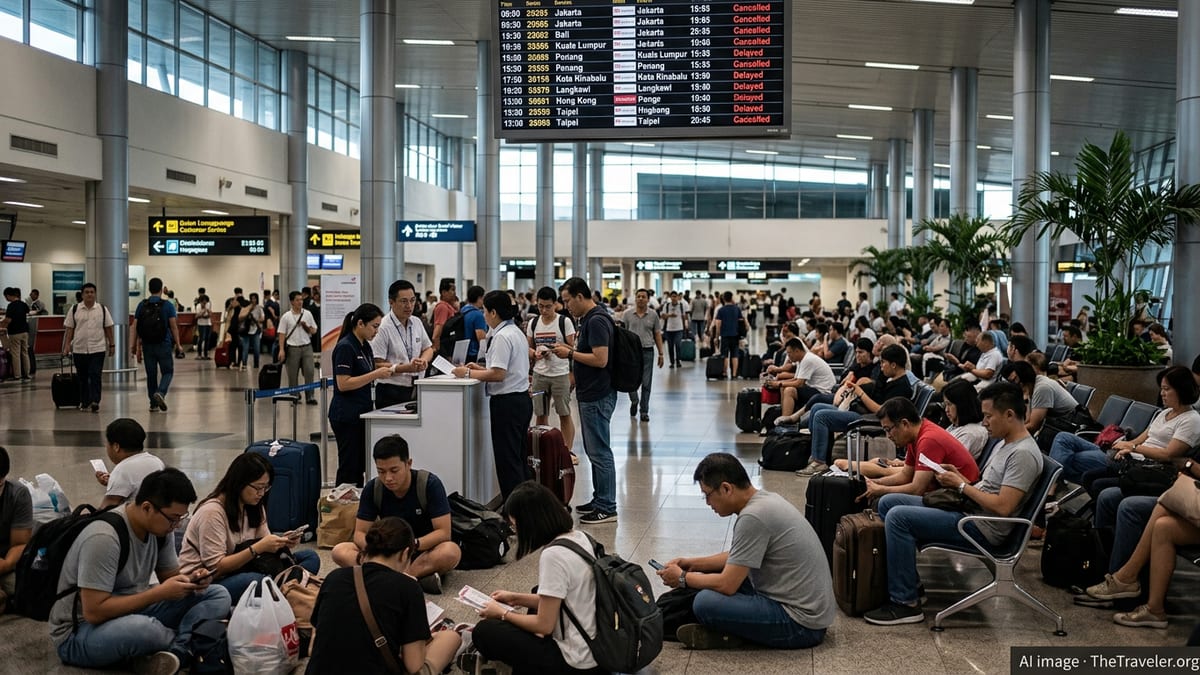
For passengers on the ground, the combined impact of monsoon weather, typhoon alerts, airspace constraints and geopolitical strains is playing out in crowded check-in halls and customer-service queues from Bangkok to Tokyo. Operational data compiled by aviation analytics firms and travel media over recent weeks points to several days when regional cancellations reached into the hundreds, with thousands more flights delayed as airlines struggled to re-thread their schedules.
Consumer-rights guidance across multiple Asian markets urges travellers to monitor flight status closely, build in generous connection times and stay in direct contact with airlines through official apps or messaging services. In jurisdictions such as India, regulators have set out refund and rebooking rules that require carriers to offer alternative flights or compensation when cancellations are within their control, although weather and security-related disruptions are often treated differently. Similar frameworks are in place in parts of East and Southeast Asia, but awareness among international tourists remains uneven.
Travel advisors increasingly recommend that passengers transiting Asia during the peak monsoon and typhoon months consider overnight layovers rather than tight same-day connections, particularly when flying through hubs with known weather vulnerabilities. Flexible tickets, comprehensive travel insurance and a willingness to reroute via secondary gateways can also improve the chances of reaching a final destination on time when disruption strikes.
With more than 6,600 flights already cancelled in recent weeks and the most intense phase of the monsoon still ahead in many countries, Asia’s 2026 summer travel season is shaping up to be a stress test for airlines, airports and passengers alike. How carriers adapt their schedules, and how governments manage the intersection of weather, infrastructure and geopolitics, will determine whether the current wave of disruption eases or intensifies in the weeks to come.