


More news on this day
Renewed conflict involving Iran is rippling through one of the world’s most important aviation corridors, slowing Middle East air traffic growth and undermining the region’s hard-won post‑pandemic recovery.
Get the latest news straight to your inbox!
Regional hubs face sharp but uneven traffic declines
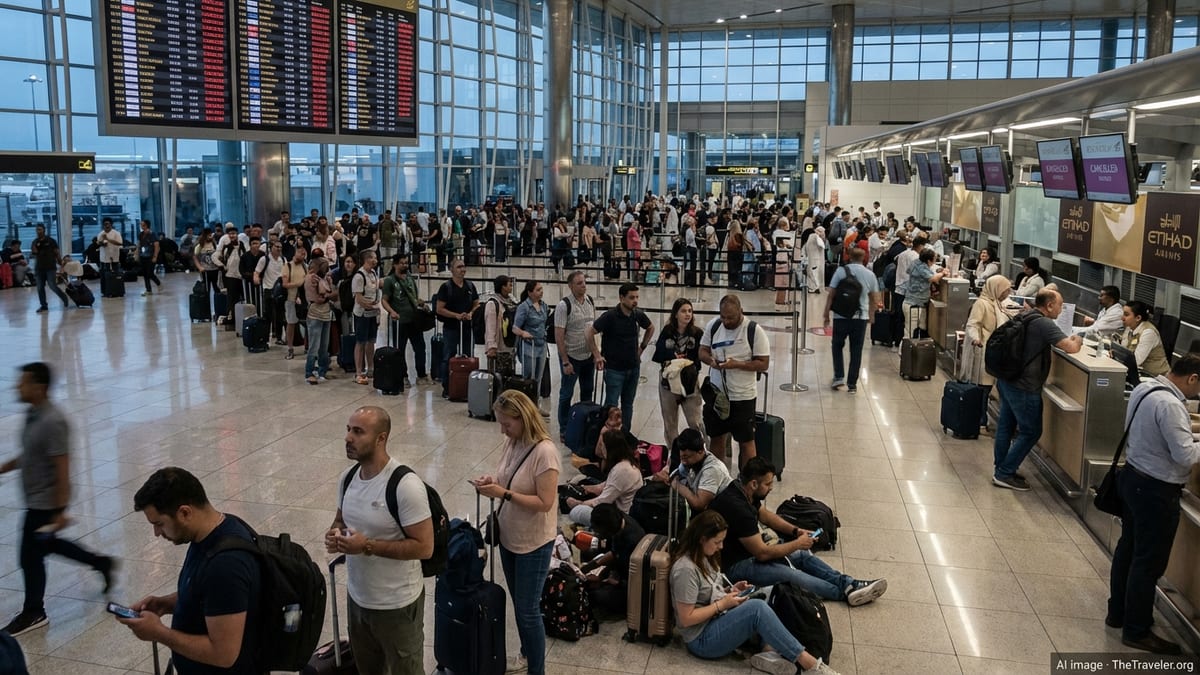
Published industry data shows that the conflict centered on Iran and the Gulf has sharply reduced traffic at key Middle East hubs that sit on the main corridor between Asia, Europe and Africa. Analysis by Airports Council International Asia-Pacific and Middle East indicates that nine major hubs in the region operated at less than half of their pre-conflict scheduled capacity for several weeks in March, with an estimated loss of more than 14 million passengers compared with a year earlier.
The impact has been most visible at large transfer hubs whose business models depend on overflying Iranian or adjacent airspace. Dubai International, Hamad International in Doha and airports in Abu Dhabi, Bahrain and Saudi Arabia have all reported periods of curtailed operations, with some terminals handling long queues, delays and cancellations after temporary airspace closures linked to missile and drone activity.
Despite these shocks, the picture is not uniformly negative. Earlier traffic statistics for 2024 and 2025 showed Middle East carriers outpacing global averages as travel demand to and from Asia and Africa surged. More recent IATA chartbooks still record growth in regional passenger traffic on some routes, suggesting that underlying demand remains strong even as the conflict periodically disrupts the network and diverts flows away from traditional hubs.
Rerouting around Iran lengthens journeys and raises costs
With stretches of Iranian, Iraqi and Gulf airspace periodically restricted, many airlines have been forced to redesign routings between Asia and Europe or North America. Publicly available flight tracking and scheduling data point to large volumes of traffic being shifted either south across the Arabian Sea and Arabian Peninsula or north via Central Asia and Turkey, adding time and fuel burn to journeys that previously used more direct tracks.
Consultancy assessments of the conflict’s impact describe a sustained reduction in scheduled supply across the Middle East corridor, alongside a spike in average fares. A recent regional report prepared for airports in Asia-Pacific and the Middle East estimates that fares to and from affected Gulf hubs doubled in March compared with the previous year, and remained 40 to 50 percent higher on many markets into the northern summer period as airlines sought to recover higher operating costs.
Beyond the immediate operational challenges, the prolonged need to avoid conflict zones is complicating fleet and crew planning. Longer routings can require additional fuel stops, changes in crew duty patterns and the repositioning of widebody aircraft, which in turn tightens capacity on other long-haul routes. Network planners are increasingly weighing whether to restore previous routings when conditions allow, or to make some of the new paths permanent in order to build resilience against future flare-ups.
Gulf mega-hubs juggle resilience and vulnerability
The disruption has highlighted both the vulnerabilities and strengths of the Gulf’s mega-hub strategy. Dubai International, which handled more than 92 million passengers in 2024 and exceeded 95 million in 2025 according to official statistics, has experienced pronounced swings in activity during periods of heightened tension. Public statements from its operator in 2026 confirm that first-quarter traffic fell by more than one fifth year on year as regional airspace restrictions intensified.
Airports in Doha and Abu Dhabi have faced similar stresses. Media coverage in mid-2025 documented scenes of congestion at Hamad International and long queues in Dubai after Iran-related missile activity prompted the temporary closure of sections of regional airspace. Analysts noted that a relatively small share of passengers ending their trips in these cities magnified the impact of any disruption on global connecting flows.
At the same time, managers of these hubs emphasize that their networks are diversified enough to absorb localized shocks. Dubai’s operator has repeatedly stressed that politically exposed routes account for only a small fraction of total throughput and that growth on other markets, particularly to South and Southeast Asia, has cushioned the impact. Updated forecasts for 2026 still point to record or near-record annual passenger totals once restrictions ease, underlining the enduring appeal of the Gulf as a connecting point between continents.
Tourism and regional economies count the cost
The aviation slowdown is feeding directly into wider economic damage across the Gulf. An assessment released earlier in the year by a regional news agency put tourism-related losses from the Iran-centered conflict in the tens of billions of dollars within weeks of the first strikes. Gulf economies that have invested heavily in aviation-backed tourism, such as Saudi Arabia, Qatar, the United Arab Emirates and Bahrain, are seeing hotel, retail and business travel revenues weaken in tandem with reduced flight activity.
Tour operators and hospitality groups report softer demand on itineraries that rely on Gulf stopovers, while corporate travel managers are reassessing routings for staff who would ordinarily connect through regional hubs. Some meetings and events planners have shifted large conferences to alternative destinations in Europe or Asia, at least temporarily, to avoid perceived risk and potential travel disruption.
For governments pushing ambitious diversification agendas built around tourism and aviation, the conflict represents a setback to carefully laid plans. However, many of the flagship projects in Saudi Arabia and the wider Gulf remain long-term in nature. Industry analysts argue that while 2026 traffic and tourism numbers are likely to undershoot earlier expectations, the underlying growth story for the region’s hubs is intact provided the current round of hostilities does not escalate further or become a semi-permanent feature of the airspace.
Airlines and airports look to risk management and new corridors
In response to the prolonged uncertainty, airlines and airports in the Middle East are accelerating work on risk management and diversification. Carrier schedules show a stronger emphasis on point-to-point markets within the Gulf and to nearby regions that can be served without overflying the most volatile airspace. Some operators are adding capacity to routes into Africa, Central Asia and secondary European cities that can be reached using alternative corridors.
Airport operators are also investing in operational resilience, including upgraded air traffic coordination, strengthened crisis response centers and closer collaboration with neighboring air navigation authorities to handle sudden reroutings. Industry bodies in the region are using the current disruption as a case study for future contingency planning, emphasizing the importance of data sharing on airspace status and flexible slot allocation rules when large volumes of flights must divert at short notice.
Further ahead, the conflict is prompting a broader rethink of how much of the world’s intercontinental traffic should rely on a handful of hubs clustered around a geopolitically sensitive waterway. Some long-haul airlines outside the region are exploring more non-stop ultra-long-haul routes that bypass the Gulf entirely, while others are deepening partnerships with alternative hubs in Europe and Asia. How these strategic responses evolve over the next two to three years will determine whether the current downturn in Middle East air traffic proves to be a temporary detour or the start of a structural shift in global aviation flows.