


More news on this day
Asia’s already stretched aviation network is facing a fresh bout of disruption as a combination of seasonal storms and operational bottlenecks trigger 10,340 flight delays and 703 cancellations across the region, snarling traffic at major hubs from Shenzhen and Jakarta to Moscow, Manila and the Gulf.
Get the latest news straight to your inbox!
Regional Hubs From Shenzhen to Manila Under Strain
Publicly available flight-tracking data and industry analyses show that the latest wave of disruptions is concentrated around several high-traffic hubs in China, Southeast Asia, Russia and the United Arab Emirates. Chinese airports, including Shenzhen, Beijing Capital and Guangzhou Baiyun, are reporting some of the highest delay volumes, reflecting the central role of China’s domestic and international networks in the regional system.
In Southeast Asia, Jakarta Soekarno Hatta and Manila Ninoy Aquino are experiencing elevated numbers of late departures and arrivals, with dozens of cancellations compounding hundreds of delays. Reports indicate that weather-related airspace restrictions and knock-on congestion from earlier disruptions are pushing turnaround times well beyond normal operating windows.
Russia’s main Moscow airports and Gulf gateways serving the UAE are also part of the disruption map, as long-haul services linking Asia with Europe, Africa and the Middle East face schedule revisions, ground holds and missed connections. These hubs act as critical transfer points, so even modest local disruption can cascade into multi-leg itinerary problems for travelers far beyond the original airport.
Data-driven summaries published by travel and aviation outlets describe this as one of the most consequential disruption days of the current monsoon and typhoon season, with the imbalance between scheduled capacity and operational resilience again exposed at some of Asia’s busiest airports.
China Eastern, IndiGo, AirAsia and Others Count the Cost
The disruption is hitting a broad spectrum of carriers, from full service network airlines to low cost giants. Chinese operators, including China Eastern and regional airlines such as Tibet Airlines and Spring Airlines, appear prominently in the latest disruption tallies, mirroring the scale of their presence at the affected hubs and the density of domestic flying within China.
In South and Southeast Asia, Indian low cost leader IndiGo and groups under the AirAsia brand are among those adjusting schedules, issuing travel advisories and working through backlogs of delayed services. For these high-frequency carriers, even a short period of airport or airspace constraint can lead to aircraft and crew being out of position, with repercussions that extend across multiple countries and time zones.
Indonesia’s flag carrier Garuda Indonesia, along with other regional airlines based in Jakarta and Manila, is also navigating cancellations and delays as local weather systems disrupt approach paths and ground operations. Airlines using Moscow and UAE hubs to connect Asian cities with Europe and beyond are similarly exposed, with altered routings and re-timed services feeding into the continental network.
Operational updates compiled from carrier schedules and airport movement data indicate that the burden of the 703 cancellations is spread across dozens of airlines, but that a relatively small number of large network players account for a disproportionate share of the 10,340 delays because of their extensive intra-Asian and long haul operations.
Weather, Monsoon Patterns and Tight Schedules Drive Disruption
Analysis from aviation data firms and travel industry publications points to an interaction of seasonal weather and already tight scheduling as the main driver of the current disruption. Typhoons in the western Pacific, heavy monsoon rains over South and Southeast Asia, and associated low-visibility and crosswind conditions have all led to temporary runway closures and reduced takeoff and landing rates at key hubs.
When airports such as Shenzhen, Jakarta or Manila are forced to space arrivals and departures more widely for safety reasons, queues quickly form both on the ground and in the air. With many carriers operating near peak aircraft utilization, there is limited slack in the system to absorb such shocks. A single heavily delayed rotation early in the day can push subsequent flights back by hours, particularly on dense domestic trunk routes and regional sectors that feed international departures.
Operational constraints are further complicated by ongoing fleet and staffing challenges that linger from the pandemic period. Several Asian airlines are still in the process of rebuilding capacity and rehiring, and some have limited spare aircraft to cover last minute technical issues or weather diversions. This environment increases the likelihood that an initial delay or diversion evolves into a cancellation as duty time limits for crews are reached.
Industry commentary notes that current events fit into a broader pattern of heightened volatility in Asian flight operations this year, with clusters of weather-driven disruption having already been reported at Guangzhou, Shanghai, Tokyo, Bangkok and other hubs earlier in the season.
Knock-on Effects for Passengers Across Continents
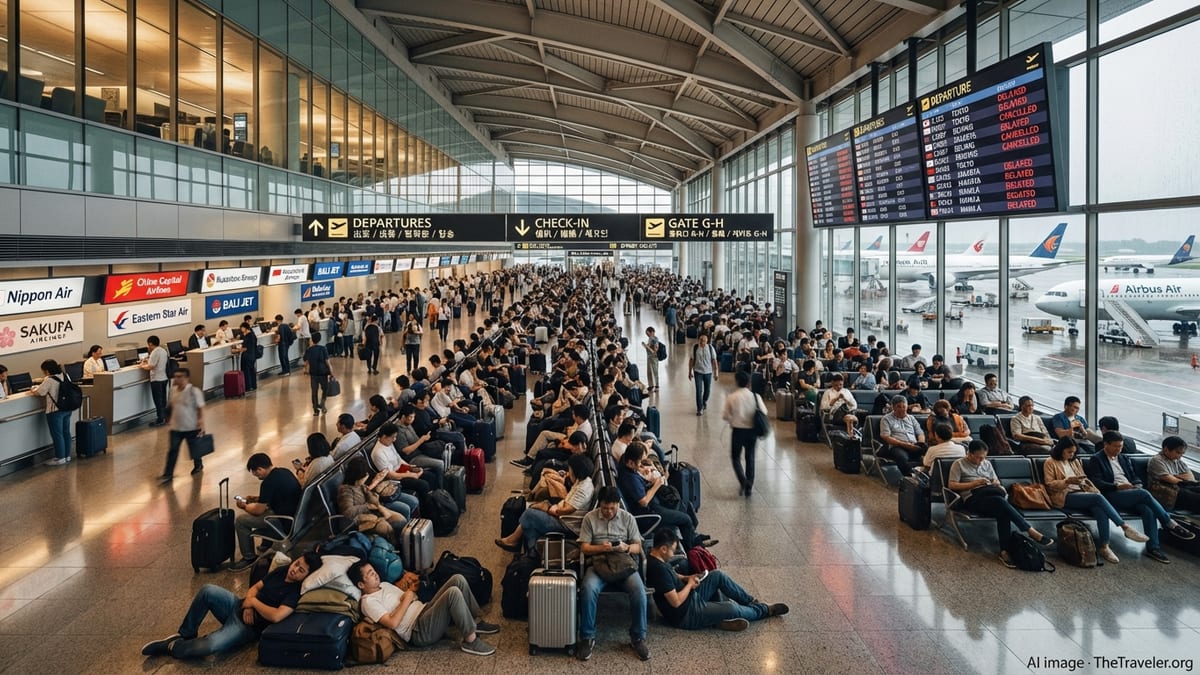
The practical impact for passengers is visible from crowded terminals and extended queues at check-in, security and rebooking desks across multiple countries. With over 10,000 delayed flights in the latest disruption cycle, missed connections have become a significant issue, particularly for travelers relying on one-stop itineraries between secondary Asian cities and long haul destinations in Europe, North America or the Middle East.
Travel advisories issued by airlines and airports encourage passengers to monitor their flight status closely, arrive earlier than usual for departures and prepare for potential schedule changes at short notice. In markets where air passenger rights frameworks apply to delays and cancellations, consumer advocacy groups are reminding travelers to keep documentation of disruption, although compensation rules vary widely across Asia and for flights involving non-Asian carriers.
For business travelers, the disruption adds uncertainty to already compressed itineraries, while leisure passengers risk shortened holidays or unplanned overnight stays near major hubs. Airlines are prioritizing aircraft and crew resources toward routes with the highest demand or limited alternative options, leaving some secondary routes vulnerable to rolling cancellations when conditions deteriorate.
Industry observers note that, even when weather improves, it can take 24 to 48 hours for flight networks to return to normal patterns after such large-scale disruption, as airlines reposition aircraft, reset crew schedules and clear backlogs of stranded passengers.
What Travelers Should Expect in the Coming Days
With seasonal storms still forecast for parts of East, South and Southeast Asia, aviation analysts expect an elevated risk of further disruption in the near term, particularly at coastal and island airports. Travelers booked on services through Shenzhen, Jakarta, Manila, Moscow or major UAE hubs may face lingering knock-on effects as airlines work to realign schedules and aircraft rotations.
Publicly available information from flight-tracking platforms shows that carriers are adding time buffers on some routes and, in a few cases, trimming frequencies on lightly booked services to create more operational resilience. Low cost airlines that rely on short ground times may continue to experience sharper knock-on delays when conditions deteriorate, while larger network carriers could prioritize maintaining connectivity on key long haul corridors at the expense of some regional segments.
For now, travel experts recommend building additional contingency into itineraries that involve tight connections within Asia or through Middle Eastern and Russian hubs. Flexible ticket options, travel insurance that includes disruption coverage and a willingness to reroute through alternative gateways such as Singapore, Bangkok or Seoul can reduce the risk of extended stranding.
As the current episode of 10,340 delays and 703 cancellations illustrates, Asia’s rapidly growing air travel market remains highly sensitive to seasonal weather and operational shocks, and recovering full reliability across such an interconnected network is likely to remain a challenge through the peak travel months.