


More news on this day
Hundreds of travelers across Asia faced missed connections and long airport waits as flight-tracking dashboards showed a disruption day marked by 3,744 delays across major hubs, with knock-on impacts spreading through tightly timed regional and long-haul networks.
Get the latest news straight to your inbox!
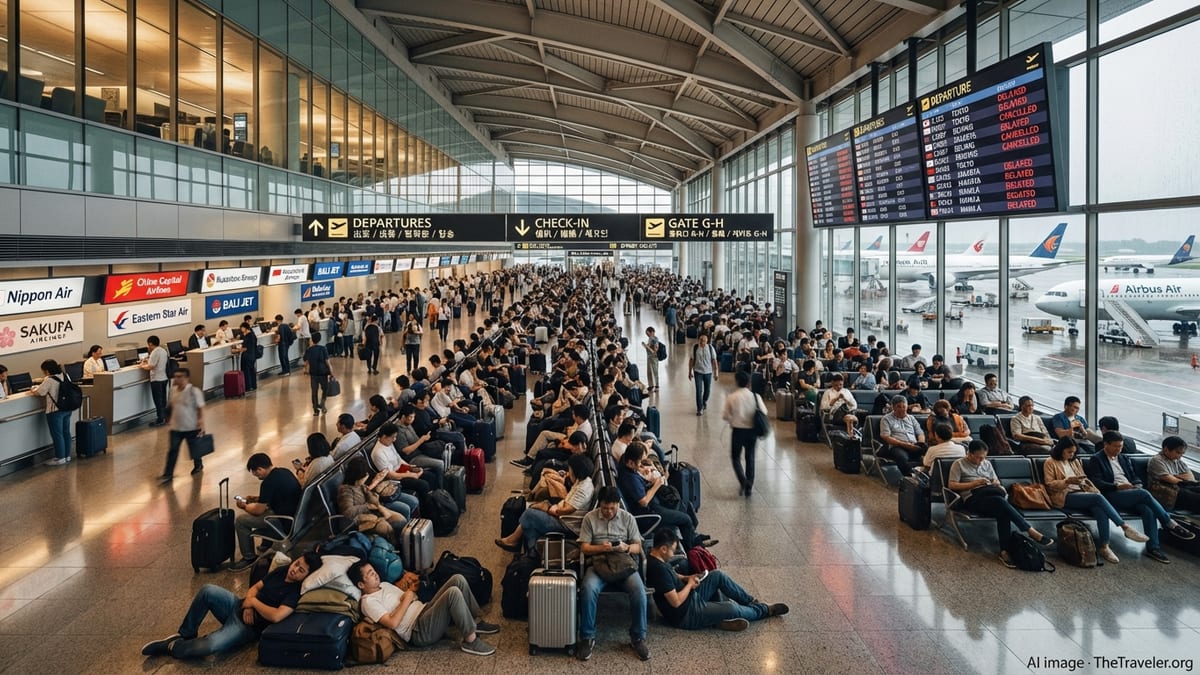
Where the disruption clustered across Asia
Live disruption maps and airport status pages have shown delays concentrating at large connection points where aircraft rotations and inbound congestion can quickly cascade. In Asia, that typically means the biggest capital-region airports and multi-terminal hubs that feed dense domestic networks and high-frequency international banks.
On disruption days, the delay picture can shift hour by hour. Flight-tracking platforms such as Flightradar24 and FlightAware publish rolling airport delay and cancellation snapshots, and those public dashboards frequently show Southeast Asia and North Asia hubs moving up and down the regional rankings as weather, runway constraints, and air-traffic flow restrictions change.
For travelers, the practical effect is familiar: when hubs slow down, short connections disappear first. Even passengers departing on time can arrive late if inbound aircraft are held, gates are unavailable, or air-traffic initiatives stretch taxi and airborne holding times.
Indonesia’s volcanic ash disruption adds to delay pressure
One of the clearest recent sources of large-scale disruption in the region has been volcanic activity in Indonesia. Published coverage and aviation updates have tied widespread schedule changes to ash-related airspace restrictions affecting Jakarta and nearby airports, a scenario that can force ground stops, diversions, and rolling rescheduling.
In early September 2026, reports about the Mount Anak Krakatau ash situation described major operational impacts at Jakarta’s Soekarno-Hatta International Airport, including hundreds of affected flights. Separate reporting indicated that flights later resumed after ash prompted airport closures that halted a large number of services, underscoring how quickly a weather and geologic event can overwhelm normal recovery buffers.
Even after airspace reopens, recovery can take days. Aircraft and crews can end up out of position, and airlines often prioritize longer-haul or higher-load services first, leaving some short-haul frequencies to be retimed or consolidated as schedules are rebuilt.
Why thousands of delays can happen without a single dominant cause
A total like 3,744 delays rarely reflects one single failure. Across Asia’s busiest corridors, delays often stack: morning thunderstorm activity or low visibility can reduce arrival rates, which then compresses gates and pushes departures, which then leads to missed departure slots and longer taxi queues.
High utilization makes the system more fragile. When aircraft are scheduled to operate multiple segments per day, a modest late arrival early in the rotation can snowball into a multi-hour delay by evening if there is no spare aircraft available, crew duty limits are reached, or maintenance windows are squeezed.
Travel demand also plays a role. When flights are full, reaccommodation becomes harder: the next available seat might be tomorrow, not later that day. That increases the number of passengers who end up stranded overnight or rerouted through secondary hubs, further loading already busy airport terminals and customer-service channels.
What passengers can do during mass delay events
When delay totals climb into the thousands, the most valuable tool is timing. Travelers generally get better outcomes by checking flight status the evening before departure, again on the day of travel, and once more before leaving for the airport, because schedule changes and aircraft swaps can occur late in the recovery cycle.
During region-wide disruption, airline apps and official airport channels typically update gate changes, revised departure times, and cancellation notices faster than third-party summaries. Travelers connecting through a hub can also monitor the inbound aircraft assigned to their flight, since a late inbound is often the earliest warning sign of a growing delay.
For those already at the airport, the goal is to reduce compounding risk. If a connection is tight, passengers can consider rebooking to a later flight proactively rather than waiting for an automatic misconnect. Travelers with essential meetings or onward nonrefundable plans may want to explore reroutes through alternate hubs when seats exist, since a single saturated airport can bottleneck an entire itinerary.
What to watch next as schedules normalize
In the days after a major disruption, the operational story usually shifts from cancellations to residual delays. Airports can look “open” while still running behind due to backlogged departures, late-arriving aircraft, and uneven crew and fleet positioning.
Travelers should also watch for rolling retimes, where flights remain in the schedule but depart significantly later than originally planned. Those adjustments can ripple into hotel check-in times, ground transport availability, and onward connections, particularly for late-night departures that slip past midnight into the next day.
As airlines and airports work through the aftereffects, the fastest improvements often appear on routes with multiple daily frequencies and abundant alternative connections. Thin routes and long-haul services, by contrast, may take longer to stabilize because there are fewer spare aircraft and fewer same-day replacement options if a disruption repeats.